

 Platform Overview

 Integration Hub

 Agent One™

 Agent One Teams™

 Customer Data Management

 Personalization

 Journey Orchestration

 Reporting & Data

 Behavioral Analytics

 Web
Web

 Email
Email

 Site Search

 Conversational CX

 WhatsApp

 Web Push

 InStory

 App
App

 SMS & RCS

 Join the $0 Migration Movement™

 The Insider One Difference

 Compare Vendors

 Switch to Insider One

 Success Story

 Retail & Ecommerce

 Financial Services

 Travel & Hospitality

 Beauty & Cosmetics

 Automotive

 Telecommunications

 Total Economic Impact™ Study

 Blog
Blog

 E-Books & Guides

 Events

 Glossary
From Mass Mailings to AI Decisioning: Zgonc’s Customer Data Foundation Playbook

Updated on 4 Oct 2026
10 min.
Table of Contents
- Why does a specialist retailer need a customer data foundation
- What does a customer data foundation look like in practice
- How does customer segmentation make a seasonal campaign relevant
- How can 1% of the audience match the revenue of a mass send
- How do cross-selling journeys pick the product and the channel
- What results did customer segmentation deliver on the same channels
- How do you replatform to Shopify without rebuilding your marketing
- How does AI decisioning change site search
- How do personalized product recommendations replace manual merchandising
- Where should AI decide, and where should people
- What can retailers learn from Zgonc's customer data foundation
- How does Insider One power the path from customer data to AI decisioning
Most Popular
At DMEXCO 2026 in Cologne, Zgonc and Insider One presented the customer data foundation behind one of Austria’s specialist retailers for tools, machinery, and garden equipment. The session skipped the theory. It covered live campaigns, current numbers, and a webshop migration still in progress.
Zgonc runs 39 stores across Austria and serves two audiences: DIY enthusiasts and professional tradespeople. Its catalog holds around 15,000 products across 700 categories and 600 brands. Online, the retailer reaches 200,000 website visitors a month.
The story on stage came down to sequence. Zgonc built its data foundation first, kept it running through a Shopify replatforming, and is now handing search and merchandising decisions to artificial intelligence (AI). A team of five did all of it.
Why does a specialist retailer need a customer data foundation
In its stores, Zgonc wins on things that are hard to copy: expert advice, a deep specialist range, a five-year guarantee, and full product availability.
Online, those advantages are harder to see. Store customers are moving to digital channels, where Zgonc competes with international DIY chains, online-only retailers, and price comparison portals. The company responded by creating a dedicated ecommerce department with a clear brief: grow online revenue and support the stores.
Two obstacles stood in the way.
Scattered data. Zgonc ran a standalone email tool and a handful of separate automation tools. “We had the data in all kinds of channels, but we couldn’t bring it together,” said Vanessa Koller, who leads digital marketing at Zgonc. Without a single view, targeted campaigns weren’t possible.
One message for everyone. Until last year, every campaign followed the same pattern: pick a topic, send it to all 65,000 email subscribers, and hope enough of them care. “We didn’t know who these people were,” said Dominik Beneder of Zgonc’s ecommerce team. With 700 categories to choose from, guessing the right message for each customer wasn’t realistic.
Placeholder image 1: Before and after. Separate email and automation tools versus one unified customer profile.
What does a customer data foundation look like in practice
Zgonc went looking for a customer data platform (CDP) that could collect behavior, build a profile behind every email address and every visit, and make that knowledge usable in campaigns. Two criteria shaped the decision.
Usability. “We’re marketers, not engineers,” Dominik Beneder said. The team wanted a platform it could run without technical support.
Openness. Zgonc didn’t want to depend on a single vendor. Open APIs meant its customer data would stay usable even if the email or search tool changed later.
Zgonc has worked with Insider One since Q4 2025. The setup rests on three layers:
- Data: one unified profile per customer, combining website behavior with CRM, loyalty, and in-store purchase data
- Segmentation: audiences built on that profile, so each customer gets a message that fits
- Activation: multi-channel journey orchestration across email, web push, and on-site personalization, with SMS in testing
How does customer segmentation make a seasonal campaign relevant
Seasonal reorders are a staple of DIY retail. They were also Zgonc’s clearest example of wasted reach.
The goal. Turn a seasonal reminder into a message the recipient needs.
Before. A newsletter on preparing a pool for winter went to all 65,000 subscribers. Zgonc had no idea which of them owned a pool.
The move. The next edition goes only to customers who’ve shopped the pool category. A customer who bought car products gets the equivalent for their world: antifreeze and winter care for the vehicle.
The behavioral data collected in the webshop now decides who receives which version.
How can 1% of the audience match the revenue of a mass send
Two months before DMEXCO, Zgonc launched an online-only promotion called “Wochenendhammer,” a weekend deal.
The target. A small list of subscribers who signed up for the deal, plus predictive audiences: shoppers who are close to a purchase and shoppers who respond to discounts.
The timing. The email lands when the promotion starts.
The numbers. Open rates sit between 60% and 80%, with a click-through rate of around 30%. On average, each send brings in the same net revenue as the old themed newsletters, with about 1% of the audience size.
The extension. Visitors who viewed the promotion page form a dynamic audience. Where they’ve given consent, Zgonc syncs that audience to its advertising platforms for retargeting.
How do cross-selling journeys pick the product and the channel
Real-time triggers and rules turn single campaigns into personalized flows. Zgonc’s cross-selling journey shows two decisions moving from the team to the platform.
The product. Emails carry an automated recommendation block. Zgonc is A/B testing it against the product picks its team used to choose by hand.
The channel. The platform identifies which channel each customer engages with most and sends the message there.
Placeholder image 2: Cross-selling journey with a real-time trigger, an A/B test of manual versus automated recommendations, and channel selection per customer.
What results did customer segmentation deliver on the same channels
Between Q1 and Q2 2026, Zgonc reported:
- 4x incremental revenue from its customer engagement program
- 7x revenue from web push
- Nearly 16% conversion rate uplift, up from around 10%
- 77,000 email contacts at the end of Q2, and well over 80,000 today
- 44,000 web push subscribers
The channel mix barely moved. Zgonc relied mainly on email before, and it relies mainly on email now, with web push alongside. The growth came from knowing who to talk to.
Dominik Beneder’s advice to the room: get the foundation and the segmentation right first, and reach the right people, before adding a “fancy new channel.”
Take the interactive product tour to see how unified data and journeys work together.
How do you replatform to Shopify without rebuilding your marketing
Zgonc is preparing a full relaunch of its webshop on Shopify Plus. A project of that size usually freezes everything around it. Teams wait for the new shop before they invest in data, and then start from zero on launch day.
Zgonc planned for the opposite. Vanessa Koller wanted a partner that let the team start on the old shop right away and carry everything into the new one.
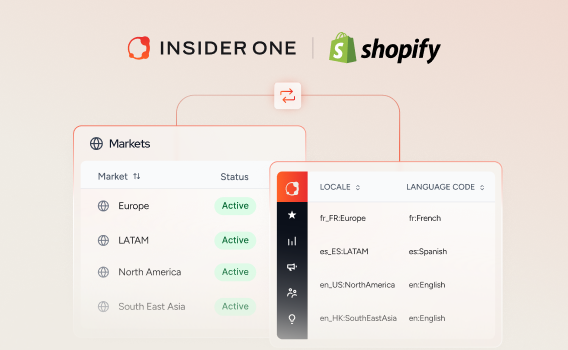
The migration turned out lighter than expected. “It surprised us how little impact this migration has,” Dominik Beneder said. Insider One integrates natively with Shopify. The team installed the app, chose how data should sync, and had customer profiles, journeys, and channels available in the new environment.
That changes what a replatforming costs:
- The data foundation stays in place
- Journeys built on the old shop keep running, with no second build
- The team works on the shop project and its campaigns at the same time
On the cutover date, Zgonc switches the data source from the old shop to the new one. Everything else carries on as before.
Placeholder image 3: Replatforming timeline. The data foundation and journeys run continuously while the shop switches from the legacy system to Shopify.
How does AI decisioning change site search
For years, marketing technology fed people information so they could decide. Insider One’s Digital Growth Expert, Anna Taeschner, described the shift now underway: systems can make those decisions themselves, on the same unified data. For Zgonc, that starts with search.
The new shop replaces keyword matching with search that knows who is typing. Take one query, “cordless drill,” and three customers:
- A DIY enthusiast sees solid entry-level models first
- A professional sees premium brands such as Makita
- A shopper who browses the weekly flyer sees discounted products first
Zgonc doesn’t plan to write these rules by hand. The search recognizes the customer and ranks the results on its own.
How do personalized product recommendations replace manual merchandising
Today, Zgonc fills every product slider on its site by hand. For the weekly flyer, that means choosing eight to 10 items out of 300 and hoping they’re the ones people want.
On the new site, automated recommendations select the most relevant products for each visitor from the same pool. Zgonc has already seen the effect in email, where personalized recommendations are a main reason campaigns outperform the previous tool.
Accessories show why manual curation runs out of road. A single battery system from one brand works with 350 to 400 products. Nobody can curate that by hand for every visitor. A system that knows whether the customer shops garden equipment or power tools can.
There’s a wider benchmark too. Insider One customers that use AI-selected bundle recommendations see average order value grow by 10% to 12%.
Placeholder image 4: One search query, three customers, three different result rankings.
Where should AI decide, and where should people
The speakers closed the chapter with a clear order of operations.
Start with search. It’s the first decision a customer makes on your site, and the risk is low. A weak ranking costs one extra click. It doesn’t cost you the customer.
Expand recommendations step by step. Begin with bundles or a single category. Check what the system delivers, then extend it across the catalog.
Keep human judgment in the loop. Brand communication, sensitive topics, and cases with no clear pattern still need a person. So does the moment when the output is technically correct and still feels wrong for the customer. Someone has to be able to step in.
What can retailers learn from Zgonc’s customer data foundation
Put the foundation before the campaign. “You can set up the most creative campaign there is,” Vanessa Koller said. “If you can’t see and understand what the customer does, it’s wasted effort.”
Don’t wait for your big moment. Zgonc didn’t hold its data project until the Shopify relaunch was finished. It ran both in parallel, so the new site opens with a year of customer knowledge behind it.
Don’t wait for perfect data. Collection starts on day one of implementation. Teams improve step by step from there, while other projects run alongside.
A year ago, Zgonc sent one newsletter to everyone. Today, a team of five runs personalized customer engagement across channels. Next, search and recommendations on the new site start making their own decisions, without anyone telling them what to show.
How does Insider One power the path from customer data to AI decisioning
Zgonc’s progress in one year comes from having its data, decisions, and channels in one place. Insider One brings unified customer data, AI decisioning, personalization, cross-channel orchestration, and measurement together in a single platform. That removes the integration work and manual effort that usually sit between a good idea and a live campaign. More than 2,800 brands use it today.
- Unified customer data: online and offline behavior, including store purchases, CRM, and loyalty data, resolved into one profile per customer
- AI decisioning: predictive audiences for purchase likelihood and discount affinity, plus channel selection for each customer
- Personalized recommendations: products and bundles chosen for each visitor on site, in search, and inside messages
- Multi-channel journey orchestration: email, web push, SMS, and on-site experiences in one journey, triggered in real time
- Native commerce integrations: a direct connection to Shopify, so data and journeys carry over when the shop changes
If you’re serious about building a customer data foundation that’s ready for AI decisioning like Zgonc, request a demo of Insider One and map your first use case to a platform that can launch it.

Keep Reading
4 min.

Chris Baldwin
3 Feb 2026
10 min.
Chris Baldwin
5 Oct 2026
7 mins.

Nicolas Algoedt
1 Oct 2026