

 Platform Overview

 Integration Hub

 Agent One™

 Agent One™ Teams

 Customer Data Management

 Personalization

 Journey Orchestration

 Reporting & Data

 Behavioral Analytics

 Web
Web

 Email
Email

 Site Search

 Conversational CX

 WhatsApp

 Web Push

 InStory

 App
App

 SMS & RCS

 Join the $0 Migration Movement™

 The Insider One Difference

 Compare Vendors

 Switch to Insider One

 Success Story

 Retail & Ecommerce

 Financial Services

 Travel & Hospitality

 Beauty & Cosmetics

 Automotive

 Telecommunications

 Total Economic Impact™ Study

 Blog
Blog

 E-Books & Guides

 Events

 Glossary
How WhatsApp Turns Real-Time Signals into Revenue, Not Just Reach

Updated on 7 Jul 2026
10 min.
Table of Contents
- Summary
- Why real-time is the only mode that matters on WhatsApp
- The trigger architecture: from behavioral signal to sent message
- Personalization beyond the first name: how CDP data changes WhatsApp outcomes
- Automating support without losing the human thread
- Measuring what real-time WhatsApp interactions actually produce
- Frequently asked questions
Most Popular
Summary
Successful WhatsApp marketing depends on timely, behavior-triggered messaging powered by real-time customer data. Combining automation with seamless human handoff and measuring conversion-focused metrics helps maximize engagement and business results.
Somewhere between your brand’s last email campaign and your customer’s next purchase decision, there’s a 48-hour window where the right message in the right channel could close the gap.
WhatsApp is increasingly the place that window lives. People respond quickly, not hours later, and the psychological contract between sender and recipient is fundamentally different from inbox behavior.
The problem is that many brands are still using it like a faster email: batch sends, templated blasts, and one-way announcements dressed up as conversations.
The architecture required to make WhatsApp work as a real-time engagement layer is meaningfully different from broadcast. It demands live behavioral triggers, unified customer data, and a tiered automation model that handles volume without stripping out the human thread.
When those three components work together, WhatsApp becomes one of the highest-performing channels in a brand’s stack. When they don’t, it becomes a compliance burden with mediocre return on investment (ROI).
Why real-time is the only mode that matters on WhatsApp
The timing gap between email and WhatsApp
Email operates on a forgiving timeline. A campaign sent Tuesday morning gets opened by Wednesday evening for a meaningful portion of the list, and that’s considered acceptable. WhatsApp does not operate on that logic.
Consumers pick up WhatsApp the way they pick up a phone call, not the way they sort their inbox, and the platform’s design reinforces that expectation at every level.
A cart-abandonment message delivered four hours after a session ends is not a real-time signal; it’s a reminder of something the customer has already mentally moved past.
The brands that have made the shift from campaign-think to trigger-think are the ones seeing WhatsApp drive measurable revenue contribution rather than just high open rates on messages that never prompt action.
What platform behavior actually demands
The shift goes deeper than send timing. Consumers have rewritten their expectations for how businesses communicate with them on messaging channels.
They want to message a brand the way they message a contact: asynchronously when it suits them, with the expectation of a relevant, contextual reply rather than a form-letter response. Batch sends to segmented lists don’t fit this model. They fit an email paradigm transplanted into a channel that rejects it.
This isn’t an aesthetic objection. It’s a functional one. WhatsApp’s delivery mechanics, including read receipts, typing indicators, and conversation threading, all signal to the recipient whether they’re in a real exchange or a broadcast.
The moment a message feels like a broadcast, the trust the channel carries evaporates. Unlike email, where a missed open has no downstream consequence, a WhatsApp message that feels out of place actively damages the brand’s presence in the user’s most personal communication channel.
The trigger architecture: from behavioral signal to sent message
Mapping the five highest-value real-time triggers
Not all behavioral signals justify a WhatsApp send. The channel carries enough intimacy that over-triggering is a faster path to opt-out than under-triggering.
The five use cases that consistently justify the real-time investment are cart abandonment, post-purchase onboarding, price-drop alerts, support escalation, and reorder reminders. Each one requires different data to fire accurately, and each one has a different window of relevance.
- Cart abandonment: Requires session data, cart contents, and a last-seen timestamp; the window is short, generally under two hours from session end
- Post-purchase onboarding: Requires order confirmation status and product category so the follow-up content is relevant to what was actually bought, not a generic “welcome” template
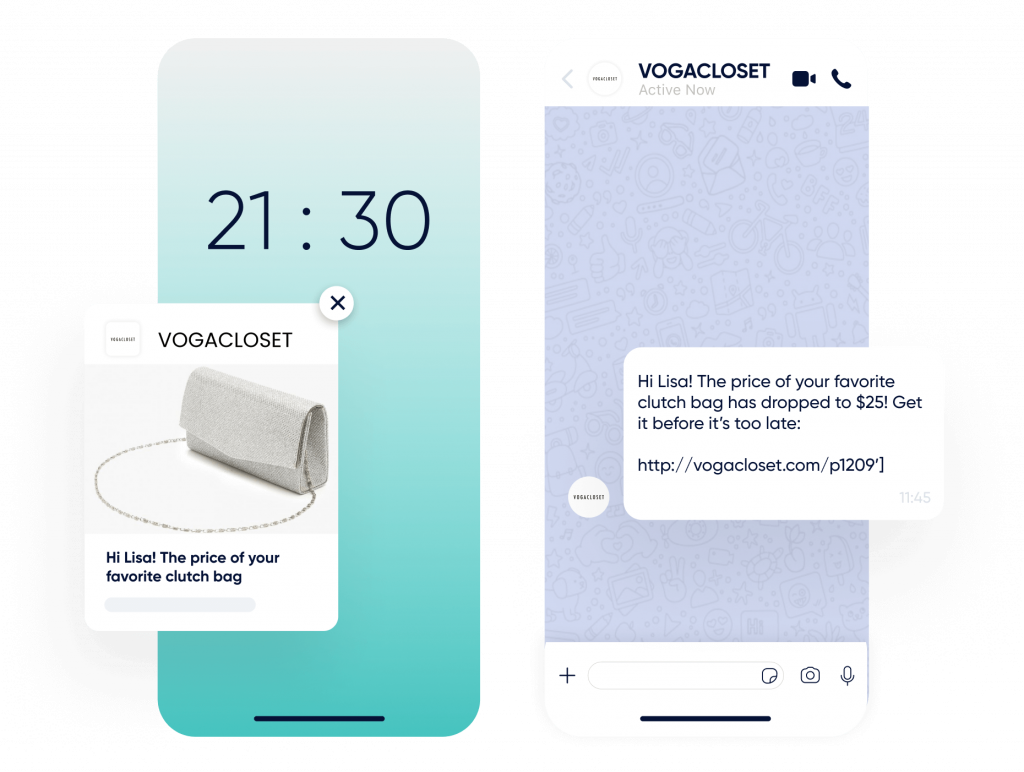
- Price-drop alerts: Requires wishlist or browsing history data matched against live inventory pricing, plus an opt-in signal that the user wants this type of notification
- Support escalation: Requires integration between the customer service layer and the messaging platform so the hand-off from automated response to human happens without the customer having to re-explain their situation
- Reorder reminders: Requires purchase frequency data and predictive modeling on replenishment cycles, not just a fixed-interval send
Why latency in the data layer kills relevance
Each of these triggers depends on a live, unified customer profile. Not a static list exported from a customer relationship management (CRM) system the night before, and not a segment refreshed on a six-hour batch cycle.
The moment a behavioral signal has to travel through a sync layer, whether a third-party integration, a webhook queue, or a delayed data pipeline, before it can fire a WhatsApp message, the window for relevance has often already closed.
This is the structural weakness in stacks where WhatsApp is added as a bolt-on channel rather than built into the underlying data platform. The Conversational CX capability inside a customer data platform-backed platform like Insider One means the trigger, the profile lookup, and the message composition all happen inside the same data environment.
There’s no sync latency because there’s no sync step. Because the channel is native, the conversation can also become the transaction: shoppers can browse products, add to cart, and check out inside the WhatsApp thread, so a cart-abandonment or reorder trigger can convert without ever pushing the customer back to the site.
Personalization beyond the first name: how CDP data changes WhatsApp outcomes
From template to context
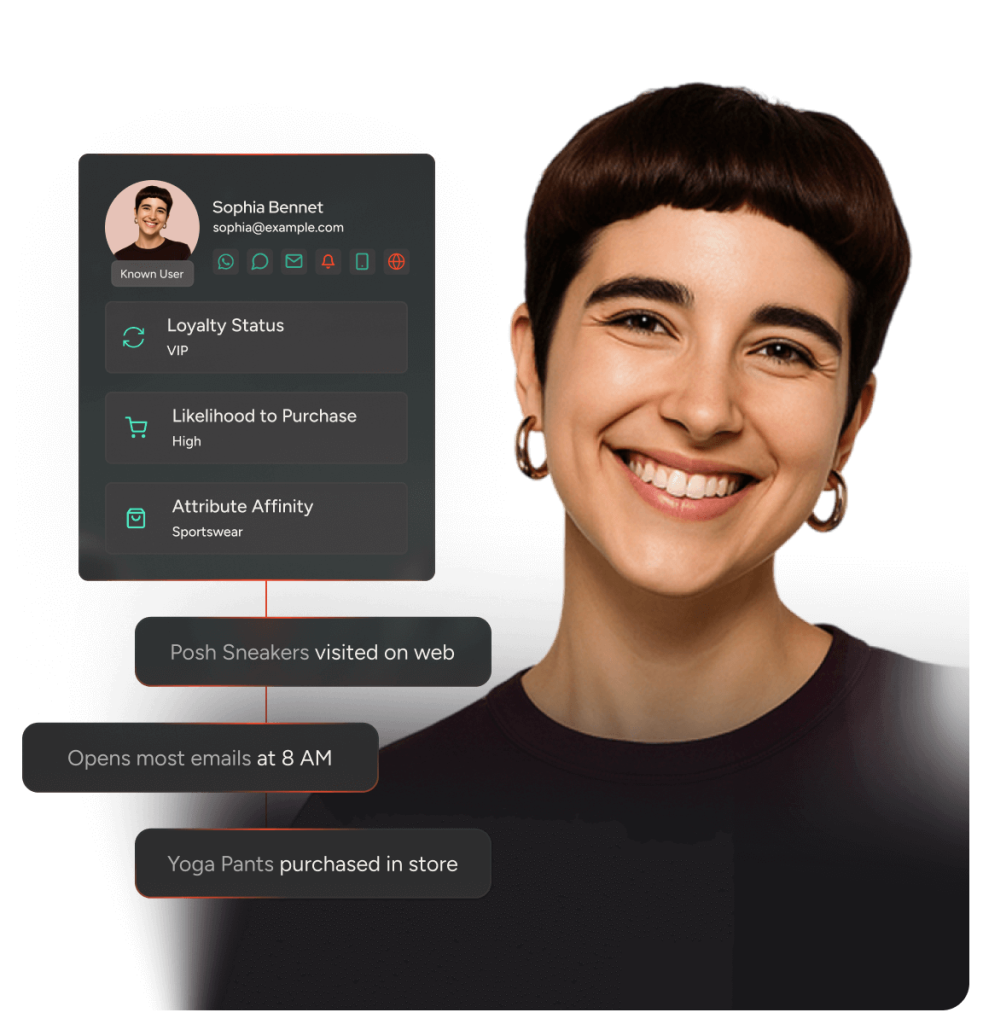
A first-name merge tag is not personalization. It’s variable substitution. Real WhatsApp personalization draws on lifecycle stage, purchase history, channel preference, and predictive affinity scores to construct a message that could not have been sent to anyone else on the list.
The practical difference is clear: a generic cart-abandonment template says “You left something behind,” while a contextually personalized message references the specific product, surfaces a relevant social proof signal if the user has shown hesitation patterns, and adjusts the call-to-action based on whether this is the customer’s first purchase or their fifth.
The data required to build that message exists in most enterprise stacks. The challenge is that it’s fragmented across ecommerce platforms, loyalty systems, support tickets, and browsing history, and it’s rarely assembled into a single profile that a WhatsApp send can access in real time.
Insider One’s Customer Data Management layer is designed to unify those sources into actionable profiles that power precisely this kind of triggered, contextual send.
Want to see what a unified profile makes possible on WhatsApp? Book a personalized demo and we’ll walk through cart abandonment, price-drop, and reorder triggers built on your own customer data.
The native integration advantage
When WhatsApp is integrated via a third-party connector, there’s an inherent ceiling on personalization depth. The data the messaging layer can access is limited to what the integration is configured to pass, and that configuration becomes a bottleneck every time the personalization requirement evolves.
Native CDP-backed WhatsApp, by contrast, has access to the full unified profile at send time: real-time browsing signals, predictive purchase probability scores, loyalty tier, preferred language, and previous WhatsApp interaction history.
Clarins Mexico demonstrates what that depth produces in practice. By building personalized WhatsApp journeys directly inside Insider One’s platform, Clarins achieved 20x WhatsApp sales growth and an 8% increase in digital net sales over two years.
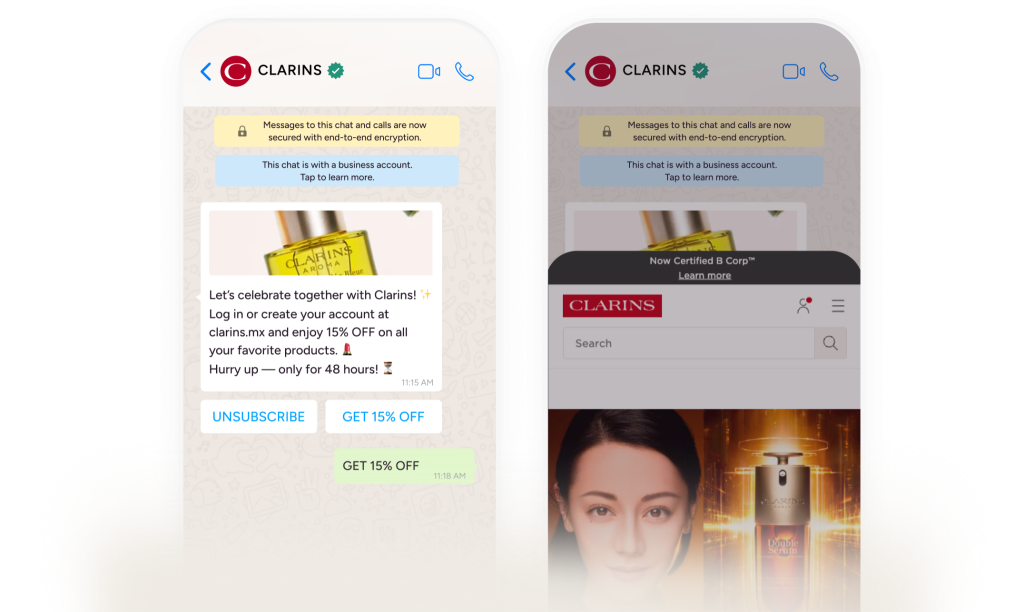
Those outcomes depend on access to unified customer context, not just a connected channel.
Automating support without losing the human thread
The tiered automation model
WhatsApp support automation works best when it’s structured as a triage system, not a replacement for human judgment. Automated responses can reliably resolve order-status queries, frequently asked questions (FAQs), return initiation requests, and basic account management tasks, covering a significant share of inbound support volume without requiring a live agent.
That resolution rate matters because it determines whether support automation adds capacity or just adds friction.
The part that brands consistently underinvest in is the escalation layer. When a conversation exceeds what automation can handle, the hand-off to a live agent needs to be invisible to the customer.
That means the agent receives the full conversation context, the customer’s unified profile, and any relevant purchase history before they type a single word.
An escalation that forces the customer to re-explain their issue from scratch is a trust failure disguised as a process step. Insider One’s Journey Orchestration capabilities support exactly this kind of context-preserving transition between automated and human touchpoints.
The automation tier itself is Agent One, Insider One’s AI agent for WhatsApp: it resolves order status, FAQ, and returns queries conversationally using the live customer profile, and when a conversation exceeds what it should handle, it hands off to a human agent with the full thread and profile already in view, so the customer never repeats themselves.
Trust mechanics and opt-in hygiene
The trust equation on WhatsApp is more fragile than on email, and more valuable when protected. WhatsApp’s end-to-end encryption and verified business profiles reinforce users’ confidence that their conversations are private and that the business on the other end is legitimate.
But deliverability and reputation depend on more than verification status; they depend on opt-in hygiene.
Opt-in consent on WhatsApp is not a checkbox to be acquired once and ignored. It’s an ongoing signal of the customer’s willingness to receive a specific type of communication.
Brands that send promotional content to users who opted in for transactional updates erode that consent relationship quickly, and WhatsApp’s spam reporting mechanisms translate directly into delivery rate consequences.
Maintaining clean opt-in records, segmenting by consent type, and honoring frequency preferences are not merely compliance tasks; they’re the mechanics by which the channel remains effective.
Measuring what real-time WhatsApp interactions actually produce
The four key performance indicators (KPIs) that matter beyond open rate
Open rate is a vanity metric on WhatsApp. Because messages arrive in a channel people check quickly, open rates are structurally high across virtually all senders.
The metrics that indicate whether those opens are producing business value are different, and worth tracking by use case rather than by channel overall.
- Response rate: The percentage of recipients who reply to a message, which measures whether the conversation model is working
- First-contact resolution (FCR): For support use cases, the share of issues resolved in a single conversation without re-contact, the primary measure of automation quality
- Revenue-per-recipient: The total revenue attributable to a WhatsApp conversation divided by the number of recipients in the triggered cohort, the clearest indicator of channel ROI
- Conversation-to-conversion rate: For commerce triggers specifically, the share of WhatsApp conversations that result in a completed transaction
Setting benchmarks by use case rather than by channel overall is what makes this measurement framework actionable.
A cart-abandonment flow for a fashion retailer and a reorder reminder for a health supplement brand operate in different conversion windows and against different baseline intent signals, so comparing them against the same channel-level target obscures more than it reveals.
Attribution inside a unified platform versus a point tool
How WhatsApp revenue gets attributed determines how much budget the channel receives in the next planning cycle. In a stack where WhatsApp operates as an isolated point tool, attribution is limited to last-click or last-touch logic within that tool’s own reporting environment.
That model undercounts assisted revenue, misses multi-touch journeys where WhatsApp was the decisive nudge rather than the initiating touchpoint, and creates channel-versus-channel budget arguments that have no grounding in actual customer behavior.
Inside a unified platform like Insider One, WhatsApp attribution draws on the full customer journey, including web sessions, email engagement, app behavior, and purchase history, to assign credit accurately across all touchpoints.
Vogacloset is a concrete example: by running WhatsApp journeys through Insider One’s unified customer profiles, the brand achieved 30x return on investment. That result depended on seeing WhatsApp’s contribution within the context of the full engagement picture, not in isolation.
Explore more about how WhatsApp marketing automation works as a revenue driver, or read the comprehensive guide to WhatsApp Business API to understand the technical and strategic requirements before scaling the channel.
If you want to see how Insider One’s Customer Data Management turns live customer data into coordinated, revenue-driving experiences, book a personalized demo to see the exact use cases, decision logic, and growth levers most relevant to your team.
Frequently asked questions
The WhatsApp Business application is designed for small businesses managing conversations manually.
The WhatsApp Business API (application programming interface) is built for enterprise-scale sending, automation, and integration with customer relationship management (CRM) and CDP systems. It enables programmatic message sending, bot integration, multi-agent access, and the behavioral triggering required for real-time engagement at scale.
For time-sensitive transactional messages, such as order confirmations, shipping updates, and one-time passcodes, WhatsApp often outperforms email on engagement speed and read rates.
Most enterprise brands run both channels in parallel, using WhatsApp for immediate, high-value triggers and email for longer-form nurture sequences and campaigns where a slower response timeline is acceptable.
The primary driver of opt-out growth is relevance failure: sending promotional content to users with transactional consent, over-triggering on low-intent signals, or sending at frequencies that exceed what the customer relationship justifies.
Maintaining strict opt-in segmentation by consent type, enforcing frequency caps by customer tier, and continuously testing message relevance against response rate are the operational practices that keep opt-out rates stable as volume scales.
It requires a live event stream from your digital properties, a customer data layer that can resolve anonymous events to known profiles in near-real-time, a rules or artificial intelligence (AI) engine to evaluate trigger conditions, and a WhatsApp Business API connection that can send templated or free-form messages within the relevance window.
Brands often underestimate the data infrastructure requirement and focus too narrowly on the WhatsApp integration itself.

Keep Reading
4 min.

Chris Baldwin
3 Feb 2026
9 min.
Chris Baldwin
22 Oct 2026
8 mins.
Chris Baldwin
8 Oct 2026