

 Platform Overview

 Integration Hub

 Agent One™

 Agent One™ Teams

 Customer Data Management

 Personalization

 Journey Orchestration

 Reporting & Data

 Behavioral Analytics

 Web
Web

 Email
Email

 Site Search

 Conversational CX

 WhatsApp

 Web Push

 InStory

 App
App

 SMS & RCS

 Join the $0 Migration Movement™

 The Insider One Difference

 Compare Vendors

 Switch to Insider One

 Success Story

 Retail & Ecommerce

 Financial Services

 Travel & Hospitality

 Beauty & Cosmetics

 Automotive

 Telecommunications

 Total Economic Impact™ Study

 Blog
Blog

 E-Books & Guides

 Events

 Glossary
Retail Email Marketing: Five Flows That Drive Revenue

Updated on 24 Sep 2026
9 min.
Table of Contents
- Summary
- Why email still leads retail revenue, and why most programs underperform
- The retail email lifecycle: five flows that compound revenue
- Behavioral segmentation: from list blasts to revenue-weighted audiences
- AI personalization in retail email: where it actually moves revenue
- Platform criteria and measurement: choosing infrastructure that scales
- FAQs
Most Popular
Summary
High-performing retail email programs rely on automated lifecycle journeys, behavioral segmentation, and AI-powered personalization instead of promotional blasts. Connecting email to real-time customer data enables more relevant campaigns, stronger customer loyalty, and sustainable revenue growth.
Somewhere between “batch and blast” and a fully automated lifecycle engine, there’s a gap where most retail email programs quietly stall. The calendar fills with promotional sends, the list grows, and revenue ticks up just enough that nobody questions the model.
But that model has a ceiling, and high-growth retail brands tend to find it at the worst possible moment, when a competitor discounts harder, or when rising acquisition costs make the math on one-time buyers brutal.
The brands pulling away from the pack aren’t necessarily sending more emails. They’re sending smarter emails, built on behavioral logic rather than a promotional calendar.
The difference isn’t a tactic or a template; it’s a structural decision about how email fits into the full customer lifecycle, from the first welcome message to re-engagement campaigns years down the line. This guide is about building that structure.
Why email still leads retail revenue, and why most programs underperform
Email’s return on investment advantage over paid channels is well-documented, but the figure that matters most isn’t the average. It’s the distribution.
Programs that send predominantly promotional content cluster at the low end of ROI, while lifecycle-driven programs, built around behavioral triggers and customer stage rather than calendar events, consistently outperform.
The gap between the median retail email program and the top tier isn’t marginal; it’s structural.
The promotional-blast trap
The core problem with blast-first email strategies isn’t that promotions don’t work. They do, in the short term. The problem is what they teach your subscribers. When every email is a discount or a sale announcement, you train your list to buy only when there’s an offer on the table.
Over time, that behavior compounds: your full-price conversion rate drops, your margin per email shrinks, and your list becomes increasingly unresponsive to anything that isn’t a deal. Promotional dependency is a slow leak, not a blowout, which is exactly why it’s so easy to ignore until it’s expensive to fix.
The alternative isn’t sending fewer promotions. It’s building the behavioral and lifecycle infrastructure that makes every send more contextually relevant, so promotional emails land with higher intent audiences rather than a cold, undifferentiated list.
The retail email lifecycle: five flows that compound revenue
The sequencing question, which flows to build first, is where most email marketing for ecommerce guides go quiet. The answer depends on where your biggest revenue leak is right now, but there’s a priority logic that holds across most mid-market and enterprise retail programs.
The five flows and why order matters
Welcome series sets the revenue trajectory for every subscriber. It’s the highest-engagement window you’ll ever have with a new contact, and it shapes purchase intent, brand perception, and long-term open rates. Build this first, because every other flow depends on having an engaged, well-onboarded list.
Browse abandonment captures intent that hasn’t converted yet. A visitor who spends time on a product page and leaves without buying is not a lost customer; they’re a warm prospect who needs a nudge. These emails are low-volume but high-intent, and they convert at multiples of standard promotional sends.
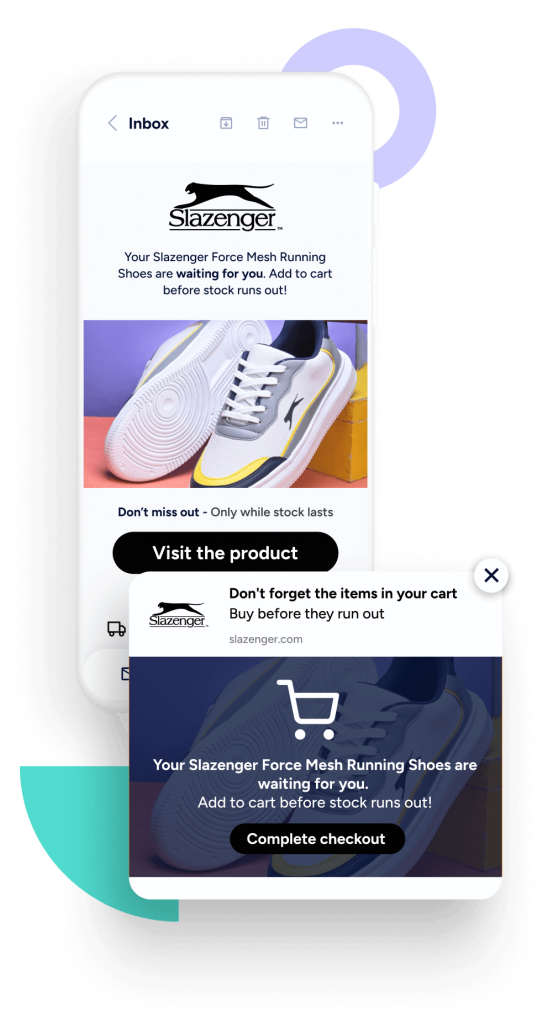
Cart recovery is the most commonly deployed automated flow, for good reason. Abandoned carts represent real, expressed purchase intent. A well-structured cart recovery sequence, typically two to three emails over 24 to 48 hours, recaptures revenue that would otherwise disappear entirely.
Post-purchase cross-sell is where lifetime value (LTV) is actually built. Getting a customer to make a second purchase is dramatically more cost-effective than acquiring a new one. A triggered cross-sell sequence, informed by purchase history and product affinity data, turns single-transaction buyers into repeat customers.
Win-back is the most underbuilt flow in most retail programs. Lapsed customers are expensive to reacquire through paid channels, but often respond to personalized email re-engagement, especially when the trigger is behavioral (long absence from site or email) rather than time-based alone.
Automated flows like these produce a disproportionate share of email-driven ecommerce revenue from a fraction of total send volume. That asymmetry is the core argument for building lifecycle infrastructure before optimizing your broadcast calendar.
For example, Slazenger achieved 49X ROI in eight weeks after shifting to Insider One’s omnichannel lifecycle approach, a result that promotional calendars alone rarely deliver.
Behavioral segmentation: from list blasts to revenue-weighted audiences
Generic segmentation, splitting your list by engagement level or geographic region, is a starting point, not a strategy.
The retail email programs that consistently outperform build segmentation on behavioral signals: what customers have browsed, what they’ve bought, how recently, and how often.
Building the segmentation ladder
RFM scoring, grouping customers by recency, frequency, and monetary value, is the foundational layer. It lets you identify your highest-value active customers, your at-risk repeat buyers, your one-time purchasers, and your fully lapsed segments, and treat each group differently in terms of send frequency, offer depth, and content focus.
Above RFM, behavioral signals from browse and purchase history add product-level context. A customer who’s browsed running shoes three times in two weeks needs a different email than one who bought a formal jacket last month.
The former has live, in-session intent; the latter needs a cross-sell or a care prompt. Treating them identically with the same weekly newsletter is a missed opportunity at both ends.
The top of the segmentation ladder is predictive: using purchase probability scores and churn risk indicators to intervene before a customer lapses rather than after. This is where AI personalization starts to pay off structurally, not just for content, but for audience construction.
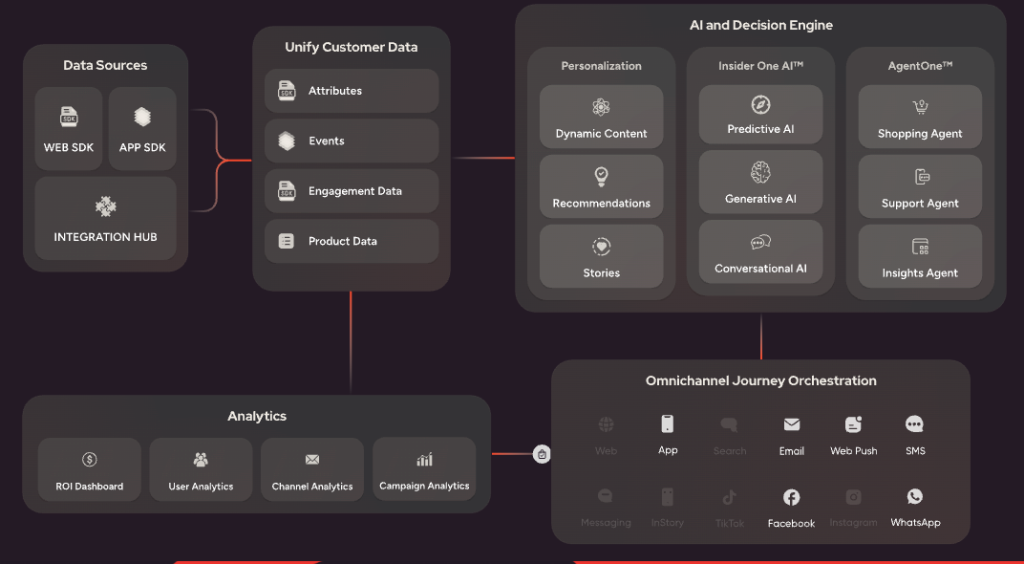
Insider One’s Customer Data Management capability unifies purchase, browse, and behavioral data into persistent customer profiles, giving retail teams the segmentation foundation they need without requiring a separate data engineering project.
The platform connects those profiles directly to email and lifecycle automation, so segments update in real time rather than on a batch export cycle.
AI personalization in retail email: where it actually moves revenue
AI has been applied to email marketing in a lot of ways, not all of them equally useful. The clearest signal of where AI actually moves the needle comes from how leading retail programs deploy it: not for drafting copy, but for the three levers that directly affect revenue, product recommendations, send-time prediction, and subject-line optimization.
The three AI levers that matter most
Product recommendation blocks are the highest-ROI application of AI in retail email. When recommendations are driven by individual purchase history, real-time browse behavior, and affinity modeling, rather than static bestseller lists, click-through and conversion rates climb. The lift is consistent across categories, from apparel to electronics to beauty.
Philips achieved a 40.1% conversion rate increase using Insider One’s Smart Recommender, which draws on behavioral signals to serve individually relevant product suggestions rather than category defaults.
Send-time prediction addresses a problem that most teams solve with a single scheduled send time for their entire list. AI-driven send-time optimization identifies the window when each individual subscriber is most likely to open and engage, and delivers accordingly. At scale, this can improve open rates and downstream conversion without changing a word of the content itself.
Subject-line optimization uses historical engagement data to predict which subject-line variants will perform best for given audience segments. It’s not a replacement for good creative judgment, but it’s a meaningful accelerant, especially for teams running high send frequency across large lists.
The distinction worth drawing here is between AI used for efficiency (drafting faster, generating variants) and AI used for revenue architecture (predicting behavior, personalizing at the individual level, automating decisions).
Both have value, but the second category is where programs compound their advantage over time. Insider One AI™, Insider One’s AI layer, powers this kind of behavioral decisioning across email, SMS, and push, connecting individual-level signals to the right message at the right moment.
Platform criteria and measurement: choosing infrastructure that scales
Most retail email teams don’t outgrow their email service provider (ESP) because of send volume.
They outgrow it because the ESP can’t connect email behavior to the broader customer profile, browse data, purchase history, app activity, in-store behavior, in real time.
When that connection is missing, lifecycle automation becomes a manual workaround rather than a systematic advantage.
What to demand from your email platform
The capability gap between a standard ESP and a platform built for retail lifecycle marketing shows up in a few critical places:
• Unified customer profiles that merge email engagement with behavioral data from web, app, and purchase systems, without a separate customer data platform (CDP) integration project
• Real-time behavioral triggers that fire on live signals (a cart abandonment, a price drop on a browsed item, a lapse in purchase activity) rather than batched exports
• Native lifecycle templates for the five core flows, reducing the time from decision to deployment
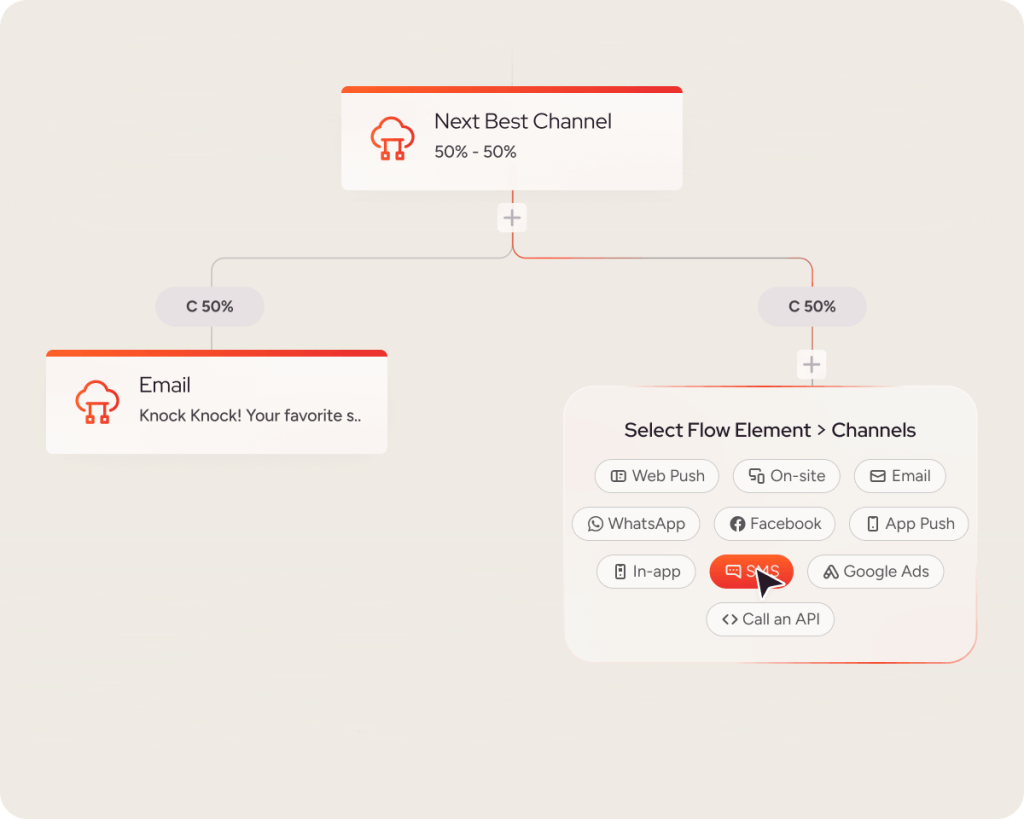
• Omnichannel coordination with SMS, push notifications, and on-site personalization, so email isn’t operating in isolation from the rest of the customer experience
Adidas achieved a 259% increase in average order value and a 13% lift in conversion rate in a single month using Insider One’s personalization suite, results that require exactly this kind of connected infrastructure, not siloed channel tools.
Shifting to revenue-based measurement
The measurement conversation matters as much as the tooling. Open rates and click-through rates are operational metrics; they tell you whether your emails are getting seen, not whether they’re building your business. The measurement framework that connects email activity to boardroom-level outcomes includes:
• Revenue per email sent, the clearest indicator of program efficiency
• List health metrics, unsubscribe rate, spam complaint rate, and deliverability scores, which predict future program viability
• Repeat purchase rate by cohort, the signal that lifecycle email is actually building LTV, not just driving one-time conversions
• Customer lifetime value by acquisition channel, connecting email-sourced customers to long-term revenue performance
When email measurement is anchored to these metrics rather than vanity engagement rates, the conversation about investment, tooling, and resource allocation becomes substantially easier to make.
If you want to see how Insider One’s Smart Recommender, Customer Data Management, and AI personalization turn live customer data into coordinated, revenue-driving experiences, book a personalized demo to see the exact use cases, decision logic, and growth levers most relevant to your team.
FAQs
Start with the welcome series and cart recovery flow. Both have the clearest revenue attribution and the shortest path to deployment. Welcome series improves the quality of your entire list over time; cart recovery captures revenue that’s already in motion. Once those two flows are running, add browse abandonment and post-purchase cross-sell in that order.
RFM segmentation works with relatively modest data—purchase history and email engagement are enough to get started. The richer signals (browse behavior, real-time intent, predictive churn scores) become more valuable as your data infrastructure matures. Don’t wait for perfect data; start with what you have and build the architecture to capture better signals over time.
Not with the right platform. AI-driven product recommendations, send-time optimization, and predictive segmentation are now available as platform-native capabilities in tools built for retail and ecommerce. The implementation complexity varies by vendor and your existing data setup, but most mid-market teams can activate these features without dedicated machine-learning resources.
Track repeat purchase rate and average order value by email cohort over 90, 180, and 365-day windows. Compare customers who moved through your lifecycle flows against those who didn’t. If your lifecycle flows are working, you’ll see higher repeat purchase rates and higher LTV in the cohort that received them, which is the business case for continued investment.

Keep Reading
4 min.

Chris Baldwin
3 Feb 2026
7 min.
Chris Baldwin
23 Oct 2026
8 min.
Chris Baldwin
23 Oct 2026