

 Platform Overview

 Integration Hub

 Agent One™

 Agent One™ Teams

 Customer Data Management

 Personalization

 Journey Orchestration

 Reporting & Data

 Behavioral Analytics

 Web
Web

 Email
Email

 Site Search

 Conversational CX

 WhatsApp

 Web Push

 InStory

 App
App

 SMS & RCS

 Join the $0 Migration Movement™

 The Insider One Difference

 Compare Vendors

 Switch to Insider One

 Success Story

 Retail & Ecommerce

 Financial Services

 Travel & Hospitality

 Beauty & Cosmetics

 Automotive

 Telecommunications

 Total Economic Impact™ Study

 Blog
Blog

 E-Books & Guides

 Events

 Glossary
Real-Time Predictive Analytics: A Vendor-Neutral Buyer’s Guide for 2026

Updated on 25 Aug 2026
9 min.
Table of Contents
- Summary
- What does 'real-time' actually mean across predictive analytics vendors?
- Which core capabilities should you test before shortlisting a vendor?
- Build vs. buy vs. hybrid: which architecture controls your costs?
- What belongs on a vendor-neutral RFP checklist and scorecard?
- Which buying mistakes stall predictive analytics rollouts?
- Conclusion
- Frequently asked questions
Most Popular
Summary
- Match latency needs to the use case: milliseconds for in-app personalization and bidding, minutes-to-hours batch refresh for planning and reporting
- Test identity resolution and unified profile depth before trusting any vendor’s model accuracy claims
- Weigh build, buy, and hybrid architecture against your existing customer data platform (CDP) and data warehouse stack, not just the sticker price
- Use a written request for proposal (RFP) checklist to force real latency service level agreements (SLAs) and model explainability documentation
- Budget for change management and data readiness, the two costs most rollouts underestimate
Real-time predictive analytics refers to software that scores customer behavior and generates forecasts, such as churn risk or purchase likelihood, as events happen rather than after a batch job runs overnight.
This guide is built for marketing operations leaders, customer data platform (CDP) and revenue operations (RevOps) managers, and digital analytics directors evaluating predictive analytics or personalization vendors for the first time or during a platform switch.
Most vendor content answers the wrong question.
Competing platforms describe their own real-time features without publishing latency benchmarks or total cost of ownership (TCO) ranges. They also skip the build-versus-buy tradeoff entirely.
None of that helps you compare vendors on equal terms. You’ll leave this guide with a scoring framework built around latency SLAs, integration cost, and model governance, the three variables that actually predict whether a rollout succeeds.
What does ‘real-time’ actually mean across predictive analytics vendors?
“Real-time” is a marketing term first and a technical spec second, and the gap between the two is where implementation timelines quietly slip. Before you compare any two vendors, get both to define latency in writing, not in a deck.
True streaming vs. near-real-time batch processing
True streaming architectures score events as they occur, typically in the sub-second to low-second range, because they process data on arrival rather than in scheduled cycles.
Near-real-time systems batch updates every few minutes to several hours, which still feels fast in a demo but can miss the exact moment a shopper is deciding whether to buy. Ask vendors to specify their actual refresh interval under production load, not their best-case number.
Matching latency requirements to the use case
Not every workflow needs millisecond scoring, and paying for streaming infrastructure you don’t need inflates cost without improving outcomes.
In-app personalization, on-site recommendations, and real-time bidding depend on sub-second updates because the decision window is measured in seconds.
Churn scoring, lifetime value modeling, and campaign planning tolerate hourly or daily refreshes without hurting the business outcome, so match the SLA to the decision, not the other way around.
Which core capabilities should you test before shortlisting a vendor?
The capabilities worth testing are the ones vendors rarely demo in a sales call: identity resolution depth and how much custom model work sits behind the “out-of-the-box” label. Everything else, dashboards, alerts, integrations, is easier to evaluate later.
Identity resolution and unified profile strength
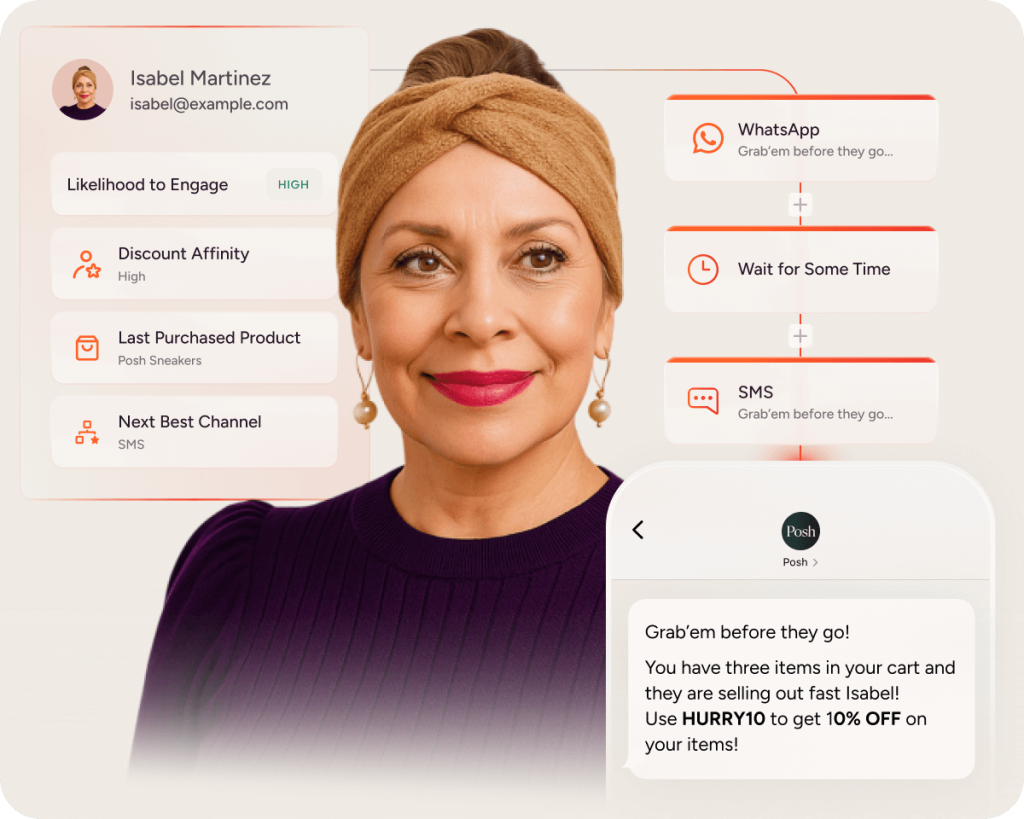
Predictive models are only as good as the profile behind them, and a fragmented profile produces confident-sounding predictions built on incomplete data.
Ask each vendor to demonstrate identity resolution across web, app, email, and offline sources using a sample of your actual customer records, not a clean demo dataset.
A strong Customer Data Management layer that stitches these sources together in real time is the foundation everything else in this guide depends on, and it deserves more scrutiny than any single predictive feature.
Out-of-the-box models vs. custom build effort
Vendors advertise churn, lifetime value, and propensity models as included features, but “included” often means a generic model that needs weeks of retraining on your data before it’s usable.
Ask for the average time-to-first-accurate-prediction from actual customer implementations, not from a sandbox environment.
This single question exposes more about real effort than any feature checklist, and it’s a fair one to insist gets answered in writing before you sign anything.
Build vs. buy vs. hybrid: which architecture controls your costs?
The architecture decision, not the vendor’s feature list, is what actually drives your total cost of ownership over three years.
Owning more of the pipeline gives you latency control at the cost of ongoing engineering maintenance, while buying a fully managed layer trades that control for speed and a recurring subscription line.
How much of the pipeline you own
Building your own real-time pipeline on top of a data warehouse gives you full control over latency and model logic, but it also means your team owns every schema change, every retraining cycle, and every outage.
Buying a managed platform shifts that maintenance burden to the vendor, usually at the cost of some customization flexibility.
A hybrid approach, where you own the data warehouse but license the scoring and orchestration layer, is increasingly common because it keeps data portability high while limiting the engineering headcount required to keep predictions current.
Integration friction with your existing stack
The advertised price rarely includes the cost of connecting a new predictive layer to your existing customer relationship management (CRM), CDP, or data warehouse, and that integration work is where budgets quietly balloon.
Ask for a documented, product-based integrations list rather than a verbal assurance that “it connects to everything,” and request a reference implementation similar to your stack complexity before you sign.
Leroy Merlin used Insider One’s platform to orchestrate journeys across its existing systems and grew ecommerce revenue by 8.8%, a result tied directly to how cleanly the platform integrated rather than to the model alone.
What belongs on a vendor-neutral RFP checklist and scorecard?
A useful RFP checklist forces vendors to put latency and governance claims in writing, since verbal assurances in a sales call carry no contractual weight once you’re mid-implementation. Score every vendor against the same document, not against whatever they chose to demo.
Questions that force written SLAs and explainability
Every RFP should include these non-negotiable items, and any vendor unwilling to answer them in writing is telling you something about post-sale support:
- Written latency SLA with penalty clauses for missed thresholds, not a marketing range
- Model explainability documentation showing which inputs drive each prediction, in plain language your compliance team can review
- Data residency and retention terms for every data source feeding the model
- A named implementation timeline with milestones tied to your actual data, not a generic rollout plan
- Reference customers in your industry willing to speak to real deployment timelines
Weighting total cost of ownership
Sticker price is the least reliable number on any predictive analytics contract, because the real cost lives in the line items vendors don’t lead with.
Build your scorecard around data egress fees, seat limits, model retraining charges, and support tiers, then weight those categories as heavily as feature coverage.
A platform that scores well on capability but poorly on TCO transparency usually costs more in year two than the initial quote suggested, so treat pricing transparency itself as a scoring criterion.
Which buying mistakes stall predictive analytics rollouts?
Most stalled rollouts trace back to two decisions made before the contract was even signed: buying advanced capability the team can’t use yet, and underestimating how long adoption actually takes. Both are avoidable with honest scoping.
Paying for AI modules your team isn’t ready to use
Teams frequently license advanced AI modules, like propensity scoring or next-best-action recommendations, that sit unused for months because the underlying data isn’t clean enough or the team lacks the analytics skills to act on the output.
Before adding an advanced module to your contract, audit whether your first-party data is complete enough to feed it and whether someone on your team owns interpreting its output weekly.
AI-powered predictive analytics platform features only produce value when someone is actually acting on what they surface, so scope the module to your team’s current maturity, not your roadmap.

Underestimating change management timelines
The technical implementation is often the easy part; getting marketing, analytics, and revenue teams to actually trust and act on model output takes longer, and that timeline rarely appears in the vendor’s proposed rollout schedule.
Build a change management phase into your project plan with its own milestones, separate from the technical go-live date, and hold the vendor accountable for training support during that window, not just during onboarding.
Aramex saw a 41.18% conversion lift after teams adopted real-time behavioral triggers into daily workflows, a result that depended on adoption discipline as much as the underlying model.
Conclusion
Real-time predictive analytics only pays off when latency, integration cost, and governance are evaluated on equal footing, not when one is traded for another mid-negotiation.
Build your scorecard before the first sales call, insist on written SLAs, and scope AI modules to your team’s actual data readiness. The vendors who welcome that scrutiny are usually the ones worth shortlisting.
To evaluate the fit of our platform, Customer Data Management, and AI capabilities for your use case, book a personalized demo to review your goals, data requirements, and implementation constraints with the Insider One team.
Frequently asked questions
True real-time systems score events in sub-second to low-second timeframes because they process data as it arrives. Many platforms marketed as real-time actually run near-real-time batch updates every few minutes to hours. Always ask vendors to specify their measured latency under production load rather than accepting the word “real-time” at face value.
Only for use cases with a short decision window, like in-app personalization or real-time bidding. Churn modeling, lifetime value scoring, and campaign planning tolerate hourly or daily refreshes without hurting outcomes. Match your SLA requirement to the specific use case instead of buying streaming infrastructure across the board.
Building gives you latency control but adds ongoing engineering maintenance for schema changes and retraining. Buying a managed platform reduces that burden at the cost of some customization. A hybrid model, owning the data warehouse while licensing the scoring layer, is a common middle path that balances portability against maintenance load.
Require a written latency SLA with penalty clauses, model explainability documentation, data residency terms, a named implementation timeline against your actual data, and reference customers in your industry. Score every vendor against the identical document so comparisons stay fair and defensible internally.
The two most common causes are licensing advanced AI modules before data is clean enough to feed them, and underestimating how long it takes teams to trust and act on model output. Both are avoidable by auditing data readiness before adding modules and building a separate change management timeline into the project plan.

Keep Reading
4 min.

Chris Baldwin
3 Feb 2026
8 mins.
Chris Baldwin
8 Oct 2026
8 mins.
Chris Baldwin
8 Oct 2026