

 Platform Overview

 Integration Hub

 Insider One AI™

 Customer Data Management

 Personalization

 Journey Orchestration

 Reporting & Data

 Behavioral Analytics

 Web
Web

 Email
Email

 Site Search

 Conversational CX

 WhatsApp

 Web Push

 InStory

 App
App

 SMS & RCS

 Join the $0 Migration Movement™

 The Insider One Difference

 Compare Vendors

 Switch to Insider One

 Success Story

 Retail & Ecommerce

 Financial Services

 Travel & Hospitality

 Beauty & Cosmetics

 Automotive

 Telecommunications

 Total Economic Impact™ Study

 Blog
Blog

 E-Books & Guides

 Glossary
How to Use RCS for Conversational Commerce: A Practical Playbook

Updated on 9 Jul 2026
8 min.
Table of Contents
- Summary
- Why SMS revenue is plateauing and what RCS changes
- The four commerce moments where RCS outperforms every other channel
- Post-purchase and loyalty flows that actually drive repeat revenue
- Building the personalization engine behind high-converting RCS
- Measuring RCS performance and making the business case to your CMO
- FAQs
Most Popular


Summary
RCS enhances mobile commerce with verified branding, interactive messaging, and in-message shopping experiences that reduce purchase friction. Combined with real-time customer data and personalization, it delivers higher conversions than traditional SMS.
Your SMS program is mature, your list is clean, and your team has optimized send time, frequency, and offer depth. Yet revenue-per-send has flattened.
That is not a creative problem or a segmentation problem. It is a format problem. Plain-text SMS was built for notifications, not commerce, and the channel has reached the limits of what a 160-character string with a bare URL can do for a shopper who is two taps away from your competitor.
Rich Communication Services (RCS) changes the structural equation. It runs inside the same native Android messaging inbox your subscribers already use, with no app download required on their end.
The difference is what you can put inside the message: product image carousels, inventory-aware call-to-action buttons, branded sender profiles with verified badges, and one-tap checkout triggers.
For ecommerce and customer relationship management (CRM) teams evaluating where to place their 2026 channel investment, RCS is the most significant shift in mobile messaging since push notifications.
Why SMS revenue is plateauing and what RCS changes
Every mature SMS program eventually hits the same ceiling. List saturation means your highest-frequency subscribers have already self-sorted: the engaged ones convert at a predictable rate, and the rest have quietly tuned out without formally unsubscribing.
Adding more sends accelerates churn without improving revenue. The format itself is the bottleneck, not the audience.
RCS restores engagement by embedding the commerce experience directly inside the message thread. A shopper receiving an RCS promotional send sees a scrollable carousel of product images, a price, an inventory status indicator, and a “shop now” button, all within the conversation.
There is no redirect to a landing page, no friction of waiting for a mobile web page to load, and no moment where the shopper loses context and abandons. The experience stays inside the inbox, which is exactly where the intent already lives.
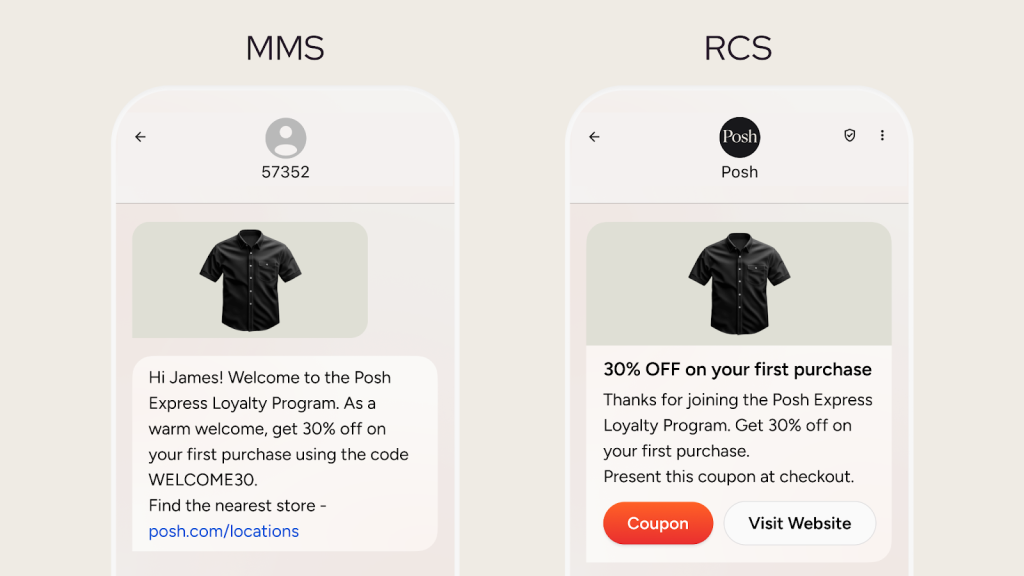
Verified sender identity: The trust layer SMS never had
Spoofing and phishing have eroded consumer trust in SMS to a measurable degree. Many shoppers now treat unrecognized SMS senders with suspicion, and that skepticism suppresses click-through even on legitimate promotional messages.
RCS addresses this at the protocol level. Before a subscriber reads a single line of copy, they see your brand logo, your verified business name, and a platform-issued verification badge.
The trust signal arrives before the offer does, and that sequence matters enormously for high-intent commerce messages where hesitation is the default.
The four commerce moments where RCS outperforms every other channel
Product discovery and promotional sends
The core problem with SMS-driven traffic is the journey it forces: a subscriber reads a text, taps a URL, waits for a mobile page to load, then tries to find the product mentioned in the copy. Each step is a drop-off point. RCS collapses that journey.
Rich card carousels let shoppers swipe through SKUs, check stock availability, and tap directly to a product page or an add-to-cart action, all within a single message thread.
The discovery and the intent moment happen in the same place, which is why RCS-driven traffic tends to arrive at the product page with higher purchase intent than SMS-driven equivalents.
Abandoned cart recovery
Cart recovery is the highest-value automation in ecommerce messaging, and it is also the flow where format friction costs the most. An SMS cart recovery message describes the abandoned item in words and links to the cart.
An RCS cart recovery message shows the shopper a visual preview of the exact product they left behind, surfaces a personalized incentive such as a limited-time discount or free shipping threshold, and presents a one-tap return-to-cart or checkout button.
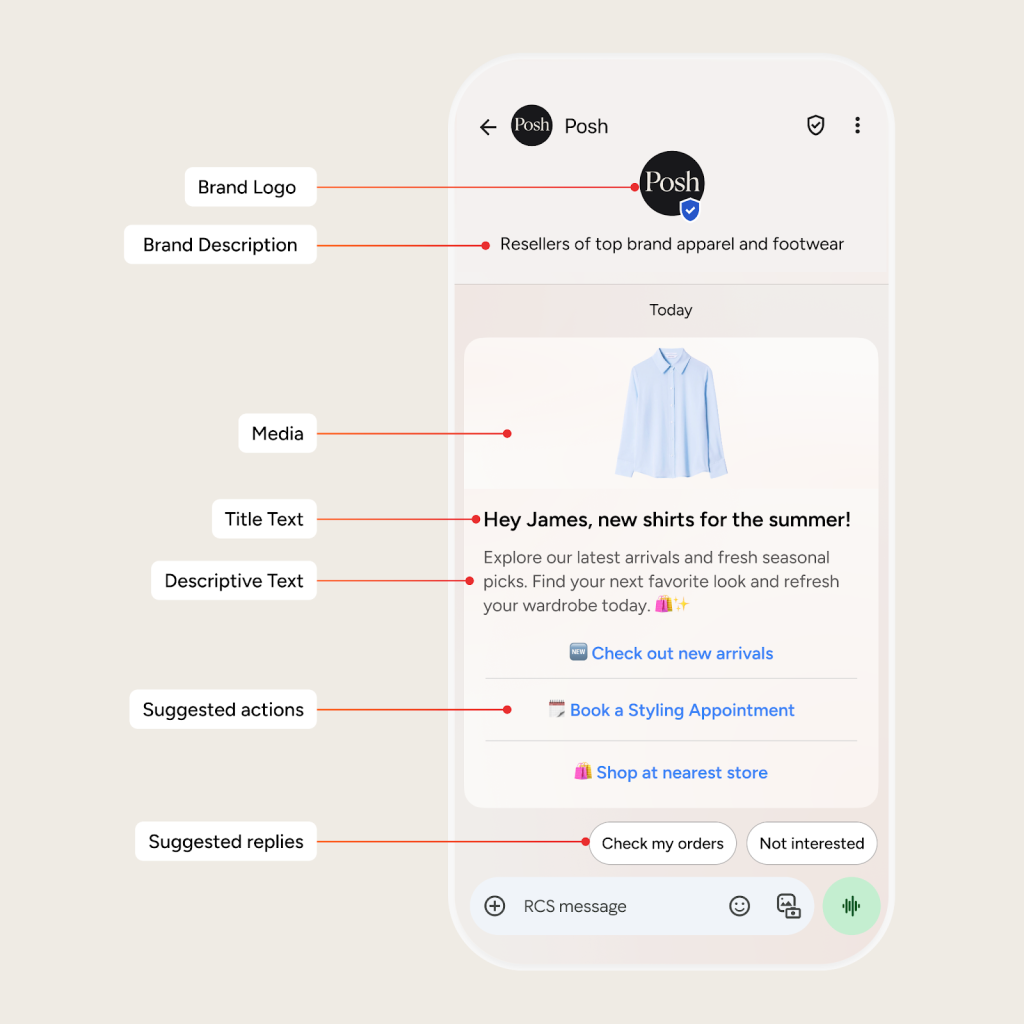
The multi-step funnel compresses into a single message. For brands already running SMS cart recovery sequences, piloting the same flow in RCS on an A/B basis is the fastest way to generate a credible conversion lift number.
Post-purchase and loyalty flows that actually drive repeat revenue
Order status and upsell sequences
The post-purchase window is the highest-trust moment in the customer relationship. The shopper has already committed, confirmation bias is working in your favor, and they are more receptive to a relevant recommendation than at almost any other point in the journey.
RCS order confirmation messages can carry dynamic rich cards that surface complementary products personalized to what was just purchased, with inventory-aware availability and a direct add-to-cart tap.
Unlike email, which competes with dozens of other messages in a separate inbox, RCS arrives in the same thread where the shopper expects transactional updates, keeping the commercial and the conversational in one continuous experience.
Loyalty reactivation
Lapsed subscriber reactivation is where email fatigue is most visible and where RCS has a structural read-rate advantage. Even for dormant segments, native inbox messages maintain significantly higher read rates than email equivalents, because the inbox context is different and the message does not require opening a separate application.
A personalized reward carousel showing a subscriber’s accumulated points balance, a time-sensitive redemption offer, and a visual preview of products within their reward tier can accomplish in one RCS message what would take a three-email nurture sequence to attempt.
Want to see what an RCS pilot would look like on your highest-value SMS flow? Book a personalized demo and we’ll map a cart recovery or loyalty reactivation test against your own subscriber data.
Building the personalization engine behind high-converting RCS
Why a customer data platform (CDP) is the prerequisite, not the nice-to-have
Rich cards are visually compelling, but a carousel of random products is not personalization. It is decoration. The difference between an RCS message that converts and one that gets ignored is the behavioral signal layer feeding the template at send time.
A shopper who browsed running shoes for 12 minutes yesterday, abandoned a specific pair at checkout, and holds gold loyalty tier status should receive a fundamentally different RCS message than a first-time visitor who clicked a seasonal promotional email.
That level of specificity requires a unified customer data platform resolving behavioral events, purchase history, loyalty data, and channel reachability into a single profile in real time, not via overnight batch exports.
Insider One’s platform was built around exactly this data architecture. Real-time behavioral signals flow directly into message templates, so the rich card carousel a subscriber sees is assembled from their actual browsing and purchase history at the moment of send, not from a segment that was last refreshed 24 hours ago.
Fallback logic: reaching the full audience without degrading the experience
RCS device and carrier coverage, while expanding rapidly, is not universal. A realistic enterprise deployment in 2026 will encounter a meaningful portion of subscribers whose devices or carriers do not yet support RCS natively.
Without a systematic fallback strategy, teams face a binary choice: restrict RCS sends to the confirmed-capable subset and sacrifice reach, or send to the full list and deliver broken experiences to unsupported devices. Neither option is acceptable for a revenue-critical channel.
The right architecture routes subscribers through an intelligent fallback sequence: RCS for capable devices, SMS for those that are not, and mobile push for subscribers who have your app installed and have opted into notifications.
Journey orchestration logic handles the routing automatically based on real-time reachability signals, so the subscriber always receives the best available format without manual list segmentation.
Insider One’s Architect, available through Journey Orchestration, is designed to support exactly this kind of cross-channel sequencing, allowing RCS to operate as the primary high-fidelity channel within a broader omnichannel flow rather than as a standalone send
Measuring RCS performance and making the business case to your CMO
The right metrics framework
Open rate is the wrong primary metric for RCS. It conflates message delivery with genuine engagement and does not capture whether the rich card interaction led to a revenue outcome.
The metrics that make the business case defensible are revenue-per-send, incremental conversion lift measured against an SMS control group running the same creative concept, and cost-per-acquisition on RCS-driven conversions.
Secondary metrics worth tracking include carousel interaction rate (the percentage of recipients who swipe through more than one card), one-tap action rate (how many tap a CTA directly from the message), and fallback rate by device segment. Together these give a full picture of both the commercial return and the operational health of the channel.
A phased pilot structure that produces a defensible ROI number
The fastest path from curiosity to budget allocation is a constrained, well-designed pilot rather than a full channel migration. Choose one high-value existing SMS flow, abandoned cart recovery being the obvious candidate, and run an A/B split: one cohort receives the standard SMS version, the other receives the RCS equivalent with the same offer and equivalent timing.
Run the test for four to six weeks to accumulate statistically meaningful volume across both high- and low-traffic periods. The result is a clean incremental lift number that reflects real audience behavior rather than vendor benchmarks.
From there, the scaling sequence follows the data: identify the next highest-revenue flows, build RCS variants, instrument the same measurement framework, and expand coverage quarter by quarter.
This approach avoids full channel migration risk while generating a compounding ROI case that finance and your CMO can evaluate on the same terms they use for every other channel investment.
Slazenger generated 49X ROI in eight weeks using Insider One’s omnichannel approach across a similarly structured phased rollout, demonstrating that compressing the test-to-scale cycle is achievable with the right orchestration infrastructure in place.
If you want to see how Insider One’s Architect turns live customer data into coordinated, revenue-driving experiences, book a personalized demo to see the exact use cases, decision logic, and growth levers most relevant to your team.
FAQs
RCS is currently native to Android devices and is distributed through Google’s Messages app. Apple added RCS support starting with iOS 18, expanding the addressable audience significantly, though feature parity between Android and iOS implementations varies.
In practice, enterprise deployments in 2026 should expect the majority of their RCS-capable audience to be on Android, with iOS coverage growing throughout the year. Fallback logic to SMS ensures full list reach regardless of device.
RCS, WhatsApp, and push serve overlapping but distinct audiences. WhatsApp is dominant in markets outside North America and Western Europe. Push requires app installation and an active opt-in.
RCS reaches subscribers in the native SMS inbox without either dependency, making it complementary rather than competitive with both.
The most effective stacks route each subscriber to the channel where they have the highest reachability and engagement history, using CDP-driven segment logic to make that decision in real time rather than by manual list management. For a deeper look at conversational commerce messaging strategy, the channel selection and orchestration principles apply across all three.
RCS business messaging requires brands to register their sender profile through a carrier or aggregator, a process that involves logo submission, brand verification, and use-case approval.
The timeline varies by market and carrier, but it is meaningfully longer than activating an SMS short code. Teams evaluating an RCS pilot should build the registration process into their timeline from the start, not treat it as a technical detail to handle after campaign planning is complete. Your messaging platform provider or aggregator partner can advise on market-specific requirements and expected approval windows.

Keep Reading
7 min.

Muharrem Derinkok
4 Jun 2026
11 min.

Chris Baldwin
2 Jun 2026
4 min.
Chris Baldwin
3 Feb 2026