

 Platform Overview

 Integration Hub

 Agent One™

 Agent One Teams™

 Customer Data Management

 Personalization

 Journey Orchestration

 Reporting & Data

 Behavioral Analytics

 Web
Web

 Email
Email

 Site Search

 Conversational CX

 WhatsApp

 Web Push

 InStory

 App
App

 SMS & RCS

 Join the $0 Migration Movement™

 The Insider One Difference

 Compare Vendors

 Switch to Insider One

 Success Story

 Retail & Ecommerce

 Financial Services

 Travel & Hospitality

 Beauty & Cosmetics

 Automotive

 Telecommunications

 Total Economic Impact™ Study

 Blog
Blog

 E-Books & Guides

 Events

 Glossary
How AI Turns Customer Segments into Revenue

Updated on 11 Aug 2026
8 min.
Table of Contents
- Summary
- Why rule-based segmentation hits a ceiling no infrastructure can fix
- What predictive segmentation actually predicts
- From prediction to decision: Why they need to live in the same model
- The capabilities checklist: What to demand from any platform
- Building the business case: Metrics that resonate with leadership
- How Insider One turns predictions into revenue
- Frequently asked questions
Most Popular

Summary
Predictive segmentation goes beyond static rules by using AI to anticipate customer behavior and optimize offers, channels, and timing in real time. The best platforms combine predictive models with native decisioning to drive revenue and retention.
The most uncomfortable moment in any campaign debrief is realising the audience never really knew what the customer was about to do. It’s tempting to blame stale data or a slow refresh cycle, and that’s part of the story.
But even a perfectly up-to-date, real-time rule engine only tells you who matched a condition someone wrote down in advance. It cannot tell you who is about to buy, who is about to churn, or which combination of behaviours actually predicts intent for a given customer.
That’s a modelling problem, not a data-freshness problem, and it’s the reason rule-based segmentation hits a ceiling that better infrastructure alone cannot fix.
Why rule-based segmentation hits a ceiling no infrastructure can fix
Rules describe the past; they don’t predict the future
A rule like “viewed category X in the last seven days, no purchase since” is, by construction, a description of something that already happened. That’s true no matter how fresh the underlying data is. Making the sync instant doesn’t change what the rule is capable of expressing; it just means the description is more current.
Genuine prediction is a different kind of task. It means weighing dozens of weak, correlated signals, browsing recency, purchase cadence, category affinity, engagement drop-off, against outcomes observed across thousands of other customers, and finding the combination that actually correlates with someone buying or churning.
That’s pattern recognition at a scale no person can hand-encode as a rule set. It’s also precisely the gap a predictive model is built to close, and it exists whether the data behind it is a week old or a second old.
The decision space grows faster than rules can cover
Even setting prediction aside, there’s a second, separate reason rules break down: the number of decisions you’d need to write rules for grows combinatorially.
Offer, channel and timing each have several viable options, and the right combination depends on the individual customer’s current state, not a fixed segment they belong to. Writing rules to cover every meaningful combination would mean maintaining thousands of them, and they’d start going stale the moment customer behaviour shifted even slightly.
Coordinating that many moving parts is exactly what journey orchestration is built to handle, rather than something a static rule set can keep up with.
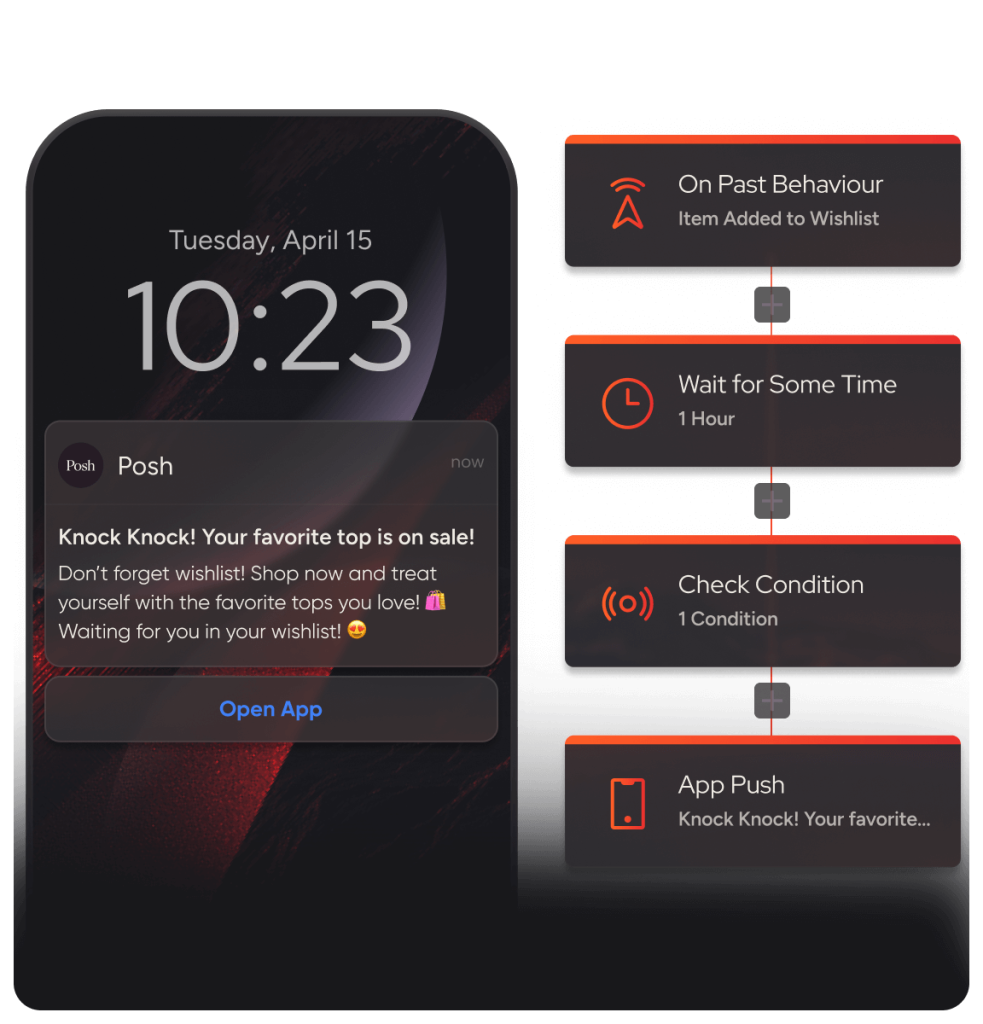
This is the second genuinely AI-shaped problem in this piece: optimising a decision across a large, constantly shifting space, rather than simply matching a customer against a static condition.
What predictive segmentation actually predicts
Likelihood-to-purchase scores, churn risk flags and lifecycle stage classifications are estimates of future behaviour, produced by a model that has learned patterns across many customers’ behavioural, transactional and engagement signals simultaneously. That’s different in kind from a rule that checks whether a condition was met yesterday, not just different in speed.
A rule-based segment tells you who bought in the last 30 days. A predictive segment estimates who is likely to buy in the next 14. That distinction is what actually shapes a spend decision, and it’s the kind of insight that shows up in reporting built to track revenue impact, not just engagement.
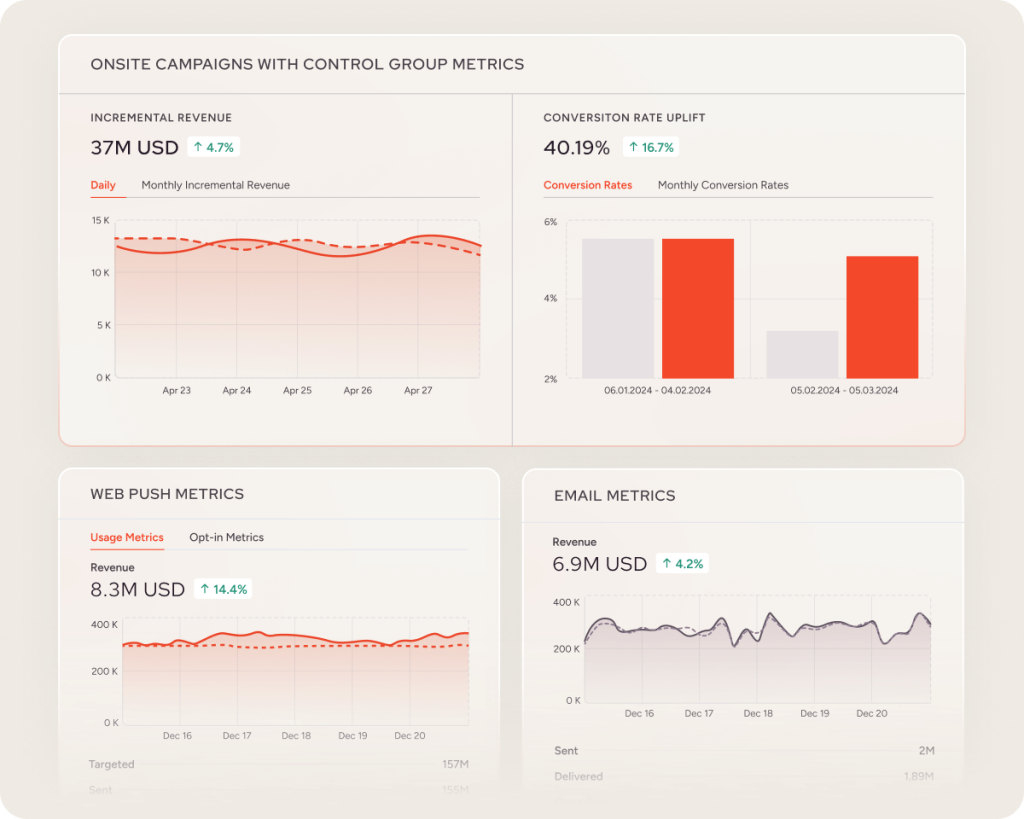
Insider One’s Customer Data Management layer unifies behavioural, transactional and engagement data across touchpoints into a single customer profile.
This matters because a predictive model is only as good as the completeness of the signal it’s trained on and scored against; fragmented data limits what any model can learn, however sophisticated the algorithm.
It’s worth being precise here: unified data is the foundation the prediction sits on, not the AI capability itself. When evaluating a platform, it’s worth separating the two clearly, since a vendor can have excellent data infrastructure and a mediocre model, or the reverse.
From prediction to decision: Why they need to live in the same model
It’s tempting to point at the old multi-system handoff, a segment built in one place, exported to email, re-synced to paid media, adapted again for push, as the core problem AI solves. It isn’t, not on its own. That’s an integration problem, and parts of it could be solved with better middleware and no machine learning at all.
The AI-specific problem sits one layer up. Once a model predicts that a given customer has reached a purchase-intent inflection point right now, deciding what to show them, on which channel, and at what moment is itself a prediction: an estimate of which combination is most likely to convert for that individual.
That’s what AI-driven personalisation is actually doing, as distinct from simply exporting a list. If that decision is made by a different, often rule-based, system than the one that produced the underlying prediction, the link between what the model knows and what the customer actually experiences breaks.
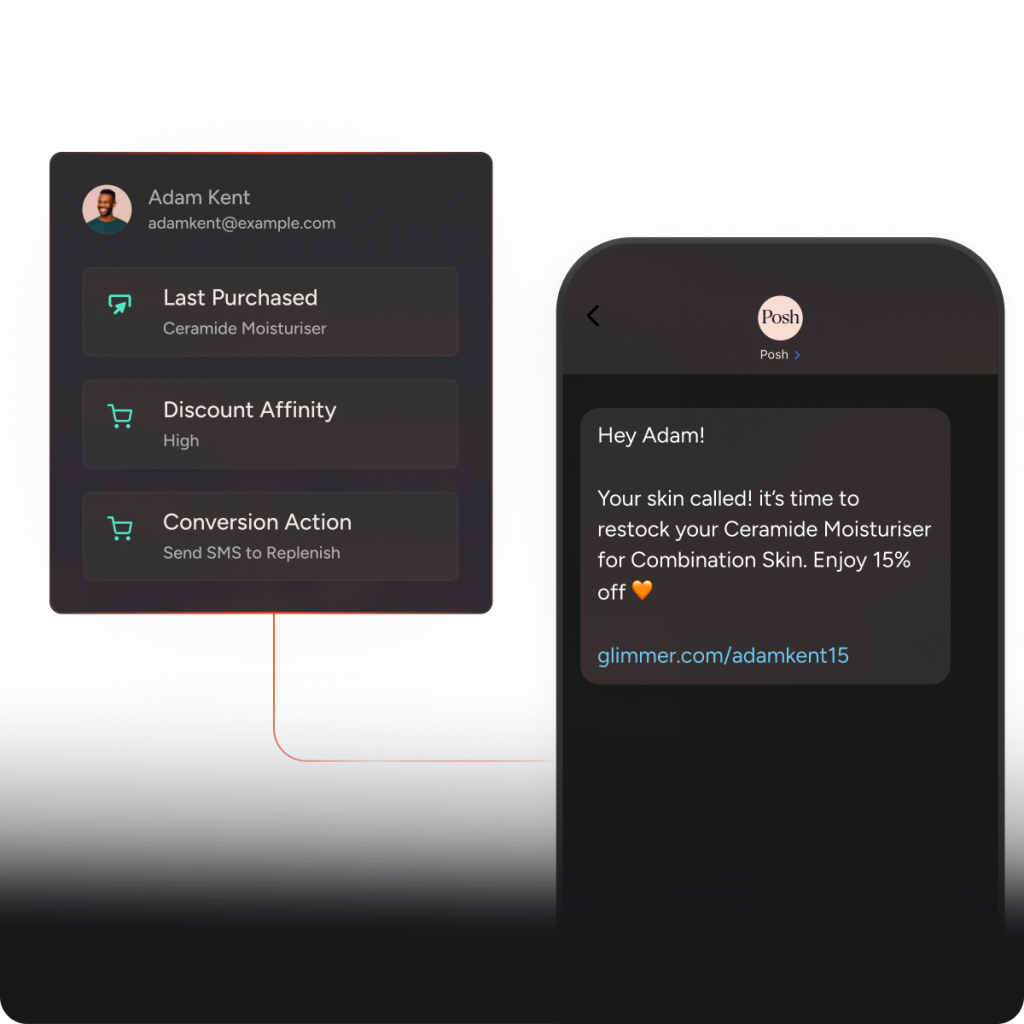
That’s why prediction and activation need to sit inside the same decisioning layer. Not primarily because syncing systems is difficult (it is, but that’s solvable with integration work), but because the decision itself has to be re-optimised every time the underlying prediction changes, and a static handoff between disconnected systems can’t do that.
Adidas is reported to have increased average order value by 259% and conversion rate by 13% in a single month by combining unified customer intelligence with coordinated personalisation across channels. That kind of result doesn’t come from stronger creativity alone; it comes from the prediction and the experience decision being handled by the same system, with no lossy handoff in between.
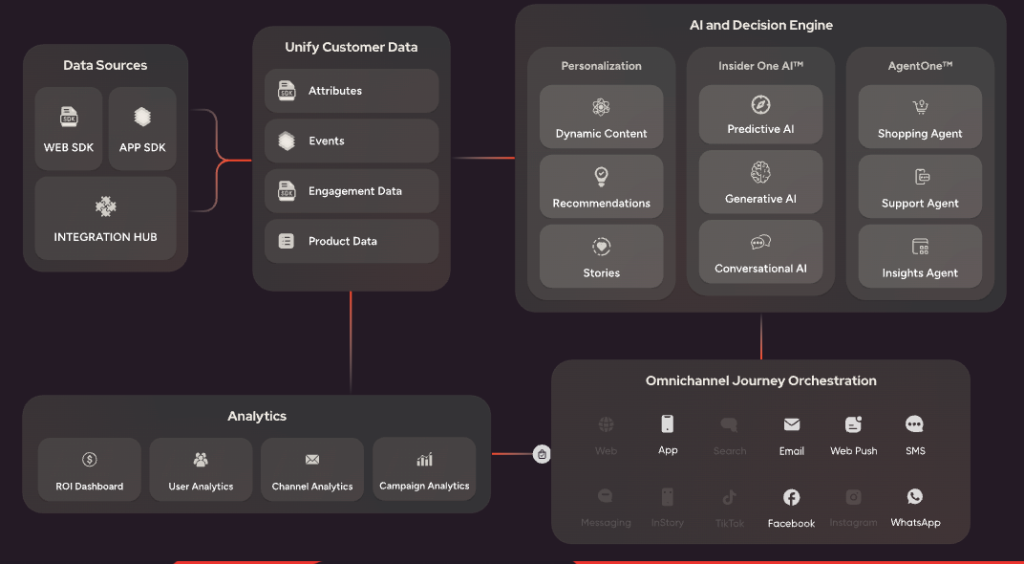
The Insider One platform brings segmentation, prediction and channel activation under a single decisioning layer, so the gap between knowing who a customer is about to become and acting on that knowledge collapses from days to seconds.
The capabilities checklist: What to demand from any platform
Not every platform claiming AI personalisation is doing the same thing underneath. Before an evaluation, these are worth pressure-testing, roughly in order of how AI-specific they actually are.
Native predictive modelling. Segmentation and prediction shouldn’t be separate modules bolted together after the fact. Look for likelihood-to-purchase, churn risk and lifecycle scoring built directly into the platform, feeding straight into targeting, not a model that lives elsewhere and gets exported in.
Coordinated decisioning across channels. A prediction should drive one decision that’s expressed consistently across email, push, in-app, web and paid media, not a segment that’s exported and then re-interpreted differently by each channel.
Built-in experimentation. AI-driven decisioning without a way to test it produces conviction without evidence. The platform should support A/B and multivariate testing natively, with statistical significance reporting that doesn’t require analyst support to interpret.
Marketer-owned controls. Ask exactly where the technical boundaries sit: can marketers adjust which signals feed the model, set thresholds, or test new hypotheses in plain English without an engineering ticket? Some platforms require engineering involvement for changes that should be a marketer’s call, and that dependency compounds across every sprint.
Real-time data ingestion. This one still matters, since a model scoring against stale inputs will make worse predictions regardless of how good the algorithm is. But it’s the foundation the other four capabilities are built on, not the differentiator on its own. Ask specifically how quickly a behavioural event, such as an add-to-cart, updates a customer profile and triggers re-scoring.
Building the business case: Metrics that resonate with leadership
Stop leading with engagement
Open rates, click-through rates and session duration are useful for optimising creative and timing, but they aren’t the metrics that unlock budget approval at the leadership level.
The conversation that moves decisions is grounded in revenue-per-customer lift, reduction in acquisition cost, and retention rate improvement over time. Those three metrics connect AI-driven personalisation directly to the profit and loss statement in a way engagement rates never will.
MadeiraMadeira is reported to have achieved strong ROI using Architect, Insider One’s journey orchestration platform, including a 3.5X higher conversion rate on WhatsApp after unifying its data in under a week.
That kind of result doesn’t surface in a click-through report; it surfaces in revenue. When building the internal case for investment, lead with the numbers leadership already cares about, not the ones that live on a marketing dashboard.
A practical measurement framework
Start with a baseline of the current cost of maintaining rule-based segments: analyst hours, sync time between systems, and campaign delays caused by decisions made on outdated logic. That figure, converted to an annual number, is the operational cost a predictive, unified decisioning layer replaces.
Next, build a projection of the revenue-per-customer uplift from prediction-driven decisioning, anchored to the specific use cases planned first. Churn risk intervention and high-intent purchase prediction tend to deliver faster, more measurable results than broad behavioural cohorts, making them strong candidates for early proof-of-concept work.
Connect both numbers to lifetime value growth over a 12-month horizon. Lifetime value bridges the gap between a marketing ROI argument and a strategic investment conversation.
If AI-driven decisioning increases the percentage of customers reaching a second, third and fourth purchase, measured through incrementality testing rather than raw engagement, the case is made in the language of the business, not the language of the marketing team.
For a deeper look at what strong personalisation programmes deliver, The ROI of personalisation breaks down the mechanics behind measurable revenue impact. If you’re thinking about how this applies across specific verticals, the market segmentation strategy piece is worth reading alongside this one.
How Insider One turns predictions into revenue
Prediction and activation run in the same layer. A predictive segment isn’t exported to a channel, it’s an entry condition in Architect, so when a score changes the journey the customer is in changes with it.
Native predictive modelling. Likelihood to purchase, churn risk, customer lifetime value and discount affinity are platform-maintained predictive segments, available to a marketer as targeting criteria rather than living in a model elsewhere and arriving by sync.
One decision, every channel. Next Best Channel and Send Time Optimization resolve per individual across 12+ native channels including web, app, email, SMS and WhatsApp, from the same canvas. The prediction drives a single decision rather than being reinterpreted separately by each channel.
Experimentation without an analyst. A/B Auto-Winner Selection resolves variants against configurable metrics with holdouts, and Architect control groups measure the incremental lift of a journey, which is the figure an incrementality-based business case actually rests on.
Marketer-owned controls. Computed Traits let marketers build custom metrics from raw data without IT support. Smart Journey Creator takes a plain-language prompt and returns a journey, showing the reasoning behind each decision point before you adopt it.
Ingestion you can inspect. Event formats are transformed as they arrive to prevent duplicate collection, and ingestion analytics exposes every source feeding a profile, so a model isn’t scoring against a feed that broke quietly.
Book a demo to score your own data, or take the platform tour first.
Frequently asked questions
Segmentation defines who is being targeted; personalisation defines what that person experiences. In a rule-based stack, those two decisions are made by different logic, often in different tools. In an AI-driven system, they’re two outputs of the same model: a prediction about who a customer is about to become drives a prediction about what will convert them, computed together rather than handed off between systems.
With a platform that has native predictive modelling and real-time data flowing in, initial predictive segments can typically be activated within the first few weeks of implementation, particularly for likelihood-to-purchase and churn risk use cases where behavioural signals are already being collected. Time to value depends heavily on the quality of data already flowing into the system and the complexity of the decisioning being built around it.
This depends on the platform. Some systems are designed to reduce marketing teams’ dependency on data science resources for day-to-day segment management, while still benefiting from collaboration with whoever owns the customer data infrastructure, particularly during initial setup and signal validation. It’s worth asking any vendor directly how model logic is adjusted and who owns that process operationally.
The advantage of a unified decisioning layer is that it’s channel-agnostic. A single predictive model can drive web experience personalisation, app push notifications, paid media retargeting and conversational channels like WhatsApp simultaneously. When every channel acts on the same prediction, the customer experience coheres naturally because the decision behind it is consistent, not because each channel happened to receive the same export.

Keep Reading
7 min.

Muharrem Derinkok
4 Jun 2026
11 min.

Chris Baldwin
2 Jun 2026
4 min.
Chris Baldwin
3 Feb 2026