

 Platform Overview


 Integration Hub


 Agent One™


 Agent One™ Teams


 Customer Data Management


 Personalization


 Journey Orchestration


 Reporting & Data


 Behavioral Analytics


 Web


 Email


 Site Search


 Conversational CX


 WhatsApp


 Web Push


 InStory


 App


 SMS & RCS


 Join the $0 Migration Movement™


 The Insider One Difference


 Compare Vendors


 Switch to Insider One


 Success Story


 Retail & Ecommerce


 Financial Services


 Travel & Hospitality


 Beauty & Cosmetics


 Automotive


 Telecommunications


 Total Economic Impact™ Study


 Blog


 E-Books & Guides


 Events


 Glossary
What Omnichannel Success Actually Looks Like in 2026?

Updated on 17 Nov 2026
8 mins.
Table of Contents
- Summary
- What future of omnichannel retailing looks like when it actually works
- Where execution breaks down for future of omnichannel retailing
- The data and orchestration layer teams usually miss
- How to fix future of omnichannel retailing without adding more channel chaos
- What to evaluate before choosing a platform
- Conclusion
- Frequently asked questions
Most Popular
Summary
- Omnichannel success in 2026 is measured by unified customer data and closed-loop retention metrics, not the number of channels a brand has live
- AI-assisted, behavior-based orchestration can help teams coordinate timing, content, and channels through configured journeys built on available customer data
- Execution breaks down when consent, identity, and inventory data sit in disconnected systems instead of one shared customer record
- Successful omnichannel retailers tie every channel to one shared set of KPIs instead of channel-specific vanity metrics
- Platform evaluation should prioritize data unification and orchestration depth over how many channels appear on a feature sheet
A brand running email, SMS, push, WhatsApp, and in-app messaging in parallel is not automatically running an omnichannel program. That is the gap most retail marketing leaders are quietly living with right now: every channel is technically “on,” yet leadership keeps asking why retention and repeat purchase rate haven’t moved.
The future of omnichannel retailing is not about adding another channel to the stack. It is a maturity curve built on unified customer data, behavior-based orchestration, and retention metrics that connect engagement activity to business outcomes.
This article is written for vice president and director-level marketing, customer relationship management (CRM), and customer experience (CX) leaders at mid-market and enterprise retail brands who are evaluating or re-platforming their engagement stack. You’ll learn what separates genuinely successful omnichannel retailers from brands that have simply multiplied their channel count, where execution typically breaks down, and what to evaluate before committing to a new platform.
What future of omnichannel retailing looks like when it actually works
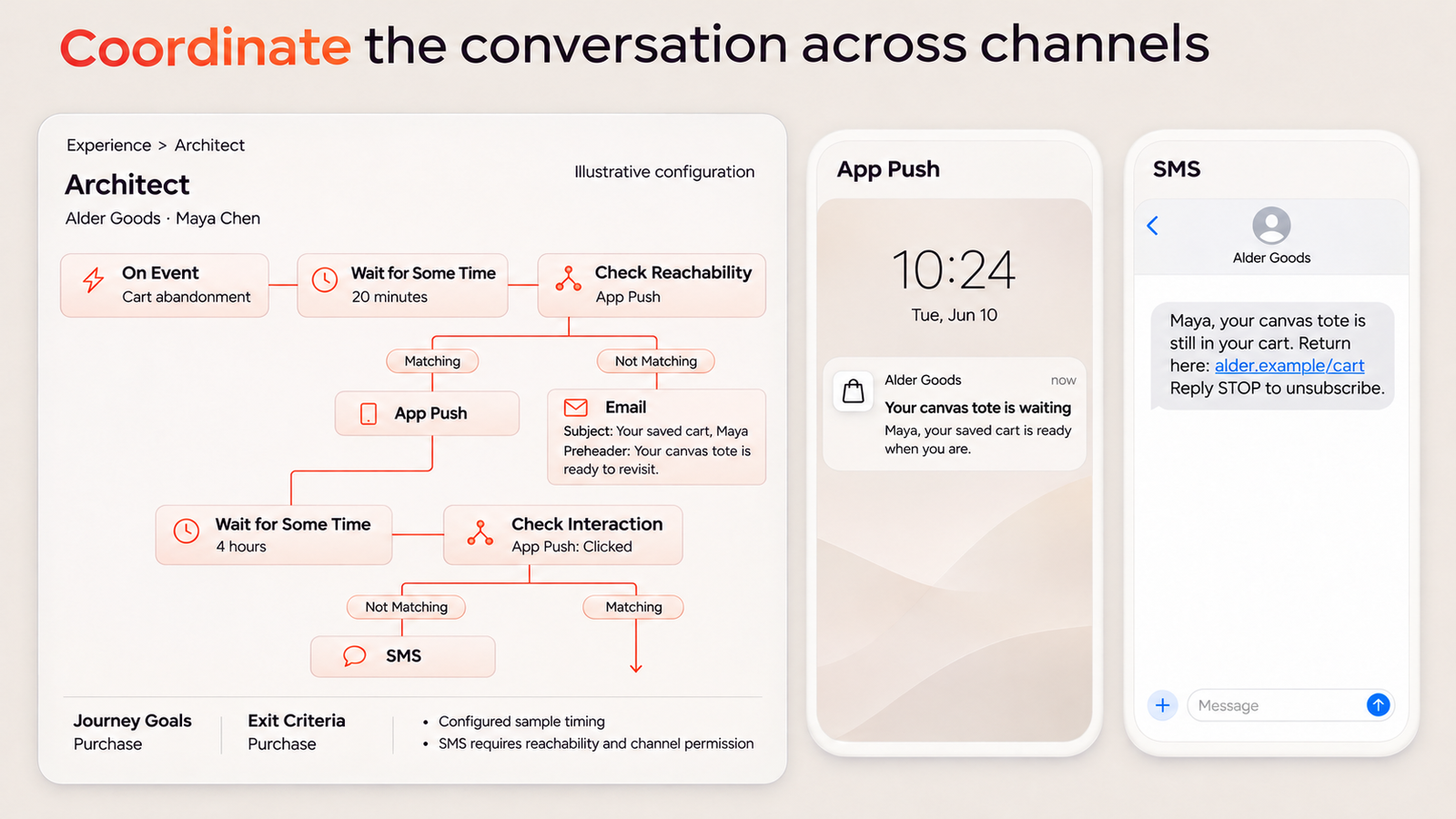
Omnichannel success in 2026 looks like a single customer record driving every interaction, not five channels operating on five separate assumptions about who the customer is. The real outcome is coordination: a customer who browses on mobile, abandons a cart, and walks into a store experiences one continuous conversation instead of three disconnected brands wearing the same logo.
The execution standard is simple to state and hard to hit. Every channel pulls from the same data, respects the same consent status, and contributes to the same retention metric. When a brand reaches that standard, channel count stops being the headline. The headline becomes repeat purchase rate, customer lifetime value, and how fast a customer moves from first purchase to second.
- One customer identity resolved across web, app, store, and messaging channels
- Consent and preference data synced in real time, not batch-updated overnight
- A shared retention KPI set that every channel owner is measured against
- Decisioning that adjusts message timing and channel based on live behavior, not a fixed send calendar
Carrefour‘s customer success story offers a relevant example of how a more unified approach can connect customer data with coordinated touchpoints. The lesson is not that another channel creates success; it is that teams need to address the coordination problem underneath every channel.
Where execution breaks down for future of omnichannel retailing
Execution breaks down at the structural layer long before it shows up in a campaign report. Most retail stacks were built one channel at a time: an email service provider bought in one budget cycle, a mobile push tool added the next, a live chat vendor layered on top. Each system holds its own version of the customer, and none of them agree.
Siloed ownership multiplies the problem
When email, SMS, and store teams each own their own data and their own KPIs, coordination becomes a meeting problem instead of a system problem. Teams optimize for their own channel’s open rate or click-through rate, not for the customer’s actual journey. Incentives built around channel-level metrics quietly work against the omnichannel outcome leadership says it wants.
Complexity compounds at scale
The gap widens as the business grows. A brand running in a handful of markets can patch data gaps with manual exports and shared spreadsheets. A global retailer running loyalty, inventory, and consent rules across dozens of markets cannot. Consent sync failures, duplicate customer profiles, and conflicting inventory feeds turn what was a minor annoyance at one scale into a structural blocker at the next.
The data and orchestration layer teams usually miss
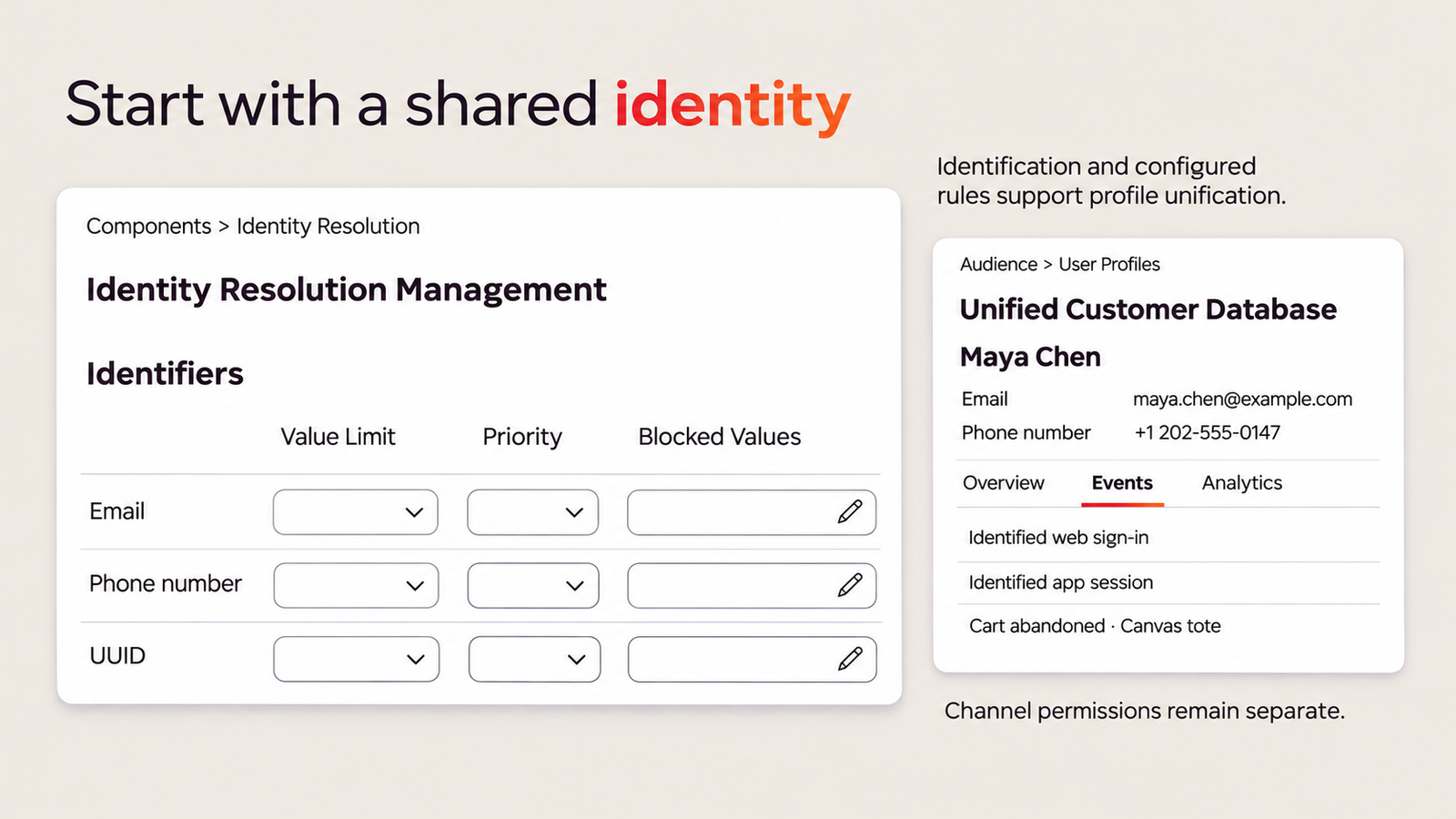
The layer most teams miss sits underneath the channels entirely: unified data, configured journey orchestration, and closed-loop measurement. Without it, a brand can have a well-funded channel strategy and still struggle to deliver the coherent customer experience shoppers expect.
Unified customer data
A customer data platform (CDP) or connected customer-data foundation can help resolve identity across devices and touchpoints. Without one unified record, a customer who just bought in-store can keep receiving acquisition offers for the item they already own, and a customer who opted out on email can be messaged on WhatsApp when preferences do not sync. Customer Data Management helps teams unify behavioral, transactional, event, attribute, and consent data into a shared profile for activation.
Real-time decisioning, not static rules
Static campaign calendars assume every customer behaves the same way on the same schedule. AI-assisted and behavior-based orchestration can help teams personalize timing, content, and channel coordination according to available customer data and configured journeys. That shift from scheduled broadcasts to responsive, configured journeys is what separates orchestration from simple channel automation.
Closed-loop measurement
None of this matters if measurement stops at channel-level clicks. Closed-loop metrics connect every touchpoint back to retention and revenue, so a marketing leader can see whether a WhatsApp nudge or a push notification actually moved a customer closer to repeat purchase, not just whether it got opened.
How to fix future of omnichannel retailing without adding more channel chaos
The fix is not another channel integration. It is sequencing the fundamentals in the right order: unify the data first, build orchestration logic second, and only then optimize individual channel tactics. Brands that reverse this order end up with sophisticated channel tools pointed at an incomplete, inconsistent view of the customer.
Prioritizing root-cause fixes starts with identity resolution and consent sync, because every downstream decision depends on knowing who the customer actually is and what they’ve agreed to receive. From there, Journey Orchestration lets teams design configured customer journeys that span channels instead of maintaining five parallel campaign calendars that occasionally collide.
Tying the fix to measurable outcomes means replacing channel-specific KPIs with a shared scorecard: retention rate, time to second purchase, and customer lifetime value, tracked the same way regardless of which channel touched the customer last. New Balance‘s customer success story is a useful reference for teams assessing how an integrated platform can reduce the operational friction of managing separate point solutions.
- Unify identity and consent before adding any new channel
- Replace channel-level KPIs with one shared retention scorecard
- Let real-time decisioning choose channel and timing instead of fixed send schedules
- Measure every campaign against lifetime value, not just immediate click-through rate
What to evaluate before choosing a platform
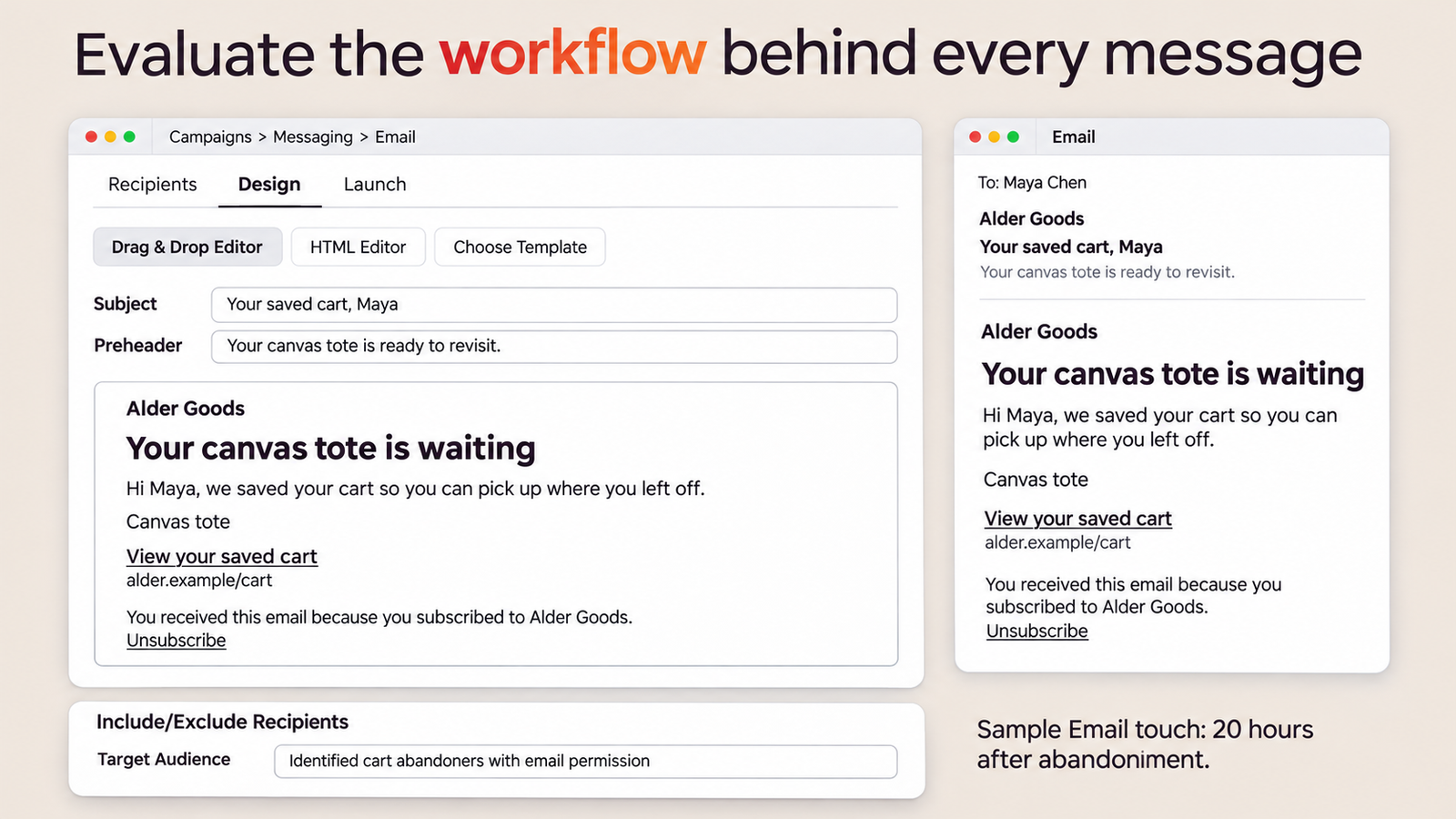
The right evaluation criteria have little to do with how many channels a vendor lists on a comparison chart. What matters is whether the platform can connect customer data, segmentation, personalization, recommendations, experimentation, journey orchestration, messaging, and analytics in a marketer-facing workflow at the scale the business actually operates at.
Decision criteria worth weighing seriously include data unification depth, real-time decisioning capability, and reporting that connects channel activity to retention rather than isolated engagement metrics. A global omnichannel strategy also needs to account for market-by-market consent requirements and local inventory realities, which is where generic channel tools tend to fall short once a brand expands beyond a single region.
- Does the platform unify identity, consent, and transaction data in one layer, or does it rely on separate integrations that can drift out of sync
- Can decisioning run in real time based on live behavior, or only on scheduled, pre-built segments
- Does reporting connect every channel back to a shared retention metric
- Can the platform scale orchestration rules across multiple markets without rebuilding logic from scratch
Insider One’s Platform and AI Overview pages describe how customer data, segmentation, cross-channel personalization, journey orchestration, recommendations, experimentation, product discovery, messaging, and analytics can work together rather than as disconnected point solutions. Agent One extends this portfolio with an agentic AI system for customer engagement, while effective execution still depends on reliable data, consent, integrations, and configured journeys.
Conclusion
Omnichannel success in 2026 is a data and orchestration problem before it is a channel problem. Brands that unify customer data, configure coordinated journeys, and measure against shared retention metrics are better positioned to deliver consistent experiences than brands focused only on channel count. The maturity curve rewards coordination, not coverage, as customer expectations keep rising.
To evaluate the fit of Architect, Customer Data Management, and Sirius AI™ for your use case, book a personalized demo to review your goals, data requirements, and implementation constraints with the Insider One team.
Frequently asked questions
Omnichannel matters because customers move between devices, stores, and messaging channels without thinking of them as separate experiences. A brand that fails to unify those touchpoints delivers a fragmented experience that erodes trust and retention, regardless of how many individual channels it has technically launched.
Successful omnichannel retailers tie every channel to one unified customer record and one shared retention metric. Channel-heavy retailers run disconnected tools that each optimize for their own engagement numbers, which often creates inconsistent, sometimes contradictory, customer experiences across touchpoints.
A global strategy has to account for market-specific consent rules, local inventory realities, and regional channel preferences, all synced back to one customer profile. Without that layer, orchestration rules built for one market tend to break or require constant manual rebuilding in another.
AI-assisted, behavior-based orchestration can complement fixed campaign calendars with responsive logic that coordinates timing, content, and channels according to available customer data and configured journeys. For example, retailers can configure browse or cart-abandonment follow-up, replenishment reminders, loyalty activation, price-drop or back-in-stock messages, store-to-digital follow-up, and personalized product discovery.
Start with data unification and consent sync, not a new channel. Reliable event, attribute, transactional, product, inventory, and consent data give configured journeys a stronger foundation; without that foundation, even well-designed journeys can deliver inconsistent experiences across touchpoints.

Keep Reading
4 min.

Chris Baldwin
3 Feb 2026
9 mins.
Chris Baldwin
11 Nov 2026
11 mins.
Chris Baldwin
11 Nov 2026