

 Platform Overview

 Integration Hub

 Insider One AI™

 Customer Data Management

 Personalization

 Journey Orchestration

 Reporting & Data

 Behavioral Analytics

 Web
Web

 Email
Email

 Site Search

 Conversational CX

 WhatsApp

 Web Push

 InStory

 App
App

 SMS & RCS

 Join the $0 Migration Movement™

 The Insider One Difference

 Compare Vendors

 Switch to Insider One

 Success Story

 Retail & Ecommerce

 Financial Services

 Travel & Hospitality

 Beauty & Cosmetics

 Automotive

 Telecommunications

 Total Economic Impact™ Study

 Blog
Blog

 E-Books & Guides

 Glossary
Omnichannel Commerce: The Strategy That Turns Retention Into Revenue

Updated on 5 Aug 2026
9 min
Table of Contents
- Summary
- Why omnichannel commerce outperforms multichannel and single-channel selling
- The core business benefits: Retention, order value, and lifetime value
- Building blocks of a winning omnichannel commerce strategy
- Real-world omnichannel commerce examples across retail, B2B, and DTC
- Metrics and KPIs to measure omnichannel commerce performance
- Conclusion
- FAQs
Most Popular

Summary
- Omnichannel commerce unifies data, inventory, and pricing across channels rather than simply adding more of them
- Brands with connected customer profiles can coordinate messaging, recommendations, and follow-up more consistently across channels
- The strategy depends on unified profiles, centralized inventory, consistent pricing, cross-channel orchestration, AI-powered recommendations, and governed activation across owned and paid channels
- Real examples span click-and-collect, endless-aisle assortments, and win-back journeys across retail, direct-to-consumer (DTC), and business-to-business (B2B) selling
- Track retention rate, cross-channel conversion, and journey-level engagement by use case to understand which omnichannel motions are improving continuity and repeat activity
Omnichannel commerce is the practice of unifying customer data, inventory, and messaging across every channel so a shopper’s history follows them from app to store to inbox instead of resetting at each new touchpoint, and in Insider One that execution sits inside an AI-powered Growth Management Platform that combines unified profiles, journey orchestration, personalization, recommendations, and cross-channel analytics in one panel.
A customer who abandons a cart on mobile and later walks into a physical store should not have to repeat themselves to an associate who has no visibility into that history.
If you are evaluating or scaling an omnichannel program, this article is for you. It covers every strategy as a measurable lever tied to retention, AOV, or customer lifetime value (CLV), not just tactics like a list of channels to switch on.
You’ll get a clear line between omnichannel and multichannel commerce, how Insider One operationalizes unified data, journeys, recommendations, and activation, real examples across retail, DTC, and B2B selling, and a clearer view of which capabilities Insider One runs natively versus where connected systems handle delivery.
Why omnichannel commerce outperforms multichannel and single-channel selling
Omnichannel commerce outperforms multichannel selling because it connects every channel into one system instead of running each as a separate, disconnected campaign.
Multichannel means a brand shows up on email, app, and in-store; omnichannel means those three channels share one customer profile, one inventory view, and one consistent price, so the experience feels continuous rather than accidental.
The gap shows up fastest in retention and basket size. A shopper who gets a push notification about an item they browsed on the website, then finds it in stock when they visit a store, behaves differently than one who gets a generic blast unrelated to anything they’ve done.
Siloed brands lose that context at every handoff, and each lost handoff is a missed chance to convert or retain a customer already showing intent.
- Multichannel: same message, multiple channels, no shared memory between them
- Omnichannel: one customer record, consistent pricing, and messaging that adapts based on what the customer already did
- The business case isn’t channel count; it’s whether those channels behave like one system
The core business benefits: Retention, order value, and lifetime value
Unified customer data matters because it lets a brand act on what a customer already told them, instead of guessing.
When purchase history, browsing behavior, and support interactions live in one profile, marketing and commerce teams can time offers around actual intent rather than a fixed calendar, which tends to lift both response rates and basket size.
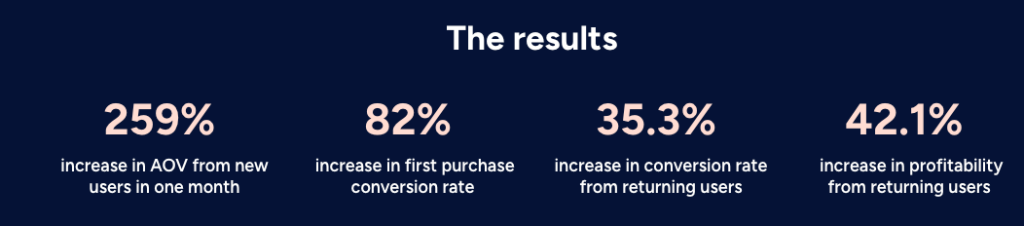
Adidas increased AOV by 259% and conversion rate by 13% using Insider One. That kind of gain doesn’t come from adding a channel; it comes from connecting the channels a brand already has so every message reflects a real customer signal.
Retention gains compound in a way single-channel wins don’t. A brand that improves repeat purchase rate by even a few points in year one keeps a larger share of that improved base into year two and year three, because retained customers refer others, spend more per order over time, and cost less to re-engage than new acquisition does.
Category leaders that treat CLV as a design input, not an afterthought, tend to widen their advantage every year rather than starting over each quarter with fresh acquisition spend.
Building blocks of a winning omnichannel commerce strategy
A working omnichannel strategy depends on connected layers: unified customer profiles, product and inventory signals, consistent pricing, journey orchestration, recommendation logic, and governed activation across owned and paid channels. Skip any one of them and the experience breaks somewhere the customer will notice.
Unified profiles, centralized inventory, and consistent pricing
Unified customer profiles pull behavioral, attribute, purchase, CRM, ecommerce, and engagement data from every touchpoint into a single record, which is why some teams map this layer to a customer data platform (CDP), even though the supplied Insider One evidence positions the product more broadly as an AI-powered Growth Management Platform.
Without this layer, teams end up managing five partial views of the same customer and none of them agree. In Insider One, APIs, SDKs, and native integrations such as Shopify, Salesforce, HubSpot, and Microsoft Dynamics 365 ingest behavioral, attribute, CRM, ecommerce, and engagement data to help keep that profile current across web, app, and offline sources.
Centralized inventory visibility matters just as much as unified customer data. A customer who sees an item marked “in stock” that isn’t actually available loses trust fast, and that trust is expensive to rebuild.
Consistent pricing across channels closes the remaining gap. A shopper who finds a lower price in-app than in-store starts questioning every price they see afterward, which quietly erodes the loyalty a unified profile was supposed to build.
Orchestration and personalization that connect every interaction
Cross-channel orchestration is what turns unified data into action, and in Insider One that orchestration is handled through Architect, which supports cross-channel flows across web, app, email, SMS, push notifications, WhatsApp, and more. Journey orchestration tracks behavior across those touchpoints so a single flow can trigger the right message, suppression, or follow-up without manual coordination between teams.
Personalization engines then decide what each customer sees within that journey, from AI-powered product recommendations to offer timing, using synced product catalogs and unified profile data to improve discovery and next-best-product suggestions across markets and locales.
Personalization capabilities and journey orchestration tools work together, and pairing them with integrations across a brand’s existing stack means teams in mixed tech environments can unify the experience without replacing every delivery system, while Agent One can extend that experience with shopping assistance and support that use catalog, recommendation, and profile data in context.
Real-world omnichannel commerce examples across retail, B2B, and DTC
Click-and-collect, endless-aisle assortments, win-back journeys, app re-engagement flows, guided app-install prompts after signup, and governed audience activation are all examples of omnichannel commerce working as one system rather than separate initiatives.
Click-and-collect connects online browsing with in-store pickup; endless-aisle lets a store associate order out-of-stock sizes for home delivery; win-back, app re-engagement, and guided app-install journeys use profile, catalog, and inactivity data to trigger relevant follow-ups across owned and paid channels, with Insider One building the audience, recommendation, and decisioning logic while connected paid media platforms handle bidding, delivery, and format rendering where needed.
Retail and DTC brands tend to lead here because their customer journeys cross physical and digital touchpoints most often.
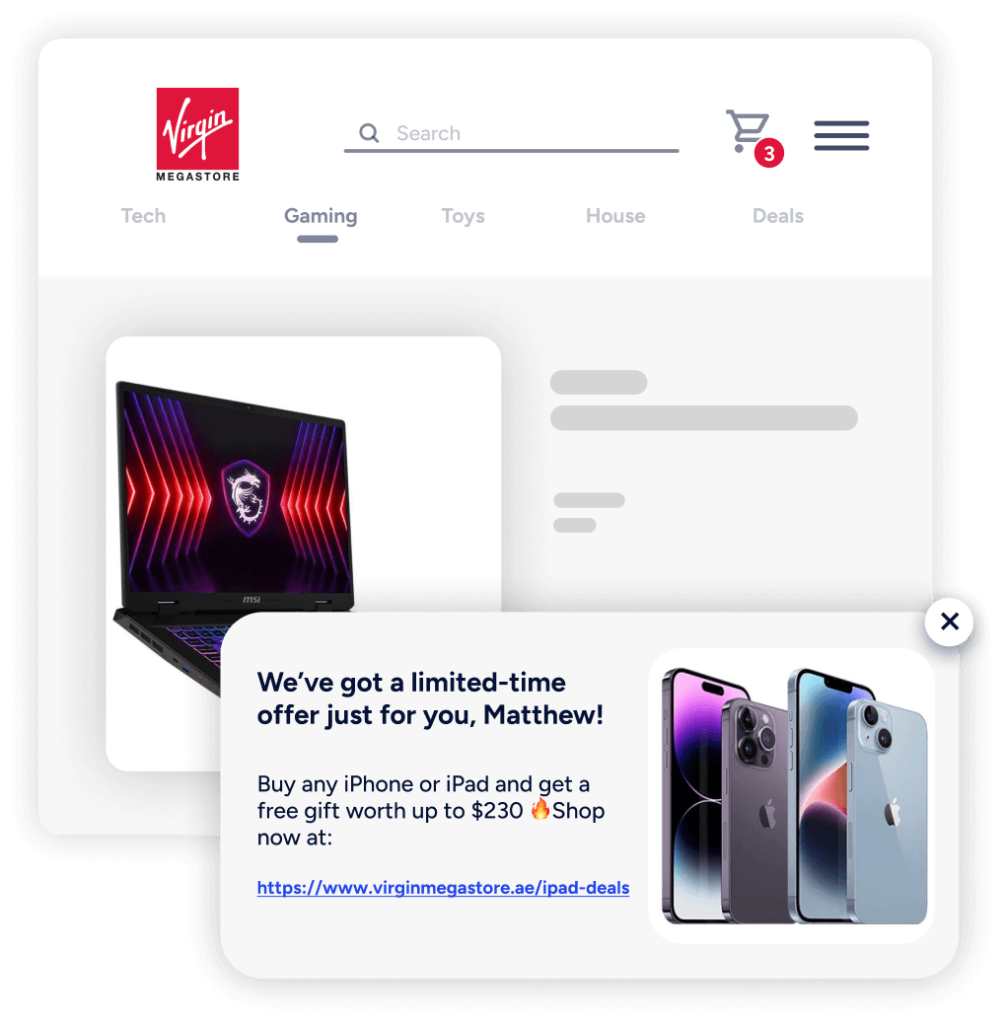
Virgin Megastore achieved a 350% increase in conversion rate using Insider One’s personalization suite, connecting on-site behavior with the offers customers actually saw next. That kind of result depends on the same building blocks covered above: one profile, one inventory view, one consistent journey.
B2B commerce follows a different pattern but the same logic. Where DTC brands connect app browsing to in-store personalization, B2B teams need self-service research, CRM sync, lead or account profiles, and journey triggers that reflect what a buyer already viewed or requested, so sales conversations start with the same context instead of resetting the relationship from zero.
In practice, that can mean syncing CRM fields and engagement history into Insider One, segmenting by product interest or lifecycle stage, and triggering follow-up across owned channels before a rep picks up the conversation.
Our guide on omnichannel retail software and this roundup of omnichannel marketing examples both walk through additional patterns worth adapting to a mixed B2B and DTC catalog.
Metrics and KPIs to measure omnichannel commerce performance
Retention rate, cross-channel conversion, and journey-specific response patterns are useful key performance indicators (KPIs) for evaluating whether an omnichannel program is working as intended.
Retention rate shows whether unified profiles are actually changing repeat purchase behavior; cross-channel conversion shows whether a customer who engages on two or more channels behaves differently than one who only engages on one; and journey-level response shows which specific flows, like win-back or click-and-collect, are sustaining continuity across touchpoints.
The simplest framework is to tie each metric back to the specific building block that should move it. If a brand invests in centralized inventory, the KPI to watch is cross-channel conversion on endless-aisle journeys specifically, not blended revenue.
If a brand invests in cross-channel orchestration, the KPI is retention rate among customers who received a connected journey versus a static campaign, with brand-specific results kept in case studies and success-story pages rather than treated as default planning assumptions.
Slazenger gained 49x return on investment (ROI) with Insider One’s omnichannel marketing solution, but case-study figures like this should be treated as brand-specific proof points rather than default planning assumptions for every omnichannel program.
- Retention rate: measures whether unified data is changing repeat purchase behavior over time
- Cross-channel conversion: shows the lift from customers engaging across two or more connected touchpoints
- AOV by journey type: isolates which specific flows, like win-back or endless-aisle, drive larger baskets
- CLV trend: tracks whether retention gains are compounding across cohorts, not just within a single quarter
Conclusion
Omnichannel commerce works when every channel shares one customer profile, one inventory view, and one consistent journey, and Insider One stands out by combining unified profiles, Architect orchestration, AI-powered recommendations, native integrations, and activation across owned and paid channels in one platform instead of forcing teams to stitch those layers together manually.
That matters in competitive evaluations because Insider One keeps the data, decisioning, personalization, and journey layers together while still connecting to the systems that handle commerce operations, CRM, and paid media delivery.
Brands that measure retention and journey performance against specific investments build a clearer case for expansion because the mechanism behind each result is visible alongside the customer outcome, from data ingestion and journey logic to recommendations, audience sync, and governed activation.
To evaluate the fit of journey orchestration and customer data management for your use case, book a personalized demo to review your goals, data requirements, and implementation constraints with the Insider One team.
FAQs
Multichannel means a brand operates on several channels independently, often with separate messaging and inventory views. Omnichannel means those channels share one customer profile, one inventory system, and consistent pricing, so a customer’s experience stays continuous no matter which touchpoint they use next.
The core benefits are more consistent customer experiences, stronger retention, and better-timed follow-up because unified data lets brands act on real customer signals instead of generic scheduling. Those improvements matter because teams can coordinate messaging, recommendations, and suppression across touchpoints rather than treating each channel as a separate campaign.
In practice, the goal is to connect customer profiles, inventory, pricing, product catalog data, and messaging across every channel into one operating model rather than leaving each channel to manage its own data and rules. Insider One approaches that need as an AI-powered Growth Management Platform fed by web and app behavior, CRM and ecommerce data, APIs, SDKs, and native integrations so journeys, recommendations, and activation can react to the same customer context.
Tie each investment to a specific KPI: track retention rate for unified profile work, cross-channel conversion for inventory and pricing consistency, and AOV by journey type for orchestration, personalization, and activation efforts. Measuring blended totals hides which specific initiative actually moved the number.
The building blocks are the same, but the journeys differ. B2B commerce typically needs self-service research to hand off cleanly to a sales conversation, while DTC commerce focuses more on app-to-store personalization and win-back journeys, both built on the same unified data foundation.

Keep Reading
7 min.

Muharrem Derinkok
4 Jun 2026
11 min.

Chris Baldwin
2 Jun 2026
4 min.
Chris Baldwin
3 Feb 2026