

 Platform Overview

 Integration Hub

 Agent One™

 Agent One Teams™

 Customer Data Management

 Personalization

 Journey Orchestration

 Reporting & Data

 Behavioral Analytics

 Web
Web

 Email
Email

 Site Search

 Conversational CX

 WhatsApp

 Web Push

 InStory

 App
App

 SMS & RCS

 Join the $0 Migration Movement™

 The Insider One Difference

 Compare Vendors

 Switch to Insider One

 Success Story

 Retail & Ecommerce

 Financial Services

 Travel & Hospitality

 Beauty & Cosmetics

 Automotive

 Telecommunications

 Total Economic Impact™ Study

 Blog
Blog

 E-Books & Guides

 Events

 Glossary
Insider One vs. Salesforce Marketing Cloud: Which Is Better for Agile Marketing Teams?

Updated on 26 Jun 2026
6 min.
Table of Contents
Most Popular
Salesforce Marketing Cloud is often considered by enterprise teams, but agile marketers should judge it against a simpler question: which platform helps them launch, learn, and improve without long operational delays?
Salesforce Marketing Cloud can support complex programs, but agile execution depends on how quickly marketers can turn data and ideas into live journeys.
Based on the documented product evidence in this comparison, Insider One makes the stronger case when the priority is faster activation, marketer-accessible execution, and supported cross-channel activation.
Here is how the two platforms stack up on what actually matters:
Focus: Use documented product capabilities and real workflow tests instead of unsupported proof points.
Proof: Compare activation, AI usability, cross-channel execution, and Salesforce integration in live evaluation scenarios.
Demo: Ask each vendor to show how quickly your team can launch a real journey in your own operating context.
How long before you actually go live?
With Salesforce Marketing Cloud, launch speed depends heavily on how your team configures data, channels, and journey orchestration. Teams evaluating it should ask how much setup, integration work, and specialist support are required before their first cross-channel campaign goes live.
With Insider One, the pitch is faster activation for common campaign workflows, built on an integrated Customer Data Platform (CDP) that unifies customer profiles in real time and feeds them directly into journey orchestration.
Insider One also supports templates, marketer-friendly workflow guidance, segmentation and personalization workflows, and native execution across 12+ channels that reduce dependency on engineering for day-to-day launches.
The fastest-growing teams do not wait for perfect setups, teams are typically up and running in weeks.
They ship, learn, and iterate. Your platform should support that, not slow it down.
Is the AI actually usable, or is it an upsell?
When buyers compare AI, the practical question is not whether capabilities exist, but how easily marketers can access them inside real campaign workflows.
Insider One’s AI story is broader, more specific, and increasingly autonomous: Insider One AI™ spans Agentic AI, Generative AI, and Predictive AI, and now includes Agent One™, a suite of autonomous agents (Insights Agent, Shopping Agent, and Support Agent) alongside Smart Journey Creator, AI text generation across channels, predictive and conversational AI, NLP, and recommendation capabilities that support end-to-end customer experience automation.
The difference is agentic execution: rather than only advising marketers, Agent One™ can autonomously select channels, optimize send timing, and act on real-time signals. In practice, that gives buyers concrete workflows to test, such as agentic journey creation, autonomous channel and send-time optimization, and channel-copy generation inside the campaign execution process.
“What impressed us most is Insider One’s AI-powered segmentation. The platform learns from customer behaviour and identifies what each person wants, without us defining every rule manually.”
Insider One customer, retail sector
Supported product evidence points to practical AI workflows such as autonomous optimization with Agent One™, Smart Journey Creator, AI text generation across channels, recommendations, predictive AI, and conversational AI rather than unsourced customer claims.
Where competing suites often position AI capabilities that require heavy data-platform investment and specialist setup before activation, Insider One AI™ is embedded directly inside the journey builder marketers use every day.
That keeps the AI comparison focused on workflows buyers can verify during a live evaluation.
Do your channels actually talk to each other?
Cross-channel execution should also be tested at workflow level: how data moves, how quickly journeys can be updated, and whether marketers can add channels without rebuilding the operating model.
Insider One positions this around native execution across 12+ channels, Email, App Push, Web Push, web and app personalization, SMS, WhatsApp Conversational CX, and AI-powered Site Search, all activated from a single unified platform rather than a fragmented set of studios and add-ons.
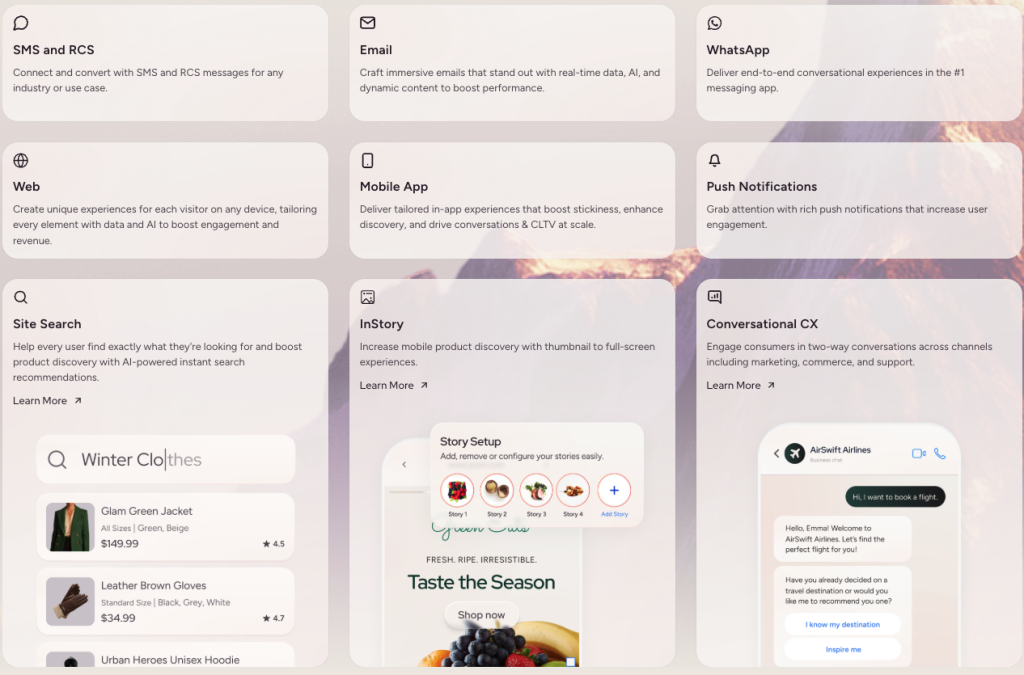
Salesforce data sync and Insider channels in Salesforce journeys remain available for brands that want a hybrid setup, while a built-in CDP resolves identity at the group level so personalization can begin the moment a profile is known.
Because identity resolves in real time rather than through batch processing, marketers can also activate anonymous visitors with web push and personalization before they ever log in, then seamlessly stitch that behavior to a known profile the moment they identify.
So how do they actually compare?
| CRITERIA | INSIDER ONE | SALESFORCE MARKETING CLOUD |
|---|---|---|
| Time to first campaign | Positioned for faster activation through templates, workflow guidance, and native journey executionTypically weeks | Launch speed depends on how the team configures data, channels, and journey orchestration. Typically 3 to 6 month |
| AI capabilities | Insider One AI™ and Agent One™ deliver autonomous, agentic execution — Insights, Shopping, and Support Agents plus Smart Journey Creator, AI text generation, predictive, conversational AI, NLP, and recommendations All native with no extra setup | Buyers should verify which AI capabilities are available in current workflows, how they are configured and what is included in their licence. |
| Cross-channel execution | Native activation across 12+ channels including WhatsApp Conversational CX and AI-powered Site Search, plus Salesforce data sync and Insider channels in Salesforce journeys | Buyers should test how data, journeys, and channels work together in their actual operating model |
| Marketer independence | Designed to reduce dependency on engineering for common journey and campaign workflows | Teams should test how much specialist support is needed for the workflows they want to run |
| Customer data for activation | Built-in CDP with real-time, group-level identity resolution that unifies profiles and feeds segmentation, personalization, and journey activation | Buyers should confirm how customer data, activation, and governance are handled in their setup as Salesforce Data Cloud is a separate product with additional cost |
| Total cost of ownership | Compare implementation effort, workflow complexity, and operating overhead in the demo process | Compare required setup, support model, and ongoing operations directly |
When does SFMC actually make sense?
If your organisation is already deep in Salesforce, Salesforce Marketing Cloud may fit best when your team wants to extend that environment and has the operational resources to support it. Insider’s advantage is that it can also work alongside Salesforce by syncing Salesforce data into Insider or using Insider channels inside Salesforce journeys.
For agile teams in retail, ecommerce, and travel, the stronger comparison is how quickly each platform supports real use cases such as predictive-led abandoned-browse recovery delivered through conversational WhatsApp and optimized autonomously by Agentic AI, reservation reminders, lead activation from Salesforce data, and coordinated web, app, push, SMS, WhatsApp, and email journeys.
Insider One’s case is strongest when those use cases depend on marketer-friendly workflows, real-time identity resolution, supported Salesforce data activation, and native Insider execution channels.
What should you actually ask in the demo?
Do not let either vendor walk you through features in isolation. Ask them:
How long from contract to first live campaign? Ask for the timeline for data setup, journey configuration, approvals, and first launch, not just the best-case demo.
Which AI features are available in the product today, and which ones require extra setup or a separate purchase? That answer matters more than a generic AI slide.
Can a marketer build and launch a cross-channel journey using the channels your team actually needs, with governance in place?
Ask them to show the workflow end to end, including data ingestion, audience creation, journey setup, and channel activation.
Our take
Speed is a growth strategy. Your platform should act like it.
Speed only matters if the platform makes activation, personalization, and iteration easier for marketers. On the evidence used in this comparison, Insider One makes the clearer case for agile execution because it combines marketer-accessible workflows, an integrated CDP, Insider One AI™ with autonomous Agent One™ capabilities, and flexible Salesforce integration paths for common campaign workflows.
Recognized as a #1-ranked leader on G2 for Personalization and Mobile Marketing, Insider One pairs that agility with independent third-party validation.
If you are comparing the two, evaluate live use cases rather than feature lists: build a journey, activate Salesforce data, test AI-assisted creation, and see how much work it takes to launch.
Frequently asked questions
Insider One is positioned for faster activation of common workflows through templates and marketer-friendly journey building, while Salesforce Marketing Cloud launch speed depends on how data, channels, and journey orchestration are configured. Ask each vendor for a contract-to-first-live-campaign timeline rather than a best-case demo.
Insider One AI™ spans Agentic, Generative, and Predictive AI. Agent One™ adds autonomous agents, Insights, Shopping, and Support Agents, that act on real-time signals and optimize execution, rather than only assisting marketers.
Insider One activates 12+ native channels from a single platform, including Email, App Push, Web Push, SMS, WhatsApp Conversational CX, web and app personalization, and AI-powered Site Search.
Yes. Insider One can sync Salesforce data into Insider or use Insider channels inside Salesforce journeys, so teams can run a hybrid setup without rebuilding their operating model.
A built-in Customer Data Platform unifies customer profiles with real-time, group-level identity resolution and feeds them directly into journey orchestration, so personalization can begin the moment a profile is known.

Keep Reading
7 min.

Muharrem Derinkok
4 Jun 2026
11 min.

Chris Baldwin
2 Jun 2026
4 min.
Chris Baldwin
3 Feb 2026