

 Platform Overview

 Integration Hub

 Agent One™

 Agent One Teams™

 Customer Data Management

 Personalization

 Journey Orchestration

 Reporting & Data

 Behavioral Analytics

 Web
Web

 Email
Email

 Site Search

 Conversational CX

 WhatsApp

 Web Push

 InStory

 App
App

 SMS & RCS

 Join the $0 Migration Movement™

 The Insider One Difference

 Compare Vendors

 Switch to Insider One

 Success Story

 Retail & Ecommerce

 Financial Services

 Travel & Hospitality

 Beauty & Cosmetics

 Automotive

 Telecommunications

 Total Economic Impact™ Study

 Blog
Blog

 E-Books & Guides

 Events

 Glossary
Hyper-Personalized Email: Boost Engagement with Data

Updated on 24 Sep 2026
12 min.
Table of Contents
- Summary
- Hyper-personalization vs. personalization: why the difference matters for revenue
- The four data layers that power hyper-personalized emails
- Core tactics: building emails that adapt to each recipient
- How to implement hyper-personalization without a full engineering team
- Measuring what counts: KPIs beyond open rate
- FAQs
Most Popular
Summary
Hyper-personalization uses real-time behavioral, transactional, and AI-driven data to tailor messages beyond basic segmentation. It outperforms rule-based approaches by focusing on individual intent signals, especially when layered into use cases like cart recovery. Success is measured by revenue and CLV, not open rates. It relies on unified data, dynamic product feeds, and works across channels with intelligent orchestration.
There’s a gap between what email marketers call “personalization” and what actually changes revenue behavior. A campaign that inserts a first name, pulls in the customer’s last purchase category, and fires at a static Tuesday-morning send time is not personalized in any meaningful sense. It’s automated, but it isn’t individual. The subscriber on the other end of that email encounters a message built for a segment they happen to belong to, not a message built for them.
The teams hitting a ceiling on their current segmentation programs are usually doing the fundamentals well. They have welcome flows, post-purchase sequences, and some form of cart abandonment in place. What they’re missing isn’t more campaigns. It’s a different architecture, one where the message itself is assembled from the customer’s live data rather than mapped to a rule someone wrote three quarters ago. That shift, from rule-based to signal-driven, is what separates shallow personalized marketing from hyper-personalization.
| Personalization level | Approach | Insider One capability |
| Level 1 – Static merge | Name + last category | Demographic data layer |
| Level 2 – Rule-based segments | VIP tiers, geo cohorts | Behavioral + transactional data |
| Level 3 – Behavioral triggers | Browse/cart sequences | Real-time Unified Customer Profiles |
| Level 4 – Hyper-personalization | Predictive AI scoring + NBC | Agent One / Agentic AI + Smart Recommender |
Hyper-personalization vs. personalization: why the difference matters for revenue
Defining the spectrum
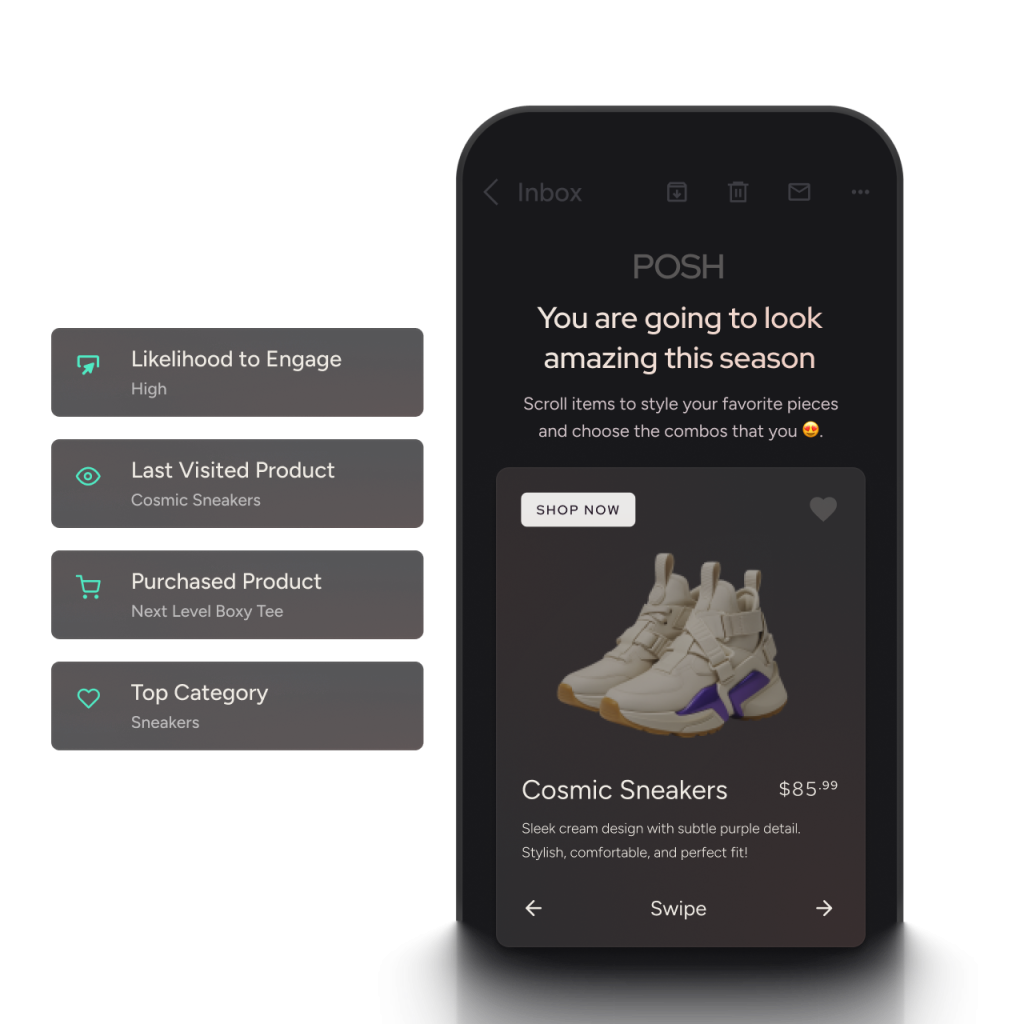
Think of email personalization as a spectrum with four levels. At the first level, you have static name-merge and product-category logic, “Hi [First Name], here are items from [Last Category Browsed].”
At the second level, you have rule-based segmentation: VIP tiers, geographic cohorts, purchase-frequency buckets. These approaches are useful and better than nothing, but they’re backward-looking. They describe who a customer was, not what they want right now.
The third level introduces behavioral triggers: browse sequences, real-time cart additions, page-visit frequency. A customer who viewed the same product page four times in two days is signaling intent that a weekly newsletter batch has no way of capturing.
The fourth level, true hyper-personalization, adds predictive scoring: likelihood-to-purchase models, next-best-offer logic, and churn propensity signals that shape not just what’s in the email but when it arrives and what content block leads it.
Where rule-based segmentation breaks
The ceiling most email programs hit is structural. Segments are static by design; a customer placed in a “high-value” cohort last month stays there until a human updates the rule.
Meanwhile, that customer has browsed new categories, responded to a sale promotion, and abandoned a cart at a different price point.
None of that live signal reaches the message unless the architecture is built to receive it. Behavioral and predictive data don’t just improve existing segments; they replace the need for rigid ones.
The four data layers that power hyper-personalized emails
Demographic and declared data
Demographic data, location, lifecycle stage, acquisition channel, gives you context. It tells you roughly who you’re talking to and provides baseline personalization: relevant currency, language, and seasonal context. This layer is necessary but never sufficient on its own.
Behavioral data
Behavioral data is where the signal gets specific. Page views, search queries, time spent on product detail pages, category affinity, and device switching, these are all indicators of real-time intent. A unified customer profile that pulls web activity continuously means an email sent four hours after a browse session can reference exactly what the customer was looking at, not a generalized product category. Personalization at this level starts to feel like the brand is paying attention. Unlike legacy ESPs that rely on batch data syncs updated once every 24 hours, Insider One’s Unified Customer Profiles aggregate these signals in real time across web, app, and email, so the message sent at 2 p.m. reflects what the customer did at 1:45 p.m., not what they did last Tuesday.
Transactional data
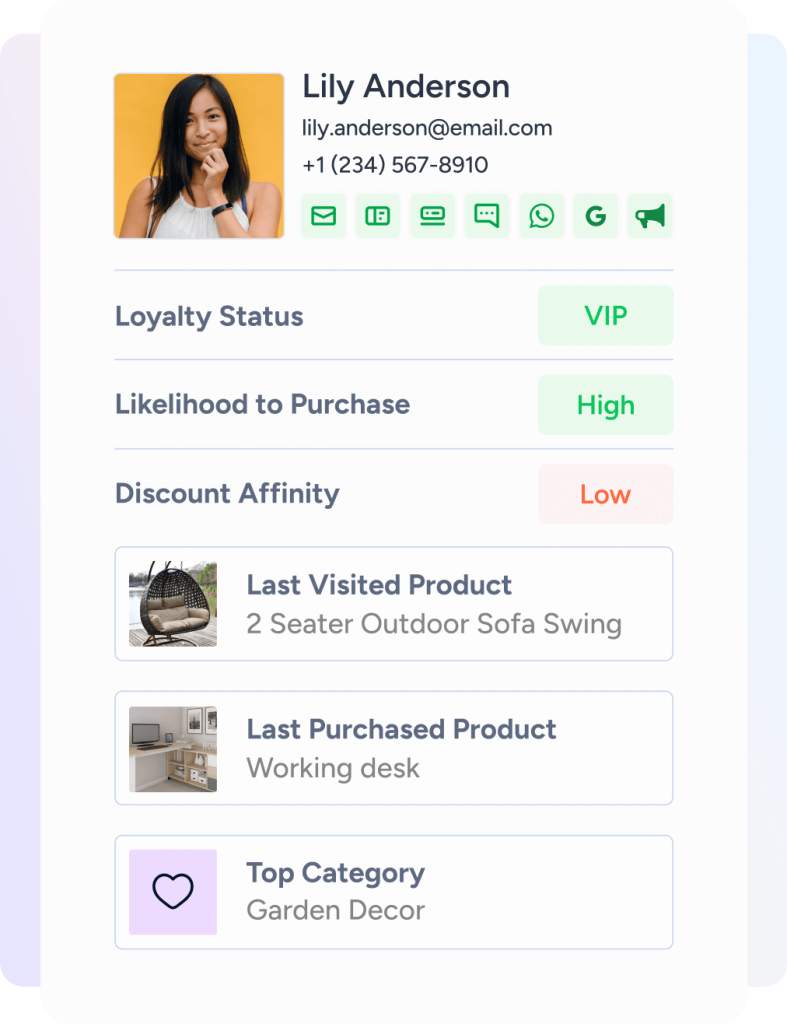
Purchase history, order frequency, average order value, return behavior, and recency all belong to the transactional layer. This data fuels replenishment reminders, upgrade prompts, and cross-sell logic. When combined with behavioral signals, transactional data answers a more precise question: given what this customer has bought and what they’re browsing right now, what’s the most relevant next offer?
Predictive and AI-scored signals
The fourth layer is where Customer Data Management technology earns its value. Predictive models calculate each customer’s likelihood to purchase, likelihood to churn, and optimal send time, not as a segment-level estimate but as an individual score that updates continuously. Agent One, Insider One’s Agentic AI layer, goes beyond static scoring by autonomously adjusting audience segments and journey branches in real time as customer signals evolve — eliminating the manual loop of segment refresh that slows legacy personalisation programs.
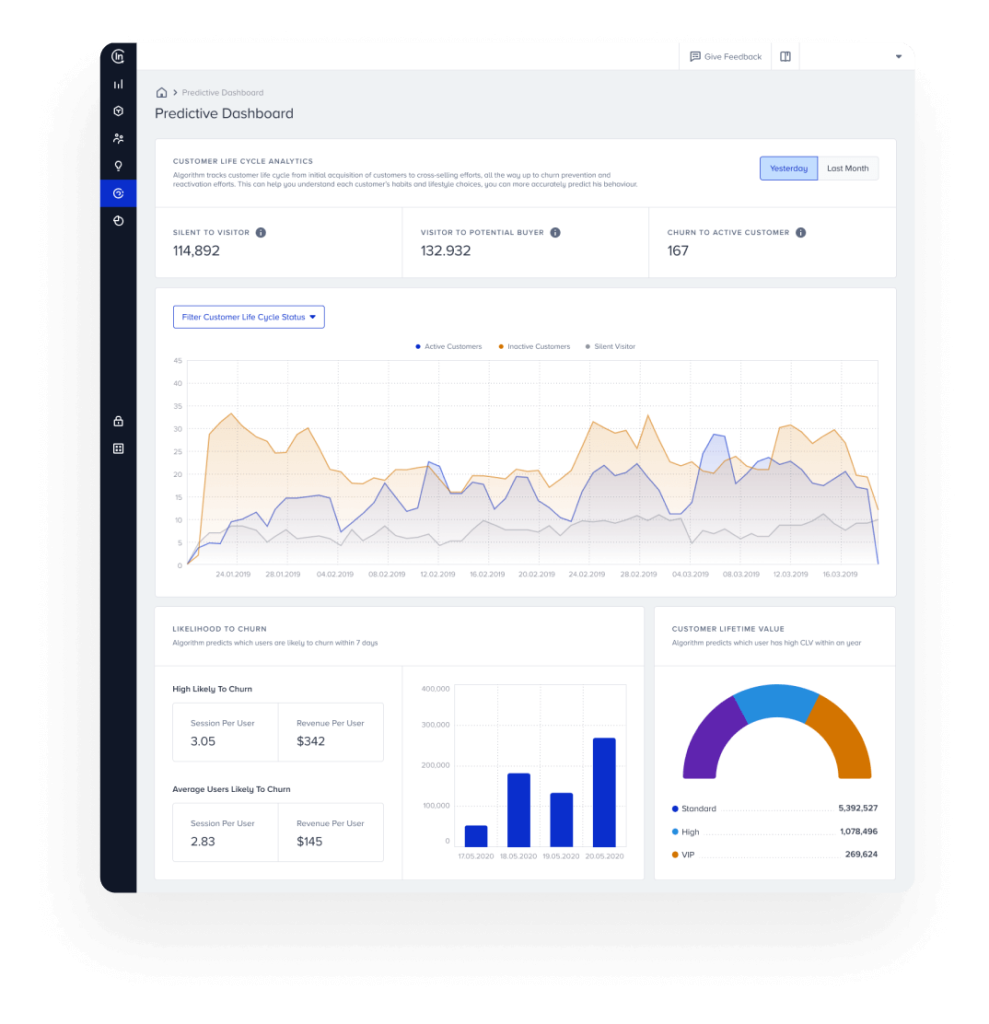
Insider One’s Smart Recommender, for example, builds attribute affinity profiles at the individual level, tracking signals like brand preference, color affinity, and price sensitivity and updating those profiles daily. That means a product recommendation block in an email can reflect behavioral shifts from earlier the same day, not from a model trained on last month’s data.
Core tactics: building emails that adapt to each recipient
Real-time product recommendations
Static “you might also like” blocks based on a single last-purchased item are the most common missed opportunity in email. The more effective approach is a recommendation block that pulls from a combination of browse affinity, purchase history, and trending products within the customer’s preferred categories. When that block is calculated at send time rather than at campaign build time, it reflects current inventory and current behavior, two factors that directly affect conversion.
Send-time optimization
When an email arrives matters almost as much as what it says. Send-time optimization at the segment level (sending to your “evening openers” cohort at 7 p.m.) is a real improvement over single-batch scheduling, but predictive optimization goes further by calculating the individual’s historical engagement pattern and projecting the window with the highest open probability. Insider One extends this further with Next Best Channel (NBC) decisioning: instead of assuming email is always the right medium, NBC evaluates each customer’s real-time engagement patterns to route the message to Web push, WhatsApp, or App notification when those channels are more likely to convert — ensuring you optimise not just when you send, but where.
For high-frequency senders, this alone produces measurable lift without changing a single content element.
Abandoned cart emails: the baseline case, made sharper
Abandoned cart emails are where most brands first experience the value of trigger-based communication. A well-executed abandoned cart sequence recovers revenue that would otherwise be lost without any incremental offer. The foundational version works: a reminder, the items left behind, a clear call to action. The more sophisticated version layers in purchase-intent score.
A customer with a high likelihood-to-purchase score doesn’t need a discount, they need a frictionless return path and, if anything, a social proof element. A customer with a lower intent score may respond better to an incentive. Running those as separate experiences rather than a single campaign produces materially different economics.
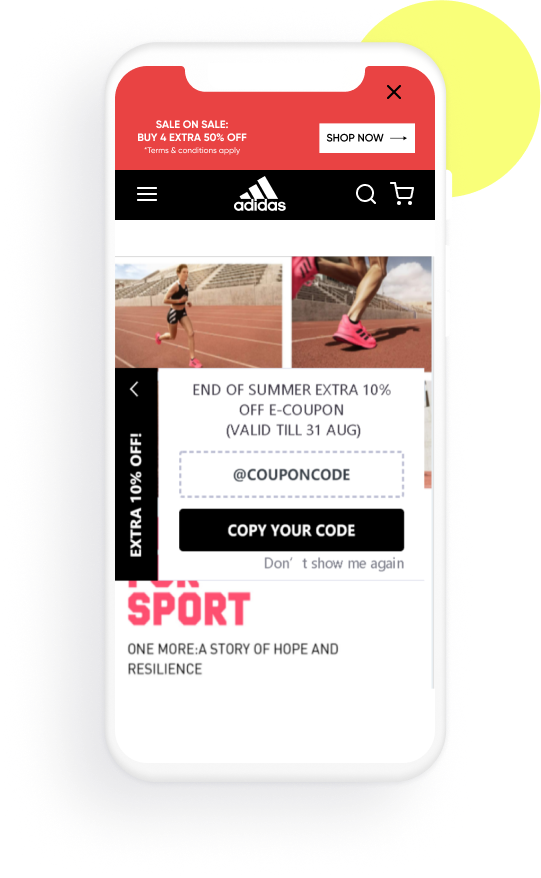
Adidas achieved a 259% increase in average order value and a 13% conversion rate lift in a single month Adidas achieved significant lifts in average order value and conversion rate in a single month by applying Insider One’s personalisation suite to onsite and triggered messaging. See how at useinsider.com/success-stories.
Lifecycle-stage content blocks
Not every subscriber is at the same point in their relationship with your brand. A content block that works for a customer in their second month of engagement is almost certainly wrong for a lapsed buyer returning after 14 months of silence. Modular email design, where specific content blocks swap in or out based on lifecycle stage, allows a single campaign to serve multiple relationship contexts without a separate campaign build for each.
Industry-specific use cases: travel, finance, and beyond e-commerce
In travel, a customer who searched for flights to Barcelona three times in a week receives a price drop alert the moment fare inventory changes, a booking reminder triggered by a real-time inventory signal rather than a static schedule.
In financial services, a next-best-product recommendation block in a monthly statement email draws on Unified Customer Profiles to suggest the savings account or credit product most consistent with that customer’s recent activity.
In fashion retail and e-commerce, browse-affinity scoring surfaces products the customer is most likely to convert on, not the highest-margin item in the category.
Insider One’s Predictive Segments and Agentic AI decisioning apply to all these verticals without vertical-specific engineering, running from a single orchestration canvas.
Reducing friction with AMP for Email
AMP for Email removes the friction between receiving a message and completing an action. Instead of clicking through to a product page, customers can browse a product carousel, update preferences, or complete a lightweight checkout step directly within the email client. For high-intent triggers, abandoned cart reminders, flash sale alerts, this zero-redirect path can produce measurable conversion lift without changing the underlying offer. Insider One supports AMP for Email natively within its email build workflow, meaning marketers can create interactive email experiences without custom development.
How to implement hyper-personalization without a full engineering team
Phase one: activate the behavioral data you already have
The most common implementation mistake is treating hyper-personalization as a greenfield project requiring new data infrastructure before anything can start.
In practice, most mid-market brands already have the behavioral data they need, it’s just not connected to their email build process. Insider One’s no-code integration layer connects web session data to the email build process without custom engineering, a critical factor for marketing teams that need to move quickly without depending on a development sprint.
The first phase is activating that data: ensuring web browse events, session data, and cart actions are flowing into a unified profile and available to the email platform at send time. Insider One’s Feedless Product Integration auto-crawls your product catalogue to keep recommendations and content blocks accurate, no engineering ticket required when prices or inventory change.
Phase two: introduce predictive scoring incrementally
Once behavioral data is connected, predictive models can be layered in without disrupting existing campaigns. Likelihood-to-purchase scoring can be applied to a single high-volume trigger first, abandoned cart is the natural candidate, and the performance difference between the scored and unscored versions establishes the internal business case for broader rollout.
Cross-device Identity Resolution: how hyper-personalisation follows the customer
Insider One’s Identity Resolution engine identifies users across devices, matching a mobile web session to a known email address to a desktop app login, so hyper-personalisation follows the customer rather than the device. Without cross-device identity, a customer who browses on mobile in the morning and opens an email on desktop in the afternoon looks like two different people to most systems. Identity Resolution eliminates that gap, ensuring the predictive scores and behavioral signals built on mobile are available in the email send decision made hours later.
This incremental approach means marketers can build evidence and organizational buy-in without waiting for a platform overhaul to complete.
Phase three: address the content bottleneck
Scale is where many hyper-personalization programs stall. Building 40 versions of an email is theoretically possible but operationally impractical without tooling to support it.
AI-assisted copy generation handles subject line variants, product description pulls, and call-to-action wording in volume, not by replacing the marketer’s judgment but by reducing the production time per variant from hours to minutes. Insider One’s Template Store provides 100+ pre-built onsite and email templates that marketers can deploy and customise without design or development resource, compressing the gap between strategy and live campaign.
Insider One’s Sirius AI™ supports this kind of at-scale content production within the email workflow, keeping the creative lead in the marketer’s hands while removing the manual production bottleneck.
MadeiraMadeira achieved 52X ROI using Architect achieved exceptional ROI using Architect to orchestrate personalised customer journeys, an outcome enabled in part by the team’s ability to operate complex, multi-branch experiences without constant engineering involvement. Full case study at useinsider.com/success-stories.
The Journey Orchestration layer matters here, too. Without cross-channel coordination, even a well-built email program ends up firing messages that conflict with what the customer has already experienced on web or mobile. Connecting those surfaces through a single orchestration canvas removes that coordination problem. Insider One’s Architect canvas orchestrates email alongside Web, App, WhatsApp, and SMS touchpoints, so a customer who opens an email but doesn’t convert can receive a contextual Web push 30 minutes later rather than a duplicate email the following morning.
Measuring what counts: KPIs beyond open rate
The metrics that reflect real personalization depth
Open rate measures deliverability and subject line appeal. It says almost nothing about whether your personalization architecture is working.
The metrics that reflect true hyper-personalization impact are further down the funnel: conversion rate by segment depth (do customers in deeply personalized segments convert at a higher rate than broadly segmented ones?), incremental revenue per email, and repeat purchase rate within a defined window after email engagement.
A simple internal reporting framework
To make the business case to stakeholders, the most defensible framework compares performance between a control group receiving standard segmented campaigns and a treatment group receiving hyper-personalized sequences.
| KPI | What it measures | Why it matters for hyper-personalization |
| Incremental revenue per email | Revenue uplift vs. control group | Isolates personalisation contribution from volume or timing effects |
| Conversion rate by segment depth | Conversion delta: deep vs. broad segments | Confirms that individual-level targeting outperforms cohort-level |
| CLV trend for personalised cohorts | Customer lifetime value over 90 days | Shows whether personalisation builds loyalty, not just one-time lift |
| Content-to-conversion efficiency | Revenue per content variant deployed | Measures ROI of personalisation production investment |
Measuring the lift in conversion rate, average order value, and customer lifetime value (CLV) between those two groups isolates the contribution of personalization depth rather than attributing it to overall volume or channel mix.
Martes Sport achieved 30X ROI with web personalization achieved significant ROI with web personalisation by applying this kind of outcome measurement, tracking the specific contribution of personalised experiences against a defined baseline, rather than rolling results into a broader channel total. See the full story at useinsider.com/success-stories.

What stakeholder reporting should show
A simple stakeholder dashboard for a hyper-personalization program should surface three numbers above the fold: incremental revenue attributed to personalized triggers, CLV trend for customers engaged via personalized sequences versus non-personalized ones, and the content-to-conversion efficiency ratio (how many content variants are producing statistically meaningful lift). These three numbers tell a cleaner story than a page of engagement metrics, and they anchor the conversation on outcomes rather than activity.
Hyper-personalization doesn’t require starting over, it requires connecting the signals you likely already have to a build process that can act on them. See how Insider One’s email marketing platform, Smart Recommender, and Sirius AI™ work together to turn behavioral data into individualized campaigns at scale. Book a personalized demo to walk through your specific use case.
FAQs
Personalization typically refers to segment-based logic: tailoring messages to groups defined by shared attributes. Hyper-personalization operates at the individual level, using real-time behavioral signals, transactional history, and predictive AI scoring to assemble a message that reflects a specific person’s current intent, not just the cohort they belong to.
A CDP significantly simplifies hyper-personalization by unifying behavioral, transactional, and demographic data into a single customer profile accessible in real time. Without that unified profile, the data layers that drive individual-level decisions often remain siloed across systems. A CDP isn’t the only path, but it removes the most common data integration blockers that prevent behavioral signals from reaching the email build process at send time.
Abandoned cart emails are one of the strongest entry points for hyper-personalization because the behavioral signal is clear and the revenue recovery window is tight. A basic abandoned cart trigger recovers some of that revenue. Adding purchase-intent scoring to the sequence, and varying the content or incentive structure based on each customer’s score, produces measurably better outcomes without requiring a fundamentally different campaign architecture.
Open rate and click-through rate alone don’t reflect personalization depth. The metrics that matter are incremental revenue per email, conversion rate lift by segment depth, and customer lifetime value movement for customers who receive personalized sequences. Running a clean control group against a treatment group producing hyper-personalized experiences gives the most defensible read on true contribution.
Hyper-personalization extends naturally to every channel in the customer’s journey. Insider One’s Next Best Channel (NBC) decisioning evaluates each customer’s real-time engagement patterns to determine whether the next message should arrive by email, Web push, WhatsApp, or App notification. AMP for Email adds another dimension by enabling interactive experiences, product carousels, cart actions, preference updates directly within the email client, reducing the click-to-conversion path for high-intent triggers. Together, NBC and AMP ensure personalisation depth translates into channel and format decisions, not just content decisions.

Keep Reading
7 min.

Muharrem Derinkok
4 Jun 2026
11 min.

Chris Baldwin
2 Jun 2026
4 min.
Chris Baldwin
3 Feb 2026