

 Platform Overview

 Integration Hub

 Agent One™

 Agent One Teams™

 Customer Data Management

 Personalization

 Journey Orchestration

 Reporting & Data

 Behavioral Analytics

 Web
Web

 Email
Email

 Site Search

 Conversational CX

 WhatsApp

 Web Push

 InStory

 App
App

 SMS & RCS

 Join the $0 Migration Movement™

 The Insider One Difference

 Compare Vendors

 Switch to Insider One

 Success Story

 Retail & Ecommerce

 Financial Services

 Travel & Hospitality

 Beauty & Cosmetics

 Automotive

 Telecommunications

 Total Economic Impact™ Study

 Blog
Blog

 E-Books & Guides

 Events

 Glossary
First-Party Data: Benefits, Real-World Examples, and How to Put It to Work

Updated on 12 Aug 2026
13 min.
Table of Contents
- Summary
- What first-party data actually is (and what it isn't)
- Five core benefits that move business metrics
- Real-world first-party data examples by channel
- How to collect first-party data without friction
- Turning raw data into revenue: activation and measurement
- How Insider One turns first-party data into revenue
- FAQs
Most Popular

Summary
First-party data is the key foundation for AI-driven marketing because it comes directly from customer behavior and enables better predictions, targeting, and retention. Its value increases as it’s used across channels like email, push, and messaging to turn insights into revenue.
A unified, real-time customer profile is essential, and platforms like Insider One use AI to convert this data into predictive segments and automated campaigns across channels from a single system.
Somewhere between your customer relationship management (CRM) platform, your email service provider, your analytics tool, and your mobile app sits a significant amount of data you already own. The problem is not that the data does not exist.
It lives in separate systems, gets used in isolation, and never quite assembles into the complete picture of a customer that would actually change how you market to them.
That is the real first-party data challenge for mid-market and enterprise brands in 2026. It is not definitional, and it is not purely a compliance question, though both of those matter.
It is an activation question: how do you take the behavioral signals, transactional records, and engagement history you have earned through direct customer relationships and turn them into revenue-generating decisions at channel speed?
This article is built around that question, with concrete examples and a framework you can bring into your next planning conversation.
What first-party data actually is (and what it isn’t)
A clean definition, without the noise
First-party data is any information collected directly by your brand from your customers or prospects, through your own channels, with their awareness.
That includes behavioral data (pages visited, products browsed, content consumed), transactional data (purchase history, order value, frequency), CRM records (name, email, account status), email and app engagement signals (opens, clicks, notification opt-ins), and in-app events (feature usage, session depth, onboarding completion).
Two properties make it structurally distinct from every other data type: ownership and consent. Your brand collected it through a direct relationship, and the customer knowingly provided it or generated it through their activity on your platforms.
No competitor can buy that same dataset, because it reflects the specific relationship between your customer and your brand.
Insider One extends this ownership advantage with cross-device identity resolution: a customer who browses anonymously on mobile, purchases on desktop using a loyalty email, and later opens an SMS link on a different device is recognized as a single unified profile.
Email addresses, phone numbers, anonymous customer IDs, and device fingerprints are stitched together directly in the platform UI, without a custom developer integration, giving marketing teams a complete cross-touchpoint view that competitors like MoEngage and Infobip require engineering support to replicate.
How it compares to second-, third-, and zero-party data
Second-party data is another brand’s first-party data shared through a direct partnership, often a co-marketing arrangement or a data-sharing agreement. It is useful but dependent on an external relationship you do not fully control.
Third-party data comes from aggregators who collect behavioral signals across many sites and sell them at scale. For a decade, it was the backbone of programmatic advertising.
Today, it is unreliable due to browser cookie deprecation, privacy regulations, and signal loss from platform-level tracking changes.
Zero-party data is a distinct category worth understanding clearly. It is data a customer explicitly volunteers, usually through a quiz, preference centre, survey, or direct declaration such as “I prefer email over SMS” or “I am shopping for a gift.” Zero-party data reflects stated intent; first-party data reflects observed behavior.
Both are valuable, and they work best in combination, which is why conflating them reduces your activation precision.
Five core benefits that move business metrics
Lower acquisition costs and better paid performance
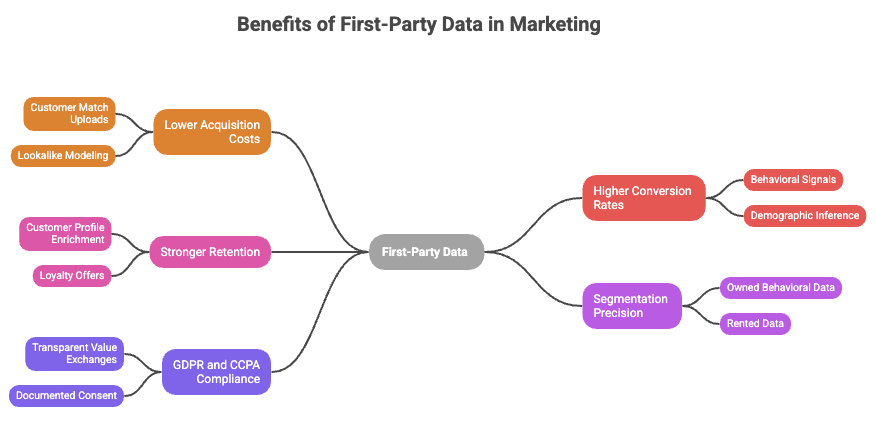
When first-party profiles are rich enough to build high-quality audience segments, those segments can feed paid channels directly through customer match uploads and lookalike modeling.
The result is paid retargeting spend that targets actual customers and suppresses people who have already converted, reducing wasted impressions.
Brands that shift from third-party audience targeting to first-party audience activation consistently see acquisition cost efficiency improve because match quality is higher and suppression is cleaner.
Higher conversion rates from relevant segmentation
Campaigns built on demographic inference underperform not because customers are disengaged, but because the message does not reflect what they actually did or want.
Behavioral signals such as browse history, category affinity, purchase recency, and content consumption allow you to build segments specific enough to send materially different experiences to materially different cohorts.
That precision lifts conversion rates because relevance is doing the work that volume alone used to do.
Stronger retention through continued enrichment
Every interaction enriches the customer profile, and a richer profile enables more relevant engagement, which increases the likelihood of future interactions.
A customer who receives a product recommendation that reflects their actual preferences is more likely to browse again, share a preference, or respond to a loyalty offer.
That cycle of relevance builds retention quietly and consistently, making first-party data a long-term compounding asset rather than a one-time implementation project.
Segmentation precision that improves over time
Third-party data ages quickly. Behavioral signals purchased from an aggregator today reflect activity from days or weeks ago, captured across dozens of unrelated sites.
First-party signals, by contrast, are captured in real time on your own properties and update continuously. Insider One extends this advantage with Insider One AI’s predictive segmentation: rather than describing who your customer was, it calculates who they are likely to become, scoring each profile for Likelihood to Purchase, Likelihood to Churn, and Discount Affinity, so your campaigns target forward-looking intent rather than historical behavior.
Predictive AI: acting on intent before it expires
Insider One AI is Insider One’s AI-native orchestration layer, purpose-built to move beyond descriptive data into predictive action.
Smart Segment lets a marketer query their entire customer base using natural-language inputs, “users most likely to purchase in the next seven days” or “customers at high churn risk this month”, generating dynamic audience cuts from predicted outcomes without SQL or a developer ticket.
Smart Journey uses predictive scoring to automatically route each customer to the highest-revenue journey path. Smart Design generates and tests creative variations from existing brand assets.
Expressions, computed attributes such as loyalty points needed for the next reward tier or days since last purchase, enrich profiles in real time and trigger context-specific messages. This is the marketer autonomy that wins competitive evaluations against Braze and MoEngage, where segmentation still requires Jinja templates or a data analyst.
GDPR and CCPA compliance as a structural advantage
As privacy regulations tighten across Europe, North America, and increasingly Asia-Pacific, brands built on third-party data face growing exposure.
First-party data collected through transparent value exchanges with documented consent is structurally aligned with the requirements of both the General Data Protection Regulation (GDPR) and the California Consumer Privacy Act (CCPA).
Building your marketing stack around first-party collection means your compliance posture improves as a byproduct of better marketing, not as a separate legal initiative.
Insider One’s Onboarding Center structures consent collection and data governance from day one, while the Test Lab lets you validate personalization logic against real customer segments before going live, accelerating time-to-value for Strategic Buyers (CMOs and CFOs) while reducing compliance exposure.
Real-world first-party data examples by channel
Browse abandonment to push notification
A customer spends four minutes browsing running shoes, views three product detail pages, and leaves without adding anything to their cart.
That behavioral sequence, captured through on-site event tracking, can trigger a personalized web push notification within a defined window, surfacing the exact category they browsed alongside a social proof element such as recent reviews or a stock-level prompt.
This activation requires no third-party signal and no cookie; it runs entirely on behavioral data collected directly through your own channel.
Purchase history to recommendation email
A customer who bought a moisturizer six weeks ago is approaching the typical replenishment window for that product category.
Their purchase record, combined with browse behavior from subsequent visits, can power a product recommendation email that surfaces the replenishment item alongside complementary products from categories they have already explored.
That email converts at a higher rate than a promotional blast because it reflects demonstrated behavior rather than demographic inference.
Unified profile feeding multiple channels simultaneously
A single customer profile can simultaneously serve an InStory content carousel on the homepage for a returning visitor, converting web traffic before an app download is even required, update an on-site overlay with a personalized offer, inform a customer match audience upload for paid social, trigger an SMS sequence after a purchase, and suppress that same customer from a paid retargeting campaign because they have already converted.
All of that runs from one profile, updated in real time via Insider One’s onsite personalization engine, without manual coordination between channel teams.
This is the cross-channel activation use case that separates brands with genuinely unified first-party infrastructure from those working with siloed channel tools.
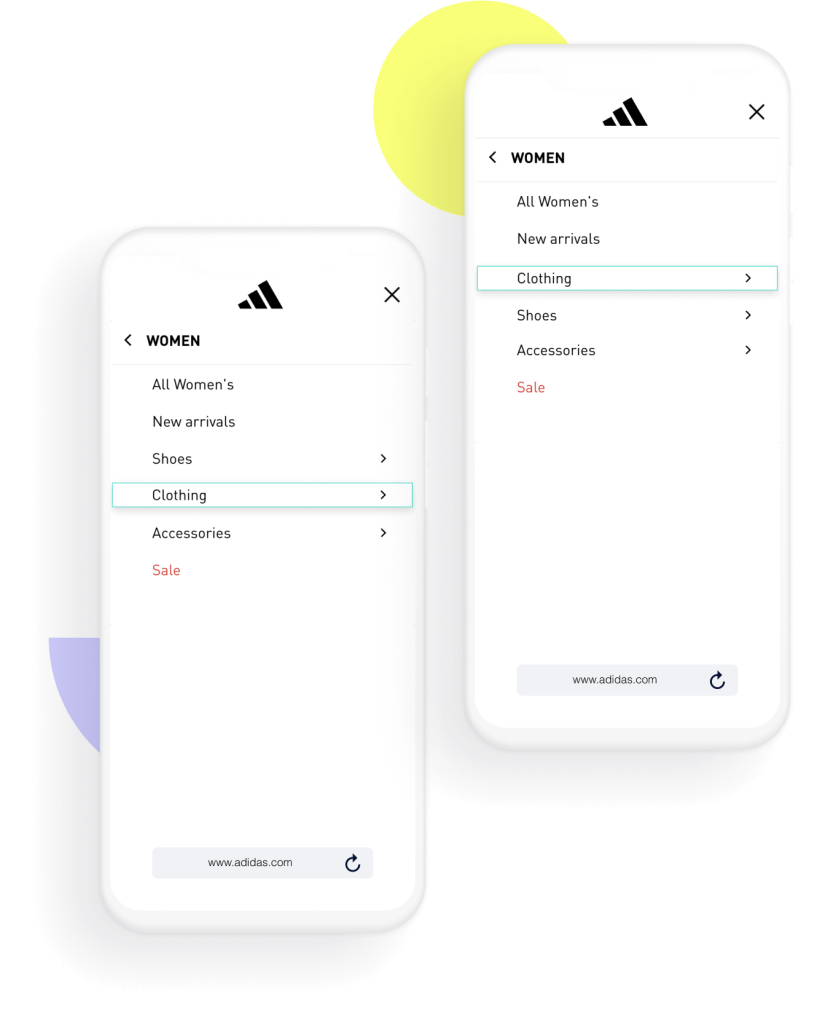
Adidas demonstrated what this kind of cross-channel activation can produce, achieving a 259% increase in average order value (AOV) and a 13% lift in conversion rate within a single month by building personalized journeys from unified customer data. The improvement came from relevance at scale, not from increasing spend.
Predictive segmentation to prevent churn and capture high-intent buyers
A travel brand identifies customers with an Insider One AI Likelihood to Purchase score above 70%, flagged from flight search frequency, destination page revisits, and price-comparison behavior, and triggers a cross-channel sequence: a WhatsApp message with a time-sensitive price lock, a personalized web overlay on their next site visit, and a suppression flag that pauses generic promotional emails until the sequence concludes.
In retail, the same predictive logic flags customers approaching churn, declining purchase frequency, reduced engagement scores, increased price-sensitivity signals, and fires a loyalty incentive journey before they unsubscribe.
In financial services, Discount Affinity scoring identifies customers unlikely to respond to full-price offers and routes them to an exclusive member-rate campaign instead of a blanket discount.
None of these activation flows requires a developer ticket; all three run from no-code visual logic built directly in Insider One. This is Omnichannel Orchestration as a native capability, not a middleware layer.
How to collect first-party data without friction
The highest-yield collection touchpoints
Not all data collection mechanisms are equally worth the implementation effort. Ranked by data richness relative to deployment complexity, the most productive touchpoints are:
• Loyalty program enrollment: Customers who join loyalty programs actively provide profile data and generate rich behavioral signals through ongoing engagement, which makes loyalty programs one of the highest-return collection investments
• Post-purchase surveys: A well-timed, low-friction survey immediately after purchase captures intent signals, gifting context, and satisfaction data that behavioral tracking alone cannot infer
• Preference centers and progressive profiling: Rather than asking for everything at signup, progressive profiling collects one or two new data points at each interaction, reducing abandonment while continuously enriching the profile
• Gated content and tools: Calculators, guides, or planning tools that require a light-touch sign-in generate declared interest signals alongside contact data
• In-app behavioral tracking: For brands with a mobile app, in-app event tracking captures session-level signals such as feature usage, content preferences, and notification response patterns that are highly predictive of future behavior
The value-exchange principle
Customers share data when they understand what they receive in return, and vague promises of “a better experience” rarely move opt-in rates.
Explicit, tangible benefits do: earlier access to new arrivals, recommendations based on stated preferences, or loyalty points for completing a profile. Every collection mechanic you deploy should be paired with a specific, immediate benefit the customer can recognize and act on.
That pairing is not just good ethics; it is the practical reason your opt-in rates will be materially higher than those driven by generic consent prompts.
Turning raw data into revenue: activation and measurement
The activation stack
Collected data becomes revenue only when it is unified, segmented, and acted on at speed. In 2026, the activation stack that makes this possible also needs to be AI-native: capable of generating audiences, journeys, and creative from your data without requiring an engineering resource at every step.
The four foundational components that need to work as one system are:
First, data ingestion: behavioral events, CRM records, and transactional data need to flow into a unified customer profile in real time via an event-driven architecture.
Insider One’s Real-Time Event Bus processes behavioral signals and resolves customer identity at millisecond speed, ensuring that a customer action on your website or app immediately updates their unified profile, not hours later in a nightly batch sync.
Second, real-time segmentation: that unified profile needs to be queryable by channel tools without a manual export step.
Third, journey triggering: when a behavioral signal crosses a threshold such as a browse abandonment, a loyalty tier change, or a replenishment window, a journey should fire automatically.
Fourth, closed-loop attribution: conversions need to route back to the profile so the system learns which activations drove outcomes.
Fifth, AI-native orchestration: once the four foundational layers are in place, Sirius AI closes the gap between data and decision. Marketers use no-code visual logic and Expressions, computed attributes that calculate values such as points needed for the next loyalty tier or days since last engagement, to enrich profiles and trigger journeys in real time.
Smart Segment reduces audience creation from a multi-day analytical process to a natural-language query. Smart Journey automatically routes each customer to the highest-revenue path based on predictive scoring. This layer is what separates an actionable CDP from a data warehouse with a marketing interface attached.
Platforms that separate the data collection layer from the activation layer introduce delays and data loss at every handoff.
Insider One’s Customer Data Management layer eliminates that gap: the Real-Time Event Bus resolves customer identity and updates unified profiles at sub-second speed, feeding journey orchestration without a separate middleware export step.
Marketers interact with that data through no-code visual logic, building predictive segments via Sirius AI’s natural-language interface, enriching profiles with Expressions (custom computed attributes), and launching omnichannel journeys across SMS, WhatsApp, Web, App, and email without opening a developer ticket.
For brands assessing their current stack, the diagnostic question remains: how long does it take for a customer behavioral event to become a triggered message in a channel? If the answer is measured in hours, you are losing the moment, and ceding ground to competitors who have already closed that latency gap.
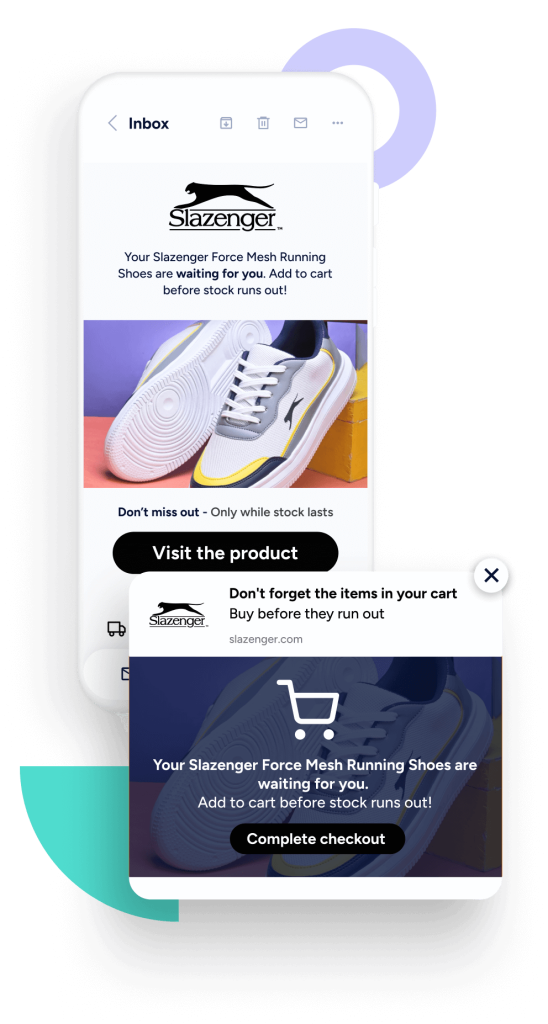
Slazenger achieved 49x return on investment (ROI) in eight weeks by activating unified first-party data through coordinated omnichannel journeys. The speed of that result came from eliminating the delay between data capture and activation.
The three-metric framework for proving first-party data ROI
When you need to justify continued investment in first-party data infrastructure to finance or senior leadership, three metrics make the clearest case.
First, incremental revenue per activated profile: compare revenue generated from customers with fully enriched profiles against customers with sparse profile data, and the delta quantifies the revenue value of data enrichment directly.
Second, reduction in paid retargeting spend: track the percentage decline in cost-per-acquisition as you shift audience targeting from third-party segments to first-party customer match audiences.
Third, customer lifetime value (CLV) lift for owned-data segments: measure CLV for segments built on behavioral first-party data against matched groups targeted through demographic or third-party signals. These three metrics translate infrastructure investment into outcome terms that speak directly to finance and leadership teams, without requiring them to understand marketing data architecture. Brands that build personalization at scale from a strong first-party foundation consistently see this kind of compound return as their profiles deepen.
How Insider One turns first-party data into revenue
Collection. Interactive gamified experiences give anonymous visitors a reason to become known, and compliant opt-in collection templates handle consent capture on web and app without a build. Both feed the same profile as behavioural data, so stated preference and observed behaviour arrive in one place.
Unification. Identity Resolution Management stitches known identifiers and anonymous signals across devices and sessions. 100+ integrations bring in CRM, analytics, commerce, POS and contact centre data, with a bidirectional warehouse connection, and event formats are transformed at ingestion so the same action is recorded consistently across sources.
Consent as an asset. Consent Management holds a full lifetime view of consent history, including opt-in dates and sources, on the profile itself. That is what makes an audit answerable from the same record the campaign runs on.
Prediction. Likelihood to purchase, churn risk, predicted lifetime value and discount affinity are computed in real time as part of the profile. Computed Traits let marketers build custom metrics from raw data without IT support.
Activation. Predictive segments become entry conditions in Architect across 12+ native channels, with unified frequency capping and suppression applied from the same canvas.
Book a demo to audit your own collection points, or take the platform tour first.
FAQs
Zero-party data is information a customer explicitly volunteers, such as stated preferences, survey responses, or quiz answers. First-party data is behavioral and transactional data generated through a customer’s actions on your channels. Both are owned by your brand and require no third-party intermediary, but they serve different roles: zero-party data captures stated intent while first-party data captures observed behavior. Used together, they produce the most complete customer profile.
Not necessarily, but the benefits of first-party data compound significantly when profiles are unified in a single system rather than stored across separate channel tools. A CDP, or a platform with equivalent unified profile capabilities, enables real-time segmentation, cross-channel journey triggering, and closed-loop attribution that siloed tools cannot support at scale. Brands starting small can begin with one or two high-yield collection touchpoints and a single activation channel, then expand as data richness grows.
First-party data improves paid media in two ways. Customer match uploads allow you to target known customers or build lookalike audiences based on your highest-value segments, improving match quality over third-party demographic targeting. Suppression lists built from first-party purchase data prevent you from serving paid ads to customers who have already converted, which directly reduces wasted spend. Both mechanisms become more effective as your first-party profiles grow more complete and current.
First-party data collected through transparent value exchanges with documented consent is structurally aligned with the requirements of both GDPR and CCPA. The key compliance requirements are that customers are informed about what data is collected, how it is used, and how they can opt out. Brands with strong first-party data strategies typically find that their compliance posture improves as they shift away from third-party data sources that are harder to audit and govern.

Keep Reading
7 min.

Muharrem Derinkok
4 Jun 2026
11 min.

Chris Baldwin
2 Jun 2026
4 min.
Chris Baldwin
3 Feb 2026