

 Platform Overview

 Integration Hub

 Agent One™

 Agent One Teams™

 Customer Data Management

 Personalization

 Journey Orchestration

 Reporting & Data

 Behavioral Analytics

 Web
Web

 Email
Email

 Site Search

 Conversational CX

 WhatsApp

 Web Push

 InStory

 App
App

 SMS & RCS

 Join the $0 Migration Movement™

 The Insider One Difference

 Compare Vendors

 Switch to Insider One

 Success Story

 Retail & Ecommerce

 Financial Services

 Travel & Hospitality

 Beauty & Cosmetics

 Automotive

 Telecommunications

 Total Economic Impact™ Study

 Blog
Blog

 E-Books & Guides

 Events

 Glossary
Email Marketing Automation Strategies, Tools & Examples

Updated on 24 Sep 2026
20 min.
Table of Contents
- What is email marketing automation?
- Key benefits of email marketing automation
- Core strategies for effective email marketing automation
- Choosing the right email marketing automation tools
- Step-by-step email marketing automation implementation process
- High-impact email automation examples and templates
- Best practices and common mistakes to avoid
- Insider One: Executing revenue-driven email automation at scale
- Frequently asked questions
Most Popular
The era of rule-based triggers is gone.
What replaced it is a stack built on behavior-based triggers, real-time ingestion from first-party data sources, and orchestration layers that execute personalized journeys at scale without a developer touching the queue.
Most teams are somewhere in the middle of that transition, running a few automated flows on top of a legacy ESP while their CDP sits underutilized and their Golden Profile remains a roadmap item rather than an operational asset.
That gap is expensive.
Every day, a welcome sequence runs without behavior-based branching, every abandoned cart email that fires on a fixed 24-hour delay instead of a predictive send window, every replenishment campaign built on static cohorts instead of CLV-weighted segments, they are compounding revenue losses dressed up as automation.
This guide covers the strategies that drive measurable results from email automation, practical examples you can implement immediately, how to choose the right platform for your use case, and a step-by-step implementation process from data audit to revenue attribution.
What is email marketing automation?
Email marketing automation is the use of rules, triggers, and data to send timely, personalized emails at scale. It replaces manual batch sends with behavior-based journeys, enabling consistent communication that runs in the background while your team focuses elsewhere.
The distinction matters.
- A batch send is a broadcast.
- An automated journey is a response to what a customer did, didn’t do, or is predicted to do next.
That’s behavioral orchestration delivered through the inbox.
The modern automation stack has three layers.
- The first is the ESP or automation platform: the engine that sends, sequences, and schedules.
- The second is an orchestration layer, that connects triggers, runs conditional logic, AI-powered steps, and cross-tool coordination. Then in the Insider One section, explicitly state that Architect + Insider One AI™ serves as this orchestration layer natively.
- The third is a unified data layer (a CDP or customer data platform) that builds the Golden Profile: a single, deduplicated record combining purchase history, browse behavior, lifecycle stage, and channel engagement that feeds real-time segmentation and suppression logic.
Most teams stitch these layers together from separate vendors, creating ingestion latency and data fragmentation between tools. Platforms like Insider One collapse all three; ESP, orchestration engine, and CDP, into a single integrated stack, eliminating the stitching and ensuring that behavioral triggers fire on real-time data rather than batch imports.
Key benefits of email marketing automation
Email marketing automation is a revenue infrastructure decision that compounds over time.
The primary business benefits of email marketing automation, mapped to the metrics that validate them:
- Conversion rate lift: Behavior-based triggers reach contacts at peak intent, producing conversion rates that batch campaigns cannot match.
- Customer lifetime value: Automated replenishment, milestone, and re-engagement sequences extend the active customer window and increase average order frequency without proportional increases in send volume.
- Activation rate: Welcome and onboarding journeys, personalized via CRM properties and signup source move new contacts from acquisition to first meaningful action faster than manual follow-up cadences.
- Operating efficiency: A single automated workflow replaces hundreds of manual sends per month, freeing marketing teams to focus on strategy, segmentation logic, and journey architecture rather than execution.
- Deliverability health: Engagement tagging and suppression logic built into automated flows reduce spam complaints and hard bounces by keeping fatigued or unresponsive contacts out of active send pools.
- Predictive engagement: Send-time optimization, powered by machine learning at the contact level, increases open rates without increasing send frequency. It’s the same message, delivered at the moment each subscriber is most likely to act.
Core strategies for effective email marketing automation
The strategies below map directly to the flows that drive the highest revenue impact across B2C and B2B programs. Each one is built around a single goal, a defined trigger, and a measurable downstream KPI.
Personalized welcome email campaigns
The welcome sequence is the highest-leverage automation in any program.
It fires at peak intent, when a new contact has just signaled interest, and it sets the expectation for every interaction that follows.
A well-structured welcome series runs two to three emails, each serving one purpose:
- Email 1 delivers immediate value and confirms the relationship
- Email 2 provides a practical how-to or resource that moves the contact toward activation
- Email 3 presents a proof point (a case study, a customer outcome, a benchmark) paired with a single next-step CTA.
Personalization beyond first name is what separates a high-activation welcome flow from a generic confirmation.
Smart content blocks keyed to CRM properties (signup source, role, industry, lifecycle stage) allow the same template to render a different headline, a different resource link, and a different CTA for a mid-market operations lead versus a D2C founder.
The welcome sequence is also the right moment to capture zero-party data.
Like preferences, use case, purchase intent that feeds suppression logic and journey branching downstream.
Abandoned cart recovery workflows
Cart abandonment is the most direct revenue recovery opportunity in ecommerce automation, and most programs underperform it by either sending too few touches or sending them too slowly.
The proven cadence is a three-email series with escalating angles:
- A 1-hour reminder that catches the shopper while the purchase decision is still active
- A 24-hour follow-up that introduces social proof (reviews, ratings, user counts) to reduce hesitation
- And a 72-hour email that introduces a time-bound incentive or an alternative product recommendation for contacts who have not converted.
Enable predictive send-time optimization starting at Email 2, the first email should fire at exactly 1 hour to catch intent while it’s live, but subsequent touches benefit from per-contact timing models.
The sequence has one goal. That’s recovery rate.
Lead nurturing email sequences
Lead nurturing is where behavior-based triggers replace calendar-based drips.
The sequence structure maps to lifecycle stage:
- Awareness-stage contacts receive educational content that builds category understanding
- Evaluation-stage contacts receive comparison content, proof points, and feature-specific messaging
- Decision-stage contacts receive demo invitations, ROI frameworks, and sales-aligned triggers.
The trigger for each stage transition is a behavior, a whitepaper download, a pricing page visit, a demo booking, and/or an email reply.
Event-based automation systems handle this branching natively.
A contact downloads a guide, enters a 5-day nurture sequence, clicks the case study link on day 3, and the system branches them into a decision-stage flow with a direct sales CTA without a human reviewing the activity log.
That conditional path logic, built on tags, waits, and behavioral conditions, is the architecture that makes nurture programs scale without scaling headcount.
Event-triggered messaging automation
Event-triggered flows are the infrastructure for any program that runs webinars, product milestones, or account-based engagement at scale.
A webinar automation sequence follows a defined architecture:
- A confirmation email fires immediately after registration
- A 24-hour reminder delivers the agenda and speaker context
- A 1-hour reminder fires with the direct join link
- And a post-event email delivers the recording and a clear next-step CTA within 24 hours of the session ending.
Each touchpoint is triggered by a calendar event or a registration status.
The sequence runs the same way for 50 registrants or 5,000.
Dynamic content personalization
Dynamic content is the mechanism that makes a single template behave like a hundred different emails.
It renders different headlines, product recommendations, CTAs, and imagery based on what the platform knows about each contact at send time.
Smart blocks keyed to CRM properties and behavioral data allow the content layer to adapt without creating parallel template versions.
- A returning customer who last purchased in the skincare category sees a replenishment recommendation and a cross-sell for a complementary product
- A first-time visitor in the same send sees a bestseller block and a social proof module.
One template. Two entirely different emails.
Subject line optimization
Subject lines are the single variable with the highest leverage-to-effort ratio in email optimization.
They determine whether the rest of the campaign gets read at all.
The recommended workflow:
- Generate five to seven subject line variants using AI
- Select two for A/B testing per send
- And rotate the winning angle category quarterly to prevent engagement decay.
Insider One’s Sirius AI™ handles this natively, generating subject line variants from a short prompt and scoring each variant’s predicted performance before send.
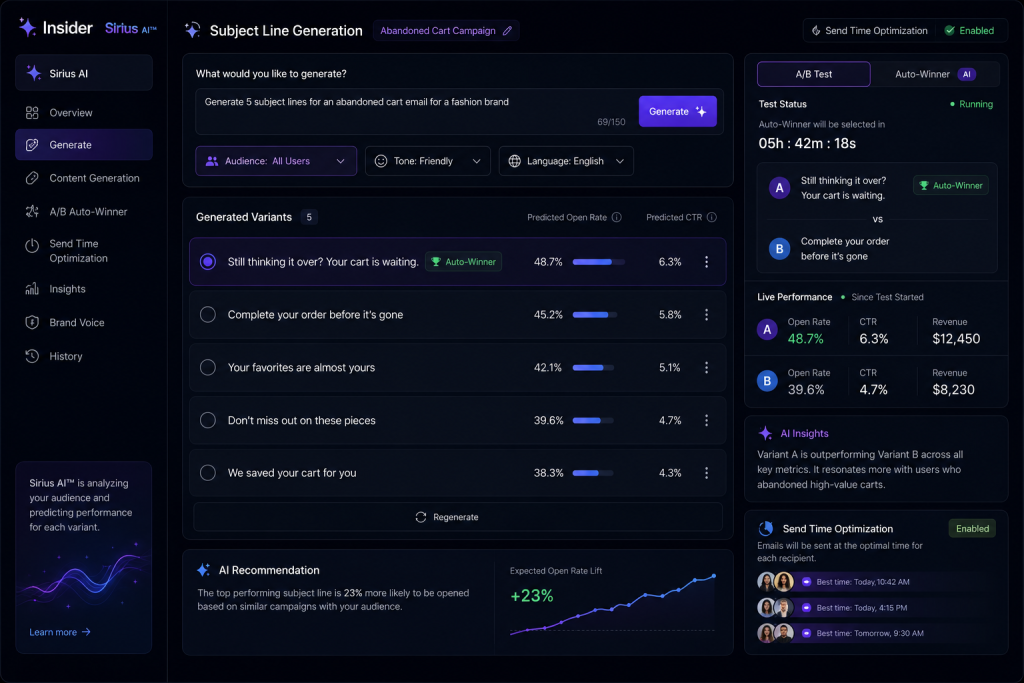
High-performing patterns cluster around three angles, benefit-led (“Get your order back in stock”), urgency-framed (“Your cart expires tonight”), and social proof-anchored (“2,400 customers chose this”).
And each pattern fatigues at a different rate depending on the segment’s engagement history.
Emoji and preview text combinations should be tested by segment and engagement tag.
Choosing the right email marketing automation tools
The right evaluation starts with use case.
A B2B demand generation team running lead nurturing sequences has fundamentally different requirements than a DTC brand orchestrating post-purchase upsells and replenishment flows.
The same tool that handles one with precision will create friction for the other at scale.
What to evaluate before comparing platforms:
- Native CDP: Does the platform include a built-in CDP with real-time identity resolution, or do you need to integrate a third-party data layer that introduces batch latency?
- Ingestion latency: Does the platform support real-time event streaming, or does it rely on batch imports that make behavioral triggers fire on stale data?
- Journey-level experimentation: Can you A/B test entire journey paths (not just subject lines or content blocks) with auto-winner selection?
- Pricing model: Does pricing scale by contact volume, send volume, or tracked users? Understand the metering model before committing.
Step-by-step email marketing automation implementation process
Follow these six steps in order.
- Audit data sources and define KPIs. Inventory every event source feeding your automation stack: site behavior, CRM records, POS transactions, and product usage data. Identify consent gaps and ingestion latency issues before they corrupt your segmentation. Assign a specific KPI to each planned flow so every automation has a measurable definition of success from day one. Use orchestration to run data hygiene in parallel: classify contacts by lifecycle stage, normalize job titles for B2B segmentation, and dedupe records in real time to prevent Golden Profile fragmentation before it starts.
- Map journeys and customer triggers. Translate each KPI into a trigger condition, a delay window, and a branch logic path. Set frequency caps at the journey level to prevent a single contact from hitting three concurrent automations simultaneously. Test delay windows in staging before pushing to production.
- Select and integrate your email stack. Match the platform archetype to the use case. Layer an orchestration tool on top for cross-platform logic, AI copy steps, and external data enrichment that the ESP alone cannot execute. If your platform includes native journey orchestration and AI capabilities (as Insider One does with Architect and Sirius AI™), this layer is already built in. Confirm that real-time segmentation is possible, if your CDP or data layer updates contact attributes on a 24-hour batch cycle, behavior-based triggers will fire on stale signals, and the personalization breaks at the moment it matters most.
- Build minimal viable automation flows first. Launch four flows before anything else: welcome/onboarding, 3-email abandoned cart, replenishment, and a milestone or birthday sequence. Each flow serves one goal.
- Test, iterate, and refine. A/B test two subject line variants per send and rotate winning angles quarterly to prevent engagement fatigue. Run timing experiments on delay windows. Like shifting the 24-hour cart recovery email to 20 hours and measure recovery rate delta. Enable predictive sending for contacts with sufficient engagement history, and apply engagement tagging to identify fatigued segments before suppression logic kicks in. Tag every responder and non-responder at the flow level so retargeting and suppression decisions are driven by actual behavior.
- Monitor deliverability and attribute revenue. Track bounce rate, spam complaint rate, and unsubscribe reasons as leading indicators of sender domain health. Attribute revenue directly to each automated flow using UTM parameters and downstream conversion tracking.
High-impact email automation examples and templates
The flows below translate each pillar of a modern automation program into working templates.
Welcome and onboarding series
Goal: Activation, move a new subscriber or customer from sign-up to first meaningful action.
Structure the series around three emails, each with one job:
- Email 1: Subject line angles: benefit-led (“Here’s what you unlocked”) or social proof (“Join 40,000+ marketers who…”). Dynamic fields: first name, signup source, product category viewed. CTA: one action, start a trial, browse a category, download the resource they opted in for.
- Email 2: Subject line angles: urgency-adjacent (“Your first step to [outcome]”) or specificity (“3 things to do in your first 48 hours”). Dynamic blocks: swap the how-to module based on CRM lifecycle stage or role property. CTA: complete one setup step or consume one piece of content
- Email 3: Subject line angles: outcome-led (“How [Company] achieved [result] in 30 days”). Dynamic blocks: industry-matched case study pulled from a CRM property. CTA: book a demo, start a paid plan, or make a first purchase.
In Insider One, Architect builds this entire sequence with behavior-based branching, dynamic content blocks keyed to CDP attributes, and AI-generated journey paths from a single text prompt.
Personalize via signup source and CRM properties, a contact who signed up after viewing your enterprise pricing page should receive a different Email 2 than one who downloaded a beginner’s guide.
Modular content blocks make this manageable without duplicating entire flows.
Multi-stage abandoned cart campaigns
Goal: Cart recovery, convert high-intent shoppers who left before completing a transaction.
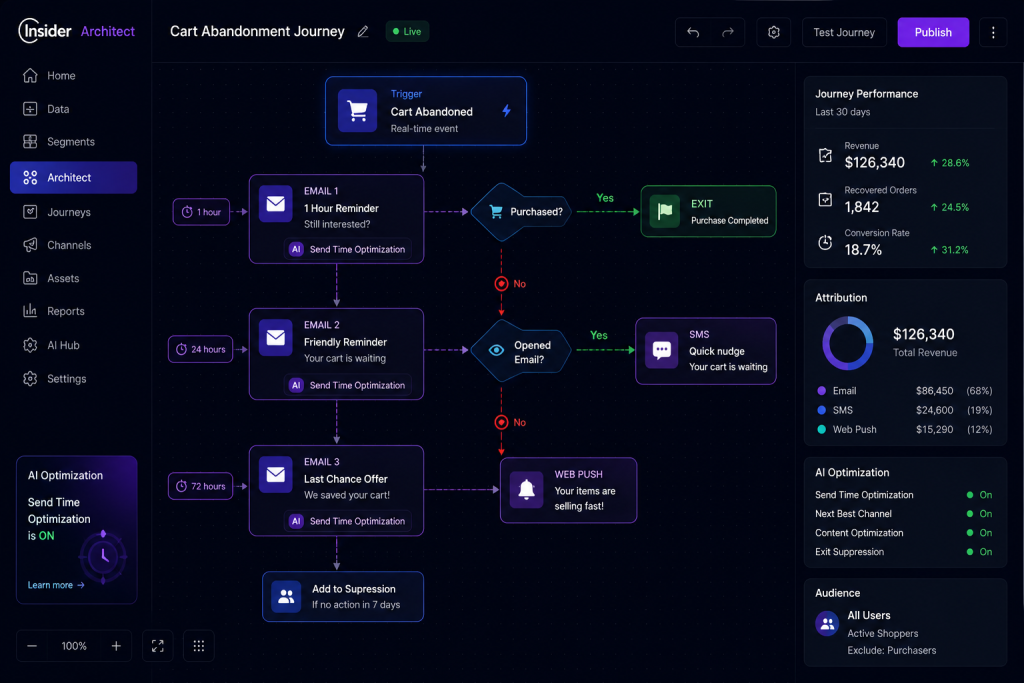
A shopper who abandons a $340 cart with a $12 shipping fee is not disinterested.
They are comparison shopping, distracted, or waiting for a nudge. The 3-email cadence below is built to meet each of those scenarios in sequence.
- – Email 1: Subject line angles: direct (“You left something behind”) or product-specific (“Your [Product Name] is waiting”). Dynamic fields: cart contents, product image, price, and a single-click return-to-cart CTA. No discount here.
- Email 2: Subject line angles: review-led (“4,800 people love this, here’s why”) or scarcity (“Only 3 left in stock”). Dynamic blocks: product reviews pulled from your review platform, inventory status if low-stock logic is configured. CTA: return to cart with a trust signal adjacent to the button.
- Email 3: Subject line angles: offer-led (“Here’s 10% off, just for you”) or recommendation-led (“Not sure? Here are 3 similar options”). Dynamic blocks: discount code generated via your ESP’s coupon module, or a product recommendation block driven by browse history. CTA: redeem offer or explore alternatives.
Insider One’s Architect fires the first email on real-time cart abandonment events, applies Send Time Optimization from Email 2, and uses Smart Recommender to power the product recommendation block in Email 3.
Enable predictive send-time optimization starting at Email 2, the first email should fire at exactly 1 hour to catch intent while it’s live, but subsequent touches benefit from per-contact timing models.
Replenishment and milestone campaigns
Goal: Repeat purchase
Replenishment automation is the clearest proof that a CDP or unified data layer pays for itself.
Build the replenishment trigger around predicted repurchase timing (calculated from average days-between-orders for that product category) rather than a fixed calendar interval.
- Replenishment 1: Subject line: usage-specific (“Running low on [Product]?”). Dynamic fields: product name, last purchase date, reorder CTA. Include a usage tip or benefit reminder to reinforce the habit loop, not just the transaction.
- Post-purchase upsell: Order confirmation emails carry near-perfect open rates, use the follow-up window to surface a complementary product recommendation based on purchase history. Keep the upsell relevant and non-aggressive: one recommendation, one CTA, no discount required at this stage.
- Re-engagement sequence (triggered by 60–90 days of inactivity post-purchase): Subject line angles: win-back (“We miss you, here’s what’s new”) or value reminder (“Your last order was [X], time to restock?”). Dynamic blocks: last purchased product, new arrivals in the same category, loyalty points balance if applicable.
For more precision, use predictive churn scoring rather than a fixed inactivity window, Insider One AI™ flags subscribers showing disengagement signals before they reach a hard cutoff, enabling intervention while the relationship is still recoverable
Insider One’s CDP calculates predicted repurchase timing from each customer’s purchase history, and Architect triggers the replenishment sequence at the individual level rather than a fixed category cadence.
Best practices and common mistakes to avoid
The difference between an automation program that compounds revenue quarter over quarter and one that quietly erodes list health comes down to a handful of operational disciplines and an equal number of avoidable failures.
- Keep every flow anchored to a single goal. Welcome sequences that try to onboard, upsell, and re-engage simultaneously produce diluted CTAs and ambiguous attribution. So, it’s a good idea to follow one flow -> one conversion objective ->one measurable KPI.
- Personalize beyond the first-name merge tag. Behavior-based triggers produce segmentation depth that a name field never will. A customer who viewed a product three times in 48 hours warrants a different content block than one who hasn’t opened in 90 days; treating them identically is a segmentation failure.
- Test timing and frequency with the same rigor you apply to copy. Predictive sending analyzes historical open rates by date and time to schedule delivery at each contact’s highest-engagement window, deploying it without also setting frequency caps is a half-measure. Engagement tagging identifies fatigued segments before they unsubscribe; suppression logic removes them from active cadences before inbox placement degrades.
- Use orchestration AI steps to maintain data hygiene at the ingestion layer. Classifying contacts by role, normalizing job titles, and deduping records in real time prevents segment noise from compounding downstream. A churn risk score calculated against a fragmented Golden Profile is directionally wrong before the journey even branches. Insider One’s CDP handles this natively, identity resolution deduplicates profiles in real time across channels and devices without requiring a separate orchestration layer for data hygiene
Insider One: Executing revenue-driven email automation at scale
Insider One is recognized as a Leader in the 2026 Gartner® Magic Quadrant™ for Personalization Engines and the Forrester Wave™ for Cross-Channel Campaign Management. Here’s how the platform maps to the email automation strategies in this guide.
Most email automation programs stall at the platform layer.
The ESP fires the right message, but the underlying data is fragmented, the segments are stale, and the attribution stops at click-through.
Revenue never gets traced back to the flow that generated it.
Insider One is built to close that gap.
It functions as an AI-native customer engagement platform, connecting first-party behavioral data, purchase history, web and app interactions, and CRM signals into unified customer profiles that update in real time.
You get:
- Unified customer profiles via Insider One’s Actionable CDP. Insider One’s CDP aggregates event streams from email, web, app, CRM, POS, and offline sources into a single deduplicated profile per contact with real-time identity resolution, the ‘Golden Profile’ this blog describes. Those profiles power real-time segmentation, suppression logic, and predictive audiences simultaneously.
- Journey orchestration via Architect. The behavior-based triggers, frequency caps, and conditional branching this blog covers are executed through Architect, Insider One’s journey orchestration engine. Architect builds cross-channel journeys across email, SMS, WhatsApp, web push, app push, and more, 12+ channels in a single canvas, with native frequency capping, journey prioritization, and AI-generated journey creation from text prompts via Insider One AI™. Slazenger used Architect and Insider One AI to build behavior-driven cart recovery journeys, achieving 30% productivity gains while significantly improving recovery rates. Agent One™, Insider One’s agentic AI capability, extends this further, autonomously building and optimizing journeys toward revenue goals without manual configuration, a capability not natively available in competing platforms like Braze or Salesforce Marketing Cloud
- AI-native intelligence via Insider One AI™. TAI-native intelligence via Insider One AI. The same subject line optimization and predictive sending strategies this blog covers are built natively into Insider One through Insider One AI. It generates subject lines and email body copy from text prompts, scores each message’s predicted performance against past results, selects A/B test winners automatically (Auto-Winner Selection), and applies Send Time Optimization at the individual contact level. On the predictive side, Insider One AI powers, enabling the suppression logic and CLV-weighted segmentation the blog describes.
- Cross-channel orchestration. Email journeys in Insider One can be coordinated in real time with web push, SMS, and WhatsApp, enabling true omnichannel automation at the moments that carry the highest revenue weight. Insider One AI’s Next Best Channel decisioning automatically escalates to the channel with the highest predicted engagement, routing to WhatsApp or SMS if an email goes unopened, rather than following a static fallback sequence. This level of dynamic channel selection is not natively available in point ESPs or most campaign management platforms.
- Revenue attribution. Built-in analytics in Insider One tie each automated flow directly to downstream revenue, mapping conversions to the specific sequence, send time, and content variant that influenced them.
- Dynamic product recommendations via Smart Recommender. Smart Recommender uses many ML algorithms to deliver personalized product suggestions across email, web, app, and push. For email specifically, recommendations update at open time rather than send time in supported email clients, ensuring relevance even when opens happen hours after delivery, and defaulting to send-time recommendations in clients that do not support real-time image rendering.
That’s not email marketing. That’s revenue-driven orchestration with email as the primary channel.
Explore the product demo hub → to see how these strategies map to real Insider One journeys, or book a demo → for a personalized walkthrough.
Frequently asked questions
Email marketing automation is the use of rules, triggers, and behavioral data to send timely personalized emails at scale.
As customer expectations for relevance increase and first-party data becomes the primary asset, automation is the mechanism that converts CDP-level segmentation and event streaming into actual revenue.
Without it, personalization stays theoretical and lifecycle communication stays inconsistent.
Match the platform archetype to your use case before evaluating features. The key factors to align:
CRM-native platforms: Best for B2B teams that need sales-triggered workflows, lead scoring, and account-based journey branching, where the Golden Profile lives in the CRM and automation needs to respect sales stages.
E-commerce-centric solutions: Best for DTC and retail brands that need product recommendation engines, predictive AI, pre-built abandoned cart and replenishment flows, and high-volume segmentation tied to purchase behavior.
Event-based systems: Best for SaaS and product-led teams that need granular usage triggers, real-time segments, and developer flexibility for multi-channel orchestration.
After archetype fit, evaluate segmentation depth, ingestion latency, native AI features, and how cleanly the platform integrates with your existing data sources.
Insider One spans these categories by design, combining a native CDP, AI-powered orchestration via Architect, product recommendations via Smart Recommender, and predictive intelligence via Insider One AI™ into a single platform. This is particularly relevant for teams that find themselves needing capabilities from two or more archetypes and want to avoid integrating multiple tools.
Start with welcome and onboarding sequences to drive activation, layer in a three-touch abandoned cart workflow to recover lost revenue, and add replenishment and milestone campaigns to increase repeat purchase rate and CLV.
From there, predictive send-time optimization and AI-assisted content personalization compound the baseline lift.
AI operates at four leverage points across a modern email stack.
It generates on-brand subject line variants and content blocks at the segment level, reducing copy production time without sacrificing brand voice controls.
Predictive sending analyzes historical open rates by date and time to schedule each contact’s email at their individual optimal window, lifting engagement without increasing send frequency.
AI-assisted data hygiene classifies contacts, normalizes job titles, and dedupes records in real time through orchestration layers, which keeps segmentation clean and suppression logic accurate.
And predictive segments surface churn risk scores and CLV tiers that trigger the right journey branching before a subscriber disengages.

Keep Reading
7 min.

Muharrem Derinkok
4 Jun 2026
11 min.

Chris Baldwin
2 Jun 2026
4 min.
Chris Baldwin
3 Feb 2026