

 Platform Overview

 Integration Hub

 Insider One AI™

 Customer Data Management

 Personalization

 Journey Orchestration

 Reporting & Data

 Behavioral Analytics

 Web
Web

 Email
Email

 Site Search

 Conversational CX

 WhatsApp

 Web Push

 InStory

 App
App

 SMS & RCS

 Join the $0 Migration Movement™

 The Insider One Difference

 Compare Vendors

 Switch to Insider One

 Success Story

 Retail & Ecommerce

 Financial Services

 Travel & Hospitality

 Beauty & Cosmetics

 Automotive

 Telecommunications

 Total Economic Impact™ Study

 Blog
Blog

 E-Books & Guides

 Glossary
Email Deliverability in 2026: What’s Actually Changing and What to Do About It

Updated on 10 Aug 2026
9 min.
Table of Contents
- Summary
- The delivery rate illusion: Why your dashboard is lying to you
- Authentication is the admission ticket, not the prize
- Engagement signals are now the primary inbox lever
- BIMI and branded trust: the visibility signal most senders are ignoring
- What to measure now that open rate is broken
- Why choose Insider One for engagement-driven deliverability
- Frequently asked questions
Most Popular
Summary
High email delivery does not guarantee inbox placement. Strong authentication, positive engagement signals, and modern performance metrics are essential for improving inbox visibility and maximizing email marketing results.
A campaign reporting a 98.5% delivery rate can look perfectly healthy on a dashboard while a significant portion of those messages land in spam, promotions tabs, or secondary folders subscribers never open. The dashboard isn’t wrong, exactly. It’s measuring the wrong thing, and that distinction costs revenue at scale.
This is the central problem with how enterprise email programs get evaluated in 2026. The metrics executives track were designed around infrastructure reliability, not inbox competition.
As mailbox provider filtering has grown more sophisticated, particularly at Gmail and Microsoft Outlook, the distance between “delivered” and “seen” has widened. Knowing which signals actually close that gap, and what to do about each one, is what separates programs that generate revenue from ones that silently decay.
The delivery rate illusion: Why your dashboard is lying to you
Delivery rate measures whether a receiving mail server accepted your message and returned a successful response code. It doesn’t tell you where the message went after acceptance.
An email that lands in the spam folder, the promotions tab, or a suppressed category is still “delivered” in every system you’re measuring. The metric that matters is inbox placement rate: the percentage of delivered mail that reaches the primary or visible inbox.
The gap between these two numbers isn’t cosmetic. If your program sends five million emails a month with a 99% delivery rate but only a 65% inbox placement rate, roughly 1.75 million messages a month are technically delivered but functionally invisible.
Apply any reasonable open rate to the recoverable portion of that gap and the revenue impact becomes concrete fast. Yet many teams optimise for delivery rate because that’s what the email service provider (ESP) surfaces by default.
Inbox placement rate requires a seed list or third-party monitoring tool; most sending platforms don’t calculate it automatically. Setting that baseline, broken down by mailbox provider, is what determines whether the rest of your optimization effort is even pointed in the right direction.
Authentication is the admission ticket, not the prize
Where most senders actually stand
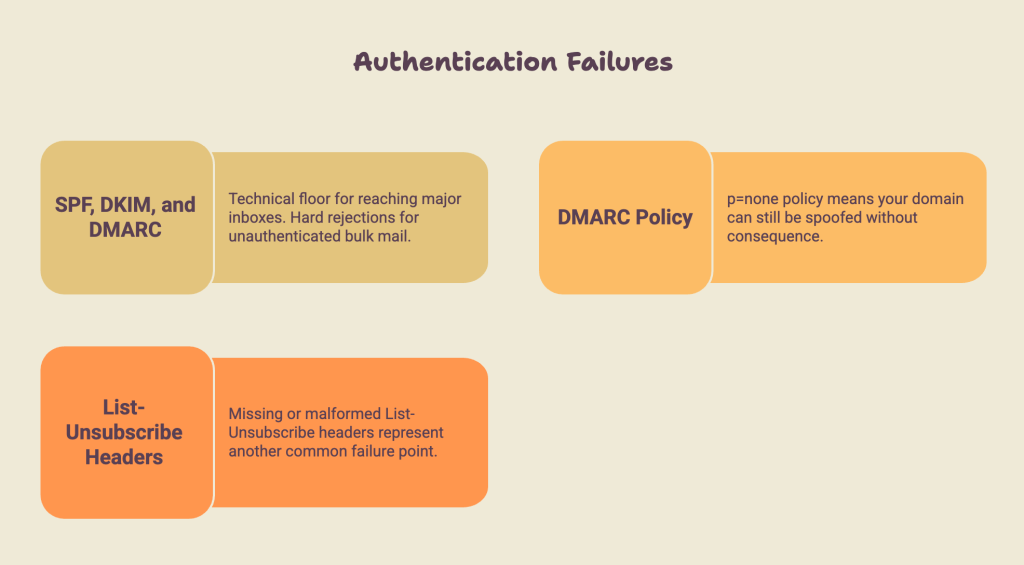
SPF, DKIM, and DMARC configured at enforcement level are the technical floor for reaching any major inbox. Gmail and Microsoft have both formalised hard rejections for unauthenticated bulk mail, and senders still running DMARC at p=none have monitoring without protection.
A “p=none” policy means your domain can still be spoofed without consequence, which signals low trust to receiving filters. Missing or malformed List-Unsubscribe headers, specifically the one-click variant now required by Gmail and Yahoo for bulk senders, is another common failure point.
Both gaps are correctable without major infrastructure changes, but they need audit work many teams deprioritise while delivery rates stay high and the problem sits beneath the surface.
That usually means auditing current SPF, DKIM, and DMARC records, moving DMARC from p=none to p=quarantine and then p=reject on a deliberate timeline, and confirming one-click List-Unsubscribe is implemented for every bulk sending domain.
Why authentication alone isn’t enough
Authenticated mail still lands in spam at high rates. Authentication confirms who sent the message; it says nothing about whether recipients want it.
Mailbox providers evaluate these two questions separately. Passing DMARC gets you access; the actual placement decision happens downstream, based on how your recipients behave. A fully authenticated sender with a disengaged list will still miss the inbox consistently.
Teams that complete the technical setup and assume the work is done hit this ceiling. What determines whether you stay in the inbox after you’ve been admitted is engagement, not credentials.
Engagement signals are now the primary inbox lever
How AI-driven filters actually score you
Gmail’s filtering infrastructure and Microsoft’s Junk Mail filter have both moved toward AI-driven models that weight dynamic behavioural signals over static sender reputation. IP reputation and domain age still matter, but their weight as standalone signals has declined.
What filters now emphasise is how recipients actually interact with mail: reply rates, deletion-without-open patterns, spam complaint trajectory, and move-to-inbox actions from users who first received mail in spam. These signals are harder to game because they reflect genuine engagement and update continuously rather than lagging weeks behind.
Building the segmentation logic that protects placement
Large disengaged lists aren’t neutral. When a significant share of sending volume reaches subscribers who delete without opening or mark mail as spam, those signals pull down your engagement profile across your entire sender identity, including for subscribers who’d otherwise engage.
New sending domains or IP addresses need a deliberate warm-up cadence: low volumes to verified, high-engagement contacts first, scaling gradually over several weeks before reaching full capacity. Sunset policies for subscribers with no engagement across a defined window, typically 90 to 180 days, are placement protection as much as list hygiene, alongside engagement-based sending tiers that give high-engagement subscribers full frequency and declining-engagement subscribers progressively reduced cadence.
This is where the infrastructure you’re sending from matters, not just the policy you’ve written. Insider One handles the mechanics of this rather than leaving it to a manually maintained spreadsheet:
- Automated warm-up: Insider One’s automated email warm-up generates a daily sending schedule tailored to your target volume and enforces it automatically per sender domain, with a tracker showing whether each day’s warm-up is on schedule, so ramping a new domain or IP doesn’t depend on someone remembering to check a spreadsheet
- Engagement-based segments: Email Engagement Segments group subscribers by click and open behaviour specifically so you can re-engage inactive contacts and reward engaged ones with different cadence, rather than sending every campaign to the whole list
- Real-time suppression: because segments run on Insider One’s unified customer database rather than a batch export, an unsubscribe or complaint updates the profile immediately, so the next send doesn’t have to wait for an overnight sync to exclude that contact
- Onboarding support: Insider One’s deliverability guidance includes a deliverability expert evaluating your projected daily volume during onboarding to size dedicated IP infrastructure correctly from the start, rather than after a warm-up has already gone wrong
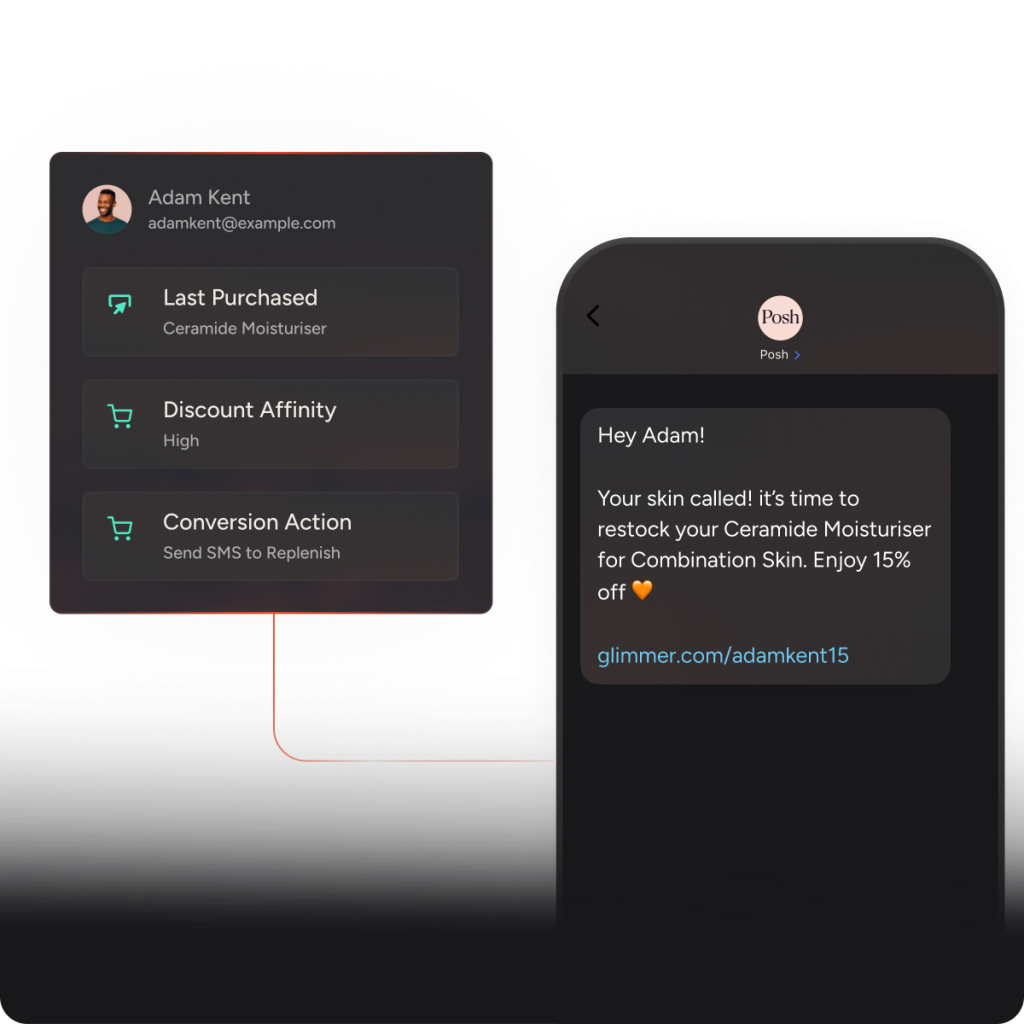
Personalisation reinforces the same mechanism from the other direction: sending more relevant content to engaged segments keeps engagement rates up, which protects placement quality for the entire program. Journeys built in Architect that trigger at the right point in a customer’s lifecycle tend to hold engagement better than broadcast sends with no behavioural context behind them.
BIMI and branded trust: the visibility signal most senders are ignoring
What BIMI actually requires
BIMI lets your brand logo display next to your emails in supporting inboxes, including Gmail, Apple Mail, and Yahoo. Verified logo display increases recognisability in a crowded inbox and works as a trust signal recipients see before they open.
Reaching BIMI display requires DMARC at “p=reject” or “p=quarantine”, the enforcement level many high-volume senders haven’t reached yet. The certificate path matters too: a Verified Mark Certificate (VMC) is issued against a registered trademark and is required for BIMI display in Gmail, while a Common Mark Certificate (CMC) covers common-law marks with narrower mailbox provider support.
For most enterprise brands with registered trademarks, the VMC path is the right one, but it needs trademark registration and DMARC enforcement already in place.
Why the gap is a competitive window
BIMI adoption among high-volume senders remains relatively low even among large enterprises, which creates an opening. Displaying a verified brand logo in Gmail’s primary inbox is a measurable visibility advantage over senders who haven’t reached this level.
The implementation sequence is fixed, and DMARC enforcement is almost always the bottleneck: full SPF and DKIM alignment, DMARC at enforcement, confirmed trademark registration, the VMC, then the BIMI DNS record. This work sits at the DNS and certificate level, independent of whichever platform sends your mail, so it needs to happen alongside your ESP setup rather than through it.
For the operational detail behind authentication and content practices together, the guidance in our email deliverability tips covers the mechanics.
What to measure now that open rate is broken
The Apple Mail Privacy Protection problem
Apple’s Mail Privacy Protection (MPP), introduced in 2021 and now deeply embedded across Apple Mail usage, pre-fetches email content regardless of whether the recipient actually opened the message. Open rate data for programs with significant Apple Mail representation is structurally inflated as a result.
Send-time optimization, engagement segmentation, or re-engagement thresholds built on open history all produce distorted outputs when the underlying open data is unreliable. Because MPP operates at the infrastructure level, no sender-side configuration prevents it, and the distortion compounds at scale.
The replacement KPI stack
- Click-to-open rate (CTOR): clicks as a proportion of opens, which filters out some MPP noise by focusing on the ratio rather than the raw open count
- Reply rate: a strong signal mailbox filters weight heavily; even small increases tend to improve placement scores
- Complaint rate slope: the direction and velocity of complaint rate over time, not just the current rate. A rising slope is a warning sign even when absolute rates look acceptable
- Per-provider inbox placement rate: broken down by Gmail, Outlook, Yahoo, and Apple Mail separately, since filtering rules differ meaningfully across providers
These metrics need different tooling than a standard ESP dashboard provides, usually a seed list service or third-party inbox placement monitor layered on top of your sending platform. That’s genuinely separate infrastructure, not something to expect from segmentation and journey tools alone.
Why choose Insider One for engagement-driven deliverability
If engagement is now the primary placement lever, relevance stops being only a revenue tactic and becomes deliverability infrastructure.
That is the argument for running placement work from an engagement platform rather than bolting hygiene rules onto a sending tool. Insider One covers both halves.
The mechanics. Automated warm-up generates and enforces a daily sending schedule per sender domain, with a tracker showing whether each day is on plan. Email Engagement Segments tier subscribers by click and open behaviour so cadence can differ by engagement level.
Suppression runs on the unified customer database, so an unsubscribe or complaint excludes that contact from the next send immediately rather than after an overnight sync. During onboarding, a deliverability expert sizes dedicated IP infrastructure against your projected daily volume.
The engagement itself. Lifecycle journeys in Architect trigger on behaviour rather than a calendar, which holds engagement rates better than broadcast sends to the full list. Send-time optimisation and A/B Auto-Winner Selection make their decisions per contact from actual engagement history rather than raw open counts.
Per-provider inbox placement monitoring still requires a seed list service. Insider One does not replace that.
To see warm-up automation, engagement tiering and send-time optimisation configured for your sending volume, book a demo. To look around first, the platform tour needs no forms.
Frequently asked questions
Email delivery rate measures whether a receiving server accepted your message without a bounce. Inbox placement rate measures where the message landed after acceptance: primary inbox, spam, promotions, or another folder. A 99% delivery rate is consistent with a 60% inbox placement rate because spam-filtered mail is still “delivered” by the server.
No. DMARC authentication confirms sender identity but does not determine where the message is placed. Mailbox providers evaluate placement separately based on recipient engagement signals, including reply rates, deletion behavior, and complaint trajectory, which operate independently of authentication status.
MPP pre-fetches email content, triggering open-tracking pixels regardless of whether the recipient genuinely opened the message. This inflates reported open rates for programs with significant Apple Mail audiences. Send-time optimization, engagement segmentation, and re-engagement thresholds built on open rate data are all affected, which is why CTOR, reply rate, and complaint rate slope are more reliable alternatives.
BIMI requires DMARC at “p=reject” or “p=quarantine”, full SPF and DKIM alignment, and a VMC issued against a registered trademark for Gmail display. The most common bottleneck is reaching DMARC enforcement level, which many high-volume senders have not yet achieved.
The primary change is moving from broadcast volume logic to engagement-tiered sending. High-engagement subscribers should receive full frequency. Declining-engagement subscribers should receive reduced cadence. Subscribers showing no engagement over 90 to 180 days should enter a formal sunset sequence before suppression. This protects your domain’s behavioral signal with mailbox provider filters.

Keep Reading
7 min.

Muharrem Derinkok
4 Jun 2026
11 min.

Chris Baldwin
2 Jun 2026
4 min.
Chris Baldwin
3 Feb 2026