

 Platform Overview

 Integration Hub

 Agent One™

 Agent One™ Teams

 Customer Data Management

 Personalization

 Journey Orchestration

 Reporting & Data

 Behavioral Analytics

 Web
Web

 Email
Email

 Site Search

 Conversational CX

 WhatsApp

 Web Push

 InStory

 App
App

 SMS & RCS

 Join the $0 Migration Movement™

 The Insider One Difference

 Compare Vendors

 Switch to Insider One

 Success Story

 Retail & Ecommerce

 Financial Services

 Travel & Hospitality

 Beauty & Cosmetics

 Automotive

 Telecommunications

 Total Economic Impact™ Study

 Blog
Blog

 E-Books & Guides

 Events

 Glossary
SMS Marketing Benefits: Engagement, Conversions, and ROI

Updated on 5 Oct 2026
9 min.
Table of Contents
- Summary
- What is SMS marketing?
- What are the effects and benefits of SMS marketing?
- What are the disadvantages of SMS marketing, and how can you mitigate them?
- What compliance and consent rules apply to SMS marketing?
- What SMS marketing strategies and best practices drive better results?
- How do you measure SMS marketing performance?
- What affects SMS deliverability, and which sender types should you use?
- How do you choose an SMS marketing platform?
- How does Insider One help with SMS marketing?
- Frequently asked questions
Most Popular
Summary
SMS marketing delivers fast, high-engagement customer communication, but real success comes from personalization, automation, and accurate revenue measurement. The best programs combine behavioral triggers, compliance, deliverability, and cross-channel orchestration to drive measurable business results.
Most marketing teams already know SMS delivers higher engagement than email or push in time-sensitive use cases such as cart abandonment and back-in-stock alerts. Fewer understand how to measure what SMS actually contributes versus what would have happened anyway. This guide breaks down where SMS delivers real value, how to avoid the compliance and deliverability traps that kill programs, and what it takes to tie text campaigns directly to revenue without inflating the numbers.
What is SMS marketing?
SMS marketing is permission-based messaging sent to subscribers who’ve opted in. That means promotional offers, transactional updates, and conversational campaigns delivered directly to a mobile device. The focus here is application-to-person messaging, the kind brands use at scale, not the texts you send to friends.
Most marketers already know what a text message is. The confusion usually starts when multimedia messaging service (MMS) and rich communication services (RCS) enter the conversation.
| Format | Character limit | Media support | Typical use case |
| SMS | Limited | None | Alerts, promos, reminders |
| MMS | Longer | Images, GIFs | Product visuals, coupons |
| RCS | Varies | Rich cards, carousels | Conversational commerce |
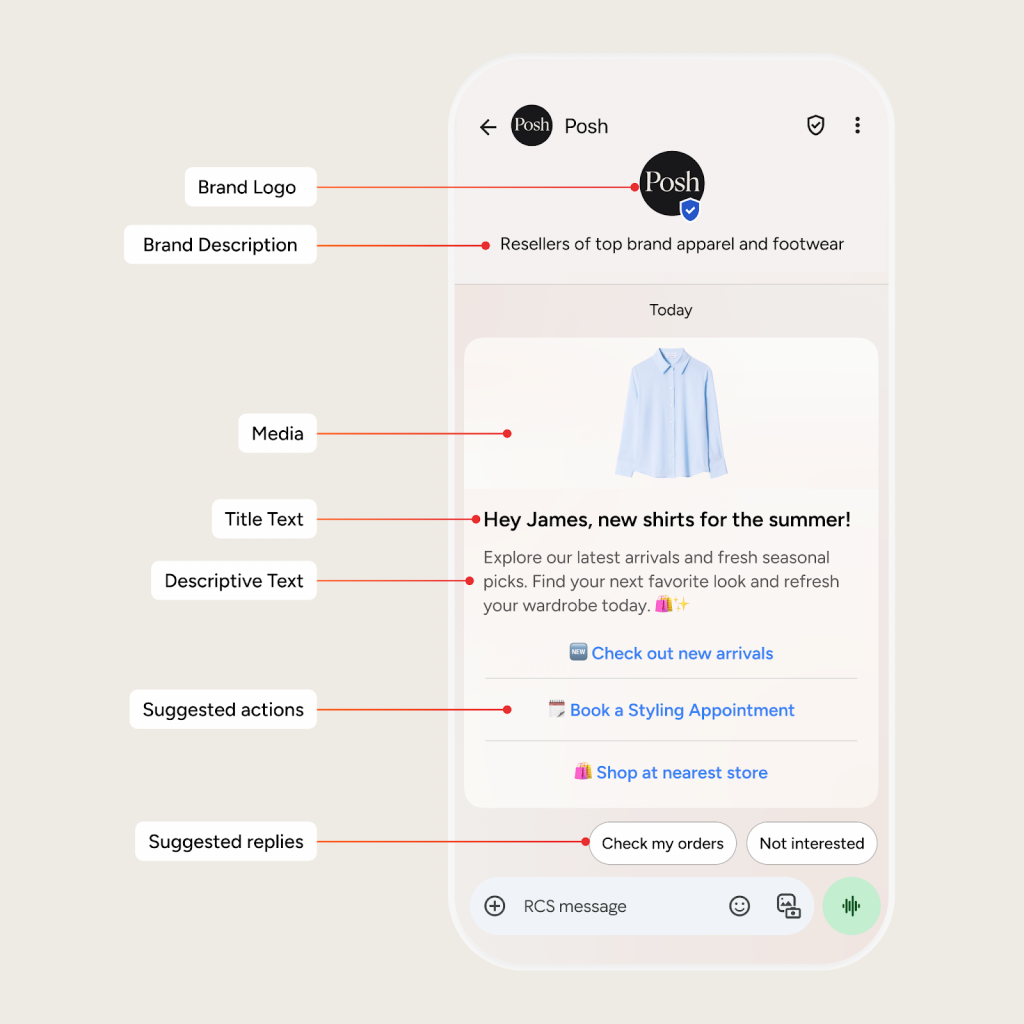
SMS is text-only and typically costs less than MMS. MMS lets you add images but costs more. RCS is the newest format, offering interactive elements like carousels and buttons, though carrier support remains inconsistent.
What are the effects and benefits of SMS marketing?
Listing benefits without context is easy. Connecting those benefits to specific campaign types and conditions is harder, and more useful.
The value of SMS depends entirely on how you use it. A flash sale announcement and a cart abandonment reminder are both texts, but they serve different purposes and produce different results. The sections below break down where SMS actually delivers.
Why do open rates and click-through rates outperform other channels?
SMS engagement consistently beats email and push when list hygiene is maintained. Open rates range widely depending on list quality, message type, and timing. Click-through rates follow a similar pattern.
| Channel | Typical open rate | Typical CTR |
| SMS | High | High |
| Moderate | Low to moderate | |
| Push | Low to moderate | Low |
One caveat: SMS open rates are inferred, not tracked with pixels like email. That makes click-through rate and conversion rate more reliable indicators of actual performance.
Why does SMS provide immediate reach for time-sensitive campaigns?
Most texts get read quickly. Email can take longer. Push notifications require an app install and permission settings that many users never enable.
SMS is the right channel when timing matters:
- Flash sales with limited windows
- Appointment reminders and confirmations
- Back-in-stock and price drop alerts
- Delivery and order status updates
If your campaign can wait, email is cheaper. If it can’t, SMS is faster.
How should you evaluate cost efficiency and ROI?
SMS costs more per message than email, but the engagement difference often makes up for it. The real question is whether the revenue you attribute to SMS would have happened anyway.
ROI = (Revenue attributed to SMS – SMS program cost) / SMS program cost
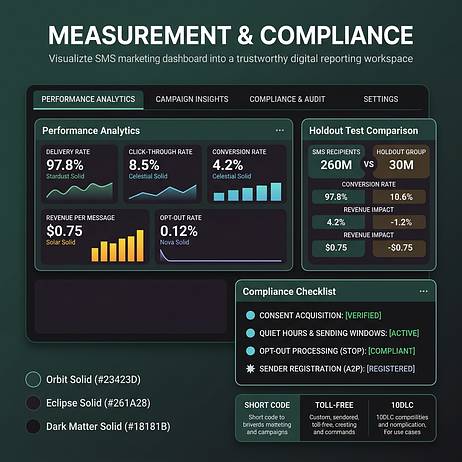
Last-touch attribution inflates SMS credit because it captures high-intent users who were already close to converting. Holdout testing gives you a cleaner picture. Withhold SMS from a small percentage of your audience and compare conversion rates between the two groups.
If you want to see what that looks like in your stack, book a demo, and we’ll walk through holdouts, incrementality, and revenue reporting end to end.
How do personalization and two-way engagement improve SMS performance?
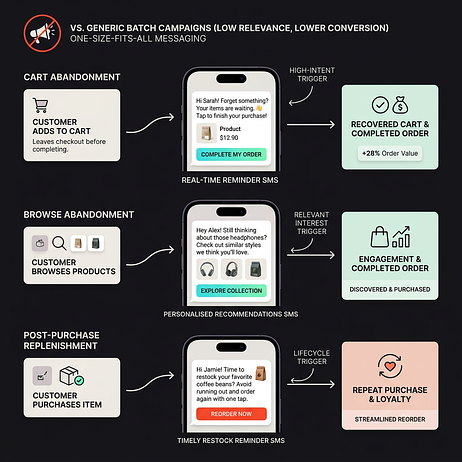
Generic text message promotions train users to ignore you. Behavioral triggers do the opposite.
| Trigger | Segment logic | Example message | Expected outcome |
| Cart abandonment | Items in cart for a while, no purchase | “Your item is waiting. Complete checkout: [link]” | Recovery rate lift |
| Browse abandonment | Viewed product multiple times, no cart | “Still thinking about it? It’s back in stock.” | Conversion lift |
| Post-purchase | Purchased previously | “Time for a refill? Reorder with a discount.” | Repeat purchase increase |
Two-way SMS, where users can reply, requires different sender types and compliance considerations. Done right, it turns a broadcast channel into a conversation. Explore proven trigger and reply patterns in the product demo hub to see what high-performing SMS personalization looks like in practice.
What are the disadvantages of SMS marketing, and how can you mitigate them?
High engagement comes with high stakes. The threshold for annoying a customer via text is much lower than email. According to Emarsys, sending too many messages increases unsubscribe risk.
| Risk | Warning signal | Mitigation |
| High opt-out rate | Higher than expected per campaign | Reduce frequency, improve targeting, audit consent quality |
| Carrier filtering | Sudden delivery rate drop | Register sender ID, avoid link shorteners, monitor throughput |
| Brand fatigue | Declining CTR over time | Implement preference center, cap frequency by segment |
| Compliance violation | Complaints, legal notices | Audit consent flows, honor quiet hours, process opt-outs fast |
Thresholds vary by industry. A retail brand with a large, cold list will see higher opt-outs than a travel brand messaging recent bookers. Context matters. If you’re seeing opt-outs, filtering, or fatigue signals, book a demo to map the root cause to fixes in segmentation, frequency caps, and deliverability controls.
What compliance and consent rules apply to SMS marketing?
You can’t scale SMS without strict compliance. Regulatory failures carry severe financial penalties and permanent damage to deliverability.
In the US, the Telephone Consumer Protection Act (TCPA) requires prior express written consent for promotional SMS. Violations carry fines of $500–$1,500 per message. In the EU, the General Data Protection Regulation (GDPR) requires consent to be freely given, specific, informed, and unambiguous.
Here’s an audit checklist:
- Consent is collected via clear, affirmative opt-in
- Consent language specifies message type, frequency, and sender identity
- Double opt-in is used where required
- Opt-out instructions are included in every message
- Opt-outs are processed promptly
- Quiet hours are honored based on recipient’s local time
- Consent records are stored with timestamp, source, and IP
- Transactional and promotional messages are distinguished in consent forms
- Third-party list purchases are prohibited
- Compliance is reviewed regularly with legal
Sample opt-in copy: “Reply YES to receive recurring messages from [Brand]. Message and data rates may apply. Reply STOP to cancel.”
Sample opt-out confirmation: “You’ve been unsubscribed from [Brand] texts. Reply START to resubscribe.”
What SMS marketing strategies and best practices drive better results?
Most best practice lists are vague. These are specific.
- Frequency: Keep promotional messaging conservative. Transactional messages don’t count toward this cap.
- Timing: Send during business hours in the recipient’s local time zone. Avoid Monday mornings and Friday afternoons for promos.
- Message length: Keep it short to avoid message splitting. Use branded shorteners if you include links.
- CTA clarity: One call-to-action per message. “Shop now” or “Book your spot,” not both.
How should you collect consent and manage opt-outs?
Your list growth strategy depends on consent quality. Opt-out processing should be automated and confirmed within seconds.
- Keyword opt-in flow: User texts JOIN to short code, receives confirmation with terms, replies YES, gets added to list
- Web form opt-in: User checks box with disclosure, receives confirmation SMS, replies YES, gets added to list
How should you optimize timing and frequency?
Different verticals see peak engagement during different windows.
| Vertical | Best send windows | Frequency cap |
| Retail and ecommerce | Tuesday to Thursday, midday and evening | Keep promotional messaging conservative |
| Travel | Weekend mornings | Keep promotional messaging conservative |
| Financial services | Tuesday to Wednesday, late morning | Keep promotional messaging conservative |
| Restaurants and delivery | Friday to Sunday, lunch and dinner hours | Keep promotional messaging conservative |
These are starting points. A/B testing with send-time optimization can improve results.
How should you integrate SMS with email and push notifications?
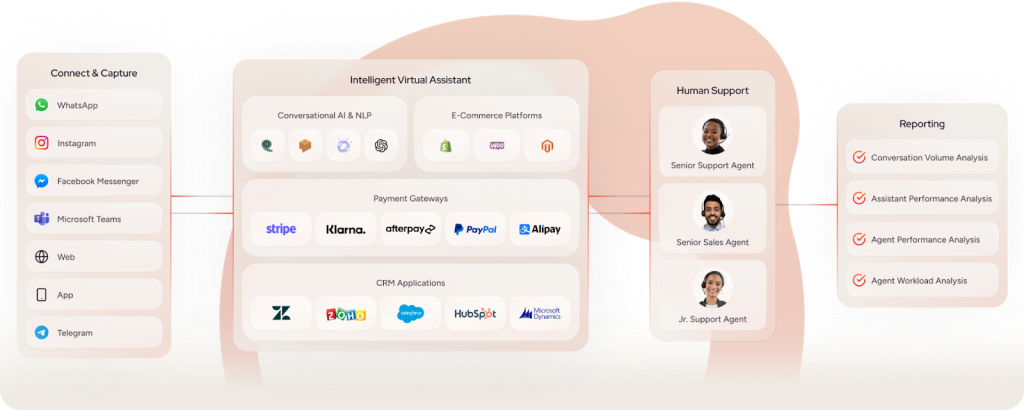
SMS works best when orchestrated alongside other channels. The question is when to use which.
| Factor | SMS | Push | |
| Urgency | High | Medium | Medium to high |
| Content richness | Low | High | Low to medium |
| Cost per message | Higher | Lower | Near-zero |
| Best for | Time-sensitive alerts | Newsletters, long-form | In-app re-engagement |
Cross-channel orchestration patterns that work:
- Cart abandonment: Email first, SMS later if unopened, push after that
- Flash sale: SMS and push simultaneously, email as follow-up
- Appointment reminder: SMS the day before and shortly before, email confirmation at booking
You can build these flows using Insider One’s journey orchestration capabilities to keep your cross-channel campaigns connected. See real orchestration templates and how they sequence SMS without spamming in the product demo hub.
How do you measure SMS marketing performance?
Most teams struggle to prove SMS impact because they rely on vanity metrics. Here’s a framework that ties to revenue.
Core KPIs:
- Delivery rate: Messages delivered divided by messages sent
- Click-through rate: Clicks divided by messages delivered
- Conversion rate: Conversions divided by clicks
- Revenue per message: Total revenue attributed divided by messages sent
- Opt-out rate: Opt-outs divided by messages delivered
Attribution methods:
- Last-touch: Simple but inflates SMS credit. Use for directional insights only
- Holdout testing: Withhold SMS from a random portion of the audience and compare conversion rates
- UTM tracking: Append UTM parameters to links for campaign-level attribution
Diagnostic checklist:
- Delivery rate drops suddenly? Check sender registration and link reputation
- CTR declines over time? Audit message relevance and frequency
- Opt-outs spike? Review consent quality and cadence
If you’re ready to move from “SMS looks good” to “SMS drives incremental revenue,” book a demo and we’ll show you the measurement setup: holdouts, dashboards, and decision-ready reporting.
What affects SMS deliverability, and which sender types should you use?
Technical factors determine whether your messages actually reach subscribers.
| Sender type | Throughput | Trust level | Best for | Registration |
| Short code | High | High | High-volume campaigns | Carrier approval required |
| Toll-free | Medium | Medium | Transactional, support | Verification required |
| 10DLC | Varies | Medium to high | A2P messaging | Campaign registry required |
Filtering triggers to avoid:
- Unregistered sender IDs
- Public URL shorteners
- High complaint rates
- Sudden volume spikes
- Messages without opt-out instructions
How do you choose an SMS marketing platform?
The right platform depends on your use case. Here’s what to evaluate.
Core capabilities:
- Native SMS and MMS support
- Two-way messaging and keyword automation
- Compliance automation for opt-outs and quiet hours
- A/B testing for message copy and timing
- Real-time analytics and reporting
Integration requirements:
- Customer data platform (CDP) or customer relationship management (CRM) sync
- Ecommerce platform connectors
- Journey orchestration for cross-channel campaigns
- Webhook access for custom workflows
| Use case | Must-have features |
| Ecommerce promotions | Ecommerce connectors, A/B testing, MMS support |
| Appointment reminders | Two-way messaging, calendar integrations |
| Cross-channel campaigns | Journey orchestration, CDP integration |
| High-volume campaigns | Short code support, high throughput |
How does Insider One help with SMS marketing?
Insider One brings together CDP, artificial intelligence (AI), personalization, journey orchestration, and reporting so teams can deliver personalized, cross-channel experiences without stitching together separate tools.
- Fragmented data? Insider One’s customer data platform unifies profiles across channels for consistent segmentation.
- Manual campaign setup? Architect, Insider One’s customer journey orchestration solution, automates SMS flows with behavioral triggers and A/B testing.
- Channel selection guesswork? Sirius AI™, Insider One’s extensive set of AI capabilities, includes Next Best Channel to route messages to the highest-performing touchpoint per user.
- Compliance burden? Built-in consent management, quiet hours, and opt-out automation reduce manual oversight.
- Cross-channel gaps? Native support for SMS, email, WhatsApp, push, and web personalization in one platform eliminates stitching.
Insider One is recognized as a Leader in the IDC MarketScape for Worldwide AI-Enabled Marketing Platforms for B2C Enterprises and is highly rated on Gartner Peer Insights. If you want to see how it all connects (data → triggers → orchestration → incrementality), start in the product demo hub.
Frequently asked questions
Yes, when tied to behavioral triggers like cart abandonment and back-in-stock alerts. Ecommerce brands typically see higher click-through and conversion rates from SMS than email for time-sensitive offers.
For promotional campaigns, a conservative cadence is a reasonable range. Exceeding this frequency increases opt-out risk. Transactional messages like order updates are separate and expected.
SMS supports text-only messages with a limited length. MMS supports images, GIFs, and longer content. MMS costs more per message but can improve engagement for visual products.
Audit consent quality, cap frequency by segment, and ensure message relevance. Opt-out rates that spike per campaign signal a problem with targeting or cadence.
TCPA requires prior express written consent for promotional SMS, including clear disclosure of message type, frequency, and sender identity. Violations carry penalties per message.

Keep Reading
4 min.

Chris Baldwin
3 Feb 2026
10 min.
Chris Baldwin
24 Oct 2026
9 min.
Chris Baldwin
24 Oct 2026