

 Platform Overview


 Integration Hub


 Agent One™


 Agent One™ Teams


 Customer Data Management


 Personalization


 Journey Orchestration


 Reporting & Data


 Behavioral Analytics


 Web


 Email


 Site Search


 Conversational CX


 WhatsApp


 Web Push


 InStory


 App


 SMS & RCS


 Join the $0 Migration Movement™


 The Insider One Difference


 Compare Vendors


 Switch to Insider One


 Success Story


 Retail & Ecommerce


 Financial Services


 Travel & Hospitality


 Beauty & Cosmetics


 Automotive


 Telecommunications


 Total Economic Impact™ Study


 Blog


 E-Books & Guides


 Events


 Glossary
The customer data you actually need for omnichannel marketing

Updated on 10 Nov 2026
10 min.
Table of Contents
- Summary
- What customer data for omnichannel marketing looks like when it actually works
- Where execution breaks down for customer data for omnichannel marketing
- The data and orchestration layer teams usually miss
- How to fix customer data for omnichannel marketing without adding more channel chaos
- What to evaluate before choosing a platform
- Conclusion
- Frequently Asked Questions
Most Popular
Summary
- Omnichannel personalization fails most often because of fragmented identity data, not a shortage of channels or campaign ideas
- A four-layer data model, identity, behavioral, transactional, and zero-party, gives you a practical way to audit whether your stack can support cross-channel activation
- A unified profile should bring together the user attributes, events, and product data available across your systems, while your team validates how identity matching is configured
- Consent-first collection, especially for zero-party data, builds the preference signals that first-party behavioral data alone cannot capture
- Before evaluating a customer data platform (CDP) or engagement platform, run an honest audit of what data you have, where it lives, and whether it reaches your channels in real time
You have email, SMS, push notifications, and paid media all running, but none of them know what the others just did. That is the gap this article addresses: what customer data for omnichannel marketing actually needs to look like, structurally, before any campaign can feel coordinated instead of coincidental. This is written for lifecycle, CRM, and growth marketers at mid-market and enterprise brands who are auditing their data stack ahead of a platform decision.
Instead of another generic list of “types of customer data,” we walk through a four-layer maturity model, identity, behavioral, transactional, and zero-party or preference data, and show you how to audit each layer honestly. You will leave with a concrete checklist for assessing your current stack, a clearer view of where identity resolution actually breaks, and criteria for evaluating whether a platform can turn that data into real-time, cross-channel personalization.
What customer data for omnichannel marketing looks like when it actually works
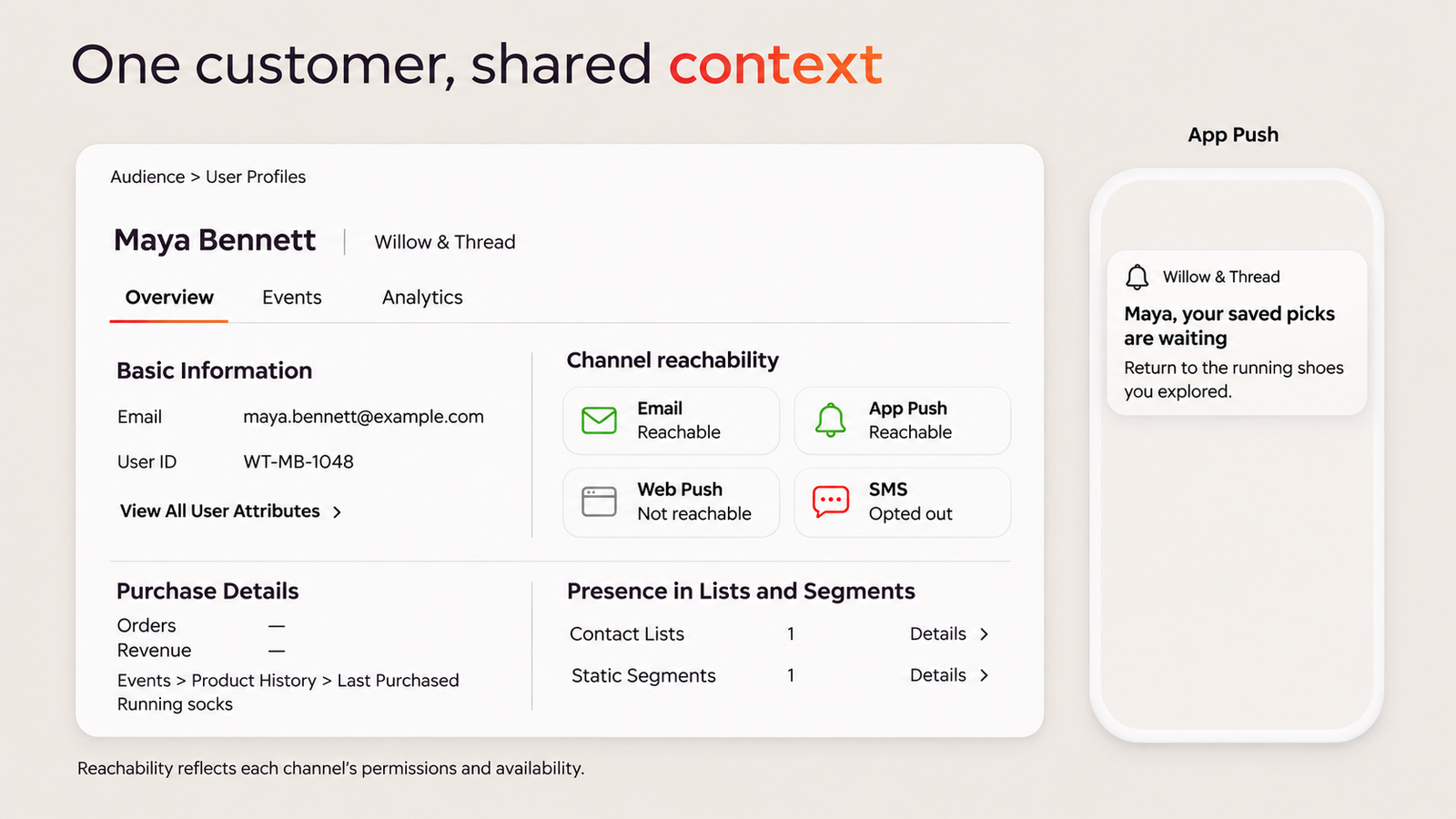
Working omnichannel data means a unified profile can support coordinated activation across configured channels, without marketers manually reconciling exports in a spreadsheet. A shopper who browses running shoes on your app can receive more relevant follow-up across configured channels when the underlying profile is shared rather than duplicated across tools.
The execution goal is a unified data foundation that supports coordinated activation across configured channels, rather than a guarantee that every channel reads from, and writes back to, the same unified customer profile. That means teams should test how purchase events and suppression logic update across their selected channels, integrations, and configurations.
Brands that get this right treat data unification as infrastructure, not a reporting exercise, which is why Journey Orchestration only works as well as the profile feeding it.
Where execution breaks down for customer data for omnichannel marketing
Execution breaks down when identity data stays fragmented across systems that were never designed to talk to each other. A customer relationship management (CRM) system holds one version of a customer, an email service provider (ESP) holds another, and the website analytics tool holds a third, each with a different identifier and no shared key to merge them.
This fragmentation compounds as you add channels. Two systems with mismatched identities are a manageable cleanup project. Six systems, each capturing a partial view through cookies, device IDs, loyalty numbers, and email hashes, turn into a structural problem that no amount of campaign creativity can fix. The result is duplicate profiles, contradictory segment membership, and personalization that contradicts itself across channels.
Batch processing makes this worse. If behavioral and transactional data only sync once a day, personalization may rely on stale customer context. A shopper who already purchased may still get the abandoned-cart email, so teams should validate data freshness and activation behavior for their priority channels and integrations.
The data and orchestration layer teams usually miss
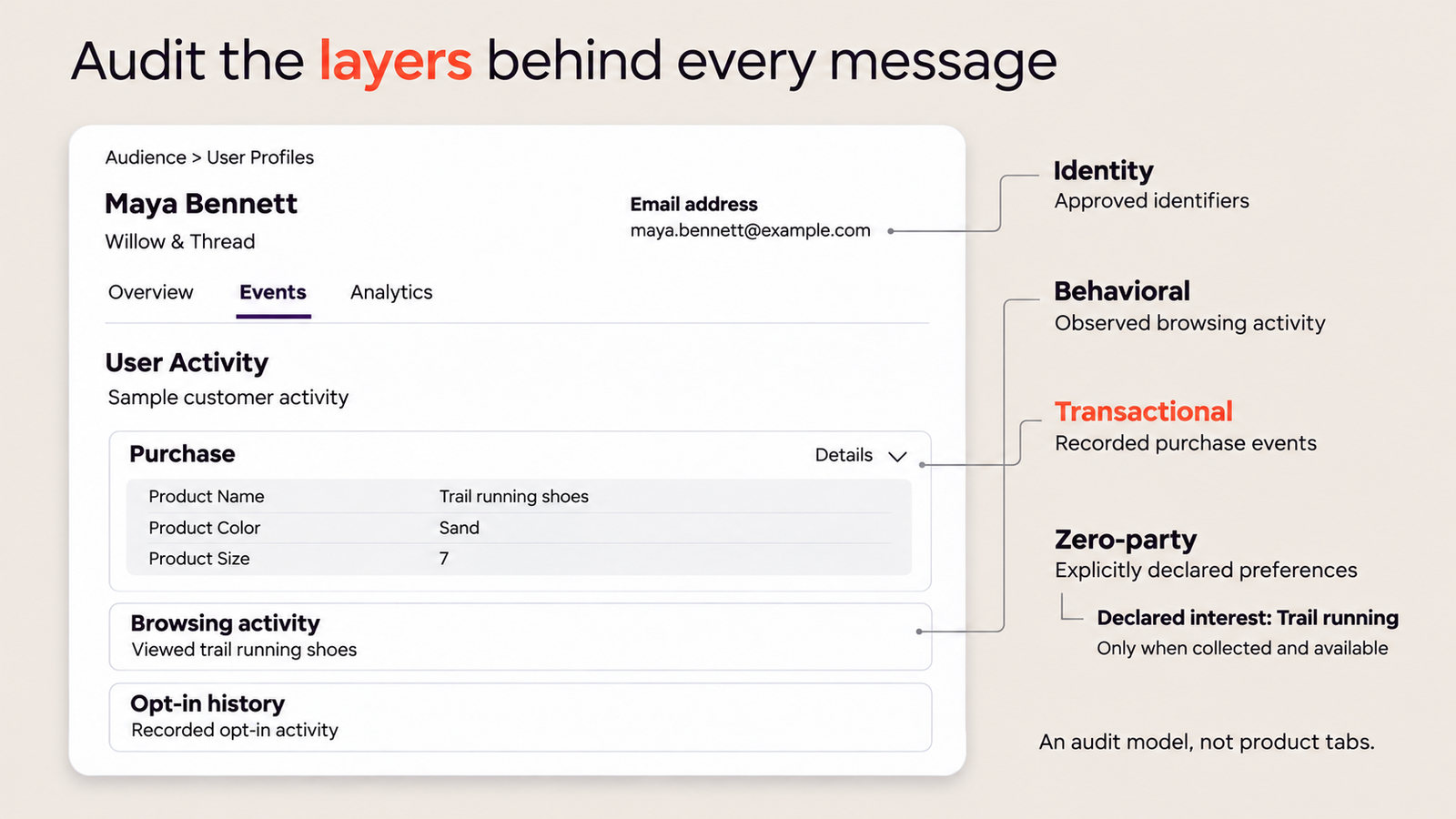
Most audits stop at “do we have the data,” without checking whether it is structured in a way that supports activation. A practical audit separates customer data into four layers, and each layer needs a different collection and resolution strategy to actually feed omnichannel personalization.
Identity data: the layer that makes everything else usable
Identity data is the connective tissue; without a dependable way to associate data across systems, behavioral and transactional data can remain siloed by channel. Known identifiers, such as a logged-in email address or loyalty ID, can help teams associate customer data across systems, while anonymous activity requires a clearly defined data strategy. Teams should validate how anonymous activity, consent, and identifiers are handled in their own implementation before relying on that data for personalization.
The practical fix is establishing a governed profile strategy that brings approved customer data into a shared foundation rather than leaving it fragmented across point solutions. Document which identifiers and data sources your team will use, then validate how those choices affect profile quality, consent, and activation use cases. A platform’s Customer Data Management layer should help teams collect approved customer data, build unified profiles, and make those profiles available for segmentation and engagement workflows.
Behavioral, transactional, and zero-party data: the layers identity unlocks
Behavioral data, browsing, clicks, and app sessions, can be useful in anonymous contexts, while associating it with approved customer identifiers can make it more useful for person-level orchestration. Transactional data, purchases, returns, order value—adds the commercial context that turns behavior into intent. Neither layer is new to most marketers, but both frequently live in disconnected systems that never reconcile against the same customer ID.
Zero-party data is the layer most stacks underuse. It is information customers volunteer directly: preferences, stated interests, communication cadence, through preference centers, quizzes, or onboarding flows. This is the clearest distinction in the zero-party versus first-party data conversation: first-party data is observed from behavior, while zero-party data is explicitly declared, which makes it more reliable for personalization that depends on stated intent rather than inferred patterns.
- Identity: approved customer identifiers and attributes organized into a unified profile strategy
- Behavioral: browsing, search, and app activity that can inform anonymous or known-user experiences, with approved identifiers supporting person-level orchestration
- Transactional: purchase history, order value, returns, refund patterns, tied to lifetime value calculations
- Zero-party: stated preferences, declared interests, and consented contact cadence collected through direct prompts
How to fix customer data for omnichannel marketing without adding more channel chaos
The fix starts with identity resolution, not with adding another channel or another point solution. Adding WhatsApp or product discovery to a fragmented stack just multiplies the number of places your data disagrees with itself. Consolidating identity first means every new channel you activate inherits an already-unified profile instead of adding another silo to reconcile later.
Consent-first collection should run in parallel with identity cleanup, because zero-party data depends entirely on trust. A preference center that asks customers what they want, and clearly uses that answer, generates more reliable signals than inferring preference from behavior alone. Brands that build this consent layer early avoid the retroactive scramble of adding compliance controls after a platform migration.
Run this checklist before any platform conversation:
- Map every system that touches customer data and note whether each has a shared identifier with the others
- Test how long it takes a purchase event to reach your suppression logic across channels
- Audit whether anonymous and logged-in sessions from the same customer ever get merged
- Check whether your preference center data actually reaches campaign targeting, or just sits in a separate database
- Confirm whether segment membership updates in real time or waits for a batch refresh
For a practical example of how a unified data foundation can support segmentation, see how Allianz used Insider One’s AI-powered segmentation capabilities.
What to evaluate before choosing a platform
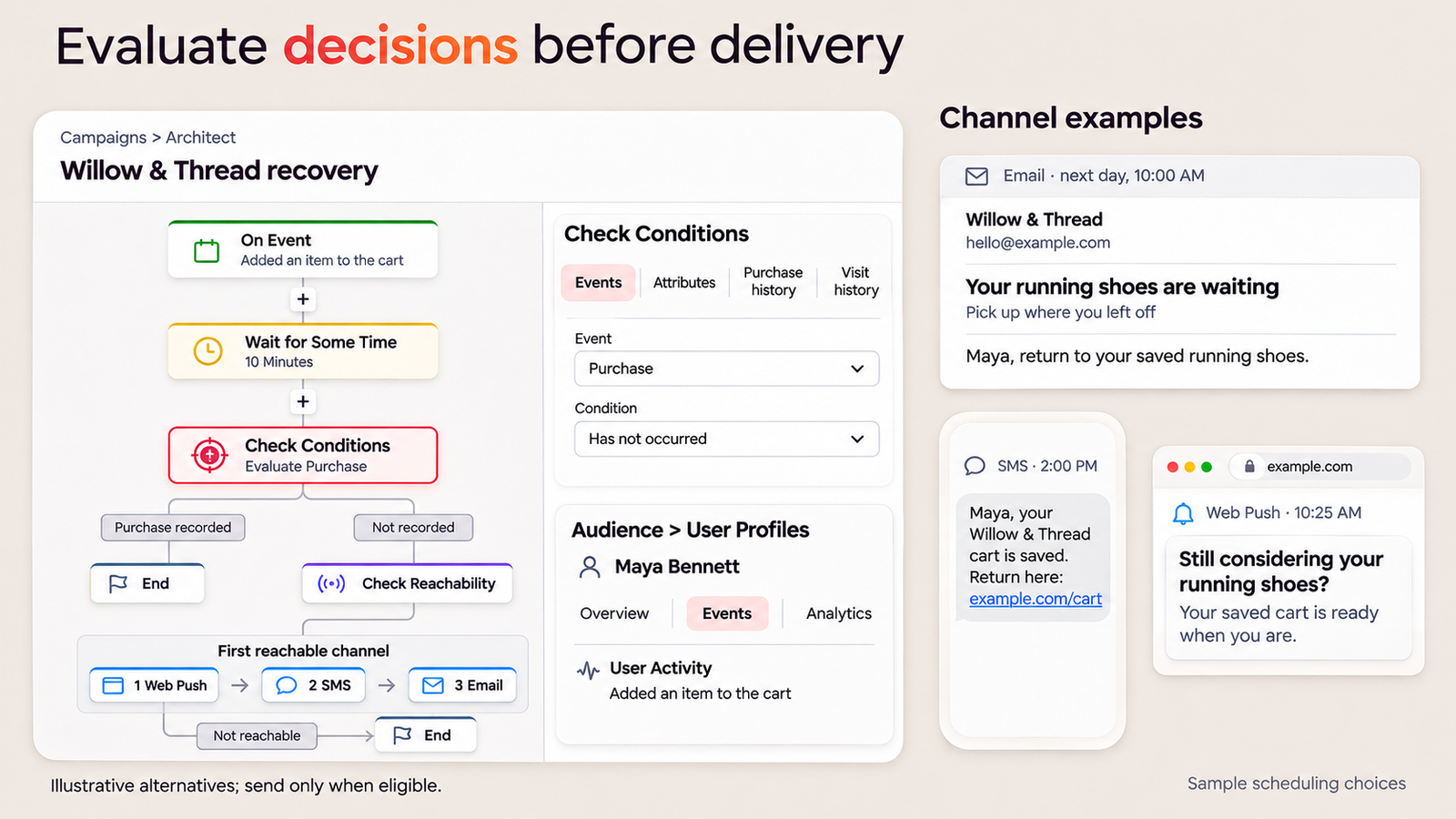
The right evaluation criterion is whether a platform can ingest the data your program needs, build unified profiles, and use them for segmentation and configured cross-channel journeys, not simply how many channels it lists on a feature page. Channel breadth is table stakes; the differentiator is whether the underlying Customer Data Management layer can collect user attributes, events, and product data, build unified profiles, and support segmentation and journey activation across the channels you configure.
Ask vendors how they collect user attributes, events, and product data, and how those inputs are used to create profiles for your intended activation workflows. Request a demonstration using your priority event, then validate data freshness and activation behavior for email, SMS, on-site personalization, and any other configured channels.
For an example of a customer using personalization, see how Philips used Insider One’s personalization capabilities.
Scale changes what “good enough” means. As data volume and channel complexity grow, teams should validate how a platform’s profile, segmentation, and activation workflows perform for their own implementation requirements. Review the Platform and Integrations documentation closely, and weigh how the vendor’s architecture, not just its feature list, holds up as your data volume and channel count both grow.
Conclusion
Omnichannel personalization is a data architecture problem before it is a channel strategy problem, and a connected Growth Management Platform can turn that foundation into coordinated engagement. The four-layer model, identity, behavioral, transactional, and zero-party, gives you a concrete way to audit your stack instead of guessing why campaigns feel disconnected; from there, Insider One can bring unified profiles, segmentation, personalization, cross-channel journeys, messaging, recommendations, and analytics into one connected operating model. Treat identity resolution as a foundation, build consent-first collection alongside it, and align integrations, channel configuration, and data governance so coordinated execution can improve over time.
To evaluate the fit of Customer Data Management for your use case, book a personalized demo to review your goals, data requirements, and implementation constraints with the Insider One team.
Frequently Asked Questions
First-party data is collected by observing behavior—clicks, page views, purchases—directly on your owned channels. Zero-party data is information customers volunteer intentionally, through preference centers, surveys, or onboarding, making it more explicit and often more reliable for personalization based on stated intent.
Four layers matter most: identity data that organizes approved customer identifiers and attributes into a unified profile strategy, behavioral data showing what customers do, transactional data showing what they buy, and zero-party data showing what they explicitly want. Omnichannel personalization breaks down when any one layer stays disconnected from the others.
Identity resolution is the process of organizing available customer identifiers and data so teams can work from a more consistent profile across systems and channels. The exact identifiers, matching approach, consent requirements, and data freshness will vary by platform, integration, and configuration, so validate them against your intended use cases.
A dedicated customer data platform (CDP) is not strictly required, but teams without one may need to assemble and maintain identity, segmentation, and activation workflows across multiple systems. The operational burden can grow as data volume, channel count, consent requirements, and integration complexity increase.
Keep requests short, contextual, and immediately useful to the customer, such as a size preference that improves the next recommendation. Avoid front-loading every question at signup; spread preference collection across the lifecycle so each request feels earned rather than intrusive.

Keep Reading
4 min.

Chris Baldwin
3 Feb 2026
10 mins.
Chris Baldwin
18 Nov 2026
10 mins.
Chris Baldwin
18 Nov 2026