

 Platform Overview

 Integration Hub

 Insider One AI™

 Customer Data Management

 Personalization

 Journey Orchestration

 Reporting & Data

 Behavioral Analytics

 Web
Web

 Email
Email

 Site Search

 Conversational CX

 WhatsApp

 Web Push

 InStory

 App
App

 SMS & RCS

 Join the $0 Migration Movement™

 The Insider One Difference

 Compare Vendors

 Switch to Insider One

 Success Story

 Retail & Ecommerce

 Financial Services

 Travel & Hospitality

 Beauty & Cosmetics

 Automotive

 Telecommunications

 Total Economic Impact™ Study

 Blog
Blog

 E-Books & Guides

 Glossary
Top Braze alternatives for AI decisioning in marketing

Updated on 16 Jun 2026
10 min.
Table of Contents
- What should you know about Braze alternatives for AI decisioning at a glance?
- Which Braze alternatives are best for AI decisioning?
- How does AI decisioning work in customer engagement?
- What evaluation criteria matter most for AI decisioning engines?
- Which Braze alternatives are free or budget-friendly?
- How can you switch from Braze without downtime?
- Why choose Insider One for AI decisioning?
- Frequently asked questions
Most Popular
Summary
Not all AI decisioning platforms are built for true real-time personalization. The leading solutions combine intelligent next-best-action selection, low-latency decision-making, and real-time customer data to deliver the most relevant experience across channels and touchpoints.
Most platforms marketed as Braze alternatives for AI decisioning deliver propensity scores wrapped in journey logic, not true arbitration. Marketing teams discover this gap mid-migration. Campaigns still require manual intervention. Decisioning latency breaks in-session personalization. Constraint-based optimization remains out of reach. Real AI decisioning evaluates all eligible actions simultaneously under constraints like frequency caps and inventory limits, selecting the optimal next action fast enough for live web and app experiences.
What should you know about Braze alternatives for AI decisioning at a glance?
A campaign running on stale data or missing the optimal channel because the platform can’t arbitrate in real time is the failure mode this table addresses.
| Vendor | Decisioning type | Latency | Exploration-exploitation | Guardrails | Bring your own model (BYOM) |
| Insider One | Native next-best-action (NBA) | Real-time | Yes | Native | Via API |
| Adobe Journey Optimizer | Rules + ranking | Near real-time | Partial | Configurable | Yes |
| Salesforce Marketing Cloud | Scoring + rules | Near real-time | Partial | Configurable | Yes |
| SAS CI 360 | Native NBA | Real-time | Yes | Native | Yes |
| Bloomreach Engagement | Scoring + rules | Near real-time | Partial | Limited | Via API |
| CleverTap | Scoring + rules | Near real-time | Partial | Configurable | Via API |
| MoEngage | Scoring + rules | Near real-time | Partial | Limited | Via API |
| Iterable | Scoring + rules | Batch | No | Limited | Via API |
| Klaviyo | Scoring + rules | Batch | No | Limited | No |
| Customer.io | External API | Batch | No | Limited | Via API |
Low latency is required for in-session personalization. Batch latency works for triggered emails and push notifications but not for real-time web or app experiences.
Which Braze alternatives are best for AI decisioning?
Teams often discover mid-migration that the new platform’s “AI” is propensity scoring piped into rules. That’s not arbitration. Here’s a decisioning-first look at each vendor.
1. Insider One
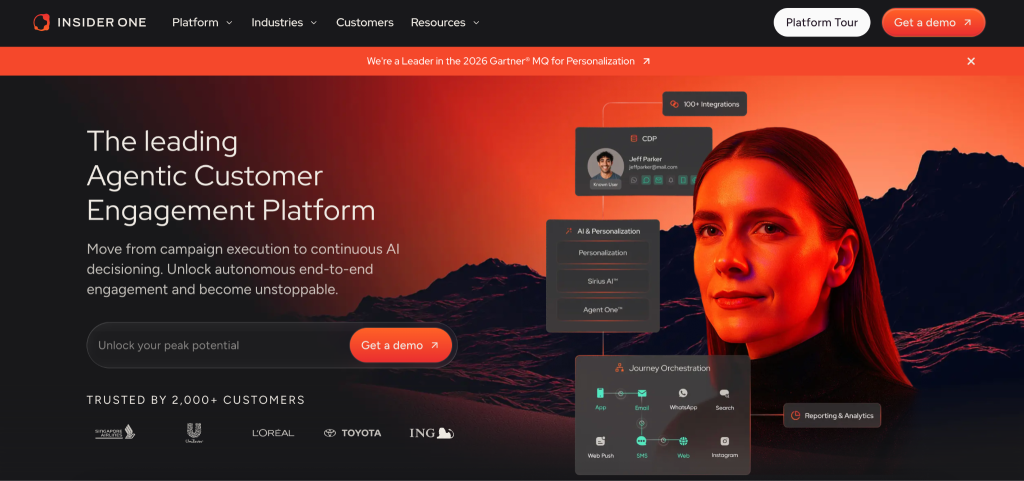
Insider One combines a native customer data platform (CDP), decisioning, and activation in one platform. Sirius AI™, Insider One’s extensive set of AI capabilities, and Agent One™, Insider One’s suite of purpose-built agents for customer engagement, serve as the decisioning layer. The Unified Customer Database feeds real-time profiles into arbitration across web, app, email, WhatsApp, SMS, and push.
Latency supports in-session use cases. Cross-channel orchestration happens through Architect, Insider One’s customer journey orchestration solution. Holdout testing and fatigue management are native.
Migrating from Braze involves SDK event mapping and identity resolution via configurable Identity Resolution Management. Migration Lab™ provides white-glove onboarding with typical activation in a matter of weeks.
Main features:
- Native next-best-action arbitration
- Real-time profile updates
- Cross-channel orchestration via Architect
- Holdout testing and fatigue management
- Integration library
Ideal for:
- Enterprise teams needing fast decisioning
- Brands consolidating CDP, personalization, and orchestration
- Teams migrating from Braze who want faster time-to-value
Pricing:
- Monthly tracked user (MTU)-based with no hidden charges for data, storage, or events
If you want to see what native, low-latency arbitration looks like in a real enterprise setup, request a demo and bring your toughest in-session use case.
2. Adobe
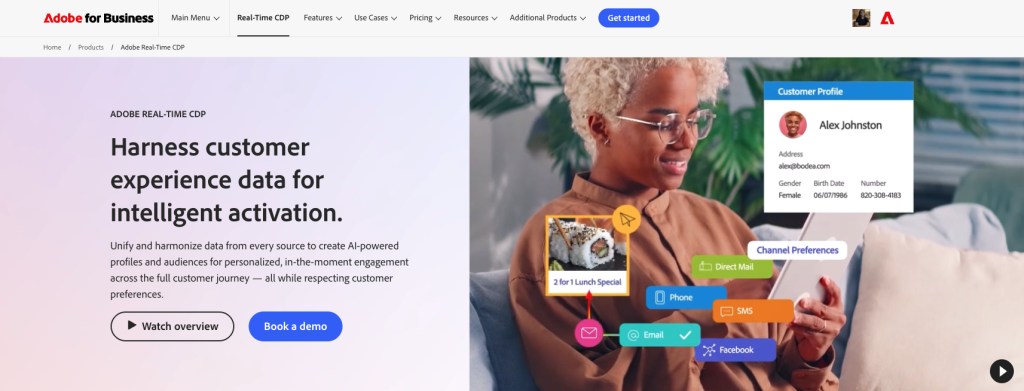
Adobe Journey Optimizer depends heavily on Adobe Experience Platform and Real-Time CDP. Offer Decisioning works through eligibility rules, ranking, and constraints. Latency varies between web personalization and batch journeys.
Governance and guardrail capabilities are strong for large enterprise teams, but implementation complexity runs high for teams not already in the Adobe ecosystem.
Migrating from Braze involves a different data model and longer ramp-up. Strong fit for enterprises already using Adobe Analytics or AEM.
3. Salesforce Marketing Cloud
Salesforce Marketing Cloud Personalization handles real-time web and app personalization. Einstein delivers propensity scoring, next-best-action recommendations, and send-time optimization. The system depends on Salesforce Data Cloud for unified identity.
Frequency capping and reason codes are available but require configuration.
Migrating from Braze requires adapting to a different identity model. Implementation takes longer for teams outside the Salesforce CRM ecosystem.
4. Bloomreach
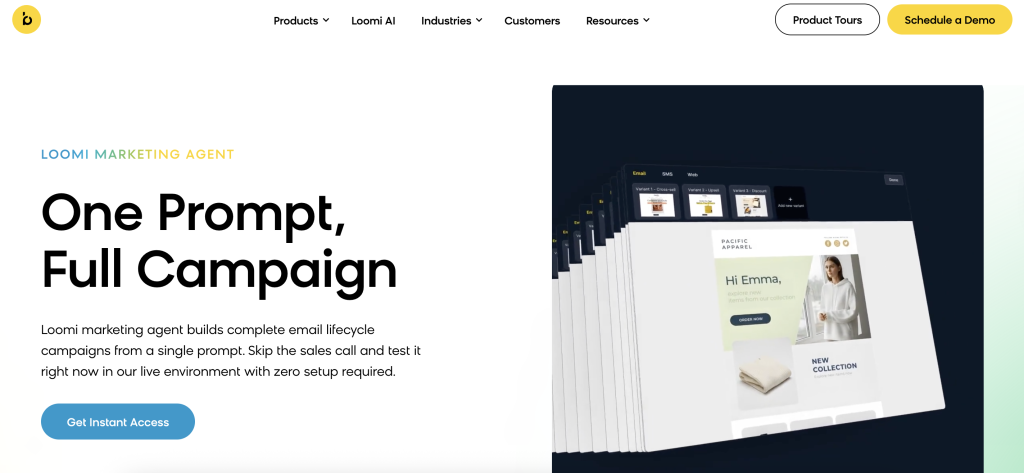
Bloomreach shows strength in ecommerce through product catalog integration and Loomi AI for recommendations. Loomi supports product recommendations for ecommerce use cases.
Cross-channel offer arbitration still depends on journey logic and rules. Real-time profile capabilities and event triggers support catalog-driven ecommerce use cases.
This vendor serves ecommerce brands that prioritize catalog-driven personalization. Less ideal for teams needing constraint-based arbitration across non-product offers. Braze vs Klaviyo comparisons often miss this distinction.
5. CleverTap
CleverTap features a mobile-first architecture covering push, in-app, and app inbox. The AI layer handles send-time optimization and engagement scoring.
A/B testing and holdouts are available. Automated optimization exists, but true bandit-style testing requires manual configuration.
Migrating from Braze involves a similar mobile SDK model. Verify push token handling and event taxonomy alignment during the switch.
6. MoEngage
MoEngage positions itself for B2C mobile and web engagement with real-time segmentation and propensity-based targeting.
Predictive segments and journey triggers are supported, but cross-offer arbitration relies on rules. External model integration via APIs is available. Verify latency for real-time use cases.
Migrating from Braze offers similar channel coverage. Audit identity resolution and push token migration carefully.
7. Iterable
Iterable focuses on journey orchestration with an AI layer that includes Brand Affinity and send-time optimization. Scoring and journey branching work well.
True constraint-based arbitration requires custom logic or external integration. Experimentation capabilities and catalog support are solid.
Migrating from Braze is often straightforward due to similar architecture and event model. Fits teams prioritizing journey orchestration over advanced decisioning.
8. Klaviyo
Klaviyo excels in ecommerce email and SMS with predictive analytics and pre-built flows. Catalog-driven email personalization and churn prediction work effectively.
Native mobile push, in-app messaging, and real-time arbitration are absent. Klaviyo fits ecommerce brands focused on email and SMS with Shopify integration.
Teams needing mobile-first apps or complex cross-channel arbitration should look elsewhere. Braze vs Klaviyo comes down to channel coverage: Klaviyo is not a direct replacement for mobile engagement.
How does AI decisioning work in customer engagement?
When a vendor says “AI-powered,” the question is whether that means propensity scores fed into if/then rules or true arbitration under constraints.
Here’s how AI decisioning works: given a customer context, a set of eligible actions, and constraints like frequency caps and inventory limits, the system selects the optimal action in real time.
Three architectures exist:
- Rules plus scores: A propensity model outputs a score. Rules determine the action. Fast to implement, but doesn’t optimize across competing actions
- Ranking with constraints: A model ranks actions. Constraints filter and cap. Better, but still sequential
- True arbitration: An optimization engine evaluates all eligible actions simultaneously, balancing expected value against constraints. Requires low-latency inference for in-session use cases
If you’re pressure-testing vendors, use the product demo hub to see decisioning patterns in action, especially how arbitration behaves when multiple offers compete under real constraints.
What evaluation criteria matter most for AI decisioning engines?
Vendor demos look similar. The differences emerge under load and at scale.
- Inference latency: What’s the tail latency for a decisioning call? For in-session web and app personalization, low latency is the threshold. For triggered messages, near-real-time is often sufficient
- Exploration and exploitation: Does the platform support bandit-style testing, or only A/B? Bandits reduce opportunity cost during experimentation
- Guardrails and frequency capping: Can you set constraints at the offer, channel, and customer level? Without real-time frequency capping, customers receive duplicate offers within minutes
- Observability and reason codes: Can you see why a specific action was selected for a specific customer? This matters for debugging and compliance
- Incrementality measurement: Does the platform support holdouts and counterfactual analysis, or only engagement metrics?
- BYOM support: Can you bring your own models, or are you locked into the vendor’s algorithms? What’s the latency for external model calls?
To avoid a costly “AI” surprise after you sign, request a demo and ask for tail latency, reason codes, and frequency-cap enforcement, live and not on slides.
Which Braze alternatives are free or budget-friendly?
Enterprise platforms dominate the conversation, but teams with smaller budgets have options. Lower cost usually means more assembly required.
- Freemium platforms: Customer.io and Klaviyo offer free tiers or low entry points. Decisioning is limited to rules and basic scoring. Suitable for teams prioritizing activation over optimization
- Warehouse-native plus reverse ETL: Use your existing data warehouse as the decision layer. Tools like Hightouch sync decisions to activation platforms. Lower licensing cost, but adds latency that disqualifies in-session use cases
- Open-source components: Feature stores, experimentation frameworks, and ML serving layers can be assembled into a decisioning stack. High flexibility, high build cost
If you’re weighing “buy vs build” (or trying to keep costs predictable while still hitting real-time), start with the product demo hub to see what’s native vs what requires additional tools and integration.
How can you switch from Braze without downtime?
Teams delay migrations because they can’t afford campaign downtime or data loss. A parallel-run framework mitigates these risks.
- Audit current state: Map Braze event taxonomy, custom attributes, and identity keys. Document active campaigns, segments, and integrations
- Align data models: Match event names and attribute schemas to the target platform. Identify gaps requiring transformation
- Implement dual tracking: Send events to both Braze and the new platform simultaneously. Validate data parity
- Migrate identity: Configure identity resolution in the new platform. Verify profile unification matches Braze
- Rebuild campaigns in shadow mode: Recreate key journeys without activating sends. Compare segment sizes and trigger logic
- Run holdout validation: Activate a small share of traffic on the new platform. Measure engagement and conversion against Braze baseline
- IP address warming: For email, warm new sending IP addresses gradually to maintain deliverability
- Cutover and monitor: Shift remaining traffic. Keep Braze active for rollback during a stabilization period
Common failure points: event taxonomy drift during dual tracking, identity resolution mismatches causing duplicate profiles, and skipping holdout validation.
If you want a migration plan that protects revenue while you parallel-run and validate incrementality, request a demo and we’ll map the cutover sequence to your current Braze architecture.
Why choose Insider One for AI decisioning?
Insider One combines CDP, decisioning, and activation in one platform. This reduces integration latency by keeping data and activation in one platform and simplifies migration by reducing external dependencies.
- Decisioning architecture: Sirius AI™ and Agent One™ handle next-best-action arbitration natively
- Latency: Low latency for in-session web and app personalization
- Migration support: Migration Lab™ provides white-glove onboarding with a typical activation timeline
- Pricing: MTU-based with no hidden charges for data, storage, or events
- Validation: Rated 4.9 on Gartner Peer Insights and recognized in Gartner and IDC reports
See the platform end-to-end (CDP to arbitration to activation) inside the product demo hub so you can judge decisioning on outcomes, not feature lists.
Frequently asked questions
Rules-based journeys use if/then logic on static segments or scores. AI decisioning evaluates all eligible actions simultaneously and optimizes under constraints. The difference matters when you have multiple competing offers or channels.
Run a holdout test. Exclude a random percentage of users from AI-selected actions and compare conversion against the baseline. Validate for statistical significance before scaling.
Decisioning at scale increases API calls and event volume. Platforms with per-event or per-call pricing can see costs spike. MTU-based models with inclusive events offer more predictable costs.
Consolidation works when the platform handles your core use cases natively. For specialized needs, use APIs to integrate rather than replace. The goal is fewer handoffs, not fewer capabilities.

Keep Reading
7 min.

Muharrem Derinkok
4 Jun 2026
11 min.

Chris Baldwin
2 Jun 2026
4 min.
Chris Baldwin
3 Feb 2026