

 Platform Overview

 Integration Hub

 Agent One™

 Agent One Teams™

 Customer Data Management

 Personalization

 Journey Orchestration

 Reporting & Data

 Behavioral Analytics

 Web
Web

 Email
Email

 Site Search

 Conversational CX

 WhatsApp

 Web Push

 InStory

 App
App

 SMS & RCS

 Join the $0 Migration Movement™

 The Insider One Difference

 Compare Vendors

 Switch to Insider One

 Success Story

 Retail & Ecommerce

 Financial Services

 Travel & Hospitality

 Beauty & Cosmetics

 Automotive

 Telecommunications

 Total Economic Impact™ Study

 Blog
Blog

 E-Books & Guides

 Glossary
Best All-in-One Martech Stacks for Email, SMS, and Customer Engagement

Updated on 29 Jun 2026
9 min.
Table of Contents
Most Popular
Summary
An all-in-one martech platform combines customer data, journey orchestration, and native marketing channels in one system, making it easier to deliver personalized omnichannel experiences. Insider One is built for enterprise teams, HubSpot suits B2B organizations, and Klaviyo is a strong choice for Shopify brands and SMBs.
If your team needs real-time identity resolution and cross-channel journeys without filing information technology (IT) tickets, prioritize platforms with native CDP and orchestration over bolt-on integrations.
This guide shows you how to choose an all-in-one martech platform that matches your data maturity, primary channels, and team capacity without creating new bottlenecks.
Most platforms still force you to choose between depth and breadth, and marketing teams end up spending more time managing tools than running campaigns.
All-in-one martech platforms promise to fix this by unifying customer data, journey orchestration, and channel execution in a single system.
What is an all-in-one martech platform?
An all-in-one martech platform combines data unification, journey orchestration, and native channel execution in a single system. You can do this from one place:
- Collect customer data
- Build automated campaigns
- Send messages across email, SMS, push, and web
This differs from point solutions that handle only one channel. It also differs from standalone CDPs that unify data but require separate tools to actually send messages.
Three main architecture patterns exist:
- Suite-centric: One vendor owns both your data and execution layer
- CDP-centric: A CDP handles data, with activation via connectors to channel tools
- Composable: A data warehouse plus reverse ETL pushes audiences to best-of-breed channels
A CRM with email bolted on doesn’t count. Neither does a data management platform focused on third-party cookies or a tag manager without activation capabilities.
Which all-in-one martech platforms are the best fit?
Each review below covers identity approach, native channels, pricing model, best-fit constraint, and known watch-outs. This consistency lets you compare platforms directly rather than decoding inconsistent vendor positioning.
1. Insider One
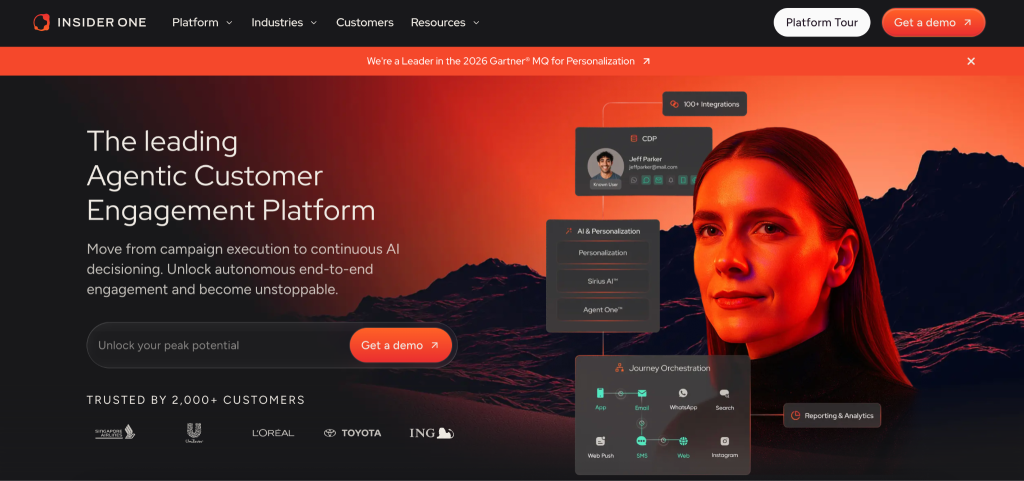
Insider One provides a unified CDP with real-time identity resolution. Architect, Insider One’s customer journey orchestration solution, connects this data to native channels including email, SMS, WhatsApp, push, in-app, web, and RCS. Teams typically go live quickly.
Sirius AI™, Insider One’s extensive set of artificial intelligence (AI) capabilities, powers predictive segmentation and send-time optimization.
The platform uses predictable MTU-based pricing with no hidden charges for data, storage, or duplicated events.
Ideal for: Enterprise and mid-market teams needing real-time personalization without IT dependency
Watch outs: Requires commitment to a unified platform approach rather than a fragmented stack. If you want to see what “unified” looks like in practice, request a demo and pressure-test identity, orchestration, and channel execution in one flow.
2. Adobe Experience Platform
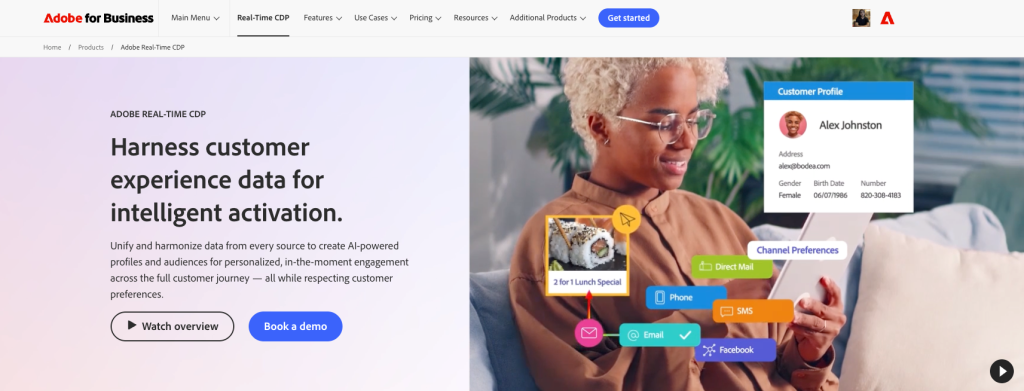
The Adobe stack includes Real-Time CDP for identity and Journey Optimizer for orchestration. These modules connect to Adobe Analytics and Target for a comprehensive enterprise suite. Full omnichannel activation requires multiple modules.
Ideal for: Organizations already heavily invested in the Adobe ecosystem
Watch outs: Requires multiple stock-keeping units (SKUs) for full functionality. Implementation typically takes several months for enterprise deployments.
3. Salesforce Marketing Cloud
Salesforce Marketing Cloud includes Journey Builder, Email Studio, and Mobile Studio. Unified profiles and cross-channel identity resolution require the Data Cloud add-on. Omnichannel activation depends on this data foundation, not just the marketing modules alone.
Ideal for: Teams already using Salesforce Sales Cloud or Service Cloud
Watch outs: Journey Builder complexity increases significantly with channel count. Einstein AI features require additional licensing.
4. HubSpot Marketing Hub
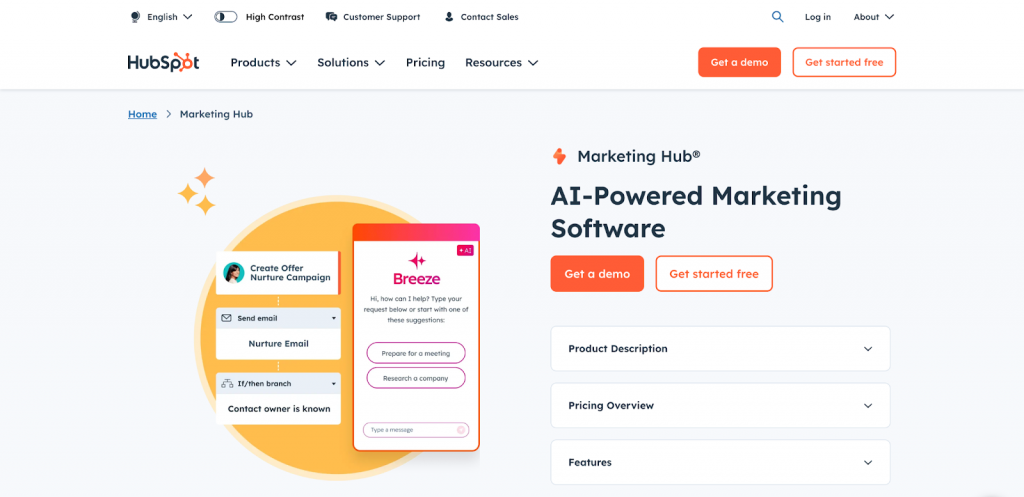
HubSpot builds its marketing hub on a Smart CRM foundation with workflow automation and native email. The platform handles ads and landing pages well for mid-market teams. You’ll face channel limitations: no native WhatsApp and limited push notifications.
Ideal for: B2B software as a service (SaaS) and mid-market teams focused on lead generation
Watch outs: Native channels limited to email, ads, and landing pages. Contact tier pricing spikes rapidly with list growth.
5. Braze

Braze uses a Canvas interface for journey orchestration and relies on a software development kit (SDK)-first architecture for real-time event streaming.
The platform handles engagement well but relies on external CDPs or data pipelines for identity resolution. You need a separate tool to unify your customer profiles.
Ideal for: Mobile-first brands with strong internal engineering teams
Watch outs: No native CDP means you need Segment or a warehouse integration for identity. Credit-based pricing creates budget unpredictability at scale.
6. Klaviyo
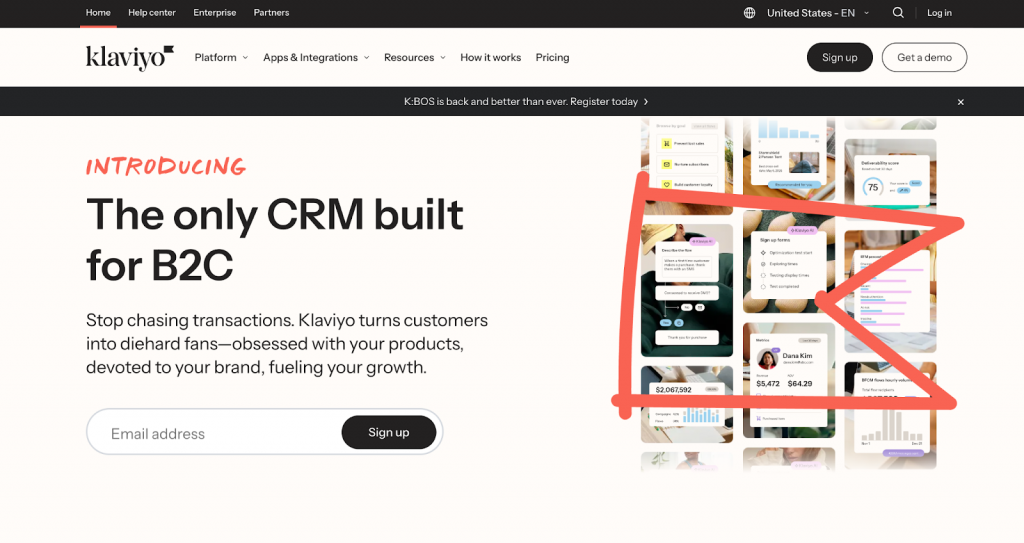
Klaviyo provides Shopify-native flows and predictive analytics for churn risk and customer lifetime value. The platform focuses strictly on email and SMS execution.
Native push notifications, web personalization, and advanced identity resolution aren’t covered.
Ideal for: SMB ecommerce brands using Shopify
Watch outs: Scope limited to email and SMS. Pricing scales steeply as your list grows.
7. Bloomreach
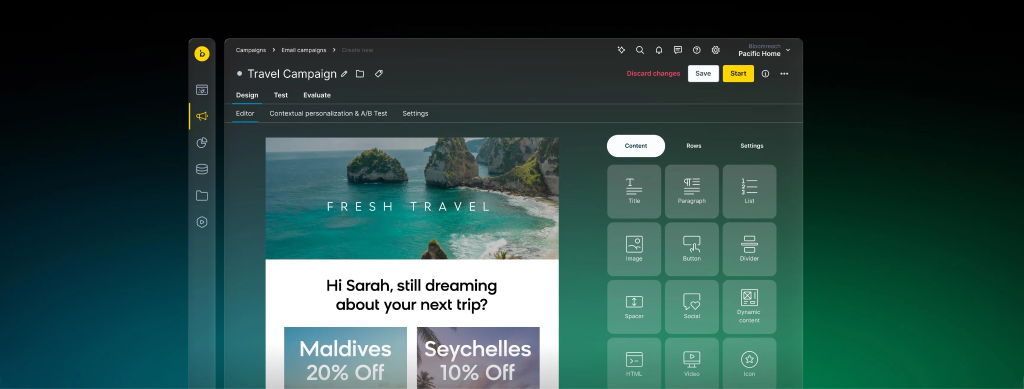
Bloomreach focuses on catalog-driven personalization and ecommerce triggers like abandoned cart or price drop alerts. The platform works well for retail brands needing web personalization.
Advanced personalization requires technical skills to use Jinja templating.
Ideal for: Retail and ecommerce brands with massive product catalogs
Watch outs: Less suited for non-catalog use cases. Event-based pricing creates cost unpredictability compared to predictable MTU pricing.
8. MoEngage
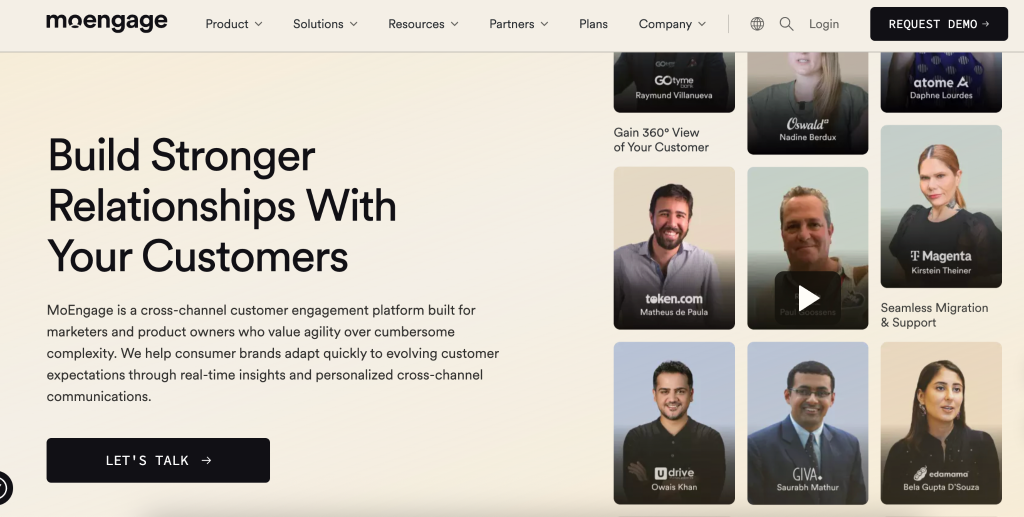
MoEngage focuses on push notifications, in-app messaging, and mobile-first journeys. The platform uses recency, frequency, monetary (RFM) segmentation and app event triggers to drive engagement.
Its warehouse-native architecture differs from a traditional CDP.
Ideal for: App-led brands focused on mobile engagement
Watch outs: Web capabilities are less mature than mobile offerings. AI features require massive event volume for accuracy. If you want a fast way to compare orchestration depth and native channel coverage side by side, explore the product demo hub before you shortlist.
What to look for in all-in-one martech platforms
The goal isn’t finding the platform with the longest feature list. You need the platform that matches your data maturity, channel needs, and team capacity.
What should you verify in identity resolution?
Platforms claim identity resolution but differ wildly in approach. Deterministic matching uses exact matches on email, phone, or user ID. Probabilistic matching uses device graphs and behavioral matching to guess identity.
Probabilistic matching without transparency into confidence scores creates false merges that corrupt your segments. During your evaluation, upload a test file with known duplicates and measure merge accuracy.
Which native channels do you actually get?
Native means the platform sends messages directly rather than via a webhook to a third party. Verify coverage for:
- SMS
- Push
- In-app
- Web push
- Ad audience sync
SMS requires number provisioning. WhatsApp requires Business application programming interface (API) approval. During your trial, test send latency on each claimed native channel. If native actually means via a partner API, expect added latency and potential rate limits.
How should you evaluate journey orchestration?
Journey orchestration ranges from simple drip sequences to real-time, event-driven branching. Key differentiators include trigger latency, branching logic, and experiment support like split testing.
Real-time triggers require streaming infrastructure and increase costs. Batch orchestration works for campaigns where minutes don’t matter. Build a test journey with an event trigger and measure time from event to message delivery. Long delays aren’t real-time. If you want to see what “real-time” looks like end to end (event → decision → message), request a demo and bring your toughest latency use case.
How should you compare pricing and total cost of ownership?
Published pricing rarely reflects your actual cost. Build a long-term model including:
- Base platform fee and contact/MTU tiers
- Channel-specific costs like SMS credits and WhatsApp fees
- Overage rates when exceeding tier limits
- Add-on modules for advanced analytics or AI features
- Implementation and migration services
MTU-based pricing is more predictable than event-based pricing for high-engagement brands. Event-based can be cheaper for low-frequency communication.
Which platform fits your team based on your constraints?
Generic recommendations don’t help you make a buying decision. Segment your choice by concrete constraints.
What fits a Shopify team with an email and SMS focus?
Teams with a modest list size and a constrained monthly budget need Shopify-native integrations. Prioritize pre-built ecommerce flows for cart abandonment and post-purchase follow-ups. Klaviyo is the default choice for this constraint.
You’ve outgrown email and SMS-only platforms when you need push notifications, web personalization, or WhatsApp.
What fits a B2B SaaS team focused on lead lifecycle?
B2B teams need lead scoring, nurture sequences, and CRM sync more than real-time behavioral triggers. HubSpot is the default for teams without an existing Salesforce investment. Salesforce Marketing Cloud fits teams already on Sales Cloud who need tighter data alignment.
Where does your sales team live? HubSpot reduces integration complexity if you don’t use Salesforce.
What fits enterprise ecommerce teams with omnichannel needs?
Enterprise ecommerce teams with very large profile counts need platforms that handle scale, latency, and governance simultaneously. Insider One, Adobe, and Salesforce make up the typical shortlist.
Adobe and Salesforce offer deep ecosystem integration but require longer implementation timelines. Insider One offers broad omnichannel capabilities. If you want to see how teams stand up omnichannel journeys without weeks of integration work, start in the product demo hub.
Which martech stack architecture pattern fits your team?
Your platform choice is also an architecture choice. Tighter integration reduces complexity but increases switching costs. Looser coupling preserves flexibility but adds operational overhead.
What is suite-centric architecture?
One vendor owns both your data and execution layer. You get a single contract, unified support, and native integrations. Swapping components becomes harder, and vendor pricing power increases over time.
This pattern fits teams prioritizing speed over flexibility or those already invested in an ecosystem like Salesforce or Adobe.
What is CDP-centric architecture?
The CDP acts as the data layer, and you handle activation via connectors to channel tools. Your data ownership stays with you, giving you flexibility to swap execution tools. You must maintain more integration points and utilize data engineering resources.
This pattern fits teams with existing data infrastructure and comfort managing multiple vendors.
What is warehouse-centric composable architecture?
A data warehouse serves as the foundation, using reverse ETL to push audiences to activation tools. This offers maximum flexibility and keeps data entirely in your control. It also creates the highest operational complexity and requires a dedicated data team.
Avoid this pattern if you lack data engineering resources. The composable promise often underestimates the ongoing maintenance burden.
Want a personalized martech stack recommendation?
Evaluating platforms for cross-channel engagement requires mapping your specific requirements to actual capabilities. Our team can help you build a shortlist based on your exact constraints and data maturity. Schedule a demo to see how a unified platform accelerates your time-to-value. Request a demo, and we’ll map your current stack to a realistic path to omnichannel.
FAQs
Costs range from free tiers for small businesses to custom enterprise pricing. Most mid-market platforms start in the low thousands per month based on contacts or MTU.
It depends on whether your platform includes native identity resolution. Platforms like Insider One and Adobe include CDP capabilities. Platforms like Braze typically require an external CDP.
Enterprise implementations often take several months, depending on data complexity and integration scope. Platforms with dedicated migration support can compress this timeline significantly.
Verify data export capabilities, API access to your profiles and events, and contract terms around data portability before signing. Platforms that store data in your warehouse reduce lock-in risk.
A suite bundles data, orchestration, and channels from one vendor for simplicity. A composable stack assembles best-of-breed tools for flexibility but requires more integration work.
Depends on scale. Klaviyo works for SMB Shopify stores. Bloomreach fits mid-market catalog-driven personalization. Insider One or Adobe handles enterprise omnichannel with predictive capabilities.

Keep Reading
7 min.

Muharrem Derinkok
4 Jun 2026
11 min.

Chris Baldwin
2 Jun 2026
4 min.
Chris Baldwin
3 Feb 2026