

 Platform Overview

 Integration Hub

 Insider One AI™

 Customer Data Management

 Personalization

 Journey Orchestration

 Reporting & Data

 Behavioral Analytics

 Web
Web

 Email
Email

 Site Search

 Conversational CX

 WhatsApp

 Web Push

 InStory

 App
App

 SMS & RCS

 Join the $0 Migration Movement™

 The Insider One Difference

 Compare Vendors

 Switch to Insider One

 Success Story

 Retail & Ecommerce

 Financial Services

 Travel & Hospitality

 Beauty & Cosmetics

 Automotive

 Telecommunications

 Total Economic Impact™ Study

 Blog
Blog

 E-Books & Guides

 Glossary
Behavioral Trigger Email Campaigns: The Fastest Fix for Underperforming Sends

Updated on 7 Jul 2026
10 min.
Table of Contents
Most Popular
Summary
Triggered emails outperform batch campaigns by responding to customer behavior in real time. The most effective programs use unified customer data, personalized content, and optimized timing, while success is measured through revenue per triggered send, trigger coverage, and conversion speed.
Somewhere in your email program, there is a gap between what you know about your customers and what you actually send them. You have to browse data, cart data, purchase history, and loyalty signals, yet a surprising number of those behavioral moments trigger nothing at all. A contact views a product three times and leaves.
A lapsed buyer returns after 90 days. A loyalty milestone passes without acknowledgment. Your platform registers the event; your campaigns do not respond.
That gap is a revenue problem. Behavioral trigger email campaigns, messages sent in direct response to a customer action or inaction, consistently outperform broadcast sends on every metric that matters, from click-through rate to revenue per send.
The real opportunity is architectural: building a sequenced trigger layer that covers every meaningful behavioral moment across the full customer lifecycle. That requires a different way of thinking about both campaign design and the data infrastructure underneath it.
The performance gap: why batch-and-blast campaigns are losing ground
Schedule-based sending made sense when inbox competition was lower and open rates were a reliable signal. Neither condition holds today. Apple’s Mail Privacy Protection (MPP), which launched in 2021, inflated open-rate data across the industry and stripped out much of the intent signal that batch senders depended on for optimization.
Sending volumes have also risen considerably over the past few years, meaning your broadcast email now lands in a more crowded inbox, competing against messages timed far more precisely to individual behavior.
The core advantage of triggered email is moment-matching. When you time a send to a specific behavioral signal, whether that is a browse session, a cart abandonment, or a post-purchase window, you reach people when their intent is highest.
That precision is something no broadcast calendar can replicate at scale, and it accounts for the consistent performance delta between triggered and broadcast sends on engagement and revenue metrics.
A practical taxonomy of behavioral triggers, and which to build first
Not all triggers are created equal. Some deliver fast, measurable revenue lifts with relatively simple setup. Others require richer data and more sophisticated suppression logic before they perform reliably. Knowing which category to prioritize is as important as knowing the triggers exist.
The five core trigger categories
Acquisition triggers fire at the earliest relationship moment: the welcome series. These are high-priority because new subscribers are at peak engagement and your brand is top of mind. A well-structured welcome sequence sets behavioral expectations, surfaces key products, and begins collecting zero-party preference data that makes downstream personalization sharper.
Consideration triggers respond to research behavior: product page views, category browses, wishlist additions, and price-drop events. These are the messages that turn passive interest into active intent. The challenge here is precision; messaging too quickly after a single browse can feel intrusive, while waiting too long allows the moment to pass.
Conversion triggers are the most widely deployed: cart abandonment and checkout abandonment sequences. These typically represent the fastest path to measurable revenue lift because they catch people who have already demonstrated strong purchase intent. They are also the easiest trigger category to justify internally, which makes them a good starting point for teams building a trigger program from scratch.
Retention triggers activate after a purchase: post-purchase onboarding sequences, cross-sell and upsell moments timed to product usage cycles, and re-engagement campaigns for contacts who have gone dormant. These are often undertriggered because teams celebrate the conversion and underinvest in what happens next.
Loyalty triggers fire on milestones: birthdays, anniversaries, loyalty tier changes, and referral events. These have lower absolute revenue contribution but an outsized effect on retention and emotional brand connection.
Sequencing, not silos
The compounding effect comes from layering these categories into a connected trigger architecture rather than running each as a standalone campaign. A customer who enters through an acquisition trigger, receives consideration triggers during the research phase, converts through a cart recovery sequence, and then enters a structured post-purchase journey is far more valuable over 12 months than one who experienced only the cart email. Each trigger reinforces the next, and suppression logic keeps the sequence from becoming noise.
The data infrastructure that makes triggers work
Trigger logic is only as good as the data feeding it. The most common reason behavioral trigger email campaigns underperform is not bad creative or poor timing windows; it is data latency. When behavioral signals have to travel through batched exports, middleware layers, or manual syncs before reaching your messaging platform, the window closes before the send goes out.
Why real-time data changes the trigger equation
Consider a contact who abandons a cart at 2 p.m. If your platform pulls a nightly customer relationship management (CRM) export, the cart abandonment email goes out the following morning. The contact has already moved on, possibly purchased elsewhere, or simply lost the urgency that made the trigger worth sending.
Keeping the send inside the window where it still has commercial relevance is a general best practice across categories, and it depends almost entirely on how quickly behavioral data reaches your trigger logic.
The middleware problem in fragmented stacks
Some platforms require a separate customer data platform (CDP) or data warehouse to activate advanced behavioral segmentation. That architecture introduces three problems: latency between a behavioral event and the message sent, significant engineering dependency every time trigger logic needs updating, and ongoing cost from maintaining the integration layer itself.
Marketers in these environments often find that behavioral triggering becomes an engineering project rather than a campaign capability, which means trigger programs stay simpler than they should because the overhead is too high.
Insider One’s built-in Customer Data Management eliminates that middleware dependency. Behavioral data collected across web, app, email, and other channels flows into unified customer profiles available for trigger logic in real time, without a separate data pipeline.
That shift matters operationally because it reduces the engineering dependency required to build and update trigger logic, allowing marketing teams to iterate faster with significantly less back-and-forth with development.
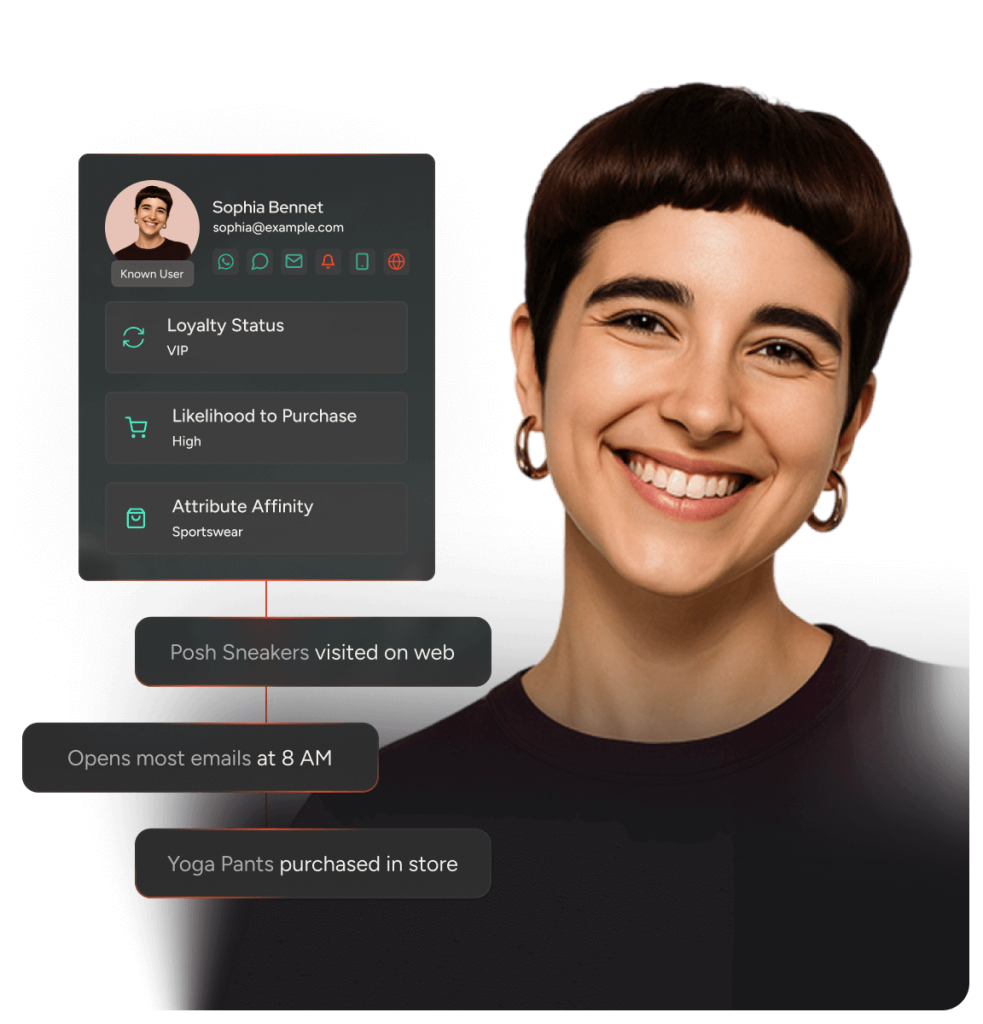
Adidas increased their average order value by 259% and conversion rate by 13% in a single month using Insider One’s personalization platform, results that depend on behavioral data activating immediately rather than arriving the next morning.
Designing triggered emails that actually convert
Getting the architecture right is necessary but not sufficient. The content inside your triggered emails determines whether a well-timed send converts or gets ignored.
The four content levers
- Timing window. For cart abandonment, early delivery matters significantly. Contacts reached within the first hour of abandonment tend to convert at higher rates than those reached several hours later, because purchase intent decays quickly once a session ends. This is why real-time data infrastructure is a content performance issue, not just a technical one.
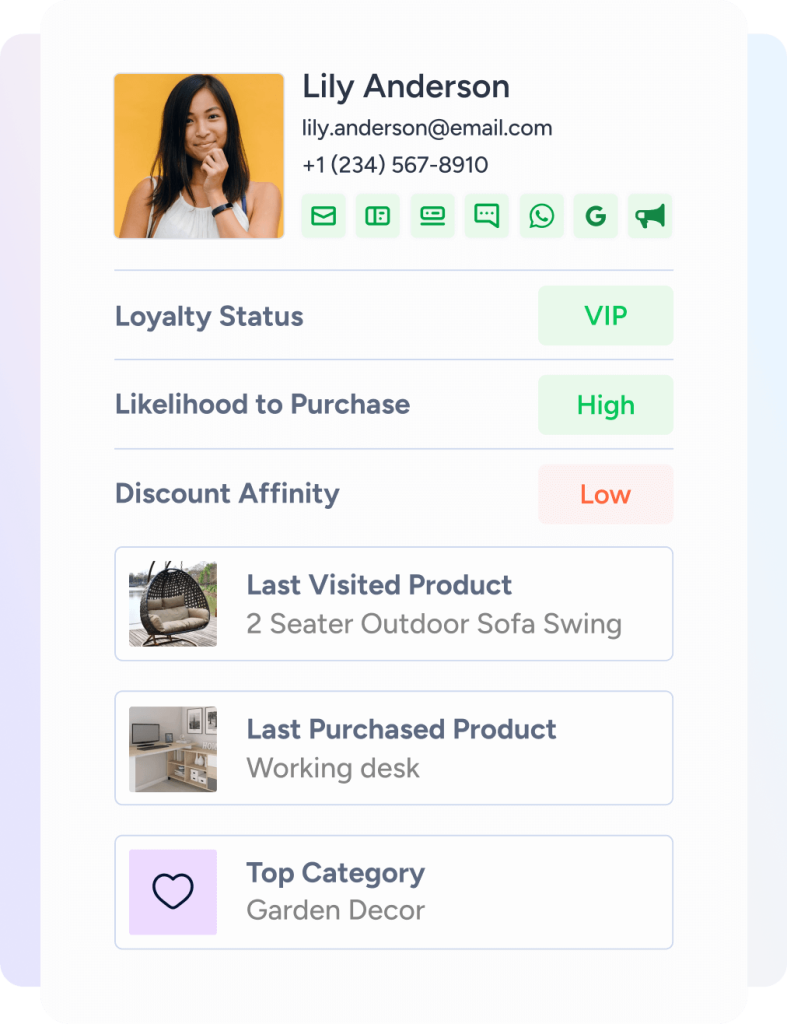
- Dynamic product recommendations. A triggered email built around the specific product a contact browsed or abandoned will outperform one that shows generic bestsellers. Insider One’s AI personalization capabilities, including Smart Recommender, draw from behavioral data and purchase history to surface products with the highest individual relevance, turning a transactional send into a personalized discovery moment.
- Real scarcity signals. Urgency mechanics tied to actual inventory levels, such as “only three left in your size” rather than a generic countdown timer, perform better and protect your sender reputation. Manufactured urgency trains subscribers to ignore the signal; real scarcity creates a genuine decision point. Insider One’s Architect supports this directly with native low-inventory, back-in-stock, and price-drop triggers that fire off real-time inventory and catalog data, so the urgency in the message reflects what is actually true at that moment.
- Suppression logic. Over-messaging is the silent killer of trigger programs. A contact who receives multiple cart abandonment emails, browse abandonment nudges, and a price-drop alert within the same week stops responding to all of them. Suppression rules governing how recently a contact was messaged, across which channels, and with what content, are what keep your trigger program from becoming the reason people unsubscribe. In Insider One, unified frequency capping enforces these limits across every channel at once, so a shopper does not receive an email, an SMS, and a push about the same moment, and the caps hold across the whole journey rather than per campaign.
Moving beyond open rates
Apple MPP has made open rates an unreliable primary metric, and some teams have been slow to replace them. If your program still optimizes primarily for opens, you are optimizing for a signal that is partly synthetic.
The better key performance indicators (KPIs) for triggered email are click-through rate, revenue per send, and downstream conversion rate, metrics that reflect genuine engagement and commercial outcome. Building these into your reporting framework before you scale your trigger program means you are measuring what the program is actually doing to revenue.
MadeiraMadeira achieved 52X ROI using Insider One’s Architect for journey orchestration, a result that required both a clean trigger architecture and the right measurement framework to surface and act on.
Measuring and scaling your trigger program
The three KPIs that matter
- Revenue per triggered send is the headline metric. It normalizes performance across triggers of different send volumes and tells you which behavioral moments are commercially significant versus which ones look good on engagement but do not drive purchases.
- Trigger coverage rate measures the percentage of key behavioral moments in your customer lifecycle that are actually captured and responded to. A high coverage rate means you have mapped your trigger architecture comprehensively. A low one reveals where customers are falling into gaps, moments of high intent that your program is not responding to.
- Trigger-to-conversion latency tracks how long it takes from the behavioral event to a completed purchase. This KPI is particularly useful for diagnosing data infrastructure problems: if latency is high even when your timing windows are set correctly, the issue is usually upstream in the data pipeline.
Building from three triggers to a full lifecycle matrix
The practical starting point for most teams is two or three high-return triggers: a welcome series, a cart abandonment sequence, and one retention trigger such as a post-purchase or re-engagement flow. These cover the highest-intent behavioral moments with manageable setup complexity and give you clean performance data to justify expanding the program.
From there, the program scales by adding trigger categories in order of revenue potential relative to setup complexity: consideration triggers next, then loyalty and milestone triggers as your data model matures. AI-driven send-time optimization and predictive churn scoring extend trigger performance at the later stages, identifying which contacts show early churn signals before the relationship degrades further rather than waiting for a fixed dormancy window to elapse.
Insider One AI™ supports this kind of predictive triggering by analyzing behavioral signals across the full customer profile and surfacing the right moment to send, not just the right message. That is the difference between a trigger program built on fixed rules and one that adapts to individual customer trajectories over time.
For teams executing a formal B2C email marketing strategy, the trigger program should eventually account for a substantial share of total email revenue, with broadcast sends reserved for time-sensitive promotions and brand moments that genuinely benefit from broad reach.
The Insider One platform brings both capabilities into a single environment, so the boundary between triggered and broadcast is a strategic choice rather than a technical constraint.
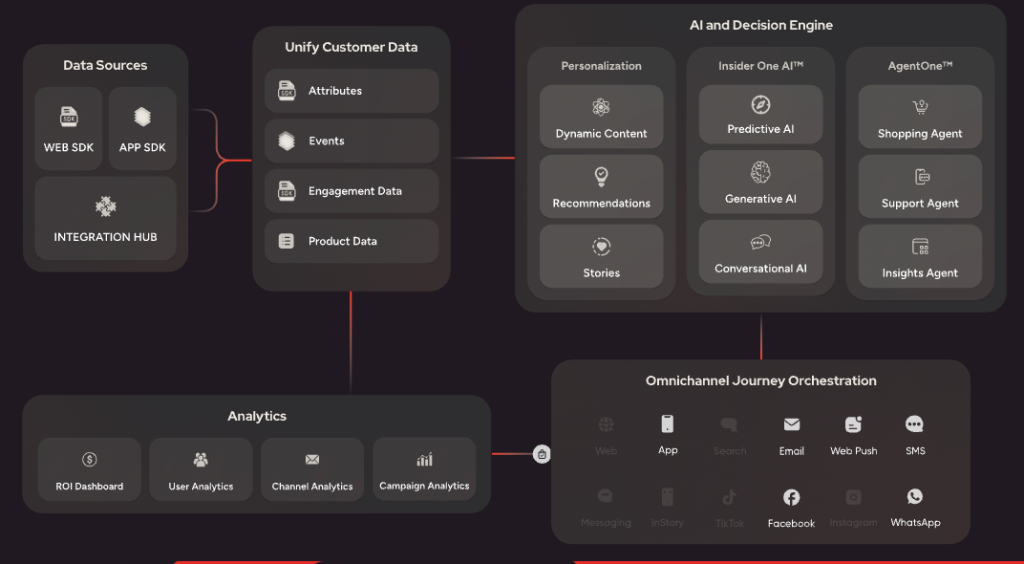
If you want to see how Insider One’s Smart Recommender, Architect, and Customer Data Management turn live customer data into coordinated, revenue-driving experiences, book a personalized demo to see the exact use cases, decision logic, and growth levers most relevant to your team.
FAQs
Transactional emails confirm a specific user action: order confirmation, password reset, shipping update. Triggered emails are marketing messages activated by behavioral signals such as browsing, abandonment, inactivity, or lifecycle milestones. Both are behavior-responsive, but triggered emails are optimized for engagement and revenue rather than information delivery.
There is no universal number, but a well-structured lifecycle trigger matrix typically covers eight to twelve distinct trigger types across acquisition, consideration, conversion, retention, and loyalty. The key is coverage rate, ensuring that every significant behavioral moment in your customer lifecycle has a corresponding response, rather than accumulating triggers for their own sake.
Suppression logic is the primary tool: rules that prevent a contact from receiving more than a defined number of triggered messages within a rolling time window, and that exclude recently messaged contacts from lower-priority triggers. Channel escalation, starting with email and moving to SMS or push only on non-response, also reduces email volume while maintaining engagement across the journey.

Keep Reading
7 min.

Muharrem Derinkok
4 Jun 2026
11 min.

Chris Baldwin
2 Jun 2026
4 min.
Chris Baldwin
3 Feb 2026