

 Platform Overview

 Integration Hub

 Agent One™

 Agent One™ Teams

 Customer Data Management

 Personalization

 Journey Orchestration

 Reporting & Data

 Behavioral Analytics

 Web
Web

 Email
Email

 Site Search

 Conversational CX

 WhatsApp

 Web Push

 InStory

 App
App

 SMS & RCS

 Join the $0 Migration Movement™

 The Insider One Difference

 Compare Vendors

 Switch to Insider One

 Success Story

 Retail & Ecommerce

 Financial Services

 Travel & Hospitality

 Beauty & Cosmetics

 Automotive

 Telecommunications

 Total Economic Impact™ Study

 Blog
Blog

 E-Books & Guides

 Events

 Glossary
How AI Powers Omnichannel Marketing With Real-Time Decisioning

Updated on 5 Oct 2026
9 min.
Table of Contents
Most Popular
Summary
| Rule-based journeys do not scale because static logic cannot adapt to real-time behavior across touchpoints. AI requires unified identity to connect customer data. Predictive segmentation and next-best-action enable continuous personalization. Marketer-led orchestration speeds iteration. Incrementality testing with holdouts, not last-touch attribution, measures true impact. |
Most omnichannel marketing problems are not channel problems. They are coordination problems dressed up as channel problems. Teams add (SMS to their email and push mix, see a short-term lift, then watch engagement plateau, because the underlying logic still fires the same message to the same segment on a schedule someone set 18 months ago. The channels multiplied; the intelligence did not.
What changes that equation is not adding more channels or more campaigns. It is replacing the static decisioning layer with one that reads behavioral signals in real time, resolves customer identity across every touchpoint, and selects the next action at the individual level. That is what AI actually does in a mature omnichannel marketing stack, and it is meaningfully different from what most vendor content describes when they use the term.
Why rule-based omnichannel falls apart at scale
The static segment problem
A segment built on last quarter’s purchase history is already wrong when a customer lands on your homepage this afternoon. Manually defined rules, for example “if customer is in recency, frequency, monetary (RFM) tier 2, send re-engagement email after 14 days of inactivity,” describe a snapshot of behavior that has already passed.
With a few thousand customers, a skilled CRM team can patch the gaps manually. At hundreds of thousands of customers across six or more touchpoints, those rules generate suppression failures, redundant messaging, and missed conversion windows daily.
The problem compounds when teams operate separate journey builders for email, push, and paid. Each system fires according to its own logic, with no shared view of what the customer just did elsewhere.
A shopper who converted via app push at 9 am receives a cart-abandonment email at 11 am because the email platform never received the conversion signal. That is not a channel problem. It is a data and decision-making problem.
Why is fragmented identity the root cause
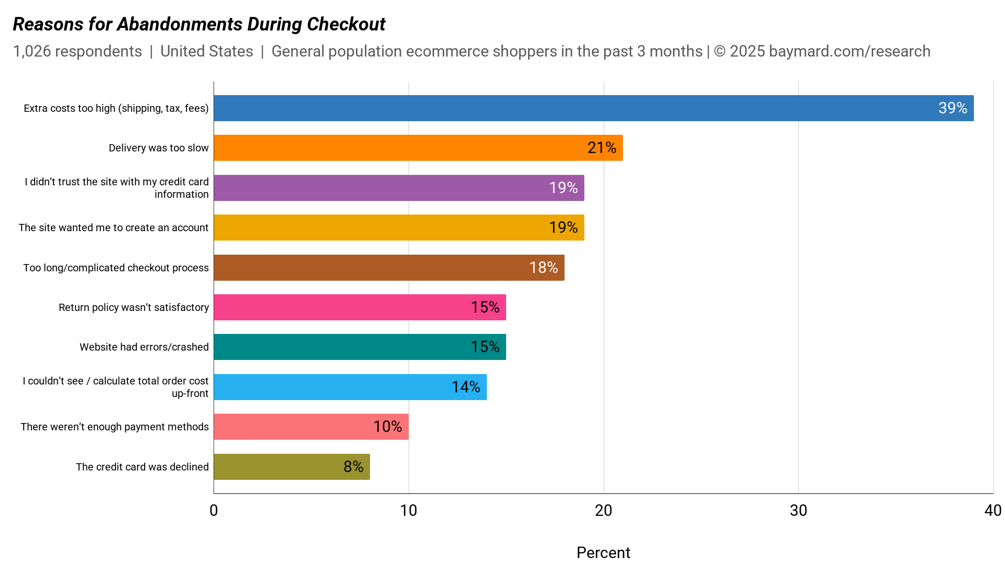
Before any AI model can make a useful prediction, it needs a coherent picture of the person it is predicting for. Fragmented identity, including anonymous web sessions that never resolve to a known profile, loyalty numbers that do not connect to email records, and in-store transaction data sitting in a separate system, means the model is working with partial information.
A churn propensity score calculated on web behavior alone misses the customer who converted in-store twice last month. A next-best-action recommendation that ignores offline signals sends a discount to someone who was never at risk of leaving. Identity fragmentation is the bottleneck most platform evaluations skip.
Buyers compare journey builders and channel breadth, yet underinvest in evaluating the identity resolution layer that determines whether the AI has reliable inputs to work with in the first place.
The AI capabilities that actually move omnichannel metrics
Predictive segmentation that updates in real time
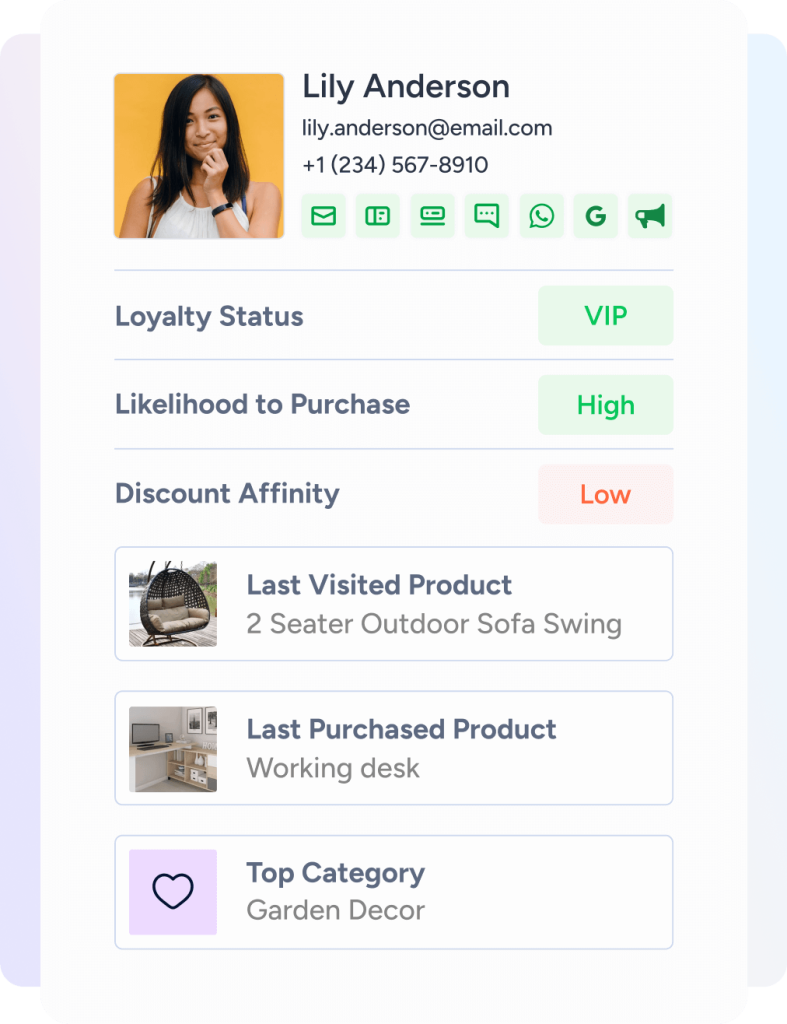
Traditional segmentation is backwards-looking. Predictive segmentation is forward-looking: it assigns each customer a continuously updated probability score, covering likelihood to purchase, likelihood to churn, and likelihood to respond to a discount, based on their most recent behavioral signals.
A customer who visited your pricing page three times this week and opened two emails should enter a high-intent segment today, not after your next scheduled batch run.
This matters because intent signals decay quickly. A window that might have converted on Tuesday becomes friction by Friday if the marketing system did not respond. Predictive segmentation closes that gap by keeping audience definitions current without requiring a manual refresh cycle.
Insider One’s AI capabilities include predictive features that apply exactly this logic, updating segments based on behavioral signals rather than static thresholds, so marketers are acting on where a customer is headed, not where they have been.

AI-powered next-best-action and channel selection
Deciding which channel to use for each individual customer used to mean A/B testing at the campaign level and applying the winner to everyone. That approach treats a segment as a uniform population and ignores the reality that one customer converts on SMS while another ignores it entirely but responds to email within minutes.
Next-best-action decisioning resolves this by learning, at the individual level, which channel, message variant, and send time produces the best outcome for each person.
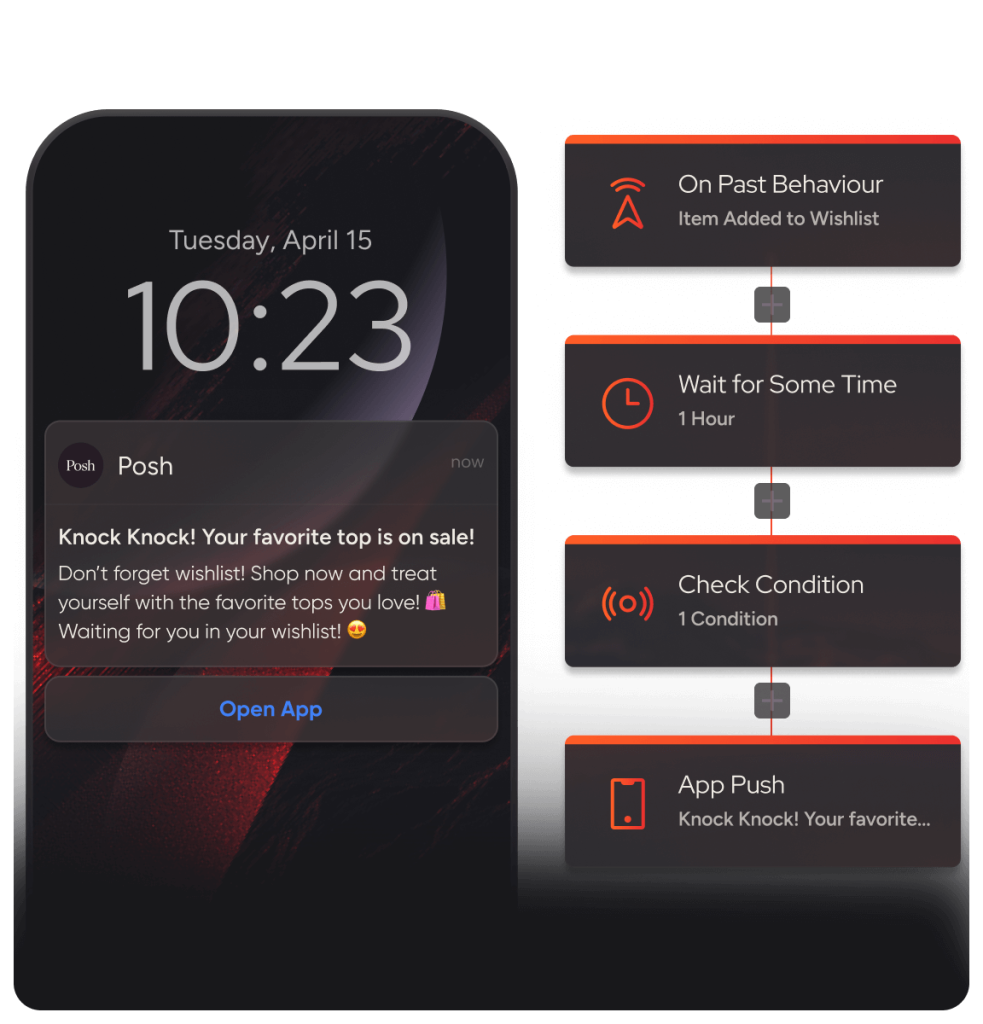
The practical implication is a shift from campaign-centric planning to customer-centric sequencing. Instead of building an email campaign and a separate push campaign, you define the goal, whether that is to convert, retain, or upsell, and let the AI select the path. This is the difference between omnichannel marketing automation as a coordination tool and as an autonomous optimization engine.
Insider One’s journey orchestration includes send time optimization and next-best-channel logic within flows, so the system makes per-customer decisions rather than applying a single schedule across an entire list.
Building the data foundation AI needs to perform
Identity resolution is the prerequisite step
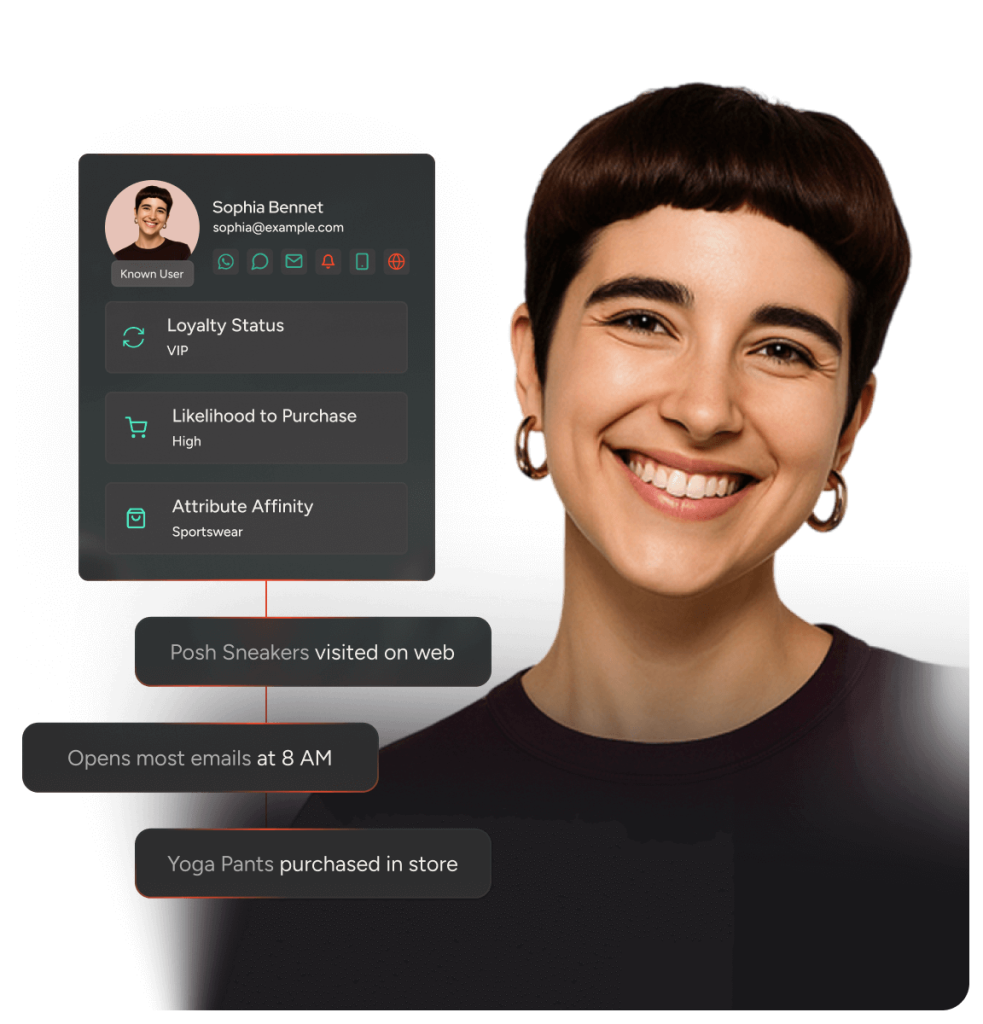
Identity resolution means connecting every signal a customer generates, including anonymous browse sessions, authenticated web visits, app activity, email engagement, loyalty program transactions, and in-store purchases, into a single persistent profile.
Without this step, your AI personalization layer is making predictions based on fragments. Because most customers interact across at least three or four surfaces before converting, those fragments miss enough context to produce genuinely unreliable outputs.
The resolution process typically involves probabilistic matching, linking records that share behavioral patterns or device signals, alongside deterministic matching, linking records that share an email address or account identifier. A well-executed identity graph reduces suppression failures, prevents duplicate messaging, and gives your attribution models a complete picture of the conversion path.
Insider One’s Customer Data Management capability is built around this principle: unifying online and offline data into a single actionable profile before any AI decisioning begins.
First-party data strategies for a cookieless environment
Third-party cookies were never a reliable foundation for personalization at the identity level. They degraded with every browser update and broke entirely across devices, making first-party data collected with explicit consent both more durable and more accurate.
The practical question is how to build that data asset without creating friction for the customer.
Progressive profiling, capturing a small amount of preference data at each interaction rather than front-loading a long form, is one effective approach. Preference centers that let customers self-select communication frequency and topic interest generate zero-party data that is both consent-safe and highly predictive.
Behavioral tracking on owned channels, including click patterns, category affinity, and search queries, rounds out the profile with signals the customer does not need to articulate explicitly. Together, these inputs feed AI models with the kind of rich, current, consented data that makes omnichannel personalization accurate rather than approximate.
Orchestrating channels without an engineering queue
Marketer-owned journey builders
One of the more practical arguments for AI-assisted journey orchestration is the reduction in time-to-launch for new journey variants. When building a new win-back flow or post-purchase sequence that requires opening an engineering ticket, teams avoid iteration.
They launch a journey once, observe performance for a quarter, and make modest edits rather than running the continuous experimentation that actually improves outcomes.
Marketer-owned builders with AI-suggested branching change this dynamic. When a CRM manager can clone a journey, adjust entry conditions, modify the channel sequence, and push it live without a code deployment, the iteration cycle compresses from weeks to days.
Insider One’s journey orchestration is designed with this in mind: journey logic, conditional branching, and AI-recommended flow adjustments are all accessible within the visual interface.
MadeiraMadeira achieved 52X ROI using Insider One’s journey orchestration capabilities, a result that reflects both the quality of the automation logic and the speed at which the team could build and refine flows without technical overhead.
Suppression logic and frequency management
Over-messaging is one of the most reliable ways to destroy the engagement rates your AI personalization worked to build. A customer who receives seven communications in three days across email, SMS, push, and WhatsApp does not experience that as omnichannel coherence. They experience it as noise, and they unsubscribe or, worse, mute the channel silently and remain technically reachable while being practically unreachable.
AI-managed frequency capping and cross-channel deduplication solve this by maintaining a single suppression layer across all channels. If a customer has already converted on one channel, they are excluded from the next trigger automatically. If they have reached their weekly message limit, the system holds the next communication rather than sending anyway.
This kind of logic, applied at scale, protects list health and keeps engagement rates meaningful rather than inflated by volume. It is also the kind of capability that is difficult to enforce when each channel operates its own suppression rules in isolation, which is exactly the architecture most rule-based stacks still run on.
Measuring AI-driven omnichannel ROI in practical terms
Why last-touch attribution misleads AI programs
Last-touch attribution assigns full credit to the final interaction before conversion. In an omnichannel program, that means a retargeting ad that fired four minutes before checkout gets credited for a customer journey that started with an onboarding email six weeks ago and included three push notifications, a browse abandonment flow, and two in-store visits.
The attribution model does not just misrepresent the journey; it actively misinforms budget decisions, channel investment, and AI training feedback loops.
Incrementality testing with holdout groups is the more rigorous alternative. A properly constructed holdout removes a randomized subset of customers from AI-driven personalization and compares their behavior against those who received it.
The difference in conversion rate, average order value, or retention between the two groups is a defensible measure of what the AI is actually contributing, independent of channel credit allocation. For teams running AI customer journey orchestration at scale, this is the measurement approach that earns budget confidence internally, because it shows incrementality rather than correlation.
The metrics that matter beyond open rates
Open rates and click-through rates measure reach and relevance at the message level. They do not tell you whether AI personalization is generating business outcomes. The metrics that do:
• Revenue per recipient: Total revenue generated divided by the number of profiles in the orchestrated program, segmented by AI-treated versus holdout
• Cross-channel conversion lift: Incremental conversion rate for customers who received coordinated, AI-sequenced messaging versus those who received single-channel campaigns
• Segment migration velocity: How quickly customers are moving from low-intent to high-intent segments, which indicates whether predictive scoring is catching intent shifts early
• Time-to-campaign for new journey variants: A direct measure of your team’s ability to iterate without engineering dependency, which determines whether your program improves continuously or stagnates between quarterly planning cycles
Adidas achieved a 259% increase in average order value and a 13% uplift in conversion rate in one month with Insider One’s personalization capabilities. These results reflect what coordinated, data-driven personalization looks like when the underlying identity and decisioning layers are working correctly. They are not typical outcomes, but they illustrate the order-of-magnitude difference between optimized AI personalization and baseline channel execution.

If you want to see how Insider One’s journey orchestration, Customer Data Management, and AI personalization turn live customer data into coordinated, revenue-driving experiences, book a personalized demo to see the exact use cases, decision logic, and growth levers most relevant to your team.
FAQs
RFM (recency, frequency, monetary) segments customers based on historical purchase data captured at a point in time. Predictive segmentation uses machine learning to assign real-time probability scores, such as likelihood to purchase or churn, based on current behavioral signals. The practical difference is responsiveness: predictive segments update continuously, so they reflect where a customer is headed rather than where they have been.
Not necessarily. Many teams layer AI-driven journey orchestration and identity resolution on top of existing platforms through integrations, rather than replacing them entirely. The evaluation question is whether your current stack can expose the data signals the AI layer needs in real time. If your CRM exports data in nightly batches, that latency will limit the responsiveness of any AI decisioning built on top of it.
This varies by implementation complexity, data readiness, and program scope. Teams with clean first-party data and a focused use case, such as post-purchase journeys, win-back flows, or browse abandonment, can often demonstrate measurable lift within the first quarter. Broader programs that require significant identity resolution work across disconnected systems typically take longer to stabilize before results are meaningful.
Start with a single high-value journey where you have sufficient behavioral data and a clear conversion goal. Browse abandonment and cart recovery flows are common starting points because intent signals are strong and conversion is proximate. Demonstrate incrementality with a holdout test, then expand to adjacent use cases once you have internal confidence in the measurement methodology.

Keep Reading
4 min.

Chris Baldwin
3 Feb 2026
7 min.
Chris Baldwin
23 Oct 2026
8 min.
Chris Baldwin
23 Oct 2026