

 Platform Overview

 Integration Hub

 Agent One™

 Agent One™ Teams

 Customer Data Management

 Personalization

 Journey Orchestration

 Reporting & Data

 Behavioral Analytics

 Web
Web

 Email
Email

 Site Search

 Conversational CX

 WhatsApp

 Web Push

 InStory

 App
App

 SMS & RCS

 Join the $0 Migration Movement™

 The Insider One Difference

 Compare Vendors

 Switch to Insider One

 Success Story

 Retail & Ecommerce

 Financial Services

 Travel & Hospitality

 Beauty & Cosmetics

 Automotive

 Telecommunications

 Total Economic Impact™ Study

 Blog
Blog

 E-Books & Guides

 Events

 Glossary
AI Decisioning in Marketing: How It Transforms Campaigns

Updated on 5 Oct 2026
9 min.
Table of Contents
- Summary
- What AI decisioning actually means (and what it doesn't)
- Why traditional marketing automation has hit its ceiling
- The core mechanics: how a real AI decisioning engine works
- Where AI decisioning drives measurable marketing outcomes
- What to demand from any platform claiming AI decisioning
- How Insider One delivers AI decisioning without replacing your data stack
- Frequently asked questions
Most Popular
Summary
AI decisioning goes beyond rules and predictions by selecting the best action in real time using machine learning and business constraints. Its effectiveness depends on unified customer data, native real-time architecture, and continuous optimization based on business outcomes.
There is a gap between what vendors call artificial intelligence (AI) and what AI actually does in a properly built decisioning system. When a platform applies a propensity score to a pre-filtered audience and routes them down a pre-built journey branch, it calls that AI.
When a platform selects the next best action for an individual customer from every eligible option, in real time, under budget and frequency constraints, using a reward signal tied to actual revenue, that is also called AI.
Treating those as equivalent is how marketing leaders end up with sophisticated-looking technology stacks that produce the same conversion ceilings they had three years ago.
The distinction matters practically, not just theoretically. Campaign-centric automation was built to scale broadcast communication, and it does that reasonably well. What it cannot do, structurally rather than by configuration, is optimize for the individual.
Every journey branch you build, every segment you define, every rule you write is a constraint on what the system can do for a specific customer at a specific moment.
Genuine AI decisioning removes that constraint. Understanding the difference is the prerequisite for evaluating any platform that claims to offer it.
What AI decisioning actually means (and what it doesn’t)
The architecture, not the label
AI decisioning, in its precise meaning, is a system that selects the optimal action for an individual from the complete set of eligible actions simultaneously, in context, under defined constraints, and updates its model based on observed outcomes over time.
The key word is “simultaneously.” The engine does not start with a segment, apply a journey, and then optimize within that journey. It starts with the individual and arbitrates across every available action at once.
That distinction has architectural consequences. A traditional marketing automation platform builds personalization by narrowing options early: segment the audience, assign a journey, branch on behavior.
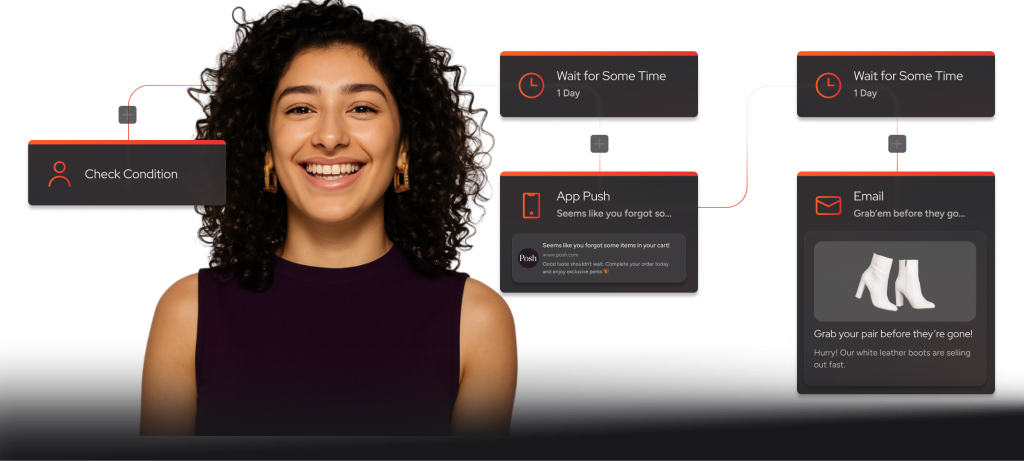
Each stage filters possibilities before a decision is ever made. The result is that what the system optimizes for is campaign performance within a lane, not the best outcome for the customer in front of it.
A machine learning model inverts this: it learns, from accumulated reward signals, which actions in which contexts produce which outcomes, and applies that knowledge to every future decision.
What decisioning is not
Propensity scoring is a common area of confusion. A likelihood-to-purchase score is a useful input to a decision, but not the decision itself. A platform that segments users by purchase likelihood and then sends each segment a pre-defined message has used AI as a filter, not as a decision engine.
Similarly, send-time optimization at the cohort level, sending a campaign when a group of users historically opens email, is scheduling intelligence rather than individual decisioning.
True decisioning selects the message, the channel, the moment, and the content for the individual simultaneously, as a single output rather than a sequence of separate filters.
Why traditional marketing automation has hit its ceiling
The manual bottleneck problem
Rule-based platforms ask marketers to pre-define every meaningful scenario: build the segment, build the journey, build the branches, build the fallbacks. This approach scales in complexity, because every new product, channel, audience, or seasonal variant adds branches, but it does not scale in relevance.
The marketer becomes a bottleneck because the system can only act on what has already been anticipated. Customer behavior does not respect the taxonomy of your journey builder.
The practical symptom is a growing gap between what the data shows and what the campaign does. A customer browsing high-margin products while enrolled in a promotional journey for a clearance item gets the clearance message because that is the segment they entered.
The system has no mechanism to arbitrate between the promotional objective and the revenue signal the customer is generating in real time. That is not an edge case; it is the structural limitation of every campaign-centric automation stack.
Segment logic optimizes the wrong thing
When a platform optimizes for campaign performance, including open rates, click-through rates, and journey completion, it optimizes for the efficiency of your predetermined paths rather than for the customer’s actual next best step.
A customer in your “lapsed buyer” re-engagement journey may be better served by a loyalty reward message than by a win-back discount. But if the loyalty message lives in a different journey owned by a different team, the system will never make that call. True journey orchestration requires the ability to arbitrate across objectives, not optimize within them.
The core mechanics: how a real AI decisioning engine works
Three layers every real system needs
A genuine AI decisioning engine requires three components working simultaneously. Remove any one of them and the system degrades into a more sophisticated version of what already exists.
Unified customer signal layer. The engine needs real-time behavioral signals combined with historical context: purchase history, channel preferences, product affinity, and churn indicators. Real-time data alone produces decisions without context, and historical data alone produces decisions without currency. The combination, drawn from a unified customer data management layer rather than siloed campaign databases, is what makes individual-level optimization possible.
Constraint arbitration layer. Business constraints are not post-filters; they are inputs to the decision. Frequency caps, contact suppression windows, budget limits, inventory availability, and channel eligibility all must be visible to the engine when it selects an action, not applied afterward to trim the output. Post-filtering degrades decision quality because the engine has already optimized for a universe of options that does not reflect the actual constraints in play.
Reward signal layer. This is where many vendor implementations fail quietly. The reward signal is what the engine learns from. If the reward signal is clicks or opens, the engine will optimize for clicks and opens. If it is revenue, retention, or long-term customer lifetime value, the engine optimizes for those instead. A system with no configurable reward signal, or one that defaults to engagement proxies, is performing attention optimization rather than business optimization.
Latency is architecture, not a setting
In-session web and app personalization requires decisioning responses well under 100 milliseconds. At that latency, the decision must be native to the platform’s real-time data pipeline: not called out to a batch-processing layer, not retrieved from a pre-computed recommendation cache, and not waiting for an overnight model refresh.
Batch-first platforms that add an AI module on top of their existing architecture cannot consistently meet this bar. The latency requirement is an architectural constraint, and it determines which personalization experiences are physically possible rather than which ones are merely difficult to configure.
Where AI decisioning drives measurable marketing outcomes
High-impact use cases
The use cases where individual-level AI decisioning creates the clearest lift over rule-based alternatives are concentrated in four areas.
- Next-best-offer arbitration across channels. Rather than assigning promotions by segment, the engine selects the right offer for the right individual on the right channel at the right moment, arbitrating across product catalog, margin targets, and customer propensity simultaneously.
- Individual send-time and channel selection. Not cohort-level send-time optimization, but true per-user decisioning: this customer responds to email on Tuesday mornings, that customer converts from app push on weekday evenings. The system learns and applies this at scale without manual configuration.
- Real-time onboarding path optimization. For new users whose preferences are not yet established, the decisioning engine explores the action space, testing which combinations of content, channel, and timing produce the strongest early engagement, and converges on an optimal path faster than any pre-built onboarding sequence could.
- Churn-risk intervention sequencing. Instead of triggering a standard win-back email when a user hits a 30-day inactivity threshold, the engine detects deteriorating engagement signals early and sequences intervention actions in the order most likely to recover the relationship, adjusting in real time based on how the customer responds.
When personalization operates at the individual level with real behavioral data rather than broad segments, decisions optimized for individuals consistently outperform decisions optimized for segments across revenue and spend efficiency, because the engine is solving the right problem at the right granularity.
Adidas achieved a 259% increase in average order value and a 13% increase in conversion rate in a single month using Insider One’s personalization capabilities, an outcome that reflects the practical difference between segment-level targeting and individual-level optimization.

What to demand from any platform claiming AI decisioning
The vendor evaluation checklist
The language around AI in marketing platforms has become imprecise enough that the most useful thing a senior marketer can do before a platform evaluation is ask questions the vendor cannot answer with a feature list.
Does the engine arbitrate across all eligible actions simultaneously, or does it rank within a pre-filtered set? A platform that pre-segments your audience and then optimizes within each segment is doing the latter, which is useful, but it is not decisioning
Can it enforce business constraints inside the decision, not as a post-filter? If frequency caps, budget limits, and inventory eligibility are applied after the model has run, the model has been optimizing against the wrong universe
Does it expose reason codes? Auditability is not optional in enterprise environments: the engine should explain why a specific action was selected for a specific user at a specific moment in terms that both marketing and compliance teams can verify
What is the reward signal, and can you configure it? If the answer is clicks or opens, or if the reward signal is not configurable, the system is optimizing for attention rather than for the business outcomes you report against
What is the decisioning latency, and under what conditions? Ask for real numbers rather than theoretical benchmarks, since in-session personalization requirements are non-negotiable
The ecosystem-lock warning
Platforms that require their own customer data platform (CDP), data cloud, or analytics suite as a prerequisite for AI decisioning are not removing complexity from your stack; they are relocating it.
If the decisioning engine only works with proprietary data infrastructure, you face a real choice: rebuild your data layer around a single vendor’s architecture, or accept a limited version of the capability you were sold.
Genuine AI decisioning should work with the customer signals you already have, drawing from your existing integrations rather than demanding a wholesale replacement of your data infrastructure.
How Insider One delivers AI decisioning without replacing your data stack
Insider One AI runs on unified profiles built from sources you already have. 100+ integrations cover CRM, analytics, commerce and paid media, with a bidirectional warehouse connection that pushes data back out as well as pulling it in.
Your warehouse can stay the system of record. Zero Copy Segmentation runs the audience query inside your own Snowflake, BigQuery or Databricks instance, on your compute, and returns only segment membership. Raw customer data is never copied across, and consent states stay where they already live. For values that move by the minute, a journey can fetch them at decision time rather than reading a synced copy.
Scores are precomputed, not run mid-decision. Predicted lifetime value, purchase likelihood, churn risk and discount affinity are computed in real time as part of the profile, so they are available instantly when a decision is made rather than adding model latency to it.
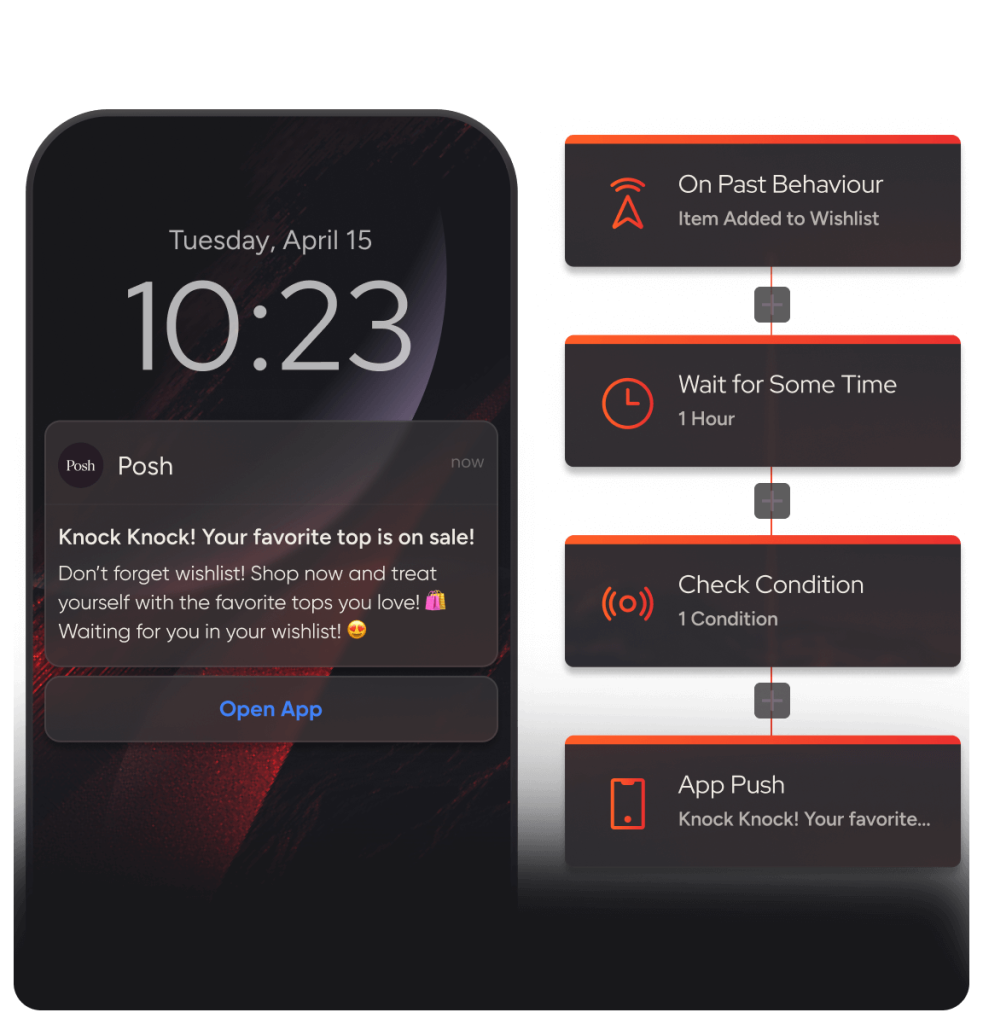
Constraints sit inside the decision. Unified frequency capping applies across every channel from the Architect canvas, alongside consent state, suppression and low-inventory triggers. Journey Prioritization selects the most appropriate message for a customer at that moment rather than sending whichever journey queued first, and reports the exit reason.
Decisioning extends into tools you already run. A native ChatGPT App integration delivers recommendations and offers inside ChatGPT, and the MCP Server lets teams query cross-channel analytics from ChatGPT, Claude or Cursor.
Book a demo to test decisioning against your existing data layer, or take the platform tour first.
Frequently asked questions
Marketing automation executes pre-defined rules and journey branches. AI decisioning selects the optimal action for an individual from all eligible options simultaneously and updates its model based on observed outcomes, without requiring a marketer to pre-define every scenario.
It depends on whether the decisioning platform requires a proprietary data layer or can connect to your existing customer data sources. Platforms that demand their own CDP (customer data platform) as a prerequisite add integration complexity; platforms with open data connectivity can work with unified customer signals regardless of where they originate.
Timeline varies by implementation complexity and baseline personalization maturity, but the key factor is how quickly the reward signal accumulates meaningful data. Use cases with high transaction or interaction volume, such as onboarding path optimization or next-best-offer on high-traffic properties, tend to produce measurable results faster than lower-frequency channels.
A genuine decisioning engine arbitrates across all channels simultaneously: email, SMS, app push, web, WhatsApp, paid media, and more. If a platform’s AI decisioning applies only to a single channel or requires separate configuration per channel, it is optimizing within a channel rather than across the customer’s full interaction surface.

Keep Reading
4 min.

Chris Baldwin
3 Feb 2026
9 min.
Chris Baldwin
22 Oct 2026
8 mins.
Chris Baldwin
8 Oct 2026