

 Platform Overview

 Integration Hub

 Agent One™

 Agent One™ Teams

 Customer Data Management

 Personalization

 Journey Orchestration

 Reporting & Data

 Behavioral Analytics

 Web
Web

 Email
Email

 Site Search

 Conversational CX

 WhatsApp

 Web Push

 InStory

 App
App

 SMS & RCS

 Join the $0 Migration Movement™

 The Insider One Difference

 Compare Vendors

 Switch to Insider One

 Success Story

 Retail & Ecommerce

 Financial Services

 Travel & Hospitality

 Beauty & Cosmetics

 Automotive

 Telecommunications

 Total Economic Impact™ Study

 Blog
Blog

 E-Books & Guides

 Events

 Glossary
How AI Decisioning Transforms Marketing (A Complete Guide)

Updated on 21 Apr 2026
15 min.
Table of Contents
- What should you know first?
- What is AI decisioning in marketing?
- How does AI decisioning work?
- Why AI decisioning transforms marketing outcomes
- Which AI decisioning use cases drive revenue and retention?
- Which marketing metrics improve with AI decisioning?
- How does Insider One's AI decisioning engine work?
- How does Insider One make AI decisioning autonomous and cross-channel?
- How does Insider One prove that AI decisioning drives incremental results?
- FAQs
Most Popular
Summary
| Most marketing failures stem from poor decision-making, not targeting. Brands often send messages at the wrong time, to the wrong people, or through the wrong channel. AI decisioning improves this by determining in real time whether to act and what action to take. ROI comes from both better targeting and smart exclusion, reallocating spend to customers who need influence. As models learn from every interaction, performance improves continuously. Success depends on unified data, clear constraints, and strong measurement, not just algorithms. |
Most marketing teams can’t prove their campaigns caused the outcomes they report; a customer who received your email might have purchased anyway, a discount sent to someone ready to buy at full price just eroded margin. These failures happen because traditional systems lack a decision layer that evaluates whether to act at all.
AI decisioning changes this. It shifts marketing from static rules and manual segmentation to real-time, model-driven action selection that adapts to each customer’s context. Every interaction generates data that improves the next decision. Return on investment (ROI) comes from exclusion as much as from better targeting. This guide explains how AI decisioning works, why it transforms marketing outcomes, and how to implement it without rebuilding your stack.
What should you know first?
AI decisioning shifts marketing from static rules and manual segmentation to real-time, model-driven action selection that adapts to each customer’s context.
- Marketing becomes a closed loop where every interaction improves the next decision
- ROI comes from exclusion (not sending) as much as from better targeting
- Success depends on unified data and clear business constraints, not just algorithms
What is AI decisioning in marketing?
You’ve probably seen this failure before: a perfectly personalized email featuring a product the customer bought yesterday. Or a discount sent to someone who would have purchased at full price. These errors happen because traditional systems lack a decision layer to evaluate whether to act at all.
AI decisioning is the system that selects:
- Which action to take
- For whom
- Through which channel
- Whether to act now or wait
It evaluates these choices against business constraints like fatigue limits, margin thresholds, and consent status.
This isn’t the same as personalization. Personalization tailors content. AI decisioning decides whether that content should be sent in the first place.
| Concept | What it does | What it doesn’t do |
| Segmentation | Groups customers by shared traits | Choose the action or timing |
| Personalization | Tailors content to individuals | Decide whether to send at all |
| Automation | Executes predefined triggers | Adapt based on predicted outcomes |
| AI decisioning | Selects the optimal action under constraints | Replace strategy or creative |
How does AI decisioning work?
AI decisioning isn’t just smarter targeting. It’s a closed-loop system where every decision generates data that improves the next decision.
The process follows these stages:
- Event capture: Customer actions stream into the system from your customer data platform
- Feature computation: Raw events become decision-relevant signals like days since last purchase or channel preference scores
- Model scoring: Propensity models estimate outcomes: likelihood to convert, churn risk, discount sensitivity
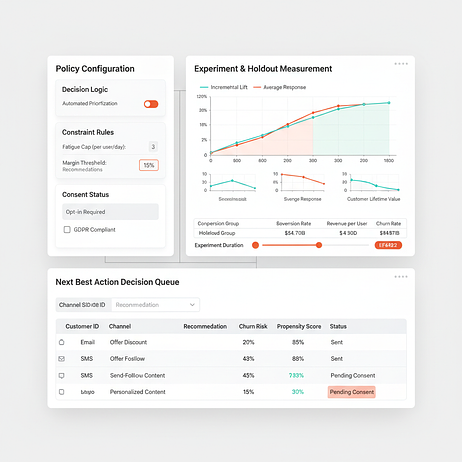
- Policy application: Business constraints filter and rank options, excluding messages if the user was contacted recently or capping discounts to protect margins
- Activation and measurement: The selected action fires, and the outcome feeds back into model retraining
Latency matters here. Batch decisioning works for email campaigns. Real-time decisioning is required for web personalization and triggered messages. Most teams start with batch infrastructure before investing in streaming.
Models trained on biased historical data will replicate past mistakes. Policies without fatigue limits will over-contact high-propensity customers. Systems without holdout groups can’t prove incremental lift.
How does reinforcement learning support closed-loop optimization?
Most marketing teams hear “the algorithm learns” but don’t understand the mechanism.
Contextual bandits are the engine. The system allocates traffic across options like send times, subject lines, or offers. It observes outcomes and shifts allocation toward winners while still exploring alternatives. A system that only exploits known winners will miss better options that emerge as customer behavior shifts.
Send-time optimization works this way. The system distributes emails across time windows, measures open rates per window for specific user clusters, and gradually concentrates sends in high-performing windows. It reserves a small percentage for continued exploration.
How do AI agents enable autonomous actions?
Agentic AI systems pursue a goal across multiple steps, selecting and sequencing actions autonomously rather than executing a predefined flow.
Here’s what that looks like for re-engaging a lapsed subscriber:
- Goal: Reactivate the user without margin erosion
- Agent behavior: Evaluates channel preference, selects initial email outreach, monitors response, escalates to SMS if no engagement, adjusts offer based on browsing behavior and discount propensity, stops sequence if purchase occurs
Most marketing teams are still operationalizing single-decision systems. Agentic capabilities require robust data infrastructure and clear guardrails before deployment; but both can be provided natively by the platform rather than assembled from separate tools.
Built-in behavioral data collection from web and app sources removes the data readiness barrier for teams earlier in their data maturity, while a native policy layer that enforces fatigue limits, consent status, and margin constraints automatically ensures autonomous execution operates within defined business boundaries from day one.
How do large language models affect content signals?
Large language models (LLMs) generate content and extract meaning. Decisioning systems choose what to do with that content. They’re complementary.
- Content embeddings: LLMs convert product descriptions into vectors that power similarity-based recommendations
- Sentiment classification: LLM-derived sentiment scores become features in churn prediction models
- Generative variants: LLMs create subject line or offer variants that the decisioning system then tests and allocates
Why AI decisioning transforms marketing outcomes
Most marketing teams can’t prove their campaigns caused the outcomes they report. Customers who received the email might have purchased anyway.
AI decisioning changes this by enabling incrementality measurement and optimizing for marginal impact rather than average response.
- Exclusion savings: Stop spending on customers who would convert without intervention and reallocate budget to persuadables
- Fatigue reduction: Fewer contacts per customer, higher engagement per contact, addressing what a 2025 consumer marketing fatigue report identifies as widespread fatigue driving unsubscribes
- Channel efficiency: Route each message to the channel with highest predicted response for that specific user
- Speed: Decisions that required analyst time now execute automatically, freeing teams for strategy
Which AI decisioning use cases drive revenue and retention?
Getting value from a decisioning platform requires mapping capabilities to specific business problems. For each use case, you need to define the decision being made, the inputs required, and the constraints that make it non-trivial.
Repurchase journeys and incremental revenue
The decision isn’t whether to send a repurchase reminder. It’s when to send it and whether to include an incentive.
A hazard model predicts each customer’s reorder window based on purchase history and product category. The policy layer applies the constraint: only offer a discount if the customer is predicted to need it for conversion.
- Timing signal: Predicted days-to-next-purchase based on historical cadence
- Incentive decision: Discount only if predicted conversion probability without discount falls below threshold
- Exclusion rule: No outreach if customer has browsed the category recently
Churn save flows and retained value
Treating all at-risk customers the same is expensive. A customer with low predicted lifetime value who requires a steep discount to retain may cost more to save than they’re worth.
- Risk score: Probability of churn within a defined time horizon
- Value score: Predicted remaining lifetime value if retained
- Intervention selection: Match offer intensity to value tier; exclude save attempts for negative net present value (NPV) customers
- Fatigue cap: Limit save attempts per customer to prevent relationship damage
The “don’t save” decision is explicit here. This is where AI decisioning differs from rules-based retention programs.
Paid media bidding and Return On Ad Spend (ROAS) efficiency
The biggest efficiency gains come from not bidding, not from bidding smarter.
AI decisioning identifies several exclusion opportunities:
- Sure bets: Customers with high organic conversion probability where paid exposure adds cost without incremental lift
- Lost causes: Customers with near-zero conversion probability regardless of exposure
- Recent converters: Customers who just purchased and will be annoyed by retargeting
Savings from exclusion fund higher bids on persuadable audiences where paid exposure actually changes behavior.
Winback programs and reactivation rate
The decision is who qualifies for winback, what sequence to run, and when to stop.
- Step 1: Content-led re-engagement (no discount) targeting customers dormant for a period of time
- Step 2: Incentive offer for non-responders, with discount level set by predicted reactivation probability
Exclude customers who have unsubscribed or marked messages as spam. Re-permissioning requires explicit opt-in.
Shopping Agent and personalized product discovery
The decision isn’t whether to surface product recommendations. It’s when to engage, through which channel, and whether the user needs assistance to convert at all.
A fashion retailer deploys a Shopping Agent to assist users with intent-based queries; “what should I wear to a wedding this spring?” or “show me something to pair with these trousers.” The decisioning layer determines whether and how to trigger the agent based on each user’s predicted behavior.
- Engagement trigger: Hesitation signals or exit intent indicate a user who is browsing but hasn’t found the right item, qualifying them for agent activation
- Exclusion rule: Users with high organic conversion probability are excluded; they don’t need the nudge and activating the agent adds cost without incremental lift
- Channel decision: The system routes the recommendation to the channel with the highest predicted response rate for that specific user; web, app, or push
- Intervention logic: The agent processes browsing behavior, purchase history, and style preferences in real time to surface items aligned with size, style, and budget, without manual segmentation
The “don’t engage” decision is explicit here. This is where the Shopping Agent combined with AI decisioning differs from a standard product recommendation widget; it selects who gets the experience, not just what they see.
Want concrete examples you can use, including policies, constraints, and holdout setups by use case? Start in the product demo hub and jump to the scenarios that match your roadmap.
Which marketing metrics improve with AI decisioning?
Most teams report campaign metrics like open rates and click rates rather than business impact. AI decisioning enables causal measurement through holdout groups.
- Incremental lift: Revenue or conversions attributable to the decisioning system, measured against a holdout group that receives no AI-driven outreach
- Customer lifetime value (CLV): Long-term revenue impact, not just immediate conversion
- Marginal ROAS: Return on the incremental ad dollar, not average return across all spend
- Fatigue index: Contact frequency relative to engagement, a leading indicator of list health
Reserve a statistically significant holdout and maintain it long enough to measure downstream effects, not just immediate response.
How should you implement AI decisioning?
Teams with mature data infrastructure and in-house ML talent can build. Teams prioritizing speed-to-value should buy. Most enterprise marketing teams fall into the latter category.
- Foundation: Unified customer profiles, event tracking, identity resolution
- Activation: Single-channel decisioning (start with email or web), holdout measurement, policy configuration
- Expansion: Cross-channel orchestration, real-time triggers, closed-loop model retraining
What data readiness and identity resolution do you need?
- Identity coverage: Ability to resolve anonymous sessions to known profiles for a substantial share of engaged traffic
- Event schema: Standardized events with consistent parameters across web, app, and offline
- Latency: Batch is sufficient for email; real-time required for web personalization
- History depth: Models need several months of behavioral data to get the maximum uplift but can be functional with weeks of data
Teams that cannot match a substantial share of anonymous sessions to known profiles should prioritize identity resolution first. Models trained on fragmented profiles will underperform.
What trust controls and brand safety measures do you need?
- Consent integration: Decisioning must respect opt-out status and channel preferences in real time
- Bias monitoring: Regular audits of model outputs across demographic segments
- Explainability: Ability to answer “why did this customer receive this offer?”
- Override paths: Human escalation for edge cases without engineering involvement
- Audit trail: Logged record of every decision for regulatory review
More guardrails reduce risk but also reduce model flexibility. Start with conservative constraints and loosen as you build confidence.
How should humans lead the operating model?
AI decisioning shifts the marketer’s role from campaign execution to objective setting and constraint definition. The system decides what to do. The human decides what success looks like and what actions are off-limits.
- Monday: Review holdout performance and incremental lift by use case
- Wednesday: Audit model drift and anomaly alerts
- Friday: Adjust constraints and approve new policies for the following week
Teams that leave AI decisioning unattended will underperform teams that actively govern it.
How does Insider One’s AI decisioning engine work?
Most enterprise marketing stacks are collections of point solutions; a CDP here, a journey tool there, an analytics platform bolted on after the fact. Data moves between systems with latency, identity breaks at every handoff, and the decisioning logic that should connect them lives in spreadsheets or tribal knowledge.
Insider One is built differently. It consolidates the entire decisioning pipeline (data unification, predictive modeling, journey orchestration, cross-channel activation, and incrementality measurement, into a single platform), eliminating the integration overhead and data loss that degrade decisioning quality in stitched stacks.
The pipeline works as follows. Insider One’s CDP resolves customer identity across every device and session, unifying behavioral data from web, app, and offline sources into profiles that update in real time. For teams already operating a data infrastructure, Insider One connects directly to existing data warehouses including Snowflake and BigQuery, and to ecommerce platforms including Shopify and Magento, meaning behavioral data, purchase history, and product catalog information flow into the decisioning layer without rebuilding pipelines.
From there, out-of-the-box predictive Segments; covering likelihood to churn, likelihood to purchase, product affinity, and more, surface propensity scores directly from the platform interface, without requiring data science resources. Insider One AI, Insider One’s extensive set of AI capabilities, then powers Next Best Channel selection, Send Time Optimization, A/B Auto-Winner Selection, discount sensitivity modeling, generative content creation, and likelihood-to-convert scoring.
Finally, Architect, Insider One’s customer journey orchestration solution, applies business constraints; fatigue limits, consent status, margin thresholds, within journey logic before any action fires.
Every component shares the same customer profile, the same constraint layer, and the same feedback loop, so decisions improve continuously rather than in isolated pockets of the stack.
How does Insider One make AI decisioning autonomous and cross-channel?
Insider One extends AI decisioning beyond single-action selection into autonomous, multi-step execution through Agent One™, its suite of purpose-built agents for customer engagement.
The Shopping Agent enables intent-based product discovery and contextual recommendations. The Support Agent delivers human-like autonomous service and actionable task resolution across channels. The Insights Agent provides real-time conversational data analysis and actionable recommendations to optimize campaign performance, letting marketers interrogate results without waiting for analyst support.
Underpinning all three agents is Architect, Insider One’s cross-channel orchestration engine, which coordinates customer journeys across email, SMS, push, app and web personalization, WhatsApp, RCS, shopping, and search. Architect sequences actions, enforces fatigue limits and consent status in real time, and adapts journey logic based on live behavioral signals rather than static triggers. This means the decisioning system doesn’t just select the right action; it selects the right channel, enforces the right constraints, and adjusts the sequence as customer behavior changes, all without manual intervention.
How does Insider One prove that AI decisioning drives incremental results?
Insider One includes built-in holdout group configuration for incrementality measurement across every channel. Rather than bolting measurement onto an existing stack after the fact, holdout logic is native to the platform; meaning the same system that makes decisions also controls the measurement framework, maintaining a consistent holdout that can capture downstream effects, not just immediate response.
The metrics this enables go beyond open rates and click rates. Incremental lift measures revenue or conversions attributable to the decisioning system against a holdout group that receives no AI-driven outreach. Customer lifetime value tracks long-term revenue impact rather than immediate conversion. Marginal ROAS measures return on the incremental ad dollar rather than average return across all spend. And the fatigue index; contact frequency relative to engagement, acts as a leading indicator of list health before unsubscribes accumulate.
If you’re done debating “build vs. buy” and ready to evaluate decisioning on your data and constraints, book a demo and we’ll show you exactly how it runs across channels.
To get more insights on how Insider One helped brands of all verticals and industries, check our case studies.
FAQs
Marketing automation executes predefined triggers and sequences. AI decisioning evaluates predicted outcomes and business constraints to select the optimal action in real time; deciding not just what to send, but whether to send at all, to whom, through which channel, and when. Unlike automation, which follows a fixed flow, AI decisioning adapts based on what models learn from each interaction, so every decision improves the next one.
No. Insider One includes a native CDP that resolves customer identity across devices and sessions, but it also connects directly to existing data warehouses including Snowflake and BigQuery, and to ecommerce platforms including Shopify and Magento. Teams with existing data infrastructure can flow behavioral data, purchase history, and product catalog information into Insider One’s decisioning layer without rebuilding pipelines.
Propensity models typically need several months of behavioral data and sufficient event volume to detect patterns. For smaller teams or those earlier in their data maturity, Insider One can collect behavioral data directly from your website; accelerating the time to a functional training dataset from months to weeks. Out-of-the-box Predictive Segments covering likelihood to churn, likelihood to purchase, and product affinity are then accessible directly from the platform interface without data science involvement, meaning teams can move from data collection to live propensity scoring faster than implementations that depend entirely on pre-existing historical data.
Insider One includes native holdout group configuration for incrementality measurement across every channel. Because holdout logic is built into the same system that makes decisions, the measurement framework is consistent and captures downstream effects; not just immediate response. This enables true incrementality reporting: revenue and conversions attributable to the decisioning system, measured against a control group that receives no AI-driven outreach.
Agent One™ is Insider One’s suite of purpose-built AI agents that pursue customer engagement goals autonomously across multiple steps. Unlike a predefined automation flow where every branch must be anticipated in advance, Agent One™ agents hold the goal, not the map. The Shopping Agent handles intent-based product discovery and contextual recommendations. The Support Agent delivers autonomous service resolution across channels. The Insights Agent surfaces real-time campaign performance analysis without requiring analyst support. All three operate within Insider One’s policy layer, so fatigue limits, consent status, and margin constraints apply automatically.
Yes. Insider One’s decisioning layer integrates with existing email platforms, ad systems, and data infrastructure. Native integrations with data warehouses (Snowflake, BigQuery) and ecommerce platforms (Shopify, Magento) mean the decisioning layer consumes data from existing tools and outputs activations across all supported channels; email, SMS, push, app and web personalization, WhatsApp, RCS, shopping, and search; without requiring teams to replace their current stack.
Insider One’s policy layer (enforced through Architect, its cross-channel orchestration engine) applies business constraints before any action fires. Fatigue limits cap contact frequency per customer. Consent status and opt-out preferences are checked in real time across every channel. Margin thresholds prevent discount erosion. Override paths allow human escalation for edge cases without engineering involvement, and a full audit trail logs every decision for regulatory review. Guardrails can be tightened or loosened as confidence in the system builds.
Insider One AI, Insider One’s AI capability layer, powers Next Best Channel selection; routing each message to the channel with the highest predicted response rate for that specific customer. This decision is made at the individual level, not the segment level, and is enforced through Architect across email, SMS, push, app and web personalization, WhatsApp, RCS, shopping, and search.

Keep Reading
4 min.

Chris Baldwin
3 Feb 2026
9 min.
Chris Baldwin
22 Oct 2026
8 mins.
Chris Baldwin
8 Oct 2026