

 Platform Overview

 Integration Hub

 Agent One™

 Agent One™ Teams

 Customer Data Management

 Personalization

 Journey Orchestration

 Reporting & Data

 Behavioral Analytics

 Web
Web

 Email
Email

 Site Search

 Conversational CX

 WhatsApp

 Web Push

 InStory

 App
App

 SMS & RCS

 Join the $0 Migration Movement™

 The Insider One Difference

 Compare Vendors

 Switch to Insider One

 Success Story

 Retail & Ecommerce

 Financial Services

 Travel & Hospitality

 Beauty & Cosmetics

 Automotive

 Telecommunications

 Total Economic Impact™ Study

 Blog
Blog

 E-Books & Guides

 Events

 Glossary
Why AI Decisioning is the Missing Link in Marketing Attribution

Updated on 9 Jul 2026
10 min.
Table of Contents
- Summary
- Why attribution without decisioning is just expensive hindsight
- How AI decisioning consumes attribution signals in real time
- Closing the loop: from attribution score to automated budget logic
- The data foundation that makes it work
- Building the attribution-decisioning bridge in your stack
- Frequently asked questions
Most Popular
Summary
AI-powered attribution goes beyond reporting by using real-time customer signals to determine the next best action. When combined with unified customer data and continuous decisioning, it helps marketers optimize campaigns and budget allocation as customer behavior changes.
Attribution has a dirty secret: it was designed to explain the past, not to improve the future. Your multi-touch attribution (MTA) model can tell you, with remarkable precision, that paid social drove 34% of last month’s conversions, but it won’t automatically reduce paid social spend tomorrow, suppress that channel for users who’ve already converted, or shift budget toward the channel showing incremental lift this week.
That gap between knowing and acting is where revenue quietly disappears.
The frustration most senior marketers carry into budget reviews isn’t that their attribution data is wrong. It’s that the data sits in a report, waits for someone to read it, waits for someone to act on it, and by the time the team realigns, the market has already moved.
AI decisioning is the architectural layer that closes this loop, converting attribution signals from a forensic record into a live input that routes spend, messaging, and timing automatically. Understanding how that handoff actually works is the difference between a reporting upgrade and a genuine performance shift.
Why attribution without decisioning is just expensive hindsight
The structural gap no one talks about
Attribution models, regardless of how sophisticated they are, operate as post-hoc accounting systems. Data-driven attribution and multi-touch attribution models assign fractional credit to touchpoints after conversion events occur.
The outputs land in a dashboard. A marketing ops manager reviews them, forms a hypothesis, escalates a budget recommendation, and waits for approval. That cycle commonly spans days or weeks, depending on how your team is structured and how often budget governance meetings run.
The problem isn’t the model’s accuracy. It’s the temporal distance between insight and action. If your MTA model runs daily and your team reviews the outputs weekly, you’re making real-time channel decisions with information that is, at minimum, several days stale.
For campaigns running against live auctions, paid search, programmatic display, and social, that lag means you’re systematically over-investing in channels the attribution signal has already flagged as declining in incremental value.
How the lag compounds
The compounding effect is what makes this genuinely costly. Channel over-crediting doesn’t just waste the budget allocated to that channel today, it skews the entire model’s next cycle.
Last-touch attribution systems, still common in organizations with limited marketing technology maturity, credit the final click before conversion and systematically over-weight retargeting and branded search.
Teams running on last-touch data increase investment in the channels that intercept already-decided buyers rather than the channels that created intent.
By the time the attribution model catches up and shows declining incremental lift, the media mix has already drifted further in the wrong direction. The correction comes late, costs more, and validates less.
How AI decisioning consumes attribution signals in real time
The technical handoff
A decision engine built for real-time arbitration doesn’t wait for attribution reports. It ingests touchpoint weights, channel influence scores, and propensity data as continuous inputs, treating them as live behavioral signals rather than static model outputs from the previous analysis window.
When a user completes a behavioral trigger, the engine evaluates the current attribution context for that user profile: which channels have influenced them, what the model currently weights those channels at, and what incremental lift probability the next action on each channel carries. The decisioning logic then selects the next best action, channel, offer, and timing based on that combined signal set.
This is architecturally different from a journey builder that fires a predefined sequence based on a conversion event. A true arbitration layer re-scores every eligible action for every user at the moment of evaluation and selects dynamically. The attribution signal is an input variable, not a reporting label applied afterward.
Batch updates versus real-time re-scoring
The contrast between batch and real-time becomes operationally significant in any session with high commercial intent.
If your attribution model updates overnight and your decisioning layer runs on a daily data sync, you have no mechanism to respond to behavioral signals occurring in-session.
A user who lands via organic search, browses three category pages, adds to cart, and then stalls is generating real-time signals about channel influence and purchase propensity that your batch system will only process tomorrow.
A real-time decisioning layer evaluates that in-session behavior within seconds and can trigger the next action, a personalized onsite overlay, a push notification, or a time-sensitive offer while the intent signal is still active.
Adidas saw a 259% increase in average order value and a 13% conversion rate uplift in a single month by applying personalization decisioning to in-session behavioral signals. The structural reason that outcome was possible is that the decisioning layer acted on live intent, not yesterday’s attribution batch.

Closing the loop: from attribution score to automated budget logic
Translating confidence into spend constraints
The more operationally valuable capability is connecting attribution confidence directly to budget constraint rules.
When a decisioning engine detects that a channel’s attribution weight is falling, measured as declining incremental lift against a holdout, it can automatically apply a spend cap, reduce bid modifiers, or suppress that channel for specific segments without requiring a human to open a dashboard and file a budget revision request.
This creates a closed loop: the attribution model generates confidence scores, the decisioning layer translates those scores into action parameters, and the resulting performance data feeds back into the model.
Over time, the system self-corrects rather than accumulating attribution drift. Budget rebalances happen continuously and proportionally rather than in quarterly corrections that are always chasing a signal that has already moved.
Holdout testing as built-in proof
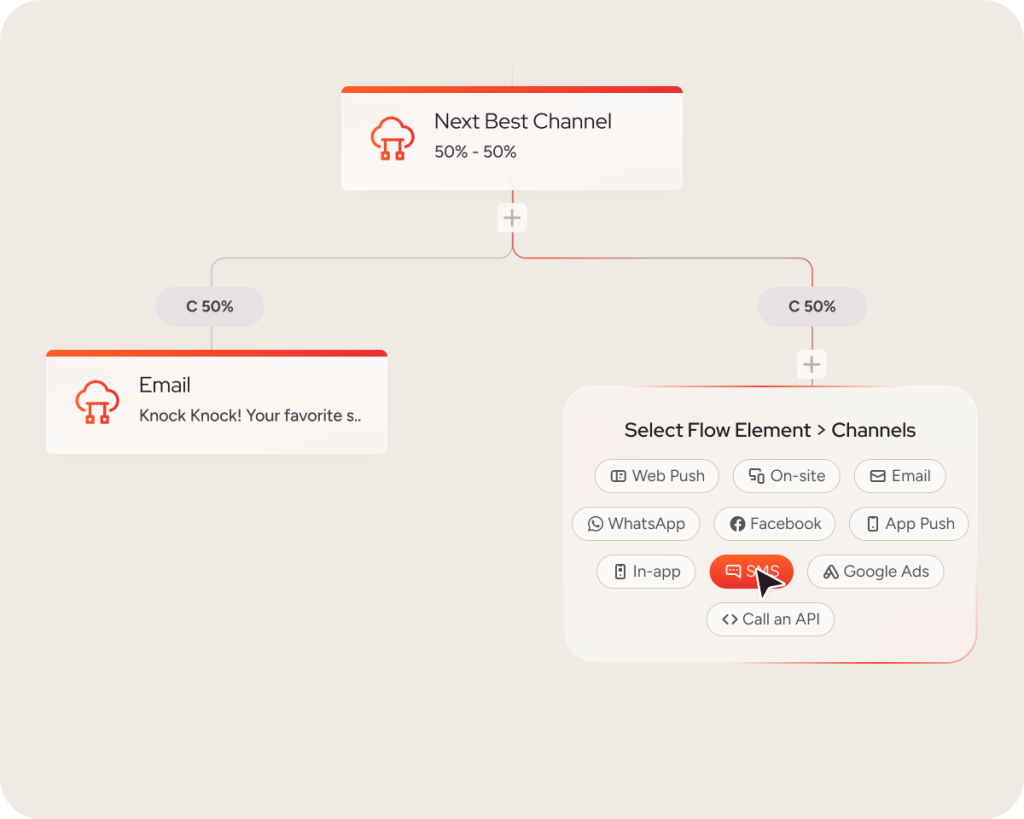
One significant advantage of running attribution and decisioning as an integrated layer rather than separate tools is that holdout testing becomes a native function rather than an additional analytics project. When the decisioning engine controls which users receive which interventions, it can maintain clean holdout groups automatically.
The lift measurement is then structural, the difference in conversion rate between users who received the next best action and the holdout group is calculated continuously, giving marketing ops a live view of incremental impact rather than a retrospective attribution assumption.
This matters especially for teams navigating internal debates about channel contribution. Incrementality measured through a live holdout is harder to dispute than a model-assigned credit share.
It shifts the conversation from “which attribution model should we trust” to “here’s what the decisioning layer has demonstrated in controlled conditions.”
The data foundation that makes it work
Minimum viable data requirements
AI-augmented decision making at the attribution layer requires four foundational elements before it can deliver reliable output.
First, unified customer identity across devices and sessions: if a user’s mobile browser session and desktop purchase are tracked as separate profiles, the attribution model is fragmenting its own signal.
Second, a clean event taxonomy: every touchpoint the model needs to weight must be tracked consistently, with the same event naming, across all channels and platforms.
Third, first-party behavioral signals: with third-party cookies in structural decline, the behavioral data that feeds propensity scoring needs to come from your own data layer, not from inferred third-party signals.
Fourth, a single defined reward metric that the decisioning agent optimizes toward, typically revenue, margin contribution, or lifetime value, not a proxy metric like click-through rate that can be optimized without any corresponding commercial outcome.
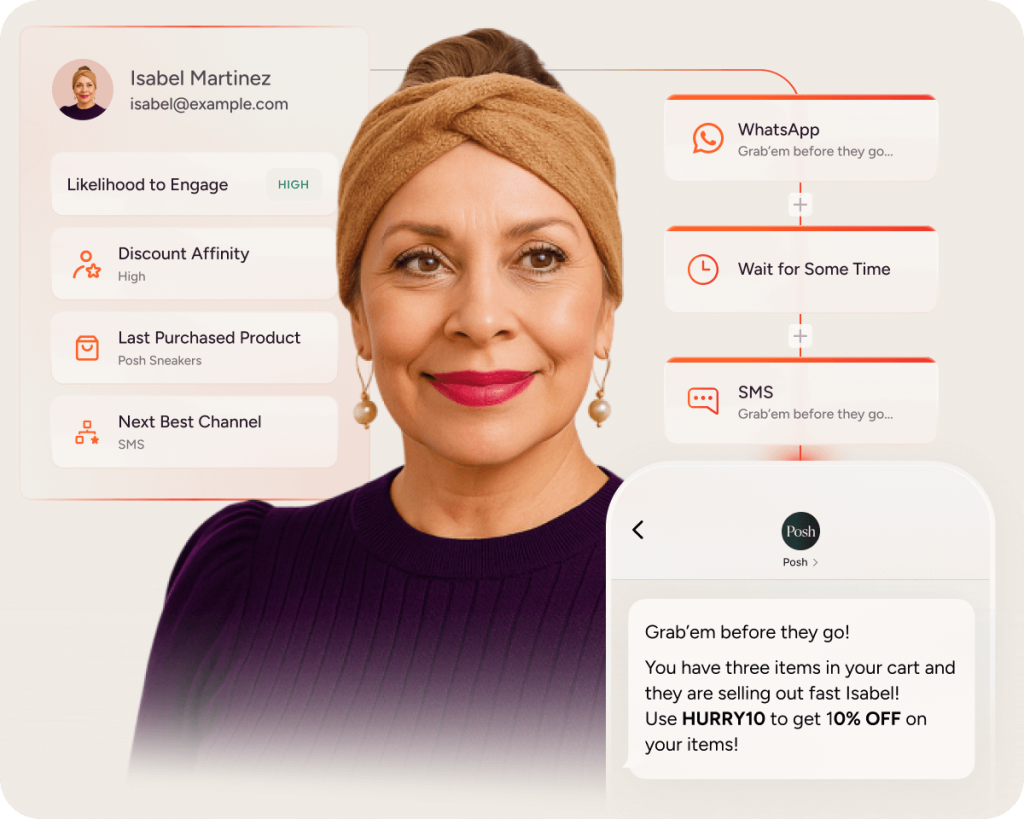
The Insider One platform is built around this data foundation, using unified customer profiles to connect behavioral signals across channels and sessions and feeding those profiles into decisioning logic in real time.
The Customer Data Management layer is what makes this identity resolution possible at scale, without requiring a separate data engineering project to reconcile identifiers before the decision engine can start.
Addressing the black box risk
Marketing attribution powered by AI introduces a real governance concern for marketing ops teams: if the decisioning engine is changing channel weights and budget constraints automatically, how do you know why it made a specific decision, and how do you audit it when results deviate from expectations?
This is where explainability requirements belong in the vendor evaluation conversation.
A well-designed decisioning layer maintains an audit trail at the action level: this user received this offer on this channel because their propensity score combined with their attribution history ranked that action highest against the defined reward metric at that moment.
That level of traceability gives marketing ops the ability to inspect any individual decision, identify patterns in decisioning logic, and intervene when the system is optimizing toward a metric that doesn’t align with actual business intent.
Without that auditability, AI decisioning becomes a black box that marketing leadership will reasonably resist trusting with budget authority.
Building the attribution-decisioning bridge in your stack
A practical three-step framework
Step one: Audit your attribution outputs for signal latency and coverage gaps. Before you can connect attribution to decisioning, you need to understand what your current attribution model is actually measuring and how current those measurements are.
Map the time lag from touchpoint to attribution output. Identify which channels are absent from your current attribution coverage, common gaps include offline touchpoints, email influence on non-email converters, and app engagement that doesn’t connect to web session identity.
Step two: Map which decisioning dimensions each attribution signal should govern. Not every attribution signal should influence every decisioning variable. Channel influence scores should govern channel selection and spend weighting.
Propensity scores derived from behavioral attribution should govern offer intensity and frequency. Session-level intent signals should govern real-time onsite personalization.
Defining these mappings before implementation prevents the decision layer from becoming a single rule that applies every signal to every decision and produces undifferentiated output.
Step three: Run a constrained pilot against a holdout before full rollout. Start with one segment, one channel, and one decisioning dimension. Measure lift against the holdout continuously for a defined period before expanding scope.
This approach validates the integration between your attribution outputs and the decisioning layer while generating internal proof of incremental impact, which is the evidence you’ll need when presenting the case for broader rollout to finance and channel owners.
What to look for in vendor evaluation
The most common failure point in this space is buying a platform that markets AI decisioning but delivers propensity scores wrapped in journey automation logic. The distinction is important: a journey builder that selects a path based on a propensity score is not performing arbitration.
It’s executing a pre-defined sequence against a filtered audience. True arbitration means the system evaluates every eligible action for a given user at the moment of evaluation and selects the highest-expected-value action dynamically, without a pre-specified path constraining the decision space.
When evaluating platforms, ask specifically: does the decisioning layer evaluate actions across all available channels simultaneously at the moment of each trigger, or does it select from actions within a pre-configured journey? Does it maintain clean holdout groups automatically? Does it provide action-level audit trails?
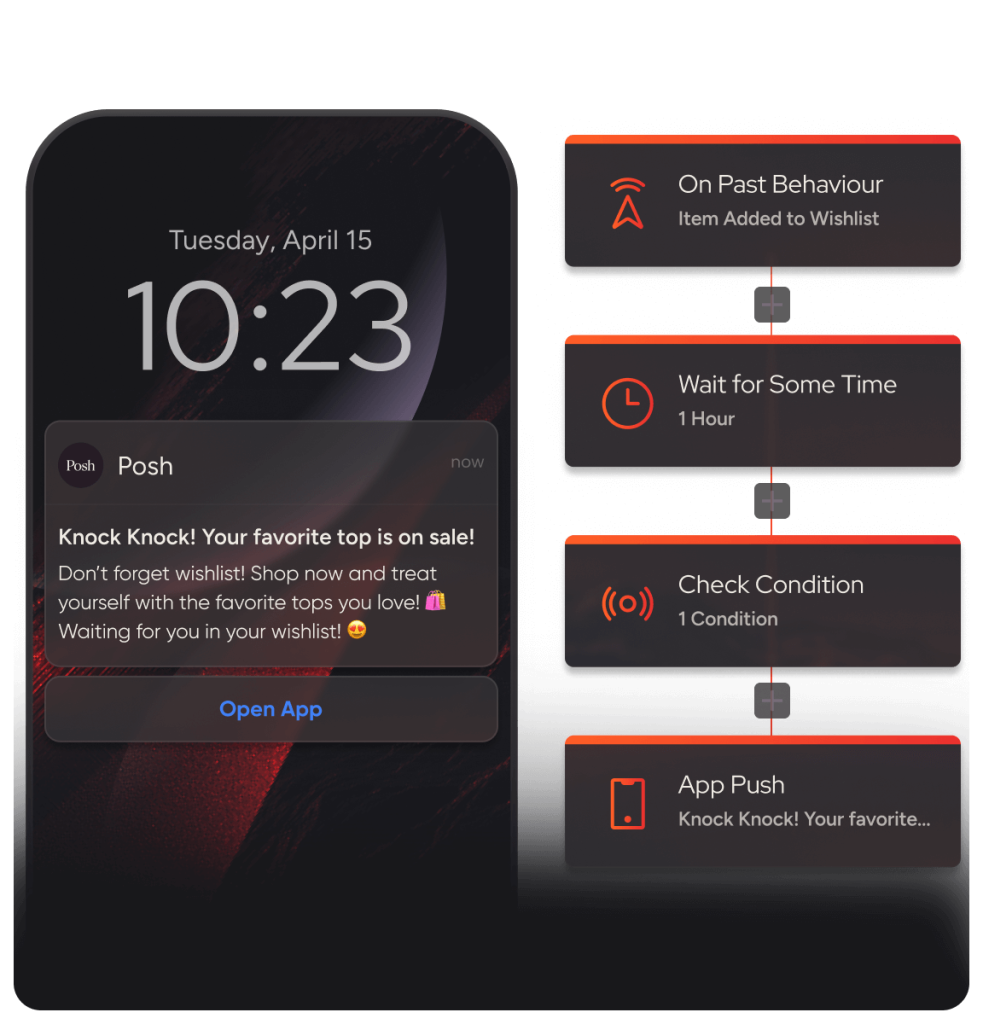
And critically: does it treat attribution signal as a live input variable, or does it consume attribution data as a batch export from a separate analytics tool? Insider One’s journey orchestration architecture is designed around real-time arbitration with live signal ingestion, which is the structural requirement for genuine attribution-decisioning integration.
For a deeper look at how data-driven approaches connect to marketing performance, our article on data-driven marketing automation covers the operational foundations that make attribution-to-action pipelines reliable at scale.
If you want to see how Insider One’s Architect, Customer Data Management, and Insider One AI™ turn live customer data into coordinated, revenue-driving experiences, book a personalized demo to see the exact use cases, decision logic, and growth levers most relevant to your team.
Frequently asked questions
Multi-touch attribution is an analytical model that assigns credit to touchpoints after conversion events occur. AI decisioning is an operational layer that ingests attribution signals as live inputs and uses them to determine the next best action per user in real time. Attribution explains the past; decisioning acts on the present. The two functions complement each other but do not substitute for one another.
Not necessarily a standalone CDP, but you do need unified customer identity resolution before decisioning can function reliably. If the same user’s touchpoints are tracked under separate profiles across devices and channels, the attribution signal the decisioning engine receives is fragmented and will produce unreliable output. Whether you achieve identity resolution through a dedicated CDP, a composable data layer, or a platform with built-in unification, the functional requirement is the same.
The primary measurement is incremental lift against a holdout group that receives no intervention from the decisioning layer. Secondary measurements include attribution model stability over time (are channel weights drifting in a direction consistent with actual performance?) and decisioning response latency (how quickly does the system re-score and re-route after a new behavioral signal?).
Avoid using last-touch conversion rate as the primary success metric. It will likely show inflated results and conflate the attribution model’s behavior with the decisioning layer’s contribution.
The technical barriers are usually solvable. The organizational barrier is almost always governance: specifically, who has authority to let a system automatically adjust budget constraints and channel selection without human approval? Defining the boundaries of automated authority before implementation—which decisions the system can make autonomously, which require human review, and under what conditions the system escalates—is the conversation that determines whether this architecture gets adopted or stalls in a proof-of-concept phase indefinitely.

Keep Reading
4 min.

Chris Baldwin
3 Feb 2026
8 mins.
Chris Baldwin
8 Oct 2026
8 mins.
Chris Baldwin
8 Oct 2026