

 Platform Overview

 Integration Hub

 Insider One AI™

 Customer Data Management

 Personalization

 Journey Orchestration

 Reporting & Data

 Behavioral Analytics

 Web
Web

 Email
Email

 Site Search

 Conversational CX

 WhatsApp

 Web Push

 InStory

 App
App

 SMS & RCS

 Join the $0 Migration Movement™

 The Insider One Difference

 Compare Vendors

 Switch to Insider One

 Success Story

 Retail & Ecommerce

 Financial Services

 Travel & Hospitality

 Beauty & Cosmetics

 Automotive

 Telecommunications

 Total Economic Impact™ Study

 Blog
Blog

 E-Books & Guides

 Glossary
Why the Best Customer Data Platforms Are Failing Marketers

Updated on 29 Jun 2026
9 min.
Table of Contents
Most Popular


Summary
The success of a CDP depends on more than collecting customer data. Real-time activation, accurate identity resolution, and clear governance are essential to delivering personalized experiences at scale.
The biggest challenge with customer data platforms isn’t collecting customer data, it’s turning that data into action. When audiences don’t sync quickly, execution depends on manual processes, and no one owns the platform, marketers end up with another system to manage instead of a platform that accelerates campaigns.
Why do customer data platforms fail marketers?
Picture this: a marketer discovers their “unified” profiles contain duplicate records. Their Meta custom audiences haven’t synced in days. Their email suppression list is out of date. This is the reality for most CDP implementations, not the vendor demo.
When you look closely at a CDP in marketing, failures cluster into distinct phases. You need to understand where the breakdown occurs before you can fix it.
Ingest failures happen before data even reaches the profile:
- Schema drift: Product or engineering teams change event structures without notifying marketing, breaking downstream segments overnight
- Missing consent flags: Activation to privacy-sensitive channels gets blocked, and the brand faces compliance exposure
- Incomplete data coverage: Web behavior gets tracked while the mobile app and call center remain siloed
Identity resolution failures corrupt the profiles themselves:
- Merged records: Distinct users get combined into a single profile because matching rules are too loose
- Duplicate profiles: The same person ends up with multiple records across channels and devices
- Missing identifiers: Key profile fields stay incomplete, leaving marketers without enough context to personalize confidently
Activation failures prevent profiles from reaching campaigns:
- Batch syncs: Audiences update infrequently while other brands respond to customer signals in minutes
- Channel connectors: Every new destination requires engineering support and custom code
- Missing QA layers: No validation confirms that segments actually reached downstream platforms
These failures introduce operational risk and unnecessary complexity. Teams spend more time diagnosing sync gaps, validating audiences, and managing workarounds between systems, while vendor lock-in compounds the problem when core workflows depend on brittle handoffs that are hard to unwind.
Another failure pattern that vendors tend to dismiss is organizational ambiguity. When no one owns the data model, schema changes break downstream campaigns instantly.
When marketers can’t self-serve segments, the platform becomes another IT dependency instead of a growth lever.
What is the CDP reframe for data unification and activation?
Your current setup underperforms, so you need to make a critical decision soon: should you invest further in your current platform, replace it, or layer a composable approach on top of your warehouse?
The right choice depends on specific constraints:
- Latency requirements: If campaigns need to respond quickly for cart or browse abandonment, batch-oriented warehouse-native approaches struggle without an activation layer that can move audiences into execution faster
- Identity complexity: Brands with multiple properties and offline touchpoints need durable stitching rules, governance, and ongoing QA that are hard to manage through warehouse SQL alone
- Team maturity: If marketing lacks SQL skills and data engineering bandwidth is scarce, a packaged platform with self-serve segmentation reduces time to value
Let’s address the warehouse-native question directly. A data warehouse serves as the system of record for complete customer profiles, but it’s not an activation layer.
Reverse ETL tools push segments to channels. They don’t natively manage journey orchestration, channel-ready audience activation, or marketer-friendly execution workflows.
The warehouse is infrastructure. The enterprise customer data platform is the operational layer that combines unified profiles, segmentation, personalization, and journey orchestration so marketers can act on that data without waiting on engineering.
You also need to actively avoid vendor lock-in. Prioritize platforms with clear integration paths, practical export processes, and an operating model your team can support without constant custom work. If moving segments, profiles, or workflows depends on bespoke engineering every time, you’re still locked in regardless of what the contract says.
This reframe is for mid-market and enterprise teams already running campaigns across multiple channels who need to move faster without rebuilding their customer data platform architecture. Teams still in early-stage data collection need clean event tracking and a clear taxonomy first.
If you want to see how an activation workflow can support time-sensitive use cases in practice, book a demo and evaluate it against your channel, governance, and execution requirements.
How do you fix failed CDP outcomes?
Don’t frame this as best practices. Frame it as triage. You need to know what to fix first based on where the system is breaking.
How do you fix identity resolution before adding more data?
When match rates are low, the instinct is to ingest more identifiers. This makes the problem worse by introducing more opportunities for over-stitching. Start with validation instead.
Export a sample of merged profiles and manually verify that each profile represents a single person. Check for conflicting identifiers or attributes that suggest records were combined too aggressively. Review stitching rules to see whether missing fields, source mismatches, or loose matching logic are creating unreliable profiles.
The fix depends entirely on the failure mode:
- Merged records: Tighten matching rules and require stronger identifiers before combining profiles
- Duplicate profiles: Standardize identifiers and close collection gaps so the same customer is less likely to appear in multiple records
Your target outcome is clear and measurable. You want strong email match rates for known users with a low duplicate rate.
How do you validate activation before trusting the dashboard?
Dashboards show segments created, not segments delivered. The gap between these numbers is exactly where campaigns fail. Build a QA flow for each critical channel.
For Meta and Google Ads, verify audience sizes match between the platform and the ad network, and check sync timestamps.
For email and SMS, confirm suppression lists are current and test that new subscribers appear in segments within your SLA. For on-site personalization, validate that profile attributes like loyalty tier and browse history are available to your personalization engine when the campaign needs them.
When activation lags behind profile updates, the root cause is often the sync pattern between systems. If your system only refreshes audiences on a limited cadence, time-sensitive campaigns such as browse abandonment, cart abandonment, or suppression updates become harder to execute reliably.
Either validate whether real-time connectors are available for supported destinations or set up a narrower workaround for the highest-priority segments.

How do you give marketers self-serve access to segments and journeys?
The most frequent CDP failure isn’t technical. It’s operational. With organizations lacking internal martech expertise, marketers submit tickets to create segments, wait days for engineering review, and launch campaigns after the moment has passed.
The fix requires both tooling and governance. For tooling, choose platforms where marketers can build segments using a visual interface, not SQL or Jinja templates. For governance, establish a shared taxonomy for events and attributes so marketers understand what data is available and what it means.
Self-serve doesn’t mean ungoverned. Implement approval workflows for segments that touch sensitive data, and restrict integration changes to the right roles with PII access.
Maintain audit logs for compliance and establish clear ownership for the data model itself. This unlocks every customer data platform use case you actually care about while maximizing your customer data platform features.
How does Insider One help marketers avoid CDP failure?
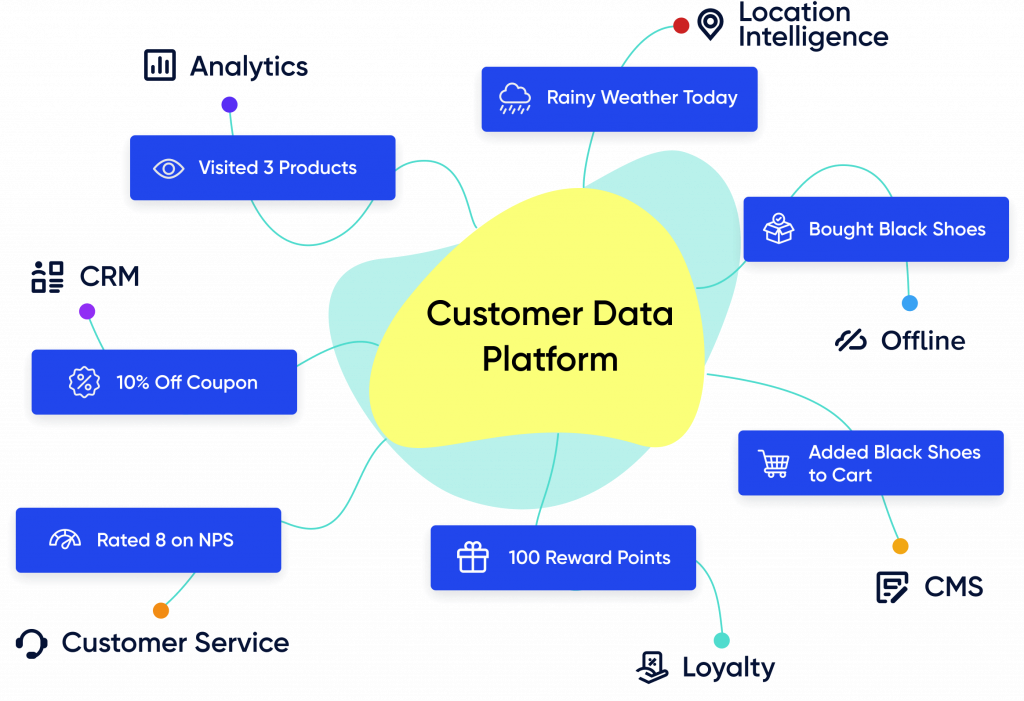
The pattern across failed implementations is consistent. Data lives in one system, activation lives in another, and marketers wait for engineering support between them.
Insider One is better understood as an AI-powered growth and cross-channel personalization platform that combines unified customer data, audience segmentation, and journey orchestration in one operating system for marketers. For supported use cases, marketers can use a visual interface to build audiences, personalize experiences, and coordinate journeys across supported channels instead of routing every change through engineering.
We built specific capabilities that address the failures outlined above:
- Unified customer data and segmentation: Teams can bring customer data together, build audiences in a visual interface, and make those audiences usable across campaigns
- Cross-channel journey orchestration: Architect helps marketers coordinate journeys across web, app, email, SMS, WhatsApp, and other supported channels from one place
- AI-powered personalization and recommendations: Insider supports personalized experiences, product discovery, and recommendation-driven engagement instead of one-size-fits-all messaging
- Governance and integrations: Role-based access, PII controls for integration changes, and external platform integrations help teams activate data while maintaining operational control
In practice, that matters most in workflows buyers already prioritize: browse abandonment, cart abandonment, suppression management, loyalty-tier personalization, and cross-channel lifecycle journeys.
The advantage is operational clarity: buyers can evaluate unified data, segmentation, journeys, personalization, and governance in one marketer-facing workflow instead of relying on broad claims about autonomous execution.
Buyers should evaluate Insider One on practical criteria: unified profiles, marketer-friendly segmentation, cross-channel journeys, AI-powered personalization, governance, channel coverage, and implementation fit.
Teams should also validate integration requirements, activation workflows, and operational ownership against their own operating model before they commit.
If you want to see the identity + activation loop running as one system instead of forcing marketers to jump between data, segmentation, and activation tools, start in the product demo hub and map unified profiles, journeys, and governance to the exact failure points you’re dealing with.
FAQs
A customer relationship management (CRM) platform tracks known customer relationships and sales pipeline activity. A customer data platform unifies behavioral, transactional, and demographic data across all touchpoints into a single profile that marketing teams can activate across channels. The CDP captures anonymous visitors alongside known users, while the CRM focuses on identified contacts with explicit sales relationships.
Export a sample of merged profiles and manually verify each represents a single person. Check for household contamination where multiple conflicting attributes appear on the same profile. Review your stitching rules for conflicting attributes, source mismatches, or loose matching logic that create false matches. Run this validation regularly or after any major data source changes.
Target strong email match rates for known users, low duplicate rates, and profile freshness within your campaign SLA. If your suppression lists are significantly stale, you risk compliance violations. The specific thresholds depend on your vertical and use cases, but the principle holds: measure match quality before measuring campaign performance.
Prioritize platforms with documented export steps, integration clarity, and an operating model your team can support without constant custom work. Before signing, test how hard it is to move key segments, profiles, and workflows if your requirements change. If the answer depends on bespoke engineering every time, you’re locked in regardless of what the contract language says.
A warehouse stores and analyzes data, but it doesn’t activate it. If you need timely audience activation, journey orchestration, or marketer-friendly channel execution, you need an activation layer on top of your warehouse. This can be a packaged CDP or a composable stack with reverse ETL. The warehouse alone won’t get you to personalized campaigns at scale.

Keep Reading
7 min.

Muharrem Derinkok
4 Jun 2026
11 min.

Chris Baldwin
2 Jun 2026
4 min.
Chris Baldwin
3 Feb 2026