

 Platform Overview

 Integration Hub

 Agent One™

 Agent One™ Teams

 Customer Data Management

 Personalization

 Journey Orchestration

 Reporting & Data

 Behavioral Analytics

 Web
Web

 Email
Email

 Site Search

 Conversational CX

 WhatsApp

 Web Push

 InStory

 App
App

 SMS & RCS

 Join the $0 Migration Movement™

 The Insider One Difference

 Compare Vendors

 Switch to Insider One

 Success Story

 Retail & Ecommerce

 Financial Services

 Travel & Hospitality

 Beauty & Cosmetics

 Automotive

 Telecommunications

 Total Economic Impact™ Study

 Blog
Blog

 E-Books & Guides

 Events

 Glossary
Smart Recommender: AI Similarity and Complementary Algorithms

Updated on 8 Jul 2026
9 min.
Table of Contents
- Smart Recommender's Similarity Engine: Three New AI Algorithms for Every Product
- The blind spot in behavior-only recommendations
- Three algorithms. One engine. Every product in your catalog.
- Fallback drops from 60% to 10%
- Built for catalog-rich, behaviorally thin setups
- Ready to run on day one
- Why this matters now
- Learn more about Insider One Smart Recommender
- Frequently asked questions
- What is the Smart Recommender Similarity Engine?
- What are the three new recommendation algorithms?
- Do these algorithms require historical purchase or behavioral data?
- What happens to the Substitute algorithm?
- Will existing Complementary results change?
- How quickly do new products appear in recommendations?
- Which verticals benefit most?
- Who can access these algorithms?
- Can I preview results before going live?
- How do I get started?
Most Popular
Smart Recommender’s Similarity Engine: Three New AI Algorithms for Every Product
Part of Smart Recommender, Insider One’s AI-powered recommendation engine, three algorithms: Visually Similar, Similar, and a smarter Complementary, now bring relevant recommendations to your whole catalog, not just your bestsellers.
Most recommendation engines are great at doing one thing: learning from your top performers. Bestsellers? Covered. Products with months of clicks, carts, and purchases behind them? Easy.
But the moment a new arrival needs a recommendation – or a niche SKU, or a long-tail product that’s never had enough traffic to build a behavioral signal – behavior-only algorithms go quiet. They fall back. And that fallback fills your recommendation slots with generic content instead of relevant products.
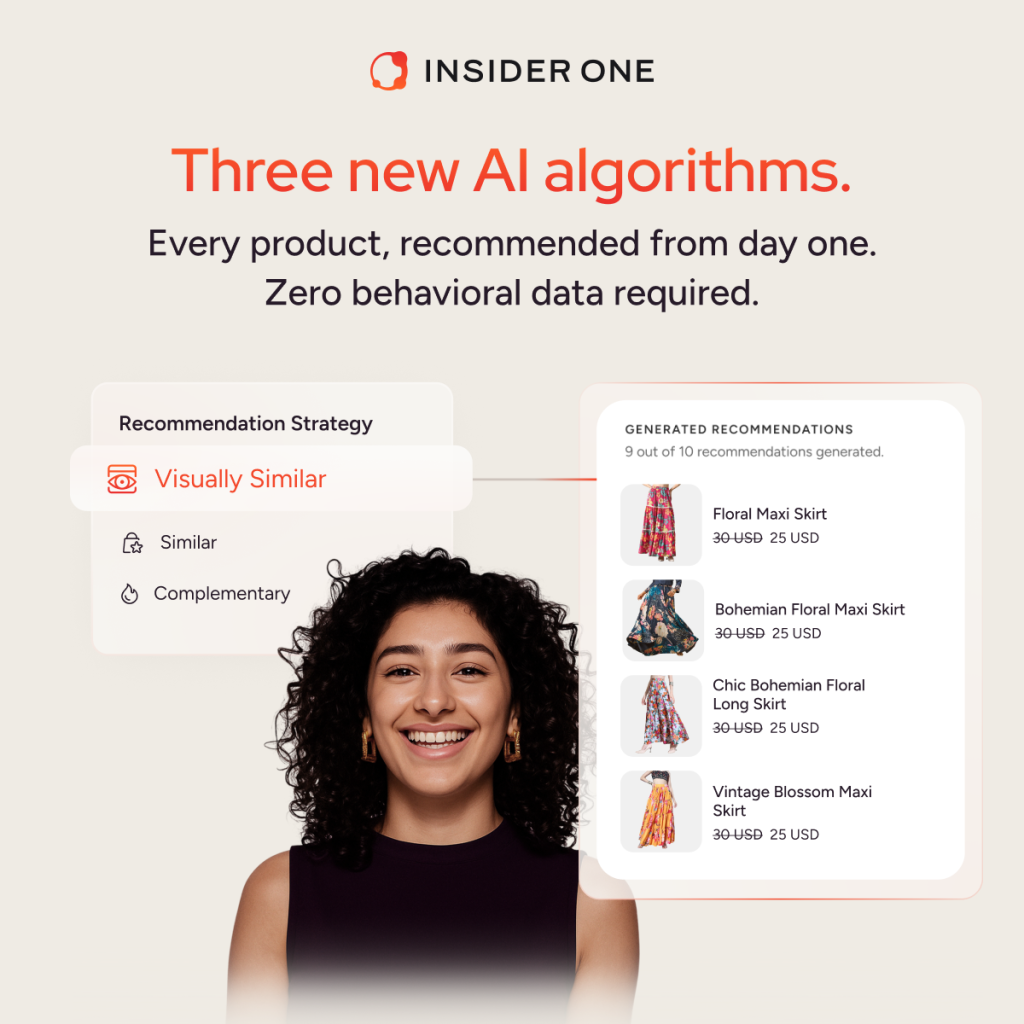
That’s the problem Smart Recommender’s new Similarity Engine is built to solve. With three new AI recommendation algorithms: Visually Similar, Similar, and an updated Complementary – every product in your catalog can earn a relevant recommendation from its first day live.
The blind spot in behavior-only recommendations
Behavioral data is powerful when it exists. Product recommendations should not fail when behavioral data is missing. For years, ecommerce recommendations have depended heavily on behavioral signals: views, clicks, purchases, carts, and co-purchase patterns. That works well for popular products with enough traffic and transaction history.
The trouble is that most catalogs are uneven. New arrivals have no history. Seasonal SKUs come and go before behavioral signals accumulate. Niche products stay niche. Long-tail inventories often sit outside high-performing recommendation logic.
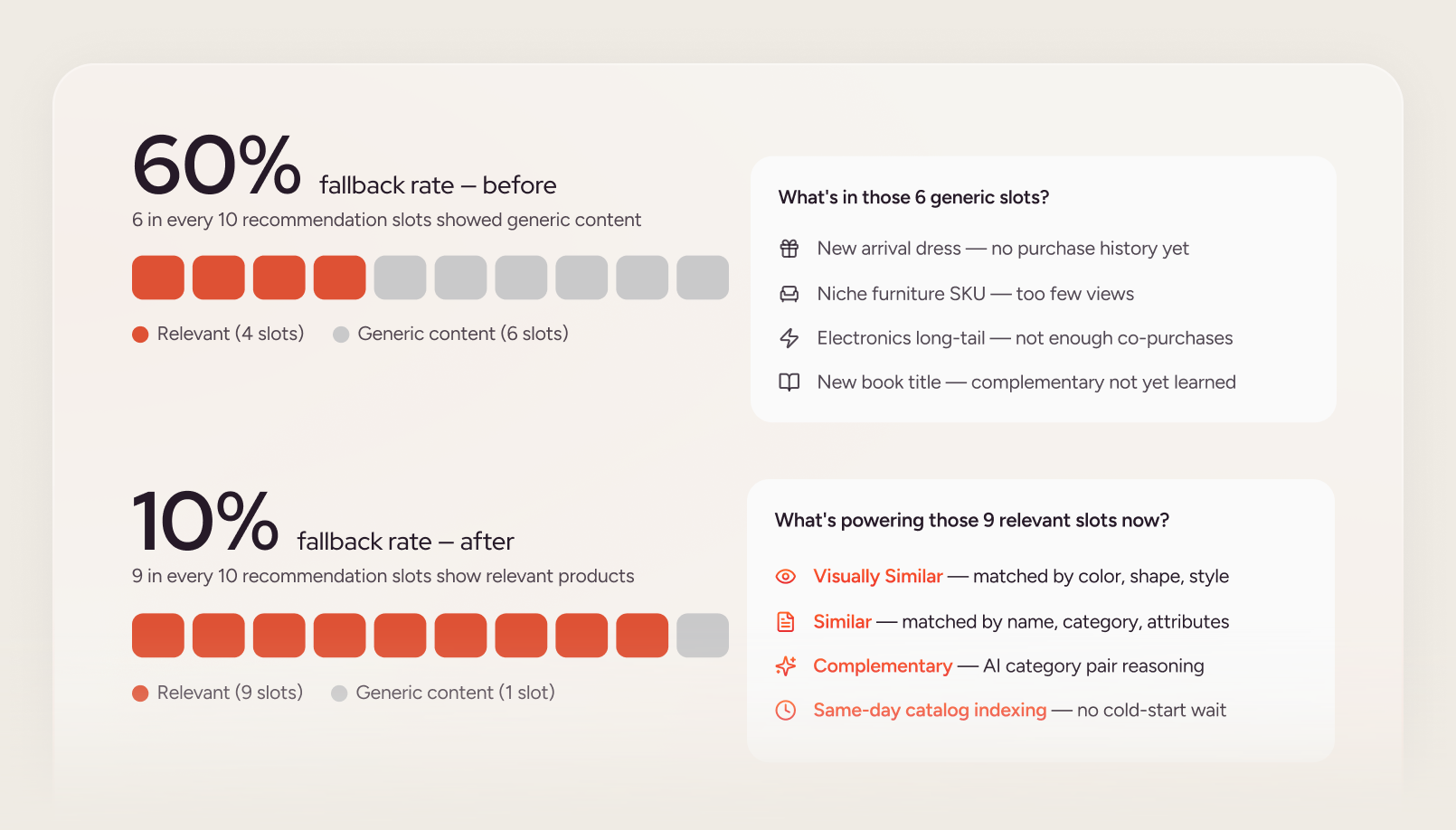
In those gaps, recommendation slots default to generic fallback content. In some catalogs, fallback rates for cross-sell and upsell algorithms were reaching 60%. That’s the majority of prime recommendation real estate – the space teams had already committed to discovery and revenue – serving shoppers products no one specifically chose for them.
The Similarity Engine reads your catalog directly, so it doesn’t need behavioral history to get started. It understands each product from what it looks like, what it’s called, what it’s made of, and what category it belongs to. That means every product becomes recommendable on day one.
Three algorithms. One engine. Every product in your catalog.
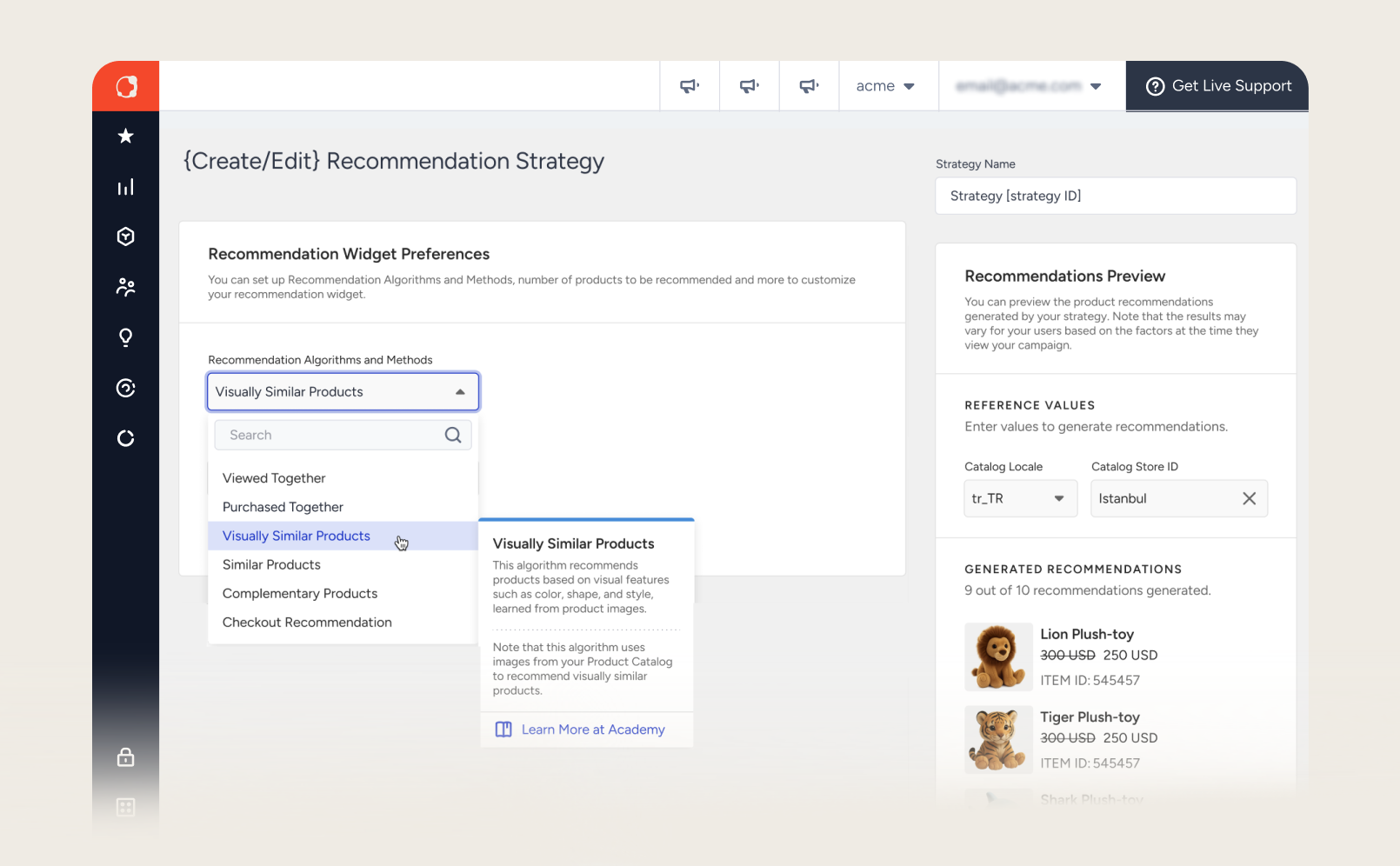
The Similarity Engine powers three algorithms inside Smart Recommender’s strategy creation flow. Each one solves a specific gap that behavioral-only models leave behind.
Together, these algorithms help ecommerce and merchandising teams create more relevant recommendation strategies even when behavioral data is limited, unavailable, or incomplete.
Visually Similar: recommendations from your product imagery
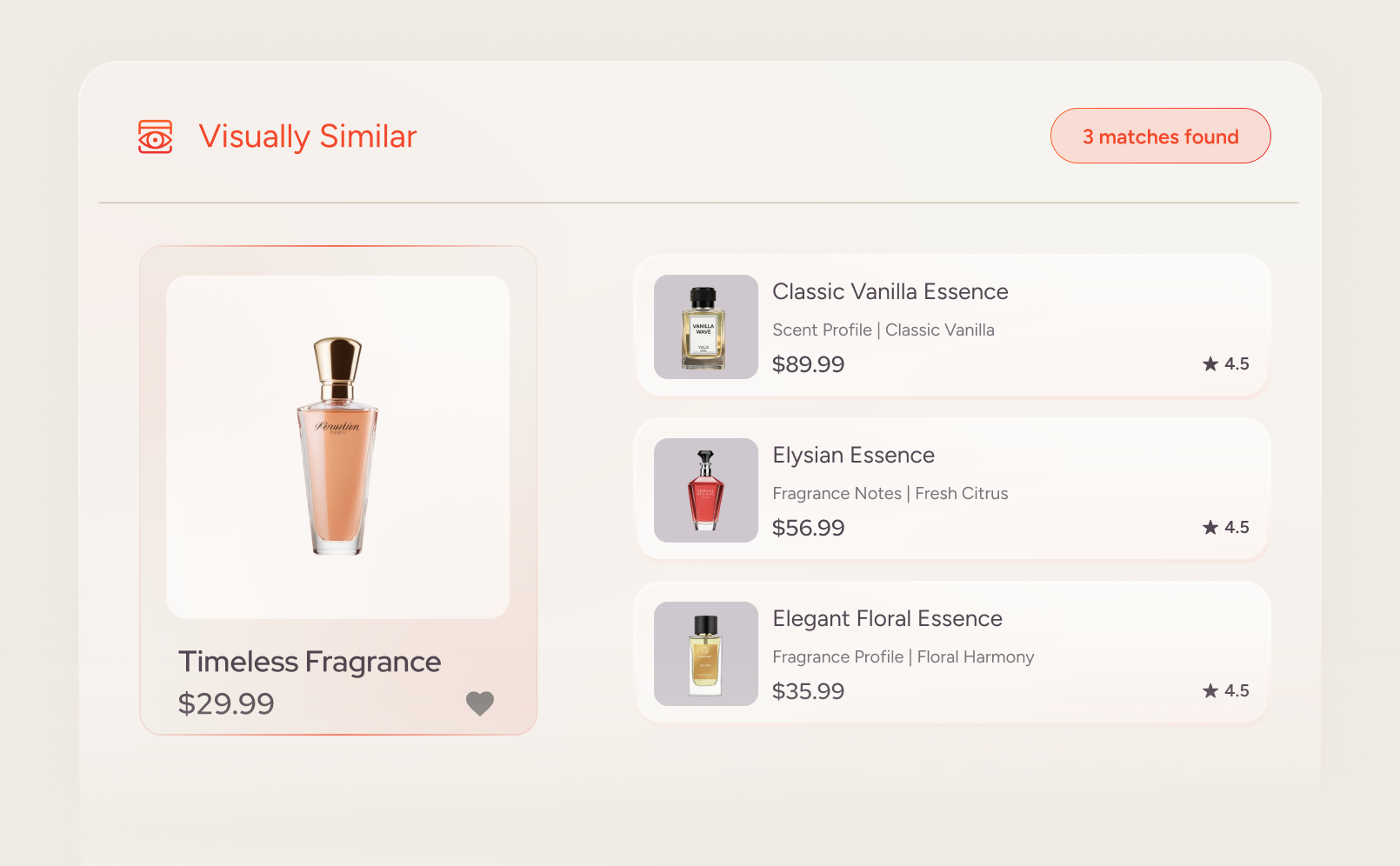
Visually Similar matches products based on visual signals: color, shape, texture, and style, read directly from product images. This is especially useful for categories where the look and feel of a product directly influences buying decisions, such as fashion, furniture, jewelry, home decor, and lifestyle products.
A fashion brand adds 200 new dresses today. Without any purchase history, those products can appear in Visually Similar recommendations within the day. For fashion, furniture, jewelry, and lifestyle verticals, your product imagery becomes a working recommendation signal from the moment a product goes live.
Similar: recommendations from product descriptions and attributes
Similar matches on meaning. It reads product names, category labels, and up to three custom attributes you define, so recommendations reflect the details that matter in your specific catalog.
An electronics retailer can enable attributes like energy_class, capacity_inKG, & spin_speed and our Smart Recommender will match washing machines on actual technical specifications, instead of relying only on category-level similarity. Because ‘Similar’ reads names and descriptions, it still delivers relevant results even when structured attribute fields are incomplete.
Complementary: cross-sell powered by AI category reasoning
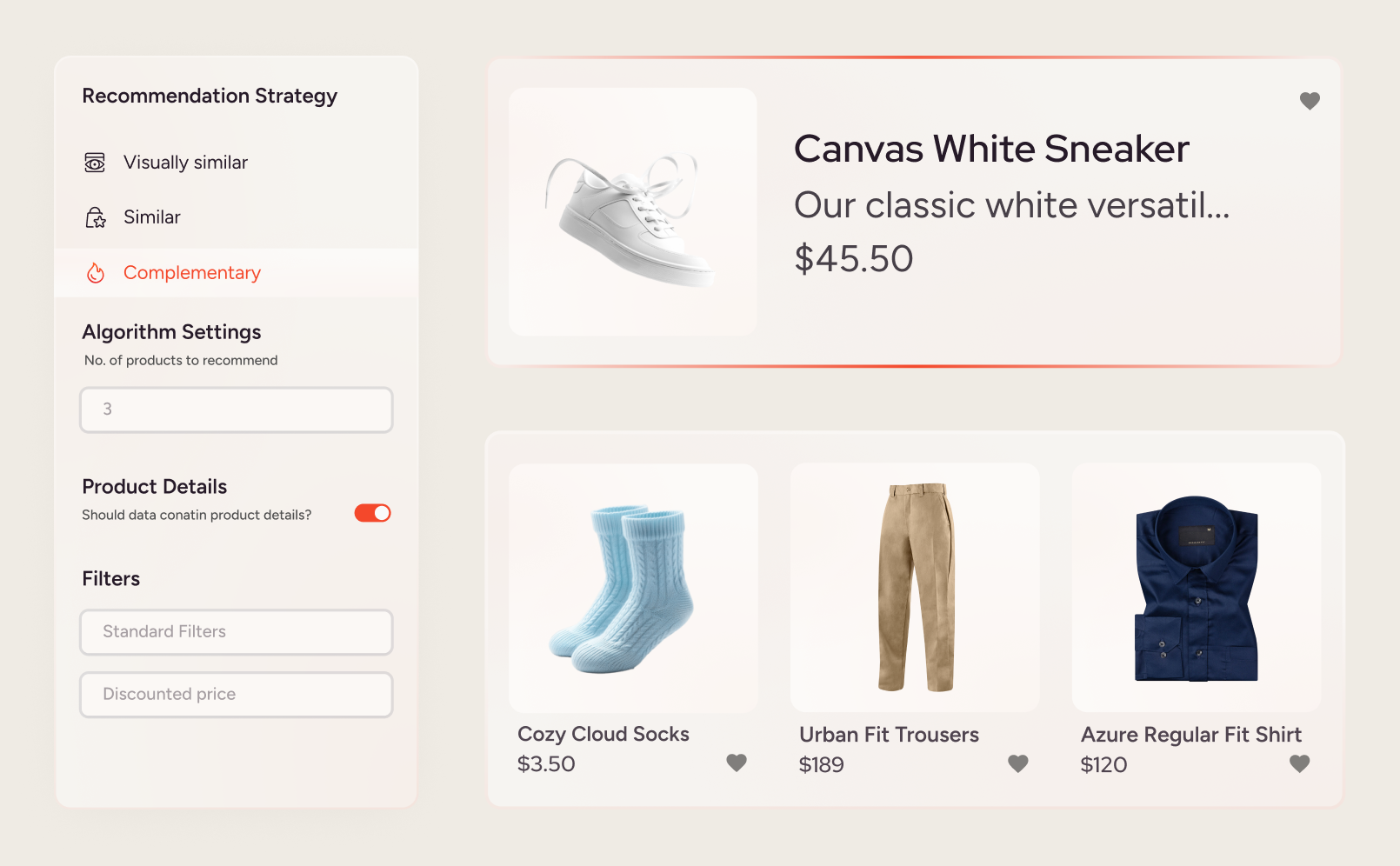
The Complementary algorithm has been updated from co-purchase logic to AI-based category pair reasoning.
Previously, ‘Complementary’ worked by learning which products customers bought together. That required transaction volume that new catalogs, new products, and low-traffic SKUs simply don’t have. The updated model understands category relationships on its own. It can pair a book with a bookmark and a reading light based on category knowledge alone, without waiting for enough purchases to make the connection.
Cross-sell now works from day one, even for products and catalogs that have never had the transaction history to support it.
Fallback drops from 60% to 10%
Behavioral recommendation models can be powerful, but they are not always enough.
They often underperform when:
- New products with no history
- Low-traffic SKUs
- Niche or long-tail catalogs
- Limited partner transaction history
- Incomplete or inconsistent product attributes
- Cross-sell/upsell logic over-reliant on past behavior
In these cases, recommendation slots may fallback to generic product suggestions instead of showing relevant products. Recommendation space is valuable. If that space is filled with generic products, brands lose opportunities to increase product discovery, improve customer experience, and drive assisted revenue.
For ecommerce teams, this creates a direct business problem. Across partners in fashion, electronics, furniture, and marketplace verticals, fallback rates dropped from 60% to 10% after enabling the new algorithms.
That’s not a technical metric. That’s the difference between your recommendation slots doing the job they were built for – driving discovery, cross-sell, and assisted revenue – versus filling with generic content that no one curated.
More of your catalog working. Less of your prime real estate wasted.
Built for catalog-rich, behaviorally thin setups
The Similarity Engine was designed with specific setups in mind: catalogs that are large and varied, but where behavioral data is thin.
Fashion brands with deep seasonal ranges. Furniture and home retailers with visually diverse inventory. Electronics retailers where product specifications matter more than browse history. Marketplaces with vast, fast-moving catalogs that change faster than behavioral models can learn.
In all of these, the Similarity Engine gives every product something to work with from the start – not just the ones with traffic behind them.
Instead of waiting for behavioral signals to build over time, Smart Recommender can use product-level signals to identify relevant matches across the catalog.
That means:
- New arrivals can be recommended without purchase history
- Low-traffic SKUs can be included in relevant recommendation strategies
- Catalog-rich businesses can reduce dependency on fallback logic
- Merchandising teams can create more useful product discovery experiences
- Complementary recommendations can work even when co-purchase data is limited
This matters for any ecommerce business with a large, fast-changing, or complex catalog
Ready to run on day one
The engine is built to keep pace with a live catalog. Same-day catalog index updates mean new products are eligible to appear in recommendation results within the day they’re added.
Dynamic filters give merchandising teams control over results by stock availability, category, and price range, with the option to exclude items a shopper has already viewed. The Strategy Previewer lets you see what recommendations look like before any strategy goes live, so teams can validate and adjust with confidence before publishing.
Why this matters now
Ecommerce catalogs are growing. Customer expectations are rising. Merchandising teams are under pressure to make every touchpoint more relevant without adding operational complexity.
Traditional recommendation logic can miss too much of the catalog when it depends only on user behavior.
Insider One’s Smart Recommender Similarity Engine helps close that gap by combining product understanding with AI-powered recommendation logic.
For enterprise B2C brands, this means product recommendations can become more resilient, more scalable, and more useful across the full catalog.
The new Similarity Engine and AI-Powered Complementary Algorithms mark a major evolution for Smart Recommender.
Recommendations no longer need to depend only on what users have done in the past. They can also be powered by what products look like, what they are, and how they fit together.
That gives ecommerce and merchandising teams a stronger foundation for product discovery, cross-sell, upsell, and catalog activation.
With Smart Recommender, every product can get relevant recommendations from day one.
Learn more about Insider One Smart Recommender
Smart Recommender is part of Insider One’s AI-native platform for individualized, cross-channel customer experiences.
The Similarity Engine and all three algorithms are available now to all Smart Recommender users.
To learn how Insider One helps enterprise brands personalize product discovery, improve ecommerce journeys, and orchestrate customer engagement across channels.
Ready to get started? Get a personalized demo today. Already a customer? Speak with your account team to see Visually Similar, Similar, and Complementary in action.”
Frequently asked questions
What is the Smart Recommender Similarity Engine?
The Similarity Engine is the AI layer inside Smart Recommender that reads your product catalog directly – using images, text, and category relationships – to deliver relevant recommendations without relying on behavioral data. It powers three algorithms: Visually Similar, Similar, and the updated Complementary.
What are the three new recommendation algorithms?
Visually Similar recommends products based on visual signals – color, shape, texture, and style – read from product images. Similar recommends products based on names, categories, and up to three custom attributes you define. Complementary recommends products that pair naturally with what a shopper is viewing, using AI category reasoning rather than co-purchase data.
Do these algorithms require historical purchase or behavioral data?
No. All three read your catalog directly and work from day one including for new arrivals, niche SKUs, and products that have never generated behavioral signals.
What happens to the Substitute algorithm?
The Substitute algorithm is being retired for new partners. Its use cases are covered by Visually Similar and Similar, which offer more precise and flexible matching.
Will existing Complementary results change?
Yes. The model moves from co-purchase logic to AI-based category pair reasoning. The intent stays the same, pairing products that naturally go together, but it no longer requires transaction history to do so. Existing configurations update automatically.
How quickly do new products appear in recommendations?
Same-day catalog index updates mean new products are eligible to appear in results within the day they’re added.
Which verticals benefit most?
Fashion, furniture, electronics, books, and marketplaces, any vertical with a visually rich, spec-heavy, or fast-moving catalog benefits significantly. The Similarity Engine is built for all verticals, with the clearest gains in catalog-rich, behaviorally thin setups.
Who can access these algorithms?
All three algorithms are available to all Smart Recommender users, accessible from the strategy creation flow.
Can I preview results before going live?
Yes. The Strategy Previewer shows you what recommendations will look like before publishing, so you can validate and make adjustments with confidence.
How do I get started?
If you’re an existing Smart Recommender user, talk to your account team. If you’re new to Smart Recommender, book a demo to see the Similarity Engine in action.

Keep Reading
4 min.

Chris Baldwin
3 Feb 2026
10 min.
Chris Baldwin
24 Oct 2026
9 min.
Chris Baldwin
24 Oct 2026