

 Platform Overview

 Integration Hub

 Sirius AI™

 Customer Data Management

 Personalization

 Journey Orchestration

 Reporting & Data

 Behavioral Analytics

 Web
Web

 Email
Email

 Site Search

 Conversational CX

 WhatsApp

 Web Push

 InStory

 App
App

 SMS & RCS

 Join the $0 Migration Movement™

 The Insider One Difference

 Compare Vendors

 Switch to Insider One

 Success Story

 Retail & Ecommerce

 Financial Services

 Travel & Hospitality

 Beauty & Cosmetics

 Automotive

 Telecommunications

 Interactive Platform Tour

 Blog
Blog

 E-Books & Guides

 Glossary
Maximizing ROI with CDPs: Strategic Implementation Tips

Updated on 6 Jan 2026
14 min.
Table of Contents
Most Popular



Can you answer how personalization drives ROI for your business? Most marketing teams can’t. Their data sits in too many places: web analytics, apps, CRM, call centers, loyalty programs, and offline stores. Attribution stays fuzzy even as the martech stack grows. That leaves marketing leaders defending budgets instead of pointing to clear lifts in conversion, AOV, and CLV.
A customer data platform or CDP, like Insider One, breaks that deadlock and lays the foundation for unlocking CDP ROI. It pulls first-party behavioural, transactional, and contextual data from every touchpoint and stitches it into a single, living customer profile. With that foundation, personalization stops residing in silos and becomes a unified engine you can activate instantly.
This article cuts straight to what drives CDP ROI. Expect clear CDP ROI metrics, honest CDP implementation challenges, and levers that unlock maximum ROI from your CDP. And you’ll also get to see how Insider One’s CDP turns personalization into revenue you can trust.
Understanding CDP ROI: Key Metrics to Track
CDP ROI is the incremental lift in revenue, margin, and efficiency you get with clean, unified, and consistent data activated across journeys. You realize that lift only when you anchor it to hard metrics that move the P&L. For most e-commerce, travel, telecom, and banking brands, that means tracking customer lifetime value, average order value, retention, churn, and campaign performance, areas where AI-driven personalization and real-time data can deliver tangible gains.
| Metric | What does it measure? | Why it matters for CDP ROI |
| Customer lifetime value | Total revenue per customer over their lifecycle | Shows how unified data improves lifecycle timing and relevanceIndicates whether a CDP is improving core customer economics |
| Average order value | Spend per transaction | Shows incremental revenue from relevant recommendations and offersProvides an early financial signal of CDP activation |
| Retention and churn | Customers staying active vs. drifting away | Shows whether unified profiles are surfacing early churn risk that siloed systems miss.Measures the financial value of interventions that keep customers from dropping off |
| Campaign performance | Engagement and conversion across channels | Reflects efficiency gains as real-time intent improves message timing, targeting, and relevanceTies directly to revenue by increasing conversion and reducing waste across owned and paid channels |
Customer lifetime value (CLV)
CLV measures the total revenue a customer generates over their entire relationship with your brand. It shows how often they buy, how long they stay, and how valuable they remain over time.
CLV quantifies CDP ROI by capturing how unified data improves the timing, relevance, and efficiency of every lifecycle marketing touchpoint. When behaviour, purchases, intent, and context sit in one profile, brands can time journeys with precision. Upsells land when interest is high, replenishment nudges arrive before the customer runs out, and win-back flows trigger before disengagement becomes irreversible. These timing gains compound across segments and extend customer lifespan, making CLV a sharp indicator of whether your CDP is improving customer economics.
ECCO’s results with Insider One CDP illustrate this compounding effect. Intent-based journeys and real-time personalization delivered a 95% increase in CVR and 7.4x ROI, with deeper engagement and higher lifetime spending.
Average order value (AOV)
AOV tracks how much a customer spends in a single transaction. It reveals how effectively your CDP strategy shapes behaviour at checkout.
Customers engage with more relevant products when a CDP powers affinity-based recommendations, dynamic bundles, and context-aware offers. Basket sizes grow without discounts because CDP aligns merchandising with intent and customer behavior in real time. A rising AOV is often the first clear signal that your CDP is influencing purchase decisions and generating incremental revenue.
Spotlight Retail Group shows how this translates into real revenue. They drove more relevant product discovery and larger baskets by unifying shopper behavior and powering real-time recommendations. The result was a 37x ROI, driven by customers buying more because the experience matched their intent.
Retention and churn reduction
While retention shows how many customers stay active, churn captures how many drift away. Together, they reveal whether your CDP is strengthening long-term customer value.
Maximizing ROI with customer data platforms depends on catching disengagement early. Unified data reveals patterns like declining frequency or shrinking baskets and enables timely, personalized interventions that prevent churn. Telecom and financial services feel this impact most, as small boosts in retention quickly compound into large revenue increases.
Campaign performance
Campaign performance reflects how effectively your targeting, messaging, and timing convert attention into revenue across channels.
With accurate identity resolution and real-time intent signals, campaigns can adjust who they target, how often they send, and what message they deliver. This improves segmentation precision, reduces frequency waste, sharpens suppression logic, and increases match rates across ad platforms. The result is higher conversion, more efficient spend, and clearer attribution. All these numbers show whether your CDP is just storing data or actively generating incremental revenue.
These metrics show the upside. The next step is understanding what gets in the way. Because you can’t unlock CDP ROI without overcoming the implementation challenges that block activation.
Common Challenges in CDP Implementation
Many organizations understand what a CDP should deliver. But the implementation reveals deeper problems: fragmented systems, inconsistent profiles, and workflows that can’t support real-time activation. Keep reading to learn why these issues slow down ROI.
Data silos and fragmented systems
Most companies still operate with data scattered across web analytics, CRM, point-of-sale, loyalty systems, and mobile apps. A CDP can only deliver value when it ingests clean, connected data, but fragmentation slows this process. Teams often realize that unifying data requires more cleansing and mapping than expected. This creates delays that push ROI further out. Without breaking silos early, brands cannot build the unified profiles that power any meaningful CDP strategy.

Incomplete or inconsistent customer profiles
Even when data flows into the platform, profiles often remain partial or mismatched. Missing identifiers, duplicate records, and outdated attributes weaken the quality of every activation. This limits segmentation accuracy and prevents AI models from delivering predictive personalization. Plus, campaigns feel generic, journeys misfire, and you never fully realize customer data platform benefits. Improving identity resolution and data hygiene is essential to maximize ROI with CDP.
Lack of cross-team adoption
CDP implementation requires buy-in from product, analytics, engineering, CRM, and sometimes even in-store operations. Naturally, CDP adoption stalls when teams don’t share a common workflow. When that happens, journeys go underused, data never powers real decisions, and CDP ROI remains theoretical. That’s why strong governance, shared ownership, and cross-functional alignment are crucial to realizing customer data platform benefits.
Poor integration with marketing and sales tools
A CDP must integrate with your email service providers, ad platforms, sales systems, and commerce engines to activate data in the moments that matter. Many brands underestimate how much effort this requires.
Weak APIs, rigid connectors, or outdated tool configurations block real-time signal flow and prevent insights from becoming action. Activation stalls and experimentation slows when campaigns can’t receive fresh data or return performance metrics into the CDP. This turns a CDP into a data warehouse and limits your ability to maximize ROI with CDP.
If these challenges are slowing you down, it’s only because you lack a clear activation plan. The good news is that each barrier has a proven path forward.
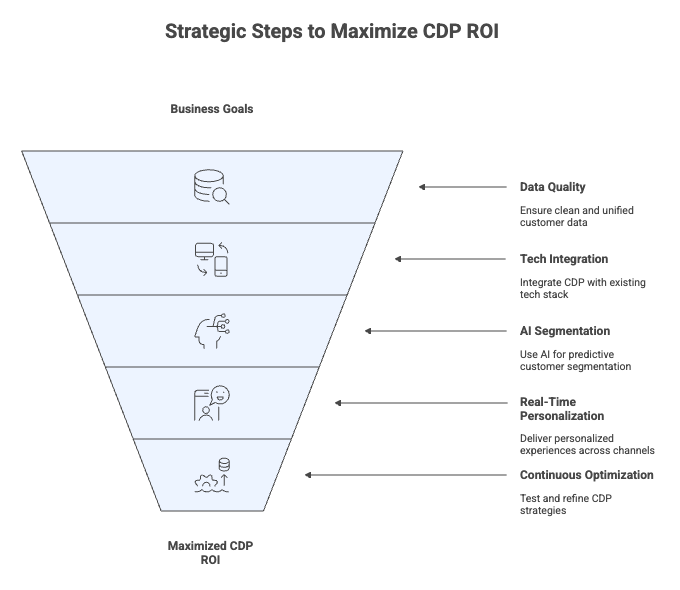
Strategic Steps to Maximize CDP ROI
To maximize ROI with a CDP, you can’t just switch it on and hope the numbers move. You need a clear CDP strategy that links business goals, data quality, activation, and optimization. Here’s how to do exactly that.
1. Set measurable business goals
Start with what needs to change on your P&L instead of asking what a CDP can do. For e-commerce and retail, that usually means conversion rate, AOV, and repeat purchase rate. For telecom and banking, it’s often churn reduction, upsell, cross-sell, and lead-to-customer conversion.
A good rule of thumb for efficient CDP implementation is to define 2-3 primary objectives and tie each to 1-2 CDP use cases. For example, an e-commerce business trying to increase conversion and AOV can tie their goals to CDP use cases like real-time product recommendations and cart-abandonment journeys.
Once the goals are clear, you can select ROI metrics: CLV, AOV, retention, revenue per user, or cost per acquisition saved. This focus helps you avoid CDP bloat, where teams chase too many use cases and dilute impact. It also gives you a clean before and after baseline to prove CDP ROI to finance and leadership.
2. Clean and unify customer data
A customer data platform is only as effective as the data it unifies. To maximize ROI with CDP, you need strong data foundations like clean inputs, reliable identifiers, and a clear understanding of which signals matter for activation. Here’s how you can achieve it.
- Start with a focused single customer view: Identify the core fields you need for activation: email, phone, device IDs, account IDs, plus key behavioural attributes like recency, frequency, monetary value, affinities, and lifecycle stage.
- Make data discovery and mapping a formal phase: Audit where your customer data lives: ecommerce, CRM, support, app analytics, POS. Then decide which events and attributes are relevant for your first few CDP use cases. This prevents over-collection and keeps the CDP strategy aligned with measurable business goals.
- Fix identity conflicts and hygiene issues: Resolve duplicates, fill missing identifiers, and correct inconsistent fields. Strong identity resolution directly impacts segmentation accuracy, predictive model performance, and the reliability of your CDP ROI metrics.
- Keep integrations purposeful and use-case led: Connect only the systems required for your initial objectives. This accelerates time-to-value and avoids overwhelming the CDP before activation begins.
- Use tooling to accelerate profile unification: If engineering bandwidth is limited, platforms like Insider One’s CDP help with automated identity stitching and prebuilt connectors. This speeds up the path from raw data to a usable single customer view.
Unified, clean data mapped to the right identifiers makes every downstream step sharper, from predictions to segmentation to personalization. This is what transforms a CDP from an information warehouse into a platform that drives real ROI.
3. Integrate across the tech stack
A CDP only creates value when data flows in, and decisions flow out. That means tight integrations with CRM, ecommerce, analytics, ad platforms, and engagement channels. In practice, that looks like:
- Streaming real-time events (browsing, cart, app actions) into the CDP
- Syncing audiences and predictions out to channels like Meta, Google, email, and on-site experiences
- Sending campaign performance data back to the CDP so models can learn
Customer data integration is often what stretches CDP implementation timelines. To avoid this, prioritize integrations that support your top 2-3 goals. For example, if your primary KPI is AOV, you’d prioritize ecommerce, on-site recommendation surfaces, and email over lower-impact destinations.
4. Use AI and predictive segmentation
Once the basics are in place, AI and predictive segmentation help you move from better lists
to smarter decisions at scale. Instead of static segments like ‘high spenders’ or ‘frequent visitors’, predictive CDP programs build audiences such as:
- Likely to purchase in the next 7 days
- High risk of churn in the next 30 days
- High propensity to upgrade/add-on
Once models learn from unified behavioural and transactional signals, they can anticipate what each customer is likely to do next. This is what makes next-best-action systems so effective. They tailor recommendations for each individual, lifting conversion, retention, and upsell far more than broad segment-based tactics.
5. Personalize in real time across channels
To truly maximize ROI with CDP, you need activation that keeps pace with the customer. That means real-time personalization across email, web, app, and push, based on the same profile and moment-in-time context.
At a practical level, this looks like:
- Updating homepages and product grids the moment intent changes
- Adjusting email content and frequency based on recent behaviour and predicted fatigue
- Syncing offers, banners, and recommendations across mobile and web so the experience feels consistent
Now, let’s look at what testing and optimization tactics to follow for your CDP strategy to work.
6. Test and optimize continuously
Markets shift, and behaviour changes fast. That’s why continuous experimentation is a non-negotiable part of any customer data platform strategy. Here’s what you can do about it.
- Run structured multivariate and A/B tests: Test journeys, offers, and channel mixes by segment to identify the combinations that actually drive lift. Regular experimentation prevents your CDP strategy from stalling as conditions change.
- Layer in AI-driven experimentation: Modern experimentation engines can reallocate traffic toward winning variants in real time. These continuous feedback loops outperform static A/B tests by letting systems learn and adapt faster.
- Feed performance data back into the CDP: Segments, recommendations, and journeys should all return outcome data to the platform. This creates a learning system where models sharpen over time instead of resetting with every campaign.
- Retire weak variants and evolve strong ones: Automated optimization helps eliminate underperforming experiences and refine high-impact ones.
Your personalization, predictions, and revenue keep getting better when you treat your CDP as a continuously learning engine. That’s how brands turn consistent experimentation into quarter-over-quarter ROI growth.
How Insider One Maximizes ROI with Its CDP
Insider One’s customer data platform is built to activate data in real time and deliver measurable ROI across channels. Its unified architecture brings together identity resolution, AI segmentation, and seamless activation so brands can go from insights to impact without friction.
Real-time unified profiles
At the core of Insider One’s CDP is the ability to build real-time 360-degree customer profiles. These profiles merge behavioural, transactional, and contextual data from all sources to offer a complete view of each customer. With up-to-the-moment identity resolution, segments and predictions stay accurate even as customer intent shifts.
AI-driven predictive segmentation
Insider One uses predictive AI to uncover high-value segments before human analysts spot them. Rather than static lists, Insider One’s CDP builds segments valuable for brands. These predictive audiences turn data into action, making campaigns smarter and more efficient. Watsons, for example, achieved 50% higher ROI on personalized campaigns by using these predictive audience segments to target the right customers with the right message.
Seamless activation across web, app, email, and WhatsApp
Insider One’s CDP lets unified profiles and predictive segments connect directly to the channels that move revenue. The same insights drive every touchpoint, whether it’s personalized web banners, in-app messages, email flows, or WhatsApp.
This end-to-end path from unified data to execution eliminates the delays and mistakes that cost teams engagement and conversions. For instance, Samsung integrated Insider One’s CDP to power experiences across channels and increased cross-channel engagement by 33%.
Insider cuts through the complexity that slows most CDP programs. You get unified profiles, predictive AI, and cross-channel activation in one platform. That means less tech friction, faster launches, and ROI that shows up in AOV, conversion, and retention.
Want to see all these in action? Book a demo to see how fast you can scale ROI with Insider One’s customer data platform.
Frequently Asked Questions (FAQs)
Got questions? We’ve got you covered.
The ROI of a customer data platform is the measurable revenue, retention, and efficiency lift you get from activating clean, unified customer data. Brands see this through higher conversions, bigger basket sizes, stronger retention, and less wasted spend. A CDP turns scattered data into real-time intelligence that directly impacts the bottom line.
A CDP boosts marketing performance by unifying customer data and powering more accurate targeting, smarter personalization, and better timing. With real-time intent and predictive insights, teams send fewer irrelevant messages and drive higher engagement. This leads to stronger conversions, better experiences, and more efficient media spend.
Key metrics for measuring CDP ROI include customer lifetime value, average order value, conversion rates, retention, churn reduction, and revenue per customer. These numbers show whether unified data and personalization are actually influencing buying behaviour. Many brands also watch engagement lifts across email, web, app, and paid channels to understand full funnel impact.
Most brands see meaningful results from a CDP within 90-120 days, especially when they activate high-impact use cases like personalized recommendations or churn-prevention journeys. Early improvements often appear in conversion, AOV, and repeat purchases. Actual time-to-value depends on data quality, integrations, and how quickly teams adopt CDP-powered workflows.
Insider One’s CDP stands out by unifying real-time profiles, predictive AI, and cross-channel activation in one platform built for speed. Instead of acting as a static data warehouse, it lets marketers activate insights instantly across web, app, email, and WhatsApp. This reduces time-to-value and delivers fast, measurable lifts in conversion, AOV, and retention.

Keep Reading
4 min.

Chris Baldwin
3 Feb 2026
9 min

Muharrem
23 Dec 2025
10 min.
Muharrem
11 Oct 2024