

 Platform Overview

 Integration Hub

 Agent One™

 Agent One™ Teams

 Customer Data Management

 Personalization

 Journey Orchestration

 Reporting & Data

 Behavioral Analytics

 Web
Web

 Email
Email

 Site Search

 Conversational CX

 WhatsApp

 Web Push

 InStory

 App
App

 SMS & RCS

 Join the $0 Migration Movement™

 The Insider One Difference

 Compare Vendors

 Switch to Insider One

 Success Story

 Retail & Ecommerce

 Financial Services

 Travel & Hospitality

 Beauty & Cosmetics

 Automotive

 Telecommunications

 Total Economic Impact™ Study

 Blog
Blog

 E-Books & Guides

 Events

 Glossary
Proven Strategies to Build a First-Party Data Strategy Using CDP

Updated on 12 Aug 2026
15 min.
Table of Contents
- Summary
- What will you learn in this guide?
- What does a first-party data strategy include?
- Why first-party data matters now.
- How do first-, second-, and third-party data differ?
- How to collect first-party data the right way.
- How do you unify customer data into a single view?
- How do consent, privacy, and governance work by design?
- How do you activate first-party data across channels?
- How do you measure impact and prove ROI?
- How do you build a first-party data strategy?
- How does Insider One power first-party data strategies?
- Frequently asked questions
Most Popular
Summary
A first-party data strategy goes beyond buying a CDP. It requires collecting the right data, unifying customer profiles, managing consent, activating data across channels, and measuring business impact. Start with clear use cases and KPIs, collect only actionable data, and use experimentation to prove ROI. Insider One helps unify, govern, and activate first-party data in real time across channels.
Third-party cookies are disappearing. Attribution models are breaking. And the brands winning right now aren’t the ones mourning signal loss, they’re the ones who built a first-party data strategy before they had to. A first-party data strategy goes beyond a customer data platform (CDP) purchase or a compliance checklist.
It’s the operating model that determines what customer data you collect, how you unify it, who governs it, and which use cases you activate first.
This guide walks you through proven strategies to build that foundation: from defining activation goals and designing consent workflows to measuring incrementality and proving ROI.
You’ll learn how to collect only the data you can activate in the near term, unify profiles without over-merging, and connect first-party investments directly to revenue outcomes.
What will you learn in this guide?
A first-party data strategy is the operating model that governs how you collect, unify, govern, and activate customer data you own directly. It’s not a platform purchase.
- Define activation goals before selecting a customer data platform or warehouse architecture
- Only capture data you can activate in the near term, with clear consent and value exchange
- Use holdout tests to connect first-party data investments to revenue outcomes
What does a first-party data strategy include?
A first-party data strategy is the operating model that determines what data you collect, how you unify it, who governs it, and which use cases you activate first. Teams often conflate buying a CDP with having a strategy, and CDP industry statistics reflect this gap. A CDP is infrastructure. The strategy comes before the tooling.
First-party data is data your organization collects directly from customers through owned touchpoints, with their knowledge or consent. This differs from third-party data, which is purchased or aggregated from external sources, and zero-party data, which consists of preferences customers explicitly volunteer.
A complete strategy includes:
- Goals and prioritization: Which business outcomes you’re solving for, whether retention, acquisition efficiency, or personalization
- Data scope: What you collect, from where, and with what consent
- Identity model: How you stitch profiles across channels and devices
- Governance: Who owns data quality, consent propagation, and retention
- Activation roadmap: Which channels and use cases you’ll launch first
- Measurement framework: How you’ll prove ROI
Vendor selection, implementation timelines, and technical architecture come after the strategy is defined.
Why first-party data matters now.
Signal loss is already affecting paid media performance. Measurement models that relied on cross-site tracking are degrading. You don’t need a history lesson on cookie deprecation to feel the impact.
- Addressability: Walled gardens like Google, Meta, and Amazon increasingly favor first-party data for audience matching. Teams without clean, consented email or phone identifiers see lower match rates and higher CPMs
- Measurement: Conversion modeling and incrementality testing become essential when deterministic attribution breaks down. First-party data is the foundation for both
- Personalization: Real-time personalization requires unified profiles. Without first-party data infrastructure, teams default to batch segments that lag customer behavior by hours or days
How do first-, second-, and third-party data differ?
When should you supplement first-party data with second-party or third-party sources? And when does that introduce more risk than value?
| Data type | Source | Consent status | Typical use | Risk level |
| First-party | Collected directly from your customers | You control consent | Personalization, retention, owned-channel activation | Low |
| Second-party | Another organization’s first-party data, shared via partnership | Inherited consent (verify chain) | Audience expansion, co-marketing | Medium |
| Third-party | Aggregated from multiple sources, purchased | Often unclear or stale | Prospecting, enrichment | High |
- Use second-party data when: You have a trusted partner with overlapping audiences, and you can verify the consent chain. A retailer partnering with a complementary brand for co-branded campaigns is a good example
- Avoid third-party data when: You can’t verify consent provenance, or when your first-party data already covers the use case
If you want to evaluate your mix of first-, second-, and third-party inputs against real activation and compliance risk, book a demo and we’ll map what to keep, what to cut, and what to fix first.
How to collect first-party data the right way.
Teams capture every available data point, then struggle to activate any of it. Collection without a near-term activation plan creates storage costs, governance burden, and stale profiles.
The principle: only collect data you can activate in the near term. If you can’t map a data point to a specific campaign, segment, or personalization use case, don’t collect it yet.
- Event tracking (web, app): Captures behavioral signals like page views, add-to-cart actions, and search queries. Requires consent under the General Data Protection Regulation (GDPR) and the California Consumer Privacy Act (CCPA). Server-side tagging improves reliability when ad blockers interfere with client-side tracking
- Forms and preference centers: Captures declared data like email, preferences, and communication opt-ins. The value exchange must be clear: what does the customer get in return for sharing?
- Transactional systems: Purchase history, support tickets, loyalty program activity. Often already consented through terms of service, but verify retention policies
- Progressive profiling: Collect incrementally over time rather than asking for everything upfront. Reduces form abandonment and improves data accuracy
Capturing granular behavioral events, every scroll and hover, without a use case inflates data volume and costs without improving activation. If your activation infrastructure can’t process real-time events, capturing them creates a backlog that degrades data freshness.
Types and examples of first-party data.
- Declared data: Name, email, phone, preferences submitted via forms. Use for identity matching in paid media and email/SMS personalization
- Observed behavioral data: Page views, product views, search queries, add-to-cart events. Use for browse abandonment triggers, product recommendations, and real-time personalization
- Transactional data: Purchase history, order value, purchase frequency, returns. Use for RFM segmentation, churn prediction, and loyalty program targeting
- Support and service data: Ticket history, chat transcripts, NPS responses. Use for proactive outreach to at-risk customers and sentiment-based segmentation
- Zero-party data: Explicitly volunteered preferences like product interests, communication frequency, and birthday. Use for preference-driven personalization and milestone campaigns
If you’re deciding what to instrument now versus later, use the product demo hub to see how teams turn a short, high-signal event taxonomy into real-time audiences without creating unmanageable data volume.
How do you unify customer data into a single view?
Data scattered across customer relationship management (CRM), ecommerce platform, support tools, and analytics creates duplicate profiles, conflicting attributes, and activation delays. Building unified customer profiles isn’t optional for personalization at scale.
| Approach | Best for | Latency | Cost profile |
| CDP-first | Teams needing real-time activation, marketer self-service, pre-built channel connectors | Real-time to near-real-time | Higher platform cost, lower engineering cost |
| Warehouse-first (reverse ETL) | Teams with strong data engineering, existing warehouse investment, batch-tolerant use cases | Minutes to hours | Lower platform cost, higher engineering cost |
| Hybrid | Teams needing both real-time activation and advanced analytics/ML on raw data | Varies by use case | Moderate platform + engineering cost |
- Choose CDP-first when: Your primary use cases are marketer-driven campaigns and you need rapid profile access. Teams with limited data engineering capacity benefit most
- Choose warehouse-first when: You have a mature data team, existing warehouse infrastructure, and use cases that tolerate batch latency
- Choose hybrid when: You need real-time activation for customer-facing channels and warehouse-based analytics for reporting and data science
Identity resolution and profile stitching.
Without clear identity rules, you end up with fragmented profiles (same person as three records) or over-merged profiles (two people collapsed into one). Both break personalization and measurement.
- Deterministic matching: Uses known identifiers like hashed email, phone number, or customer ID to link records. High confidence, lower coverage
- Probabilistic matching: Uses behavioral signals like device fingerprint, IP, and browsing patterns to infer identity. Higher coverage, lower confidence, higher risk of false positives
Most teams should start deterministic-first. Layer probabilistic matching only for specific use cases, like anonymous visitor recognition, where the risk of false positives is acceptable.
Governance requirements include defining which identifier takes precedence when conflicts occur, specifying when profiles should merge versus remain separate, and setting a re-resolution cadence as new data arrives. Default CDP rules rarely match your business context. A household with shared devices needs different rules than a business-to-business account with multiple contacts.
Data quality and stewardship.
A segment built on stale or inaccurate data sends the wrong message to the wrong people. Data quality failures show up as campaign performance drops, customer complaints, or compliance incidents.
Key dimensions to monitor:
- Completeness: Percentage of profiles with required attributes populated
- Accuracy: Percentage of attribute values that match ground truth
- Timeliness: Latency between event occurrence and profile update
- Uniqueness: Percentage of profiles that are deduplicated
Assign a data steward responsible for monitoring, alerting, and remediation. Without clear ownership, quality degrades over time as sources change and schemas drift.
When to enrich with second-party or partner data.
Enrichment introduces data you didn’t collect, with consent you didn’t obtain. If the consent chain is broken, you inherit compliance liability.
Enrichment is appropriate when the use case is specific, the consent chain is verified, and the enriched data follows your retention policies. Avoid enrichment when your first-party data already covers the use case or when the partner can’t provide consent documentation.
If identity rules and merge logic are slowing activation, book a demo to see how configurable resolution prevents both duplicates and over-merges without turning your data team into a bottleneck.
How do consent, privacy, and governance work by design?
Consent captured at the preference center but not propagated to the email platform creates problems. A customer who opted out still receives messages, triggering a complaint or regulatory inquiry.
Consent event schema: Capture consent as a structured event, not just a boolean. Include consent type, timestamp, source, and version of terms accepted.
Propagation service-level agreement (SLA): Define how quickly consent changes reach downstream systems. For suppression, the SLA should be measured in minutes, not hours.
Retention and deletion: Define retention periods by data type. When a customer requests deletion, the workflow must identify all systems holding their data and execute deletion within the regulatory window.
Teams treat consent as a checkbox at signup and never revisit it. Consent should be re-validated when terms change, when new use cases are introduced, or when data is shared with new partners.
How do you activate first-party data across channels?
Activation isn’t “turn on all channels.” It’s selecting the channels where first-party data creates measurable lift, then designing audiences and experiments to prove it.
- Start with suppression: Before building target audiences, define who should be excluded. Recent purchasers, opted-out users, and customers in active support tickets
- Define refresh cadence: Audiences built on behavioral data decay quickly. A “high-intent” segment based on recent browse behavior needs frequent refresh
- Set frequency caps: Cross-channel activation without frequency caps leads to over-messaging. Define caps per channel and aggregate caps across channels
A worked example for cart abandonment recovery: audience includes users who added to cart recently, did not purchase, have email consent, and are not in an active support ticket. Channels are email as primary and push notification as secondary. Reserve a control group to measure incrementality.
Paid media activation without third-party cookies.
Match rates for first-party audiences on Google and Meta depend on identifier quality and consent coverage. Teams with incomplete or unhashed identifiers see limited reach and higher CPMs.
- Hashing and formatting: Hash emails and phone numbers using a standard cryptographic hash function before upload. Follow platform-specific formatting requirements
- List hygiene: Remove invalid emails, duplicates, and users who haven’t engaged in a long time. Smaller, cleaner lists produce higher match rates
- Consent mode: Implement Google Consent Mode to model conversions for users who decline cookies
- Suppression lists: Upload purchaser lists to exclude from prospecting campaigns
Teams upload raw, unformatted lists and blame the platform for low match rates. Formatting and hygiene are your responsibility.
Personalization across web, app, and messaging.
Web personalization requires very low-latency profile access. If your CDP or personalization engine can’t meet that SLA, you’ll serve default experiences to most visitors.
- Web: Requires edge-side or server-side profile access. Client-side calls add latency and are blocked by ad blockers
- App: Push notification personalization can tolerate slightly higher latency because delivery is asynchronous
- Email/short message service (SMS): Batch personalization is common, but real-time triggers like browse abandonment require event streaming and rapid latency
If your infrastructure can’t support real-time personalization, start with batch-based use cases and invest in real-time infrastructure only when the use case justifies it. Use holdout groups to measure lift.
Predictive segments for churn and retention.
Many teams build churn models but never activate them. A propensity score sitting in a data warehouse doesn’t reduce churn. The model must feed segments that trigger interventions.
- Define the outcome: Churn means different things in different businesses. For subscription: cancellation. For ecommerce: no purchase in a set period
- Select features: Recency, frequency, and monetary value are baseline. Add engagement signals, support interactions, and product usage
- Set thresholds: Define the threshold that triggers intervention
- Design the intervention: Discount offer, personalized outreach, or product education. The intervention must be testable
- Measure incrementality: Use a holdout group that receives no intervention
Teams optimize the model for accuracy but never test whether the intervention actually reduces churn. A perfect model with an ineffective intervention produces no business value.
If you’re ready to move from “segments in theory” to journeys that actually launch, open the product demo hub and see how real-time audiences, suppression, and orchestration work together across channels.
How do you measure impact and prove ROI?
First-party data investments touch multiple channels and use cases. Attributing revenue to “the CDP” or “the data strategy” is difficult because the data enables outcomes across the business.
A key performance indicator (KPI) tree approach works well:
- Business outcome (top): Revenue, customer lifetime value, gross margin
- Leading indicators (middle): Conversion rate, average order value, retention rate, repeat purchase rate
- Operational metrics (bottom): Match rate, segment reach, campaign delivery rate, personalization coverage
Connect each activation use case to a specific branch of the tree, such as cart abandonment to conversion rate or churn prevention to retention rate.
For incrementality testing, reserve a meaningful portion of the eligible audience as a control group. Define the measurement window and ensure sample sizes are large enough to detect meaningful differences.
Teams report campaign performance like open rates and click rates without connecting to business outcomes. A high open rate on a churn intervention email is meaningless if churn rates don’t improve.
How do you build a first-party data strategy?
Strategy work fails when it’s treated as a one-time planning exercise. Each step produces a deliverable that informs the next, and the cycle repeats as you expand use cases.
- Define goals and success metrics
- Map data sources and identity
- Design consent and governance
- Select activation channels and experiments
- Implement and ensure data quality
- Optimize and iterate
Define goals and success metrics.
Teams define goals as “better personalization” or “improve retention” without specifying what success looks like or how it will be measured.
Prioritize use cases by value, or potential revenue or cost impact, confidence, or certainty that data and infrastructure exist, and effort, or implementation complexity. Rank use cases by value multiplied by confidence, then divided by effort.
Require a baseline for each metric. You can’t prove improvement without knowing the starting point.
Deliverable: A prioritized list of a small set of use cases with defined success metrics and baselines.
Map data sources and identity.
Before selecting tools, document what data exists, where it lives, and how it’s currently identified.
- Source system: customer relationship management (CRM), ecommerce platform, support tool, analytics
- Data types: Declared, behavioral, transactional
- Identifiers available: Email, phone, customer ID, device ID, cookie
- Consent status: Is consent captured? Is it propagated?
- Freshness: Real-time, daily, weekly?
Map identifiers across systems. Where do they overlap? Where are there gaps?
Deliverable: A data source inventory with identifier mapping and consent status.
Design consent and governance.
Consent design happens before data collection, not after. Retrofitting consent to existing data is expensive and often incomplete.
- Consent types: Marketing email, SMS, third-party sharing, personalization
- Capture points: Web forms, app onboarding, checkout, preference center
- Propagation: How will consent changes flow to downstream systems?
- Audit trail: How will you demonstrate compliance if audited?
Deliverable: A consent schema, capture UX designs, and propagation workflow with SLAs.
Select activation channels and experiments.
Don’t activate to channels where you can’t measure outcomes. If you can’t run a holdout test or track conversions, you’re spending without learning.
- Data readiness: Do you have the identifiers and consent required for this channel?
- Measurement capability: Can you implement holdouts and track downstream outcomes?
- Audience size: Is the eligible audience large enough to produce statistically significant results?
Deliverable: A channel prioritization matrix and experiment designs for the first few channels.
Implement and monitor data quality.
Implementation without monitoring leads to silent failures. A broken integration or schema change can corrupt data for weeks before anyone notices.
- Monitoring dashboards: Track completeness, timeliness, and uniqueness daily
- Alerting: Define thresholds that trigger investigation
- Incident workflow: Who investigates? What’s the escalation path?
Deliverable: Monitoring dashboards, alerting rules, and an incident response workflow.
Optimize and iterate.
The first version of your strategy will be wrong in places. The goal is to learn quickly and adjust.
- Weekly: Review campaign performance and data quality alerts
- Monthly: Review experiment results. Decide which use cases to scale, pause, or retire
- Quarterly: Review the KPI tree. Are leading indicators moving business outcomes?
Define decay rules for segments and models. A churn model trained on last year’s data may not reflect current behavior.
Deliverable: A review cadence calendar and decay/refresh rules for segments and models.
How does Insider One power first-party data strategies?
A first-party data strategy requires infrastructure that unifies data, resolves identity, enforces consent, and activates across channels in real time. Insider One delivers these capabilities in a single platform.
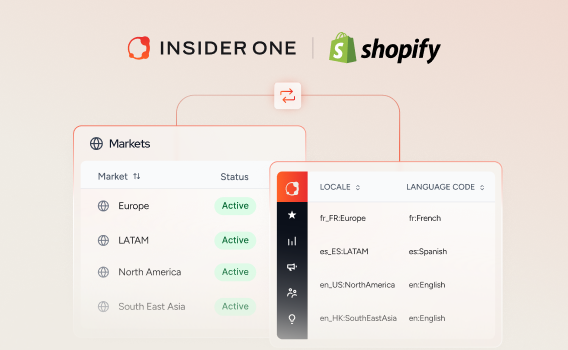
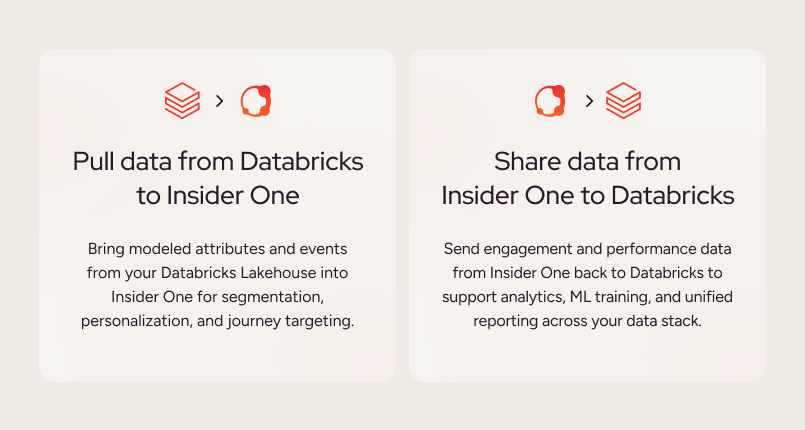
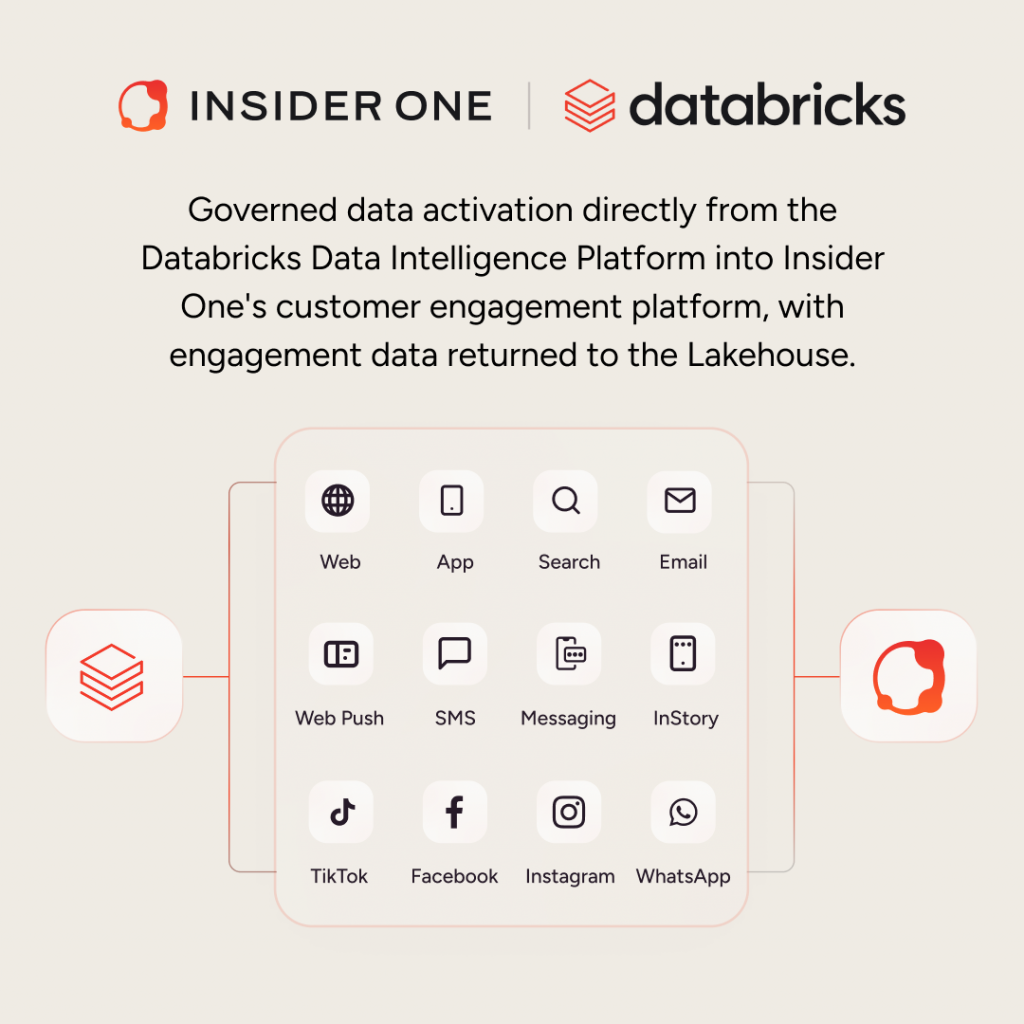
- Unified Customer Database: Insider One’s CDP infrastructure unifies customer, behavioral, and product data from many integrations into complete profiles, with 100+ integrations across 20+ categories spanning CRMs (Salesforce, HubSpot, Microsoft Dynamics), ecommerce platforms (Shopify, VTEX), analytics tools, data warehouses (Snowflake, Google BigQuery, Amazon Redshift, Databricks), and even other CDPs (Segment, mParticle, Tealium), so first-party data flows in from wherever it already lives. Identity Resolution Management prevents duplicates and supports configurable merge rules. The Unified Customer Database is warehouse-native and composable, with bi-directional connectivity to Snowflake, Databricks, BigQuery, and Redshift and zero-copy segmentation, so teams get CDP-first real-time activation and warehouse-first data ownership in one architecture instead of choosing between them
- Consent and governance: Consent signals propagate across channels with configurable retention policies and audit logging. Data warehouse and external integration monitoring dashboards give real-time visibility into data flows so issues surface before they reach campaigns, and Event and Attribute Metadata Export shows usage, coverage, and redundancies so teams can clean up and govern their data with confidence
- Activation across channels: Architect, Insider One’s customer journey orchestration solution, enables real-time, cross-channel activation across email, SMS, WhatsApp, web, app, and push. Audiences refresh in real time, and suppression rules are enforced automatically
- Artificial intelligence (AI)-powered personalization: Sirius AI™, Insider One’s extensive set of AI capabilities, powers predictive segments, Smart Recommender for product recommendations, and Send Time Optimization. Smart Segment Creator lets marketers turn first-party data into audiences from a plain-English prompt, so activation doesn’t wait on a data team or a query builder
- Measurement and optimization: A/B Auto-Winner Selection automates experiment analysis. Insights Agent, part of Agent One™, Insider One’s suite of purpose-built agents for customer engagement, proactively monitors campaign performance and surfaces anomalies
If you want to see what this looks like on your data, from identity rules to consent propagation to real-time activation, book a demo and we’ll walk through the first use cases worth launching.
Frequently asked questions
First-party data is information your organization collects directly from customers through owned touchpoints with their knowledge or consent. Zero-party data is a subset that customers explicitly volunteer, like preferences or product interests.
Yes. A CDP is one architecture option, but teams with strong data engineering can build on a warehouse with reverse ETL. The strategy defines goals, governance, and activation priorities; the platform is implementation.
Use a KPI tree that connects operational metrics like match rate and segment reach to leading indicators like conversion rate and retention, then to business outcomes like revenue and customer lifetime value. Measure incrementality using holdout tests for each activation use case.
The strategy itself, including goals, data mapping, and governance design, is often completed in several weeks, depending on the number of systems and stakeholders involved. Implementation timelines vary based on infrastructure complexity, but teams using platforms like Insider One often launch initial use cases quickly.

Keep Reading
4 min.

Chris Baldwin
3 Feb 2026
8 mins.
Chris Baldwin
8 Oct 2026
8 mins.
Chris Baldwin
8 Oct 2026