

 Platform Overview

 Integration Hub

 Sirius AI™

 Customer Data Management

 Personalization

 Journey Orchestration

 Reporting & Data

 Behavioral Analytics

 Web
Web

 Email
Email

 Site Search

 Conversational CX

 WhatsApp

 Web Push

 InStory

 App
App

 SMS & RCS

 Join the $0 Migration Movement™

 The Insider One Difference

 Compare Vendors

 Switch to Insider One

 Success Story

 Retail & Ecommerce

 Financial Services

 Travel & Hospitality

 Beauty & Cosmetics

 Automotive

 Telecommunications

 Interactive Platform Tour

 Blog
Blog

 E-Books & Guides

 Glossary
How to Boost Open Rates by 30% Using AI‑Driven Dynamic Email Creation

Updated on 31 Mar 2026
5 min.
Table of Contents
Most Popular
Email marketing remains one of the most powerful channels for driving engagement and revenue, but standing out in crowded inboxes is increasingly challenging.
AI-driven dynamic email creation within Insider One combines unified customer profiles, predictive segmentation, and real-time decisioning to personalize and optimize email content based on user behavior and data insights.
This approach allows marketing teams to deliver highly relevant emails at scale, reduce manual effort, and improve campaign performance.
The impact is measurable. Studies show that integrating AI into email marketing can increase open rates by 26%, with some brands achieving increases of over 40% by leveraging predictive personalization and automated optimization.
Beyond opens, AI helps marketers improve click-through rates, conversion, and overall engagement, all while streamlining campaign execution.
This guide shows how marketers can use AI to maximize email performance, from selecting the right platform to implementing dynamic content and predictive optimization and turning email into a continuously improving, data-driven channel.
Choosing the right AI platform for dynamic email content
Boosting email open rates with AI starts with selecting the right platform. Not all email automation tools support dynamic content, real-time personalization, or machine learning–driven optimization at scale. A platform with strong AI capabilities lays the foundation for improvements across subject lines, engagement, and conversions.
When evaluating AI email marketing platforms, marketers should look for:
- AI-powered content generation to create and optimize subject lines, preview text, and email copy.
- Behavior-based and predictive personalization that adapts content based on user actions and intent
- Workflow automation to reduce manual setup and accelerate campaign execution
- Seamless integrations with CRM, ecommerce, and analytics platforms to ensure unified customer data.
- Built-in analytics and optimization tools to continuously improve performance.
Comparison of leading AI email marketing platforms
The table below highlights how top AI email marketing platforms compare across key capabilities related to dynamic email creation and optimization:
| Platform | Dynamic Content & Personalization | Workflow Automation | Integrations | Analytics & Optimization | Best Suited For |
| Insider One | Real-time predictive segmentation and intent-based personalization | Cross-channel journey automation | CRM, ecommerce, analytics, ad platforms | AI-driven recommendations and experimentation | Enterprise and e-commerce teams delivering personalized journeys at scale |
| Omnisend | Behavioral segmentation and dynamic email blocks | Prebuilt ecommerce workflows | Shopify, WooCommerce, BigCommerce | Campaign and segmentation performance tracking | Ecommerce brands focused on lifecycle automation |
| HubSpot Marketing Hub | Smart lists and behavior-based personalization | Automated email and CRM workflows | Native CRM and broad martech ecosystem | Engagement and attribution reporting | CRM-centric marketing teams |
| Klaviyo | Predictive segmentation using ecommerce data | Automated flows triggered by user behavior | Deep ecommerce integrations | Predictive analytics and revenue attribution | B2C and ecommerce growth teams |
| ActiveCampaign | Predictive sending and engagement scoring | Advanced automation builder | Wide integration ecosystem | Performance scoring and optimization | SMB and mid-market teams seeking intelligent automation |
How to choose the best platform for your needs
The right platform depends on your goals, team structure, and technical resources. A simple decision flow can help guide selection:
- Assess your needs: Determine whether your priority is predictive personalization, omnichannel orchestration, automation depth, or ease of use.
- Shortlist platforms: Compare tools based on AI capabilities, integrations, and scalability.
- Trial or demo: Evaluate usability, workflow flexibility, and performance impact.
- Review analytics and support: Ensure the platform provides clear insights and reliable onboarding.
- Adopt at scale: Roll out the solution once it aligns with both short-term goals and long-term growth plans.
For teams looking to combine real-time segmentation, dynamic email content, and cross-channel orchestration, Insider One stands out by unifying data, automation, and AI-driven decisioning in a single environment.
Step-by-step: How to boost email open rates by 30% using AI
Using AI to optimize email open rates isn’t about replacing strategy. It’s about streamlining execution and letting data guide decisions at a scale that manual processes cannot handle. Following a structured approach ensures meaningful results rather than incremental changes.
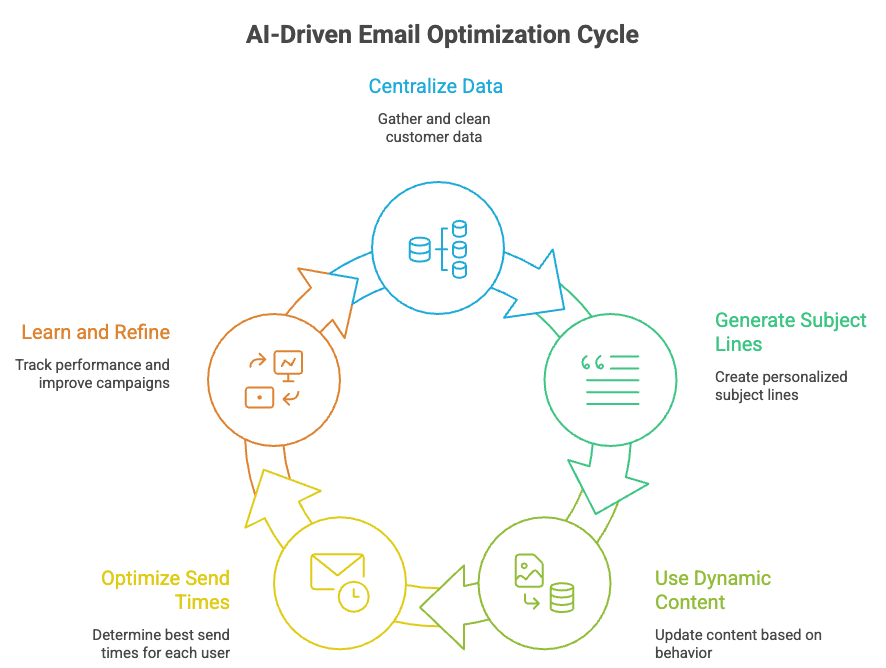
1. Centralize and clean customer data
High-quality data is the foundation of AI-driven email campaigns. Combine behavioral, transactional, and other first-party data into unified customer profiles, so AI can understand context, intent, and historical preferences more accurately. This allows AI models to understand context, intent, and historical preferences, rather than making decisions based on isolated signals.
2. Activate AI-powered subject line generation
AI can generate subject lines that adapt to user behavior and engagement patterns. Instead of manually testing a few variations, the system can create multiple options and automatically select the most effective ones in real time, optimizing language that resonates with each subscriber.
3. Use dynamic content blocks
Replace static templates with modular content blocks that update based on customer behavior. Recommendations, messaging, and calls to action can adjust depending on browsing activity, lifecycle stage, or predicted intent, making emails more relevant even before they are opened.
4. Apply predictive send-time optimization
AI can predict the optimal time windows to send emails for each subscriber. By analyzing historical open patterns, predictive send-time optimization ensures messages arrive when recipients are most likely to engage, rather than relying on generalized “best times.”
5. Continuously learn and refine
AI platforms track performance across campaigns, learning from opens, clicks, and conversions. This continuous feedback loop automatically improves subject lines, content, and send times over time, reducing manual oversight and keeping campaigns aligned with subscriber behavior.
When combined, these steps create a cohesive, data-driven approach that enhances relevance and engagement while keeping operations manageable. Each element reinforces the others, allowing teams to run smarter campaigns without adding complexity.
Common mistakes to avoid when using AI for email personalization
AI-driven email creation can deliver strong results, but only when applied thoughtfully. Many teams fall short by treating AI as a shortcut rather than a system that requires structure and oversight.
Relying on poor or fragmented data
AI models amplify whatever data they are given. Incomplete profiles, inconsistent tracking, or siloed systems lead to weak personalization and unreliable optimization. Data readiness must come before automation.
Over-automating without guardrails
Fully automated systems still need human oversight. Without brand guidelines, content rules, and review processes, AI-generated messaging can drift in tone or relevance, reducing trust rather than building it.
Treating AI as a one-time setup
AI is not a set-and-forget tool. Performance improves when teams actively review outputs, test variations, and refine inputs. Ignoring this feedback loop limits long-term gains.
Focusing only on opens
While open rates are important, optimization should account for downstream impact. Subject lines that drive opens but reduce clicks or conversions can hurt overall performance. AI strategies should optimize for engagement quality, not just visibility.
Avoiding these pitfalls helps ensure AI-driven personalization at scale delivers sustainable results rather than short-lived spikes.
How Insider One enables real-time dynamic email creation at scale
Executing AI-driven dynamic email creation requires more than isolated features. It depends on a platform that connects data, decisioning, and execution in real time.
Insider One enables dynamic email creation by combining unified customer profiles, real-time intent signals, AI-powered decisioning, and capabilities like send time optimization, and AI-generated content within a single platform.
Instead of treating email as a standalone channel, Insider One connects behavioral data across touchpoints to inform what content is delivered, when it is sent, and how it evolves.
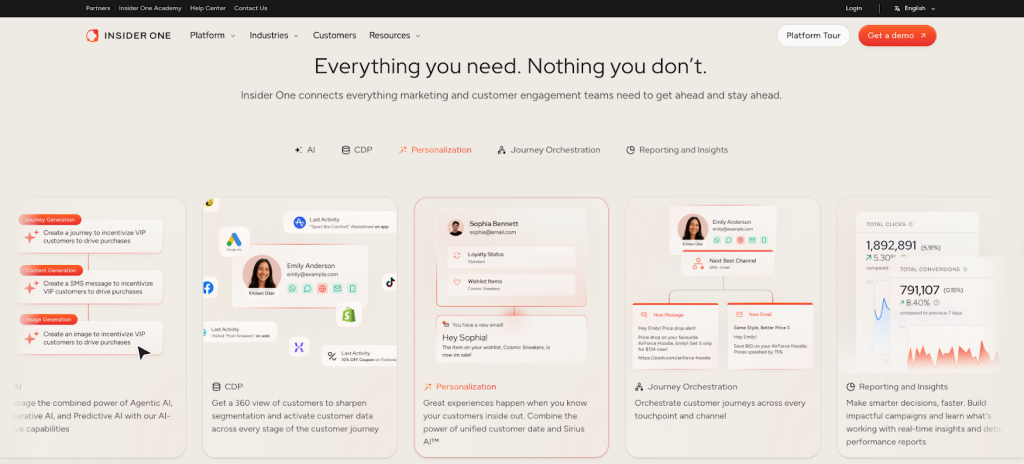
Key capabilities that support higher open rates include:
- AI-powered subject line generation and optimization based on engagement history and intent signals
- Individual-level Send Time Optimization (STO) powered by predictive machine learning
- Continuous performance learning across campaigns, reducing manual effort while still allowing teams to review and refine strategy
By aligning content, timing, and personalization at scale, Insider One helps marketing teams move beyond static campaigns to operate email as a responsive, performance-driven channel.
Ready to see AI-driven email marketing in action? Take a platform tour to explore Insider One’s features firsthand, or request a demo to discover how your team can create highly personalized, real-time campaigns that adapt automatically to customer behavior.
FAQs
AI-driven dynamic email creation analyzes customer data and uses machine learning to personalize subject lines, optimize send times, and tailor email content based on user behavior. This makes each message more relevant and engaging, significantly increasing the likelihood it will be opened.
The most effective AI-driven content includes personalized product or service recommendations, custom subject lines, and interactive elements such as countdowns, carousels, accordions, or live updates. These features adapt to recipient behavior and preferences, driving higher engagement.
AI can generate thousands of personalized email variations in minutes. This allows marketers to deploy highly targeted campaigns across large subscriber lists efficiently, without compromising on relevance or quality.
Yes. While AI handles content personalization and optimization, human review ensures emails align with brand voice, meet compliance standards, and maintain overall quality before they are sent.
Common pitfalls include relying entirely on AI without oversight, using outdated or incomplete data for personalization, and neglecting to continuously update content to match evolving audience interests. Combining AI with human strategy ensures sustained results.

Keep Reading
4 min.

Chris Baldwin
3 Feb 2026
9 min

Muharrem
23 Dec 2025
7 min.
Chris Baldwin
8 Jul 2024