

 Platform Overview

 Integration Hub

 Insider One AI™

 Customer Data Management

 Personalization

 Journey Orchestration

 Reporting & Data

 Behavioral Analytics

 Web
Web

 Email
Email

 Site Search

 Conversational CX

 WhatsApp

 Web Push

 InStory

 App
App

 SMS & RCS

 Join the $0 Migration Movement™

 The Insider One Difference

 Compare Vendors

 Switch to Insider One

 Success Story

 Retail & Ecommerce

 Financial Services

 Travel & Hospitality

 Beauty & Cosmetics

 Automotive

 Telecommunications

 Total Economic Impact™ Study

 Blog
Blog

 E-Books & Guides

 Glossary
Best E-commerce Email Marketing Platforms for Automation and Growth

Updated on 16 Jun 2026
14 min.
Table of Contents
- Summary
- What should you compare in ecommerce email marketing platforms?
- Which email marketing platforms work best for ecommerce?
- What should you evaluate in an ecommerce email platform?
- Which ecommerce email flows drive revenue?
- How does pricing change as your ecommerce email list grows?
- How should ecommerce teams choose a platform step by step?
- Why is Insider One the recommended platform for ecommerce growth?
- Frequently asked questions
Most Popular
Summary
The best ecommerce email marketing platforms help brands turn customer and purchase data into personalized, automated campaigns that drive revenue and retention. The right choice depends on your business size, automation needs, omnichannel requirements, and how well the platform can scale with your growth.
Ecommerce stores generate more customer data than most marketing teams know what to do with. Every browse session, cart addition, and purchase creates a signal. Without the right email marketing platform for e-commerce, that data sits unused while generic campaigns underperform. The platforms built for e-commerce don’t just send emails. They connect directly to your store, turn behavioral data into automated revenue-driving campaigns, and scale personalization without adding headcount or complexity.
What should you compare in ecommerce email marketing platforms?
Most comparison tables show “starting at” prices that become irrelevant once your store grows beyond an early-stage list size. This table includes pricing at representative ecommerce list sizes and flags features often gated behind higher tiers.
| Platform | Free plan | Pricing at mid-sized lists | Pricing at larger lists | Native SMS | Shopify sync | Prebuilt flows |
| Insider One | No | Custom | Custom | Yes | Enterprise-grade | Yes |
| Klaviyo | Yes (limited) | Scales by tier | Scales by tier | Add-on | Advanced | Yes |
| Omnisend | Yes (limited) | Scales by tier | Scales by tier | Yes | Advanced | Yes |
| ActiveCampaign | No | Scales by tier | Scales by tier | Add-on | Basic | Plus plan |
| Drip | No | Scales by tier | Scales by tier | No | Advanced | Yes |
| Mailchimp | Yes (limited) | Scales by tier | Scales by tier | Add-on | Third-party | Basic |
| MailerLite | Yes (limited) | Scales by tier | Scales by tier | No | Basic | Basic |
| Brevo | Yes (limited) | Volume-based | Volume-based | Yes | Basic | Basic |
SMS pricing is typically billed separately. Advanced ecommerce flows often require mid-tier or premium plans.
Which email marketing platforms work best for ecommerce?
We selected these platforms based on ecommerce-specific automation, integration depth, pricing transparency, and deliverability infrastructure. Each profile covers the overview, main features, ideal use case, and pricing at realistic list sizes.
Insider One
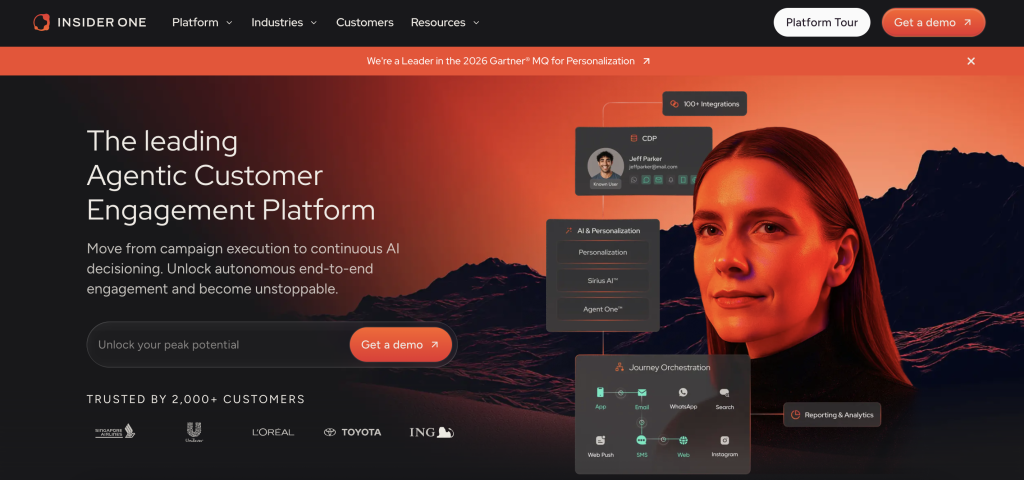
Teams running email through one vendor, SMS through another, and a separate CDP end up with fragmented data and slower campaign launches. Insider One is a unified Omnichannel Experience Platform that brings together customer data, email, SMS, WhatsApp, web push, on-site personalization, and journey orchestration in a single, unified architecture. Unlike competitors that rely on 24-hour data syncs or third-party CDPs, Insider One operates on a single-tenant architecture where data is immediately actionable across every channel.
Real-time event ingestion from Shopify Plus, WooCommerce, Magento, Commerce Cloud, and custom APIs feeds into unified customer profiles. You can build predictive segments based on browse behavior, cart events, purchase history, and predicted likelihood to purchase or churn, with offline-to-online identity stitching that handles complex custom data structures. No waiting on data teams required.
Architect, Insider One’s Omnichannel Journey Orchestration solution, includes prebuilt flows for abandoned cart, post-purchase, and winback with split testing and Auto-Winner Selection that optimizes variants automatically. Sirius AI™ combines GenAI and proprietary LLMs to power Predictive Segments (Likelihood to Purchase/Churn), Next Best Channel decisioning, and artificial intelligence (AI) capabilities including AI-generated campaign copy. Agent One, Insider’s Agentic AI capability, autonomously builds journeys and shifts messaging across channels based on goal targets. Teams can go live quickly, backed by predictable MTU-based pricing with no hidden charges for data, storage, or duplicated events.
Main features:
- Unified CDP with real-time identity resolution across web, app, and offline
- Prebuilt ecommerce flows with AI-powered optimization
- Predictive segments for likelihood to purchase, churn, and discount affinity
- Native SMS, WhatsApp, web push, and app push alongside email
- Agentic AI (Agent One) for autonomous journey building and cross-channel optimization toward revenue goals
- On-site Personalization and Eureka (Site Search) for closed-loop customer experiences
- Next Best Channel decisioning, Sirius AI™ dynamically routes each message to the optimal channel based on predicted engagement affinity
- AI-powered Smart Recommender with 18+ algorithms for on-site and cross-channel product discovery — including hybrid auto-optimization (Chef), session-level adaptation, and InStory for mobile-first brands. Includes an out-of-the-box product recommendation block for email that automatically populates cross-sells, complementary items, and trending products without manual product selection.
- InStory, Instagram-style swipeable product stories for mobile-first ecommerce, replacing the standard product grid with a high-engagement, shoppable format
- Integrations including Shopify Plus, WooCommerce, Magento, Commerce Cloud, and custom APIs, built for enterprise-grade data structures
Pricing: MTU-based with no hidden charges for events or storage, and no double-counting of profiles across channels. Unlike point-solutions that charge separately for each email, SMS, and WhatsApp subscriber, Insider’s MTU model means one customer profile across all channels counts as one. Migration Lab™ support included at no extra cost for teams switching platforms.
If you want to see what an Actionable CDP and AI-Native CX platform looks like on a real ecommerce setup, request a demo.
Klaviyo
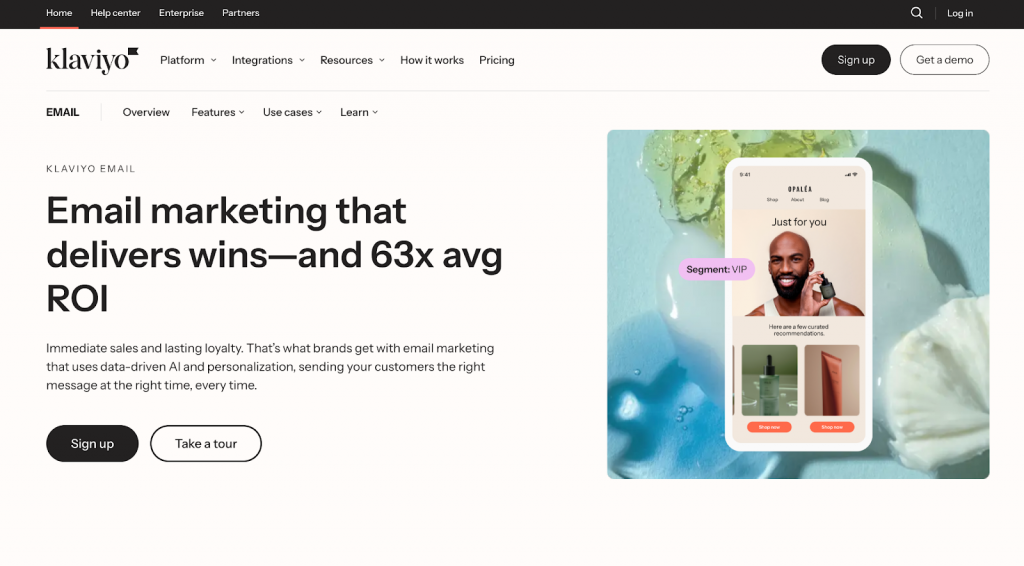
Klaviyo built its reputation as a Shopify-native platform with deep behavioral segmentation and predictive analytics. It pulls rich ecommerce data directly from your store to trigger targeted campaigns.
The platform fits direct-to-consumer brands scaling their email and SMS programs. Pricing increases as your contact list grows, and some advanced features sit behind higher tiers.
Pricing: Free tier available for small lists. Pricing scales with list size and plan level. SMS billed separately.
Omnisend
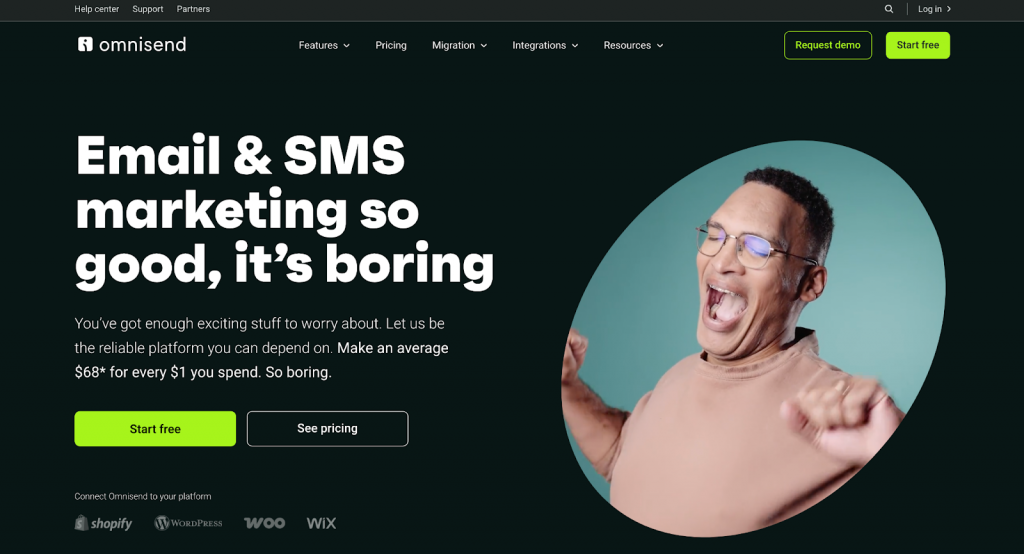
Omnisend provides a strong mid-market alternative for ecommerce teams wanting email and SMS in one tool with simpler pricing. The platform focuses heavily on ecommerce automation and prebuilt workflows.
Combined email and SMS pricing makes it easier to manage multi-channel campaigns on a budget. Predictive analytics and segmentation are more limited for teams that need advanced ecommerce use cases.
Pricing: Free tier available for small lists. Pricing scales with list size and plan level.
ActiveCampaign
ActiveCampaign offers deep automation capabilities and flexible customer relationship management (CRM) integration across business-to-business and business-to-consumer models. It excels at complex conditional logic and tagging.
Ecommerce-specific features require the Plus plan or higher. The Shopify integration is more limited than what some ecommerce-focused platforms offer.
Pricing: No free plan. Pricing varies by plan level and list size.
Drip
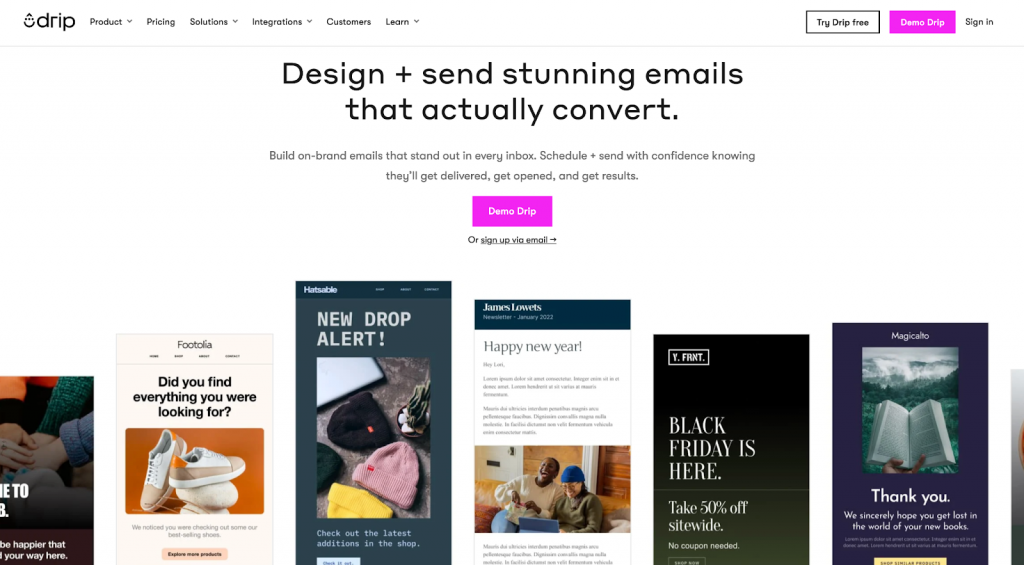
Drip serves direct-to-consumer brands with a highly visual workflow builder. It emphasizes ecommerce revenue attribution and easy-to-build automation sequences.
The visual builder makes it simple to map out customer journeys based on store behavior. The integration ecosystem is smaller, and SMS capabilities are more limited for teams that need advanced multichannel programs.
Pricing: Free trial available. Pricing scales with list size.
Mailchimp
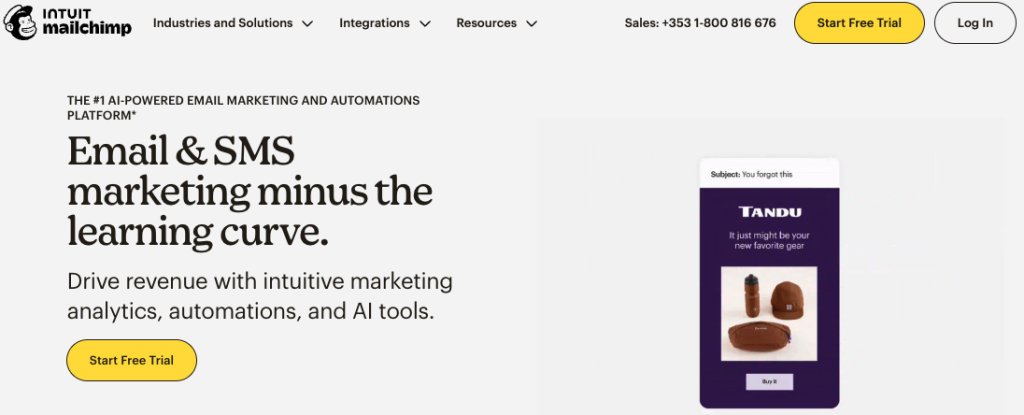
Mailchimp offers broad brand recognition and a wide feature set for general marketing. Many marketers already know the interface.
Pricing has increased significantly. Ecommerce automation is less sophisticated than purpose-built platforms, and the Shopify integration relies on third-party connections.
Pricing: Free tier available for small lists. Pricing scales with list size and plan level.
MailerLite
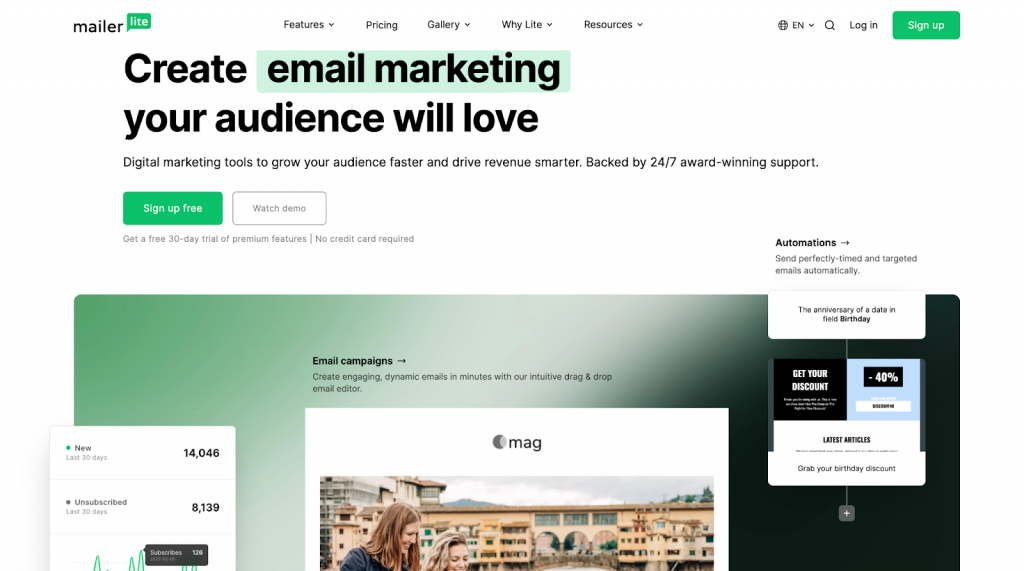
MailerLite is a budget-friendly option for early-stage stores. The platform is easy to learn for small teams.
Automation depth is limited, and there’s no native SMS.
Pricing: Free tier available for small lists. Pricing scales with list size and plan level.
Brevo
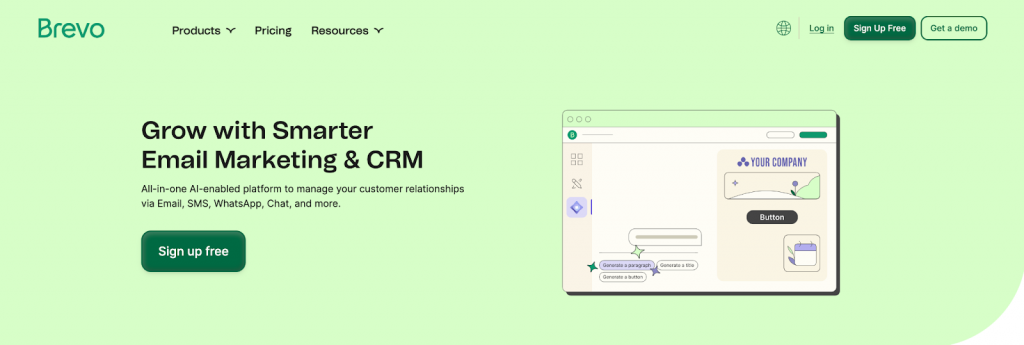
Brevo differentiates itself with send-based pricing rather than charging per contact. This works well for stores with large lists but low send frequencies.
Automation and segmentation are more limited for high-volume ecommerce teams that need advanced use cases.
Pricing: Free tier available with daily sending limits. Paid plans scale by send volume.
What should you evaluate in an ecommerce email platform?
Teams evaluate platforms based on general marketing features and discover too late that ecommerce-critical capabilities are missing or require expensive add-ons. Score platforms against this list before comparing costs.
Must-have:
- Real-time sync with your ecommerce platform
- Prebuilt abandoned cart, browse abandonment, and post-purchase flows
- Behavioral segmentation based on purchase history and cart activity
- Dynamic product blocks that pull live catalog data
- Deliverability infrastructure with dedicated IP option
Important for scaling stores:
- Predictive analytics for likelihood to purchase and churn risk
- Native SMS or WhatsApp alongside email
- A/B testing with automated winner selection
- Revenue attribution at the campaign level
- Dynamic, AI-driven product discovery in email, Smart Recommender automatically populates each campaign with personalized product blocks, eliminating manual selection
Nice-to-have for mature programs:
- AI-generated subject lines and copy
- Omnichannel Journey Orchestration with AI-Native decisioning
- Data warehouse connectivity
If you’re building a shortlist, skip the guesswork and compare what “enterprise-ready” actually means in practice. Start with the real workflows in the product demo hub.
Which ecommerce email flows drive revenue?
Most platforms advertise “automation,” but the depth varies wildly. Some offer a single abandoned cart template. Others provide configurable multi-step journeys with AI optimization. A common hidden cost is manual product selection: marketing teams spend hours each week hand-picking products for newsletters and campaign emails. Sirius AI™ and Chef eliminate this entirely — automatically selecting the best-performing product mix per segment, per send, so teams focus on strategy instead of spreadsheets.
How do abandoned cart sequences work?
A proper abandoned cart sequence reaches high-intent shoppers before they forget. The structure matters:
- Trigger: Cart created with no purchase within a short window
- Sequence: A multi-email sequence over the first few days with escalating urgency
- Conditional splits: Segment by cart value, customer type, or product category
- Exit condition: Purchase completed at any point
- Cross-channel extension: Sirius AI™ dynamically routes to SMS, WhatsApp, or web push if email isn’t opened, selecting the channel with the highest predicted engagement, not a static fallback
Sending a single abandoned cart email instead of a sequence reduces potential revenue. Failing to suppress purchasers from subsequent messages annoys customers.
Smart Recommender in abandoned cart emails: Rather than showing only the item left in the cart, Insider One uses Smart Recommender to automatically populate the same email with Complementary Items (cross-sell), increasing Average Order Value (AOV) even when the original item is recovered. Chef selects the optimal algorithm variant per segment automatically, no manual product curation required.
What should a post-purchase flow include?
Post-purchase journeys drive retention and cross-sell opportunities. Timing depends on your product:
- Trigger: Order confirmed
- Sequence: Order confirmation, shipping notification, delivery follow-up, review request, cross-sell or replenishment
- Conditional splits: First-time versus repeat buyer, product category, order value
A skincare brand triggers replenishment after a short period. A furniture brand waits longer for accessory cross-sell.
How do winback campaigns re-engage lapsed customers?
Winback campaigns re-engage lapsed customers before they churn completely:
- Trigger: No purchase within a defined period
- Sequence: A short email sequence with increasing incentive
- Conditional splits: Segment by customer lifetime value
- Suppression: Exclude customers who’ve engaged with other campaigns recently
A customer who purchased once some time ago requires different messaging than a repeat buyer who suddenly stopped. If you want to orchestrate these flows across email and SMS with real-time suppression and predictive targeting, request a demo.
Insider’s On-site Continuity also ensures that when a re-engaged customer clicks a winback email and lands on the site, the homepage dynamically reflects the offer they clicked. If you want to orchestrate these flows across email, SMS, and WhatsApp with real-time suppression and predictive targeting,
When a tracked price drops or an out-of-stock item is replenished, Insider One triggers a targeted Price Drop or Back-in-Stock email automatically. The primary message highlights the specific item the customer showed interest in. Smart Recommender fills the remainder of the email with Similar Items, ensuring a conversion opportunity even if the customer’s original intent has shifted. Chef auto-selects the algorithm (similar, trending, or personalized) that maximizes the probability of purchase for that segment, without any manual product configuration from the marketing team.
How does pricing change as your ecommerce email list grows?
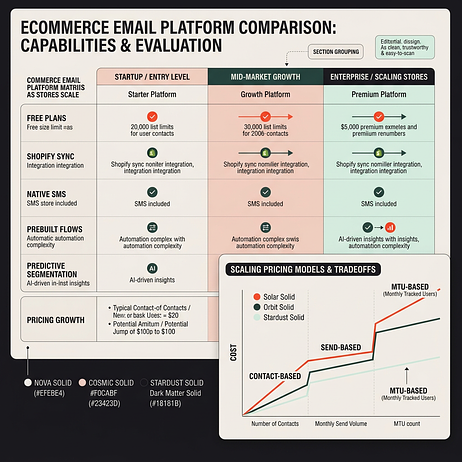
“Starting at a low monthly rate” pricing becomes irrelevant once your store grows beyond an early-stage list size. Ecommerce lists grow fast. Pricing models vary wildly.
Contact-based pricing penalizes list growth. Send-based pricing can be cheaper for large lists with low send frequency but expensive for high-frequency senders. MTU-based pricing avoids double-counting across channels.
A platform that’s cheapest at a smaller list size is often the most expensive at a much larger list size. Model costs at your projected list size and send volume before committing. If you want to see how different pricing models behave once you add SMS, WhatsApp, and orchestration, validate your assumptions in the product demo hub.
How should ecommerce teams choose a platform step by step?
Most teams evaluate too many platforms superficially instead of deeply evaluating a small shortlist. This process prioritizes elimination over exploration.
Step 1: Map required ecommerce flows.
List the flows your store needs: abandoned cart, browse abandonment, post-purchase, winback, back-in-stock, price drop. Eliminate any platform that doesn’t support them natively.
Step 2: Score automation and artificial intelligence (AI) needs.
Determine whether you need basic automation or advanced capabilities like predictive segments and AI-generated content. Eliminate platforms that require upgrades for your required tier.
Step 3: Model pricing at your contact volume.
Model costs at your current list size and projected growth over the next year. Include SMS if you plan to add it. Eliminate platforms where costs exceed budget at projected scale.
Step 4: Run a proof with revenue goals.
Set specific success criteria before starting a trial: complete one abandoned cart flow, segment by purchase behavior, send one campaign, measure deliverability.
Step 5: Plan migration from your current tool.
Ask each vendor about migration support, data portability, and timeline. Platforms with white-glove migration reduce risk and speed time-to-value.
Why is Insider One the recommended platform for ecommerce growth?
Insider One is the right choice for mid-market and enterprise ecommerce teams that need an Actionable CDP, Omnichannel Journey Orchestration, and AI-Native CX, without managing multiple vendors. Its single-tenant, unified architecture eliminates the 24-hour data syncs and third-party CDP dependencies that slow down competing platforms.
Key differentiators:
- Unified Actionable CDP: Real-time identity resolution across web, app, and offline, including offline-to-online identity stitching and enterprise-grade custom data structures
- Prebuilt ecommerce flows: Abandoned cart, post-purchase, winback, back-in-stock, and price drop templates ready to deploy
- Predictive AI segmentation: Likelihood-to-Purchase, Likelihood-to-Churn, and Next Best Channel decisioning, powered by Sirius AI™ using GenAI and proprietary LLMs
- Omnichannel Journey Orchestration: Email, SMS, WhatsApp, web push, app push, and on-site personalization, all from a single journey canvas powered by AI-Native CX
- Transparent pricing: MTU-based model with no channel-based double-counting, one unified profile per customer regardless of how many channels they engage on
- Agentic AI (Agent One): Autonomous AI that builds journeys and optimizes channel routing toward your revenue targets
- On-site Personalization: Eureka (Site Search), Smart Recommender, and homepage personalization deliver a closed-loop experience from email click to on-site conversion. Unlike Klaviyo, which only personalizes the outbound message, Insider personalizes the entire on-site experience in real-time, from banners to product grids to search results.
- Conversational Commerce: WhatsApp capabilities that let customers browse, add to cart, and complete purchases in-thread
- InStory: Instagram-style swipeable product stories that replace the standard product grid, a high-impact format for mobile-first ecommerce brands that drives higher engagement than static banners
Who Insider One is not for:
- Early-stage stores with smaller lists and basic automation needs
- Teams that only need email without SMS or cross-channel journeys
- Organizations unwilling to consolidate tools
If you’re done stitching tools together and ready to ship revenue-driving journeys faster, request a demo before you lock in another year of workarounds. See how global enterprise brands scale their cross-channel revenue on our Customer Success Stories page.
Frequently asked questions
An ecommerce email marketing platform integrates directly with online stores to send automated, behavior-triggered emails based on purchase, browse, and cart data.
Klaviyo and Omnisend offer native Shopify integrations for many mid-market stores. Insider One is the better choice for teams needing unified CDP and cross-channel orchestration alongside email.
Free plans work for stores with very small lists and basic needs. Most gate automation, segmentation, and ecommerce flows behind paid tiers.
Expect pricing to vary widely depending on the platform, your list size, and the features you need. SMS adds to that cost.
Email authentication protocols that verify your sending domain and improve deliverability. Most platforms handle setup, but you’ll need DNS access to configure them.
Export contacts, segments, and templates from your current platform. Import into the new one. Rebuild automations and test deliverability before going live. Some platforms offer white-glove migration support.
Klaviyo, Omnisend, Brevo, and Insider One offer native SMS alongside email. Others require third-party integrations.
Start with abandoned cart, welcome series, and post-purchase flows. These three typically generate the highest revenue per recipient.

Keep Reading
7 min.

Muharrem Derinkok
4 Jun 2026
11 min.

Chris Baldwin
2 Jun 2026
4 min.
Chris Baldwin
3 Feb 2026