

 Platform Overview

 Integration Hub

 Sirius AI™

 Customer Data Management

 Personalization

 Journey Orchestration

 Reporting & Data

 Behavioral Analytics

 Web
Web

 Email
Email

 Site Search

 Conversational CX

 WhatsApp

 Web Push

 InStory

 App
App

 SMS & RCS

 Join the $0 Migration Movement™

 The Insider One Difference

 Compare Vendors

 Switch to Insider One

 Success Story

 Retail & Ecommerce

 Financial Services

 Travel & Hospitality

 Beauty & Cosmetics

 Automotive

 Telecommunications

 Interactive Platform Tour

 Blog
Blog

 E-Books & Guides

 Glossary
AI vs. Rule‑Based Personalization: What Works Best for You

Updated on 19 Dec 2025
13 min.
Table of Contents
Most Popular


Most retail, travel, telecom, and banking brands start with rule-based personalization. You create demographic segments, build a few triggers, and automate cart-abandonment reminders. They deliver a quick lift. But the lift doesn’t last, as customer journeys often span across multiple channels. You keep adding conditions to squeeze out a little more performance, and the returns barely move.
That’s when AI-driven personalization comes into play. Instead of static logic, AI models learn from every interaction, detect shifts in intent, and predict what customers may do next. At this point, you have to ask: does your company need AI or rules-based personalization?
This article breaks down rules-based vs. AI personalization, shows where each works best, highlights the trade-offs, and outlines clear decision criteria.
You’ll also see how Insider One helps brands shift from manual rules to AI-powered engagement that lifts conversion and AOV across the journey.
Rule-based vs. AI personalization: Key differences marketers must know
Rule-based personalization engines follow fixed instructions for all customer segments, while AI-driven personalization learns from customer behavior and adapts every experience in real time, even when intent shifts mid-journey.
What is rule-based personalization and how does it work?
Rules-based personalization uses predefined segments and if-then rules to deliver the same experience across channels. It’s useful for predictable triggers like:
- Renewal nudges
- Low-balance alerts
- Cart abandonment
- Expirty notifications
- Basic upsells and cross-sells
- Welcome and onboarding sequences
Here’s how rule-based personalization works:
- Segmentation: The system sorts custom data into static segments based on behavioral thresholds or fixed attributes
- If-then logic: The engine checks if-then rules to decide which message or experience to fire
- Predefined paths: Journeys follow predefined paths that never change unless a marketer edits the logic
- Execution: Scheduled triggers mean the system reacts slowly. As a result, timing often doesn’t match what the customer wants right now
- Response: Every customer who meets the same condition receives the same response, regardless of intent
For example, a shopper spends time comparing two products on your website. They add one to the cart and drop off. A rule-based personalization system doesn’t read any of that nuance. It waits a fixed period and then sends the same discount email to everyone else. The message lands, but ignores everything the shopper just told you about their intent.
Rule or trigger-based personalization can’t adapt when intent changes. This lack of adaptability quickly caps performance in fast-moving journeys where relevance must update instantly.
What is AI personalization and how does it work?
AI personalization uses machine learning and predictive models to tailor experiences for each individual in real time. Instead of fixed segments or scheduled triggers, it learns from live behavior and adjusts the next-best action instantly. That’s why AI-based personalization tools outperform rule-based systems in journeys where intent shifts quickly. It works best for:
- Recommending the best plans or add-ons in telecom
- Personalizing fares, upgrades, and ancillaries during travel searches
- Predicting purchase intent and delivering AI product recommendations
- Suggesting the most relevant cards, loans, or savings products in banking
- Individualized promotions, dynamic bundles, and in-session nudges for e-commerce users
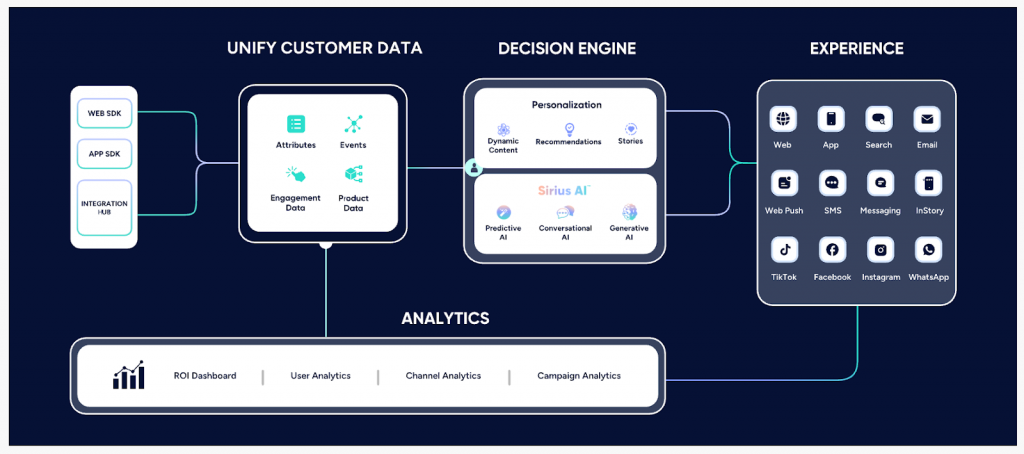
Here’s how AI personalization works:
- Real-time data processing: The system reads live behavioral signals like browsing depth, frequency, timing, device switching, and price sensitivity to update the user profile instantly
- Predictive modeling: Machine learning scores each customer’s likelihood to buy, churn, downgrade, upgrade, or respond to an offer using micro-patterns humans can’t detect
- Dynamic decisioning: Journeys stop following static paths. The system selects the next-best action in the moment, adapting to what the customer is doing right now
- Omnichannel orchestration: Decisions sync across web, app, email, SMS, WhatsApp, push, and contact center so messages stay relevant even as customers switch devices or contexts
- Individualized responses: Two customers with similar behavior can get completely different outcomes because the AI optimizes for personal intent instead of segment-level averages
For example, a shopper compares premium items across multiple visits, shows strong interest in a category, and responds better to free shipping than discounts.
When they drop off, the AI doesn’t wait for a scheduled trigger. It detects high intent and offers a personalized free shipping offer through the channel they’re most likely to engage with.
This real-time learning drives higher conversion, stronger retention, and bigger AOV. Adidas saw this firsthand: by moving beyond standard segmentation and using Insider One’s AI tools, they achieved a 259% increase in AOV across their digital channels.
Why AI personalization outperforms rule-based strategies
Rule-based systems follow if-then instructions, while AI systems interpret behavior as it unfolds. That contrast becomes decisive when intent shifts quickly. AI personalization outperforms rule-based strategies because it continuously processes intent signals, predicts what a customer is likely to do next, and adapts the experience in real time.
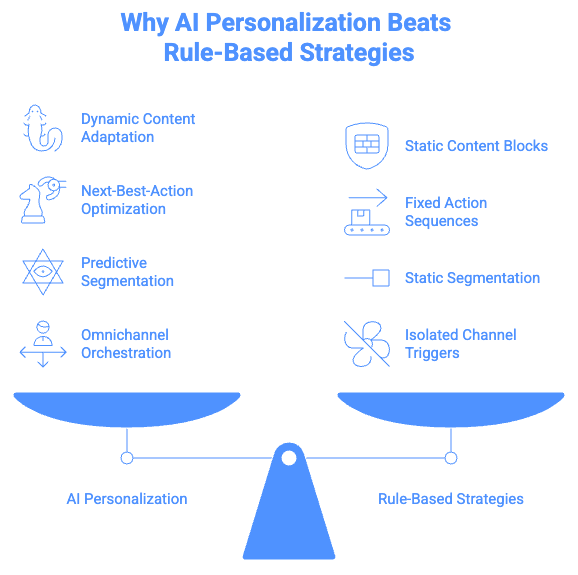
Here’s what gives AI models a structural advantage over rule-based personalization.
1. Dynamic content
AI personalization models don’t lock customers in predefined content blocks. They assess behavioral streams like product affinities, dwell time, decision cycles, price sensitivity, upgrade or churn risk, cross-device paths, and friction points.
The system then blends these signals with historical and contextual data to predict what the customer will do next. This is what enables dynamic content and offers across every channel, driving lifts in conversion, AOV, and retention.
2. Next-best-action
Next-best-action is an AI decisioning approach that analyzes intent, predicted outcomes, and business constraints to choose the optimal intervention for each customer at each moment.
Dynamic content personalizes the experience, but next-best action optimizes the sequence. This might mean holding back a discount and offering a margin-friendly bundle when the model predicts the customer will convert without incentives.
Many omnichannel customer engagement platforms now layer reinforcement learning, where the model tests different actions and learns which paths maximize outcomes over time. Rule-based systems can’t do this as they don’t score intent or learn from outcomes.
3. Predictive segmentation
Static segments age quickly. AI personalization engines replace them with micro-segments generated by clustering algorithms that update as soon as behaviour changes. Instead of broad groups like frequent shoppers or high-value customers, AI systems create segments like:
- Customers likely to purchase within the next 24 hours
- Travellers showing price volatility signals for premium fares
- Telecom users at 7-day churn risk due to declining engagement
- Banking customers exploring higher credit lines but not yet converting
These micro-segments update in real time as behaviour evolves. They let growth teams target intent states that rules miss entirely, including the early cues that signal a high-value outcome. And that’s why predictive segmentation is powerful.
4. Omnichannel orchestration
Each channel runs on its own set of triggers in rule-based systems. The email tool fires one message, and the push tool or WhatsApp fires another. No system knows what the other is doing. AI personalization systems centralize decision-making across channels instead of pushing a fixed message through a predetermined workflow. AI evaluates:
- The customer’s current state
- Their predicted responsiveness to each channel
- Their cross-device behaviour
- The urgency of the moment
- The best intervention to deploy
- The optimal delivery timing
A single intelligence layer aligns the entire omnichannel marketing system, creating a unified journey that evolves with the customer instead of delivering duplicate or conflicting messages.
When rule-based personalization works
Rule-based personalization is effective when you have limited data, simple journeys, and engagement running through one or two predictable channels. Deterministic logic can deliver consistent results in these environments. The key is knowing where this approach fits and where it starts to hold you back.
- Early-stage programs with limited data: Triggers like cart abandonment, expiry reminders, and low-balance alerts offer the fastest path to value when behavioral data is sparse or not unified
- Narrow, compliance-led journeys: Banking and telecom teams often send regulatory notices, KYC reminders, billing updates, and service alerts that must follow strict, auditable rules. Rule-based flows are ideal here because the logic must stay fixed, transparent, and easy for compliance to review
- Single-channel or low-complexity campaigns: Rule-based personalization still holds up well when your primary channels are email or SMS. It provides reliable performance without added complexity if your journeys are limited to onboarding, renewals, or simple win-back campaigns
- Stable behaviour and longer decision cycles: Real-time prediction has less advantage when customers don’t move quickly between states or decisions unfold over days or weeks. Milestone-based rules and lifecycle drips perform sufficiently well in these cases
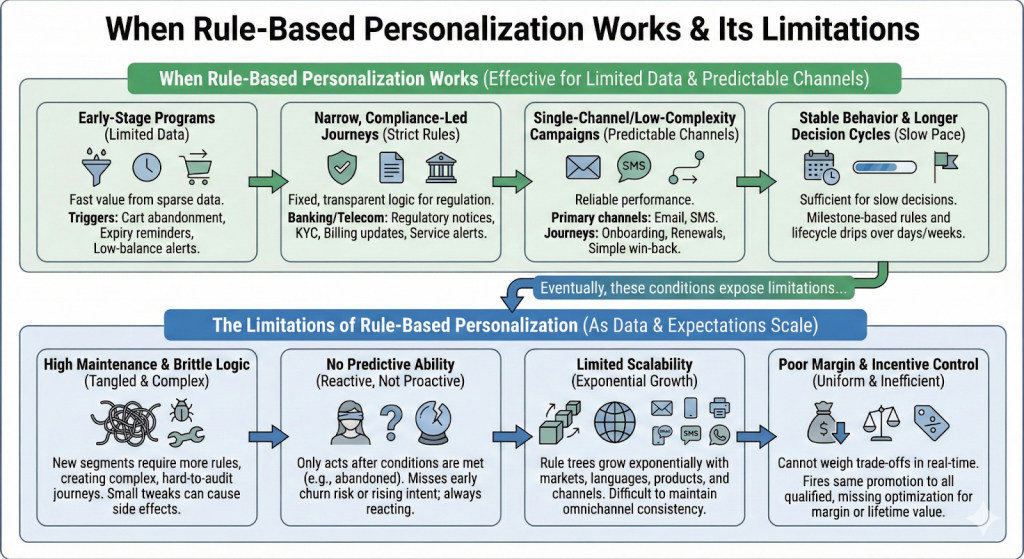
Still, the same conditions that make rules effective early on eventually expose the limitations of a rule-only approach.
What are the limitations of rule-based personalization?
Rule-based personalization can work well at first, but as your data scales, your journeys expand, and expectations increase, its limits become much harder to ignore.
- High maintenance and brittle logic: Every new segment or exception requires adding another rule. Over time, these rules create complex, tangled journeys that are hard to audit, debug, or optimize. One small tweak can trigger side effects elsewhere, and cleaning up that logic often becomes a full-blown task.
- No predictive ability: Rules can only act after a condition is met: cart abandoned, plan expiring, bill overdue. They can’t detect early churn risk, rising purchase intent, or upgrade propensity until the customer crosses a hard threshold. That means you’re always reacting to events instead of shaping them.
- Limited scalability: Rule trees grow exponentially when you add more markets, languages, product lines, and channels. Keeping email, app, push, SMS, and WhatsApp journeys aligned requires manual duplication and constant supervision. As a result, it becomes difficult to maintain omnichannel consistency.
- Poor margin and incentive control: Rules can’t weigh trade-offs between discounting, margin, capacity, risk, and customer lifetime value in real time. They fire the same promotion for everyone who qualifies, even when some would have converted without incentives or with a more profitable alternative.
Checklist: When are rules enough, and when do you need AI?
Rule-based personalization performs well only in certain environments with limited data, channels, or decision complexity. As these elements scale, AI becomes less of a nice-to-have and more of an operational necessity.
Use rule-based optimization when:
- Behavioral and transactional data are sparse or disconnected
- Engagement runs through one or two primary channels
- Compliance and ease of auditing dominate decision-making
- Customer journeys evolve slowly and predictably
- Lifecycle marketing framework is the foundational stage
Use AI-based optimization when:
- Rule engine becomes harder to maintain than to improve
- Operation expands across multiple channels, products, or regions
- Performance plateaus despite adding more rules
- Commercial goals depend on optimization trade-offs like discounting vs. margin
- Aligning email, app, push, SMS, and WhatsApp requires duplication and constant monitoring
Now, let’s look at factors to consider while choosing between rule-based and AI personalization engines.
Choosing between rule-based and AI personalization
Choosing the right personalization depends on what fits your data maturity, business goals, team structure, and time-to-value expectations.
Data maturity
AI-driven personalization relies on large, clean, well-structured datasets that capture behavioural signals, transactional history, product or plan attributes, pricing patterns, and cross-channel interactions.
The models can’t reliably predict intent, churn risk, upgrade propensity, or purchase timing without datasets. That’s why data unification through customer data platforms or a stitched event pipeline is a prerequisite before AI can deliver meaningful lift.
Rule-based personalization sits at the opposite end of the spectrum. It handles sparse or fragmented data well since it runs on simple triggers and basic attributes. But that ease comes with a ceiling: rules can’t predict intent or adjust when behaviour shifts beyond the conditions you set.
Business goals
AI consistently beats rule-based engines on goals like upsell, cross-sell, AOV lift, margin protection, churn reduction, and multi-channel conversion, simply because it predicts behaviour rather than reacting to it.
- AOV growth: AI evaluates affinity, price sensitivity, inventory, and historical spend to recommend the next-best product or bundle, optimizing both revenue and margin. Rule-based systems can’t do as they rely on static add-ons or category-level suggestions
- Customer retention: AI detects early churn signals like declining engagement, reduced app activity, or unusual browsing loops, and triggers interventions before the customer reaches the threshold of leaving. Rules only respond once churn is already visible
- Conversion optimization: AI recalibrates recommendations and messaging in real time across web, app, email, SMS, and WhatsApp, aligning the experience with shifting intent. Rule-based personalization can’t coordinate this level of cross-channel marketing optimization without manual effort
Team capabilities
Operational readiness decides how far a team can take personalization. Rule-based programs are simple to run. A small marketing or lifecycle team can manage segments, set up triggers, and maintain journeys without support from data science or engineering. They’re easy to audit, straightforward to explain, and predictable enough for compliance-heavy teams.
AI-driven personalization requires more coordination. You must monitor models, define guardrails, and oversee integrations. Teams also need comfort with testing and data governance.
Platforms like Insider One help lighten this load by automating model training, inference, and orchestration, enabling non-technical teams to run sophisticated AI programs without writing rules or code.
Time-to-value and ROI expectations
Rule-based personalization offers the fastest time-to-value. You can stand up triggers, segments, and basic journeys within days, which delivers quick but modest gains in conversion, engagement, or retention. Those gains flatten fast, especially once you’re operating across multiple channels or product lines.
AI takes longer to ramp because it needs clean data, identity resolution, and event mapping before it can outperform rules. But it scales effortlessly across channels, segments, and products once that foundation is set. ROI continues to grow because the models learn, refine, and adapt on their own, rather than relying on manual updates.
How Insider One powers AI-driven personalization
Insider One starts with an AI-native customer data platform that unifies behavioural, transactional, and contextual data across web, app, and CRM to build a unified customer view. From there, its AI-powered segmentation engine automatically uncovers micro-audiences and intent clusters, allowing you to target far beyond broad demographic buckets.
This intelligence feeds directly into real-time personalization across web, mobile app, email, SMS, push, and WhatsApp, ensuring every interaction feels relevant to the moment the customer is in. At the center is Insider One’s next-best-action orchestrator, which chooses the most effective message, offer, or product recommendation, factoring in predicted behaviour, channel preference, and business constraints.
The results speak for themselves. For instance, Sapphire saw a 98% increase in AOV and a 244% uplift in conversion using Insider One’s Smart Recommender and onsite personalization. GAIA achieved a 166% boost in conversions by combining Insider One’s CDP, cross-channel orchestration, and contextual offers. And Philips increased AOV by 35% through AI-driven recommendations and personalized journeys.
Want to see how this level of impact could look for your brand? Book a demo today!
Frequently Asked Questions (FAQs)
Got more questions? We got you covered.
Rule-based personalization uses predefined ‘if-then’ rules and static segments to decide what message, offer, or experience a customer receives. It works well for simple triggers such as cart abandonment or renewal reminders, but can’t anticipate changes in intent. As a result, it delivers predictable outcomes but plateaus quickly as journeys and data grow more complex.
AI personalization uses machine learning to analyze real-time behaviour, predict intent, and deliver individualized experiences across channels. Instead of waiting for triggers, it adapts content, offers, and timing based on what each customer is likely to do next. Platforms like Insider One enable brands to deploy AI-based personalization at scale without heavy resources.
Rule-based personalization delivers quicker initial ROI because it is simple to set up and relies on basic data. However, AI personalization produces significantly higher long-term ROI by predicting intent, optimizing next-best-action decisions, and increasing conversion and AOV across channels. Brands using Insider One often see measurable uplift within weeks of activating AI-led journeys.
AI personalization integrates by ingesting unified customer profiles, events, and transactional data from your CRM or CDP. Once connected, the AI models use this data to score intent, build dynamic segments, and trigger next-best actions across channels. Insider One offers native connectors and real-time APIs to make integration fast and low maintenance.
Yes. Small brands can benefit from AI personalization because modern platforms remove the need for in-house data science or complex infrastructure. Even with modest datasets, AI can optimize product recommendations, timing, and channels to drive higher conversions and repeat purchases. Insider One makes enterprise-level personalization accessible to teams of any size.

Keep Reading
4 min.

Chris Baldwin
3 Feb 2026
9 min

Muharrem
23 Dec 2025
10 min.
Muharrem
11 Oct 2024