

 Platform Overview

 Integration Hub

 Insider One AI™

 Customer Data Management

 Personalization

 Journey Orchestration

 Reporting & Data

 Behavioral Analytics

 Web
Web

 Email
Email

 Site Search

 Conversational CX

 WhatsApp

 Web Push

 InStory

 App
App

 SMS & RCS

 Join the $0 Migration Movement™

 The Insider One Difference

 Compare Vendors

 Switch to Insider One

 Success Story

 Retail & Ecommerce

 Financial Services

 Travel & Hospitality

 Beauty & Cosmetics

 Automotive

 Telecommunications

 Total Economic Impact™ Study

 Blog
Blog

 E-Books & Guides

 Glossary
Best Real Use Cases for AI Decisioning

Updated on 21 Apr 2026
11 min.
Table of Contents
- What should you know at a glance?
- How AI decisioning differs from predictive AI and rule-based engines
- How AI decisioning works
- What data foundation does AI decisioning need?
- How do scoring models and uplift work?
- How do policy, constraints, and optimization shape decisions?
- How do you evaluate a new decisioning policy?
- How should you monitor decisions and handle rollback?
- When do you need real-time execution versus batch execution?
- What types of AI decisioning should you plan for?
- Which AI decisioning use cases matter most for marketing and customer engagement?
- How does AI decisioning improve abandoned cart recovery?
- How does AI decisioning shape onsite personalization and next-best-action?
- How do you optimize offers and discounts with AI decisioning?
- How does AI decisioning improve channel selection and send-time optimization?
- How does AI decisioning improve churn intervention and retention offers?
- How does AI decisioning improve cross-sell and next-best-product selection?
- How should lead scores route actions?
- How does AI decisioning guide email content personalization?
- How does AI decisioning support triage and deflection?
- How does AI decisioning handle fraud and risk step-up at checkout?
- How do inventory-aware recommendations improve decisioning?
- Which AI decisioning use cases matter by industry?
- How do you implement AI decisioning?
- What to look for in an AI decisioning platform.
- How does Insider One power AI decisioning?
- FAQs
Most Popular
Artificial intelligence (AI) decisioning translates predictions into action. Most marketing teams already use predictive models to score churn risk, conversion likelihood, or product affinity. But a score alone doesn’t tell you what to do. AI decisioning closes that gap by selecting the optimal action for each customer under real-world business constraints such as budget caps, frequency limits, and margin floors.
It’s the layer that determines which offer to send, through which channel, at what time, without exceeding your discount budget or training customers to wait for promotions.
This guide walks through what AI decisioning is, how it differs from rules engines and predictive AI, and where it delivers the highest impact for marketing and customer engagement teams. You’ll see concrete use cases across cart recovery, channel selection, offer optimization, and churn intervention, plus implementation steps that focus on defining objectives and constraints before deploying any model.
The goal is simple: help you move from scoring customers to making smarter, faster decisions that protect margin while driving incremental revenue.
What should you know at a glance?
AI decisioning selects the best action to take for a specific customer under defined business constraints, not just predicting what happens next.
- Decisioning chooses what to do (send this offer, via this channel, at this time), while predictive AI only scores likelihood
- Cart recovery, channel selection, offer optimization, and churn intervention deliver the highest impact for marketing teams
- Success requires defining objectives, constraints, and guardrails before deploying any model
How AI decisioning differs from predictive AI and rule-based engines
| Approach | What it does | Example |
| Rule-based engine | Executes static if/then logic | “If cart is above a threshold, show free shipping” |
| Predictive AI | Scores likelihood of an outcome | “High churn probability” |
| AI decisioning | Selects optimal action under constraints | “Send a discount via SMS at an optimal time, within the daily budget” |
Rule-based engines follow static if/then logic. Predictive models output probability scores. Decisioning consumes predictive scores and chooses an action under your business constraints. Decisioning also optimizes dynamically based on real-time conditions.
Think of it this way: prediction answers “what might happen?” while decisioning answers “what should we do about it?”
You often need all three working together. Use rules for hard compliance constraints that can’t be broken. Use predictions for scoring customer intent or risk. Use decisioning to select the final action based on those inputs.
Here’s a concrete example: a propensity model says a customer is likely to buy. A rule-based engine automatically triggers a discount. But decisioning determines that because this customer is already likely to convert, showing a loyalty nudge instead of a discount protects your margin while still securing the sale.
How AI decisioning works
Most implementations fail not because of bad models, but because of missing feedback loops or undefined constraints. The end-to-end lifecycle runs from data foundation through feature computation, scoring models, policy and constraints, execution, measurement, and feedback.
What data foundation does AI decisioning need?
Stale data produces stale decisions. If your system can’t recognize a customer across devices, it makes irrelevant or conflicting offers.
You need to evaluate your infrastructure against specific readiness criteria:
- Identity match rate: Can you link behavior to a profile?
- Event latency: How fresh does behavioral data need to be?
- Historical depth: Do you have enough historical data for uplift models?
- Schema consistency: Are there breaking changes mid-training?
Streaming infrastructure adds cost and complexity. Batch processing works fine for email campaigns, but onsite personalization requires real-time data.
How do scoring models and uplift work?
Propensity models answer “who is likely to convert?” Uplift models answer a more important question: “who will convert because of this action?”
Propensity-based targeting often wastes the budget on customers who would have converted anyway. Uplift modeling focuses on the “persuadables”, people whose behavior changes only when treated. To do this effectively, you need control groups from the start.
How do policy, constraints, and optimization shape decisions?
A model score is not a decision. The policy layer translates scores into actions while respecting business constraints on budget caps, frequency limits, fairness rules, margin floors.
Without constraints, a decisioning engine simply gives everyone the biggest discount to maximize conversion rates. A proper policy defines the objective (like maximizing incremental revenue) and the allowed actions (discount tiers, channels) subject to specific limits.
Example constraints include:
- Daily discount budget
- Maximum messages per user per week
- Minimum contribution margin per order
- Required explanation for high-stakes actions
How do you evaluate a new decisioning policy?
Deploying a new policy without evaluation is gambling with your customer experience. Run new policies in “shadow mode” first, where the system calculates decisions and logs them without showing them to customers.
Split testing (A/B testing) remains the gold standard for proving causal impact. But offline evaluation methods like inverse propensity scoring reduce the risk of launching a bad policy.
| Approach | When to use | Pitfall |
| A/B test | Final validation of a new strategy | Slow to reach statistical significance |
| Shadow mode | Testing technical stability and logic | Doesn’t reveal actual user reaction |
| Historical replay | Estimating how a policy would have performed | Assumes past behavior predicts future reactions |
How should you monitor decisions and handle rollback?
Decisions drift over time as customer behavior shifts, inventory changes, and competitors react. Watch the decision distribution to see if actions are shifting unexpectedly. Monitor constraint hit rate to see if budgets exhaust too early. If incremental lift drops below a set threshold, you need a rollback trigger to revert immediately.
When do you need real-time execution versus batch execution?
Not every decision needs ultra-low latency. Batch processing works for email send-time optimization or weekly segment refreshes. Real-time execution is required for onsite personalization, fraud step-up, or ad bidding.
| Use case | Latency target | Infrastructure implication |
| Ad bidding | Very low latency | Edge computing, optimized feature stores |
| Onsite personalization | Low latency | Real-time identity resolution, cached profiles |
| Email send-time | Hourly/Daily | Standard batch processing |
| Weekly segmentation | Weekly | Data warehouse infrastructure |
What types of AI decisioning should you plan for?
Different decision types require different algorithms and governance models.
When should decisioning stay automated, and when should humans step in?
Full automation works for low-stakes, high-volume decisions like email subject lines or product recommendations. Human-in-the-loop processes are required when decisions carry financial, legal, or reputational risk.
Define override triggers that determine when the system should escalate to a human, for example, a retention offer above a defined dollar threshold requires agent approval.
Which decisions are high stakes, and which are low stakes?
High-stakes decisions in credit, insurance, or employment, areas classified as high risk under the European Union (EU) AI Act, require explainability and audit trails. You often need to provide “adverse action” notices if a decision negatively impacts a customer.
Low-stakes decisions like product recommendations can use more automated models when governance requirements are lower. The distinction is driven by regulatory requirements like the Equal Credit Opportunity Act (ECOA), the Fair Credit Reporting Act (FCRA), and the General Data Protection Regulation (GDPR).
When do you need single-step versus sequential decisioning?
Single-step decisions determine the best action for right now. Sequential decisions involve orchestrating a multi-touch journey where an action today influences what happens next week.
Most teams should start with single-step decisioning. Sequential decisioning requires reinforcement learning (RL), which adds significant complexity. If your decision is “which of a few offers to show” with weekly conversion feedback, start with a bandit. If you want to see what that looks like in a real lifecycle, book a demo to walk through a constraint-aware decision flow end to end.
Which AI decisioning use cases matter most for marketing and customer engagement?
How does AI decisioning improve abandoned cart recovery?
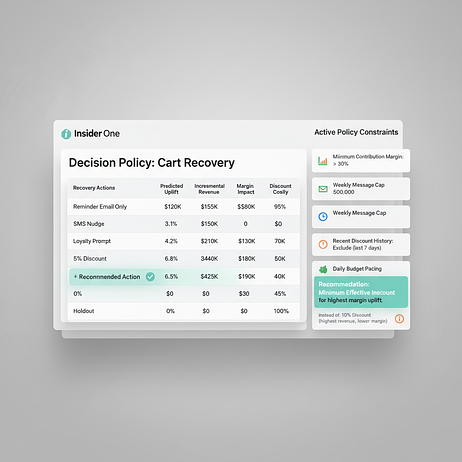
The goal is recovering revenue without giving away unnecessary margin. Many customers return to buy without any incentive.
- Trigger: Cart abandonment event
- Inputs: Cart value, product margin, customer lifetime value, discount history
- Model: Uplift model predicting incremental conversion
- Policy: Minimum effective incentive, start with a reminder, escalate to discount only if needed
- Decisions: Select channel, timing, and discount tier
- Key performance indicator (KPI): Incremental conversions, not total conversions
- Failure mode: Leaking margin by discounting customers who would have bought anyway
How does AI decisioning shape onsite personalization and next-best-action?
Next-best-action selects from a broader set of possibilities: show a recommendation, trigger a survey, display a loyalty prompt, or do nothing.
The policy layer enforces constraints like rate limits to prevent user fatigue and ensures journey consistency so checkout flows aren’t interrupted. If you want proven patterns for those guardrails, explore the examples in the product demo hub.
How do you optimize offers and discounts with AI decisioning?
The objective is maximizing incremental margin, not just conversion rate. This requires understanding price elasticity at the individual level.
Policy constraints include margin floor (never discount below a threshold), budget cap (daily or weekly), and frequency limit (max discounts per customer per month). The failure mode is training customers to wait for discounts by being too predictable.

How does AI decisioning improve channel selection and send-time optimization?
Multi-armed bandits balance exploration (testing new channels or times) with exploitation (using what works). Constraints include fatigue caps to limit messages per channel and cost differences between channels.
How does AI decisioning improve churn intervention and retention offers?
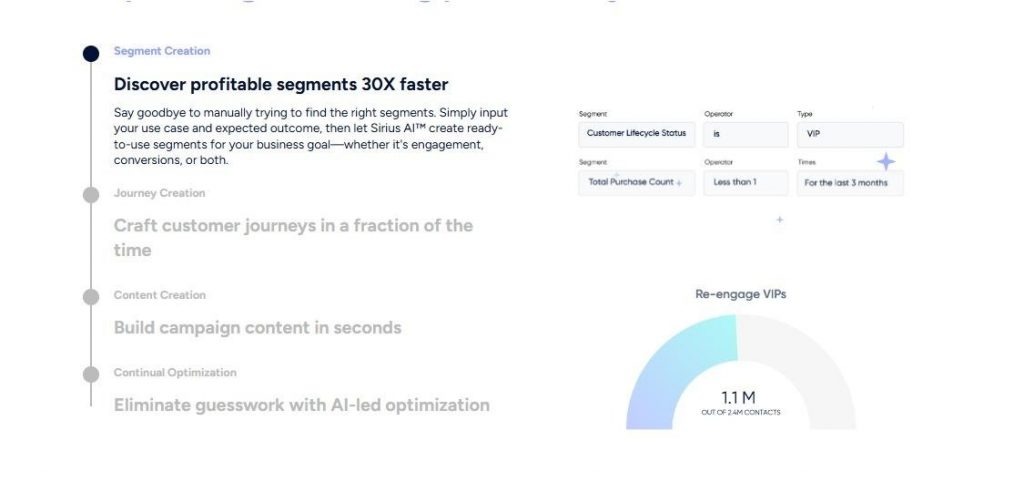
Predicting churn is not the same as preventing it. The decisioning layer selects the specific intervention: proactive outreach, a loyalty bonus, or a service call.
Eligibility rules prevent offering saves to customers who received one recently. The KPI is incremental retained revenue. The failure mode is wasting budget on customers who have already decided to leave or who would have stayed without an offer. If you want to pressure-test your churn policy against real constraints (budget, eligibility, channel fatigue), book a demo and we’ll map it to your retention motion.
How does AI decisioning improve cross-sell and next-best-product selection?
Recommenders rank by relevance. Decisioning adds suitability and eligibility. A customer can show strong interest in a product and still be ineligible due to credit limits or inventory restrictions.
How should lead scores route actions?
An action policy is essential for a lead score to have any practical value. High scores route to sales within a defined service-level agreement (SLA). Medium scores enter a nurture sequence. Low scores receive automated content.
| Score band | Action | Service-level agreement (SLA) | Constraint |
| High | Route to sales rep | Contact quickly | Sales capacity |
| Medium | Email nurture sequence | Send soon | Content relevance |
| Low | Automated newsletter | No SLA | None |
How does AI decisioning guide email content personalization?
Generative AI creates content. Decisioning selects which variant to send based on predicted engagement and constraints like fatigue caps and brand safety rules.
How does AI decisioning support triage and deflection?
The decision includes choosing the path that minimizes cost while maintaining satisfaction, whether that path is a chatbot, a human agent, or another route. The policy includes a customer satisfaction (CSAT) guardrail: don’t deflect if predicted satisfaction drops below threshold.
How does AI decisioning handle fraud and risk step-up at checkout?
Aggressive fraud prevention kills conversions. Selective step-up balances fraud loss against cart abandonment. Only trigger additional verification for risky transactions.
How do inventory-aware recommendations improve decisioning?
Recommending out-of-stock products can lead to negative experience and frustration for customers. Inventory-aware decisioning filters or substitutes items based on availability and margin.
Which AI decisioning use cases matter by industry?
Retail and ecommerce
Priority use cases include:
- Cart recovery
- Onsite personalization
- Offer optimization
- Fraud step-up
- Inventory-aware recommendations
Constraints focus on margin protection and inventory synchronization. Payment orchestration, deciding which acquirer to route a transaction to, is another high-value opportunity.
Financial services
Compliance is the primary constraint. Priority use cases include credit terms personalization, fraud detection, and churn intervention. Decisions often require human-in-the-loop workflows and strict audit trails.
Telecom
Telecom providers focus on churn intervention and upgrade offers. Constraints involve contract eligibility and network-driven signals like usage patterns or service quality issues. Timing windows around billing cycles are critical.
Travel and hospitality
Inventory is perishable. Priority use cases include ancillary upsell, dynamic pricing, and service recovery. Constraints include overbooking risk and load factor targets.
How do you implement AI decisioning?
Implementation fails when teams jump straight to building models without designing the decision framework first.
How do you assess data readiness?
Before building models, verify data quality. If identity resolution is poor, your decisions will be flawed. Check identity match rate, event latency, historical depth, and schema consistency.
How do you define the decision problem?
Structure your decision using a standard template before writing any code:
- Objective: What to maximize (e.g., incremental revenue)
- Decisions: What the system can decide on (e.g., discount tiers, channels)
- Constraints: Budget, frequency, fairness, compliance
- Metrics: Primary KPI and guardrails
How do you design governance and risk controls?
High-stakes decisions require explainability and audit logs. Define which decisions require human approval, what triggers an override, how decisions are logged, and how fairness is monitored.
How do you validate with shadow mode and offline evaluation?
De-risk deployment by running the new policy in shadow mode. Log decisions in internal systems or customer databases. Compare predicted outcomes to actuals. Define clear go-live criteria.
How do you scale, monitor, and iterate?
Post-launch, monitor decision distribution and constraint utilization. Set a retraining cadence based on how quickly your data changes. If incremental lift drops below threshold, trigger rollback.
What to look for in an AI decisioning platform.
Vendor evaluation should focus on capabilities that matter for decisioning, not generic AI features.
| Capability | Why it matters | Questions to ask |
| Policy engine | Translates scores into actions | Can I define custom constraints? |
| Constraint solver | Optimizes within boundaries | How does it handle conflicting rules? |
| Offline evaluation | De-risks deployment | Do you support shadow mode? |
| Bandit/reinforcement learning (RL) support | Enables adaptive learning | What bandits are supported? |
| Audit logs | Required for compliance | Can I export decision logs? |
| Latency SLA | Critical for real-time use cases | What’s your tail latency? |
How does Insider One power AI decisioning?
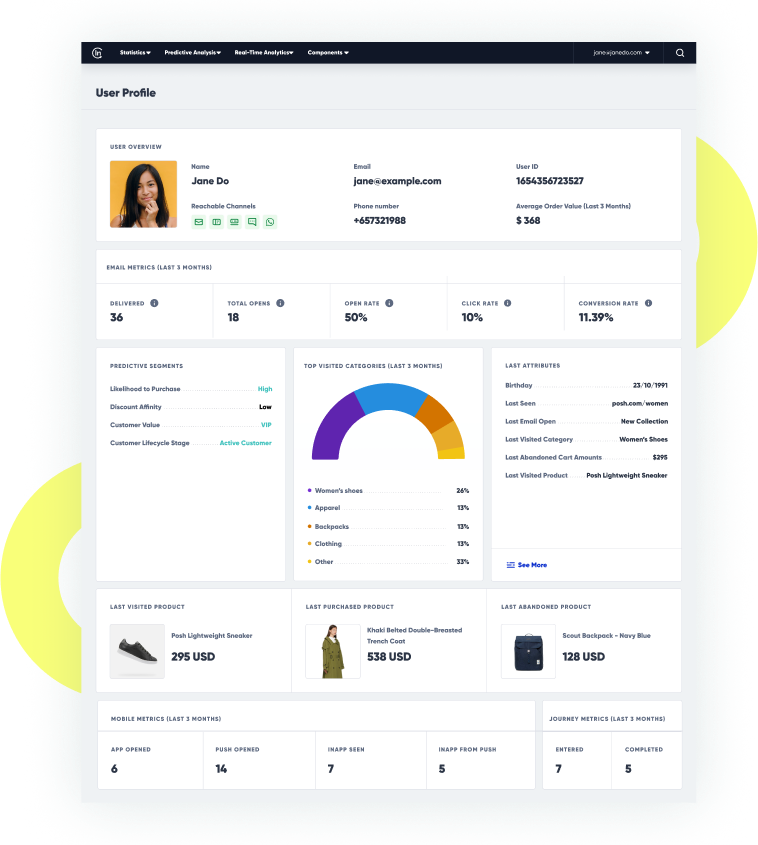
Insider One provides the unified data and orchestration layer needed to operationalize AI decisioning.
- Predictive segments and next-best-action: Insider One AI, Insider One’s extensive set of AI capabilities, selects actions based on predicted behavior and business constraints
- Journey orchestration with policy logic: Architect, Insider One’s customer journey orchestration solution, enforces frequency caps, budget pacing, and channel rules
- Constraint-aware recommendations: Smart Recommender filters by inventory, margin, and eligibility
- Unified profiles for real-time decisioning: Identity resolution powers real-time personalization
If you want to see how those pieces work together, policy logic, guardrails, and activation across channels, start in the product demo hub and pick the use case closest to your roadmap.
FAQs
Prediction outputs a score like “this customer has a high likelihood of churning.” Decisioning uses that score to select an action under constraints, such as “send a retention offer via SMS, within the daily budget.”
Next-best-action (NBA) is one application of AI decisioning. Decisioning is the underlying capability that selects actions under constraints. NBA is the use case where that capability determines the optimal action for a specific customer at a specific moment.
Minimum requirements include identity resolution coverage above a defined threshold, event latency appropriate for your use case, and sufficient historical depth for uplift modeling. Without these, models underperform or produce unreliable decisions.
Use holdout groups to measure incremental lift, not total conversions. Define a primary KPI like incremental revenue and guardrail metrics like margin and CSAT. Compare the decisioning group to the holdout to isolate the effect.
Human oversight is required for high-stakes decisions with financial, legal, or reputational risk, such as credit terms or regulatory compliance. Define override triggers and escalation paths before deployment.

Keep Reading
7 min.

Muharrem Derinkok
4 Jun 2026
11 min.

Chris Baldwin
2 Jun 2026
4 min.
Chris Baldwin
3 Feb 2026