

 Platform Overview

 Integration Hub

 Agent One™

 Agent One Teams™

 Customer Data Management

 Personalization

 Journey Orchestration

 Reporting & Data

 Behavioral Analytics

 Web
Web

 Email
Email

 Site Search

 Conversational CX

 WhatsApp

 Web Push

 InStory

 App
App

 SMS & RCS

 Join the $0 Migration Movement™

 The Insider One Difference

 Compare Vendors

 Switch to Insider One

 Success Story

 Retail & Ecommerce

 Financial Services

 Travel & Hospitality

 Beauty & Cosmetics

 Automotive

 Telecommunications

 Total Economic Impact™ Study

 Blog
Blog

 E-Books & Guides

 Events

 Glossary
Agentic AI for Email Marketing: Beyond Traditional Automation

Updated on 24 Sep 2026
10 min.
Table of Contents
- Summary
- Why rule-based automation can't keep up with real-time buyer behavior
- What an email-focused AI agent actually does (beyond writing subject lines)
- The data infrastructure that makes or breaks agentic email performance
- Where agentic AI creates measurable lift in email programs
- How to evaluate whether your email stack is actually agentic-ready
- The shift from rule-based to agentic email: what it means in practice
- FAQs
Most Popular


Summary
Agentic AI takes email automation beyond rule-based workflows by continuously deciding who to target, what to send, and when to send it based on real-time customer behavior. Success depends on a strong data foundation—including unified customer profiles and identity resolution, and teams should expect an initial learning period before evaluating performance.
There is a specific moment in every lifecycle marketing program when the cracks appear. The welcome sequence converts well. The cart abandonment flow is solid. But somewhere between the first purchase and the third campaign cycle, the message stops landing. Behavior has shifted, and the segment logic hasn’t.
You are now sending the right message for who this person was six weeks ago, not who they are today. That lag isn’t a copy problem or a send-time problem. It’s a structural limitation of rule-based automation, and no amount of A/B testing fixes it.
The conversation about how to use AI for email marketing tends to collapse quickly into generative features: better subject lines, faster copy, smarter templates.
Those are real improvements, but they are not what this article is about. What actually changes the economics of email is the decisioning and orchestration layer that determines who gets what message, when, and through which path.
That layer is where agentic AI operates, and it’s the part most platforms aren’t yet honest with you about.
Why rule-based automation can’t keep up with real-time buyer behavior
The relevance decay problem
Traditional email automation is fundamentally a prediction made in advance. A strategist looks at historical behavior, builds a segment, sequences a set of messages, and sets triggers to fire when conditions are met. The logic is sound at build time.
The problem is that customers do not stay inside the mental model you built for them. They browse differently across devices, respond to promotions unevenly, and shift intent signals in ways that batch-refresh segments simply cannot track at the pace they occur.
Relevance decay is the result. The longer a campaign runs without structural recalibration, the wider the gap grows between what the system thinks it knows about a subscriber and what is actually true.
Standard email platforms respond to this with more rules: suppression lists, re-engagement triggers, frequency caps. Each addition is a patch on a model that was never designed to update itself continuously in the first place.
What the agentic model changes
An agentic system doesn’t operate on pre-built sequences triggered by static conditions. It reads behavioral signals continuously, re-evaluates segment fit as new events arrive, and adjusts message selection without waiting for a human to initiate the next step.
The system isn’t executing a plan you wrote; it’s pursuing a goal you defined while making its own routing decisions in real time. That’s a fundamentally different architecture, and it produces a fundamentally different subscriber experience.
What an email-focused AI agent actually does (beyond writing subject lines)
The four core agent actions
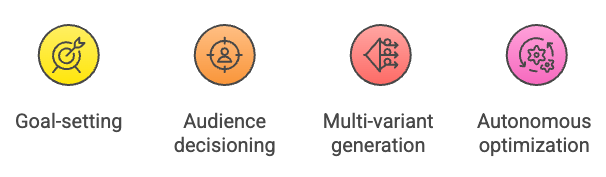
Generative AI features are the visible surface of what most platforms are shipping right now. They produce better copy faster and lower the barrier to variant creation. But an email AI agent operates on four distinct actions that sit beneath the copy layer:
• Goal-setting: The agent is given an optimization objective, such as revenue per contact, re-engagement rate, or churn prevention, and all downstream decisions are evaluated against that objective rather than a checklist of steps
• Audience decisioning: Rather than matching contacts to pre-built segments, the agent continuously evaluates each profile against the current behavioral signal to determine whether they qualify for a given campaign at that moment
• Multi-variant generation: The agent creates and maintains a live pool of content variants, weighting and rotating them based on real-time performance signals rather than a scheduled test cycle
• Autonomous optimization: Within a single campaign cycle, the agent reallocates send volume, adjusts timing, and modifies content selection without waiting for a human review round
Each of these actions depends on infrastructure that many email stacks do not currently support. Calling a feature “AI-powered” when it is applying a scoring model to a static segment list is not the same thing.
Orchestration agents vs. decisioning agents
A fully autonomous email loop requires two distinct agent types working in parallel. Orchestration agents manage the journey layer: they determine which campaign a contact enters, which channel they receive communication on, and when transitions between journeys should occur.
Decisioning agents operate at the message layer, determining which specific content, offer, or variant a contact receives within a given touch.
Both are needed. An orchestration agent without a decisioning layer still delivers static content inside a dynamic journey.
A decisioning agent without orchestration operates on isolated sends with no cross-campaign memory. The combination is where genuine autonomy begins.
The data infrastructure that makes or breaks agentic email performance
Three prerequisites agents depend on
No agent, however well-designed, can make good decisions on bad data. The infrastructure requirements for agentic email performance are specific, and failing any one of them degrades the whole system:
• Real-time behavioral data: Agents need event streams that reflect current intent, not daily batch refreshes. A contact who viewed a product page, added to cart, and then visited a competitor site in the last 90 minutes carries a very different signal than their last-refreshed segment tag suggests
• Identity resolution: Behavioral data is only useful if it’s correctly attributed to the right profile. Fragmented identity across devices, browsers, and channels produces agents that make confident decisions based on incomplete pictures of the person
• A unified customer profile: The agent’s decisioning layer needs a single source of truth that combines behavioral history, purchase data, channel preferences, and predictive attributes. Without it, agents optimize for whatever data they can access, which is rarely the full picture
In practice, the technology to run agentic systems is increasingly available, while the data foundation required to make it work is not universally in place.
That gap is what causes agentic projects to underperform expectations during initial rollout rather than any fundamental flaw in the approach itself.
Why fragmented stacks amplify bad decisions
Legacy stack fragmentation is particularly dangerous in an agentic context. A human strategist reviewing a campaign can catch a nonsensical output and override it, but an agent running autonomous send cycles compounds errors at volume.
If the identity layer is resolving contacts incorrectly, or if behavioral events are arriving with a six-hour lag, the agent’s confident real-time decisions are built on stale or misattributed signals.
Addressing the data infrastructure is not preparatory work you do before agentic deployment. It is the deployment. Teams that skip this step and go straight to agent configuration consistently discover this the hard way.
Insider One’s Customer Data Management layer is built to address exactly this dependency by maintaining a continuously updated, unified profile for every contact across channels and devices, giving agents an accurate signal to work from rather than patched-together data from disconnected sources.

Where agentic AI creates measurable lift in email programs
The performance levers that compound over time
Agentic email systems create lift across four specific dimensions, and they don’t all activate at the same speed:
• Individual send-time optimization: Rather than applying a cohort-level send-time model, agents build send-time profiles per individual contact based on historical open and engagement patterns, a precision that’s unreachable with traditional batch scheduling
• Dynamic content decisioning: Agents select content blocks, offer tiers, and product recommendations in real time at the point of send, adjusting for current inventory, behavioral recency, and predicted response rather than applying pre-built personalization rules
• Autonomous suppression logic: Agents monitor engagement fatigue signals and apply suppression decisions without requiring a human to manually build exclusion lists, reducing unsubscribe pressure while maintaining send frequency where engagement is strong
• Continuous multi-variant testing: Instead of a 30-day A/B test cycle, agents run live variant pools and reallocate send share to performing variants within the same campaign window
Setting honest expectations on timing
The lift from agentic AI compounds as the agent accumulates behavioral signal across your contact base. Early in deployment, the agent’s decisioning quality is limited by how much it has observed.
This isn’t a flaw; it’s how goal-seeking systems work: performance improves as the feedback loop matures. Teams that benchmark agentic performance against week-one results consistently underestimate the system.
A more productive evaluation frame is to measure directional improvement at 30, 60, and 90 days, treating early deployment as calibration rather than a validation test.
MadeiraMadeira achieved 52X ROI through Insider One’s platform, a result that reflects the compound effect of an autonomous system that had accumulated sufficient behavioral signal to make high-confidence decisions across the contact base, including through journey orchestration that coordinated messaging across the full customer lifecycle.
How to evaluate whether your email stack is actually agentic-ready
A four-question readiness audit
Before evaluating any platform’s agentic claims, run this audit against your current stack.
1. Is your behavioral data arriving in real time, or in batch?
If your customer data platform (CDP) or customer relationship management (CRM) system refreshes on a daily or hourly cycle, agents are making decisions on outdated signals. Real-time event ingestion, measured in minutes rather than hours, is the baseline requirement.
2. Is identity resolved across all touchpoints before data reaches your campaign layer?
If a contact can appear as multiple profiles across web, app, and email, your agent will optimize against a fragmented picture of that person. Identity resolution needs to happen upstream of decisioning, not downstream as an afterthought.
3. Can your campaign system accept goal-based configuration, or does it require rule-based sequence logic?
Platforms built on legacy batch-and-blast architecture often surface AI as a user interface layer over the same underlying infrastructure.
The test is simple: can you configure a campaign by defining a business objective and letting the system determine routing, timing, and content? If every workflow still requires you to specify every step, the system is assisted rather than autonomous.
4. Does your platform expose explainable decisioning logs?
Autonomous agents make decisions at volume and speed that humans cannot audit manually. The platform should provide logs that show why a specific message was sent to a specific contact at a specific time. Without this, you cannot diagnose underperformance, satisfy compliance requirements, or build confidence in the system’s output.
What “agentic-ready” actually looks like
A genuinely agentic-ready email marketing platform isn’t defined by the presence of an AI badge in the product interface. It’s defined by the presence of a real-time data layer, a unified profile architecture, goal-based campaign configuration, and transparent decisioning.
Platforms that meet all four criteria operate at a meaningfully different level than those applying machine learning models to static segment exports and calling it agentic.
That distinction matters enormously when you’re making a platform decision that will govern your program for the next two to three years.
Insider One’s AI-powered personalization capabilities, including Sirius AI™ for autonomous decisioning and Agent One™ for agentic campaign execution, are built on a unified data architecture designed to meet all four audit criteria.
The data layer is warehouse-native and composable, with bi-directional connectivity to Snowflake, Databricks, BigQuery, and Redshift, so behavioral signal flows in near real time rather than overnight batches.
Campaigns are configured by objective rather than rigid step logic: in Architect you define the business goal, and the system determines routing, timing, and content, with Agent One agents running natively as steps inside the journey.
On the transparency criterion, the AI Analytics Assistant explains results in plain language and the Agent One Evaluation Suite scores every agent decision on accuracy, tool calls, policy compliance, and tone, with performance tracked over time, so autonomous sends remain auditable instead of becoming a black box.
Together, this gives agents the real-time signal, resolved identity, and behavioral history they need to make decisions that improve over time rather than degrade.
The shift from rule-based to agentic email: what it means in practice
The core argument of this article is simple enough to state plainly. Rule-based automation is a prediction made in advance. It works until behavior diverges from the model, and then it works less and less well over time without manual intervention. Agentic AI inverts that dependency.
Instead of humans writing rules and the system executing them, the system pursues goals and humans set the boundaries. That shift changes what your team is responsible for, what the platform is responsible for, and where lift actually comes from.
Understanding that distinction is the prerequisite to evaluating any platform’s agentic claims honestly, and to building an email program that compounds rather than plateaus.
If you want to see how Insider One’s Architect, Customer Data Management, and AI personalization turn live customer data into coordinated, revenue-driving experiences, book a personalized demo to see the exact use cases, decision logic, and growth levers most relevant to your team.
FAQs
No. Traditional marketing automation executes sequences you define in advance using fixed rules and triggers. Agentic AI pursues goals you define and makes its own routing, timing, and content decisions based on real-time behavioral signal. The difference isn’t cosmetic; it represents a fundamentally different architecture and a different set of infrastructure requirements.
There’s no universal timeline. Performance improves as the agent accumulates behavioral signal across your contact base, which is why measuring directional improvement at 30-day intervals gives a more accurate picture than benchmarking against week-one output. Treat early deployment as a calibration period rather than an immediate validation test.
Fragmented data infrastructure. Agents amplify the quality of the data they have access to. When that data is siloed, batch-refreshed, or identity-mismatched, autonomous systems make confident bad decisions at volume. Fixing the data layer isn’t preliminary to deploying agentic AI; it is the deployment.
Scale accelerates the learning loop, so larger programs do accumulate behavioral signal faster. That said, even mid-market programs can see meaningful improvement in send-time precision and content decisioning once the data prerequisites are in place. The readiness audit above applies regardless of program size.

Keep Reading
7 min.

Muharrem Derinkok
4 Jun 2026
11 min.

Chris Baldwin
2 Jun 2026
4 min.
Chris Baldwin
3 Feb 2026