

 Platform Overview

 Integration Hub

 Sirius AI™

 Customer Data Management

 Personalization

 Journey Orchestration

 Reporting & Data

 Behavioral Analytics

 Web
Web

 Email
Email

 Site Search

 Conversational CX

 WhatsApp

 Web Push

 InStory

 App
App

 SMS & RCS

 Join the $0 Migration Movement™

 The Insider One Difference

 Compare Vendors

 Switch to Insider One

 Success Story

 Retail & Ecommerce

 Financial Services

 Travel & Hospitality

 Beauty & Cosmetics

 Automotive

 Telecommunications

 Interactive Platform Tour

 Blog
Blog

 E-Books & Guides

 Glossary
SMS vs. Email Marketing: Which Channel Drives More Conversions?

Updated on 1 Apr 2026
12 min.
Table of Contents
Most Popular
In 2026, email still dominates reach. The global email user base is projected to hit 4.6 billion. At the same time, 97% of consumers who subscribed to a brand’s SMS program also engaged with that brand’s emails. The takeaway is that customers move between both channels rather than choosing one.
But they use them differently. SMS shows up in the most interruption-friendly moment on a phone screen. Email shows up where people research, compare, and come back later with higher intent. And that’s why SMS vs. email marketing is ultimately a conversion strategy question.
When budgets shrink, and attention spans splinter, the real question becomes: which channel actually drives more conversions, and under what conditions does it outperform the other? To answer that, we’ll compare SMS vs. email marketing across reach, deliverability, engagement, ROI, and where they perform best.
Is SMS marketing effective?
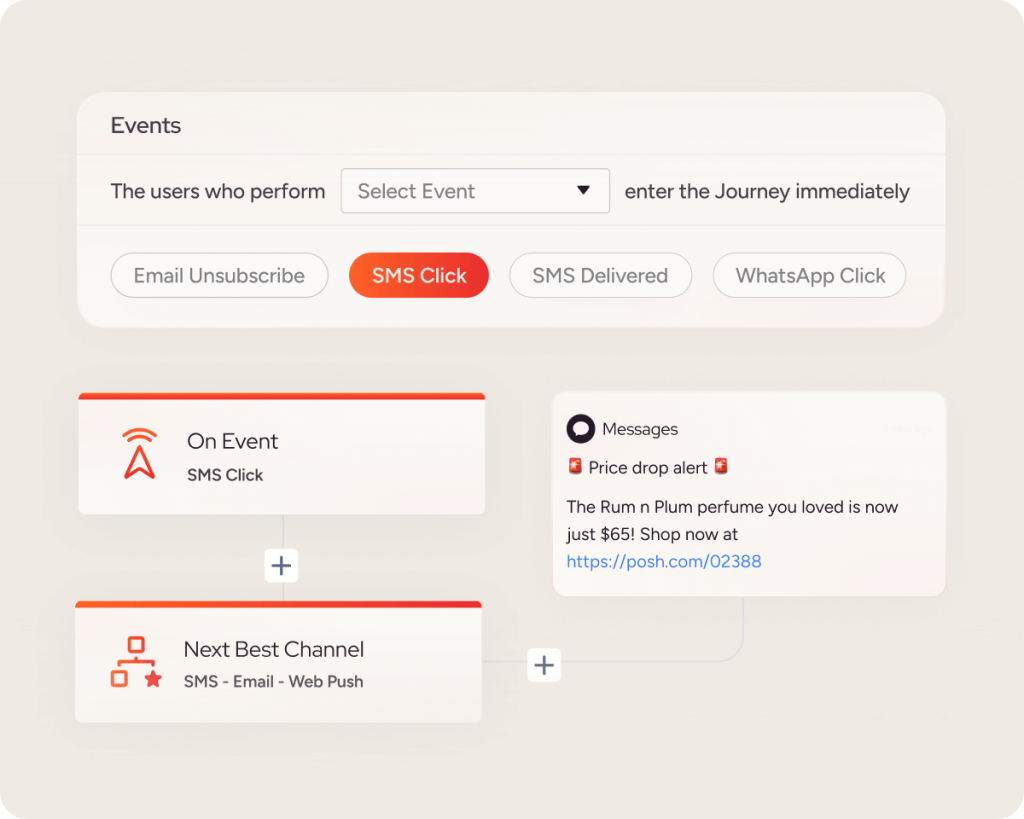
Yes, SMS marketing is effective because it reaches people quickly. Research shows open rates of around 98% and that most texts are read within minutes, which is what you want for time-sensitive prompts like cart recovery, back-in-stock, and appointment nudges. And, e-commerce benchmarks show revenue of up to $4.54 per message. But results depend on list quality, segmentation, and strict compliance with consent and opt-out requirements.
SMS engagement and open rates
SMS leads by a wide margin if engagement means immediate visibility. However, email still holds strategic weight if you’re looking for sustained interaction over time. Here are some key performance metrics to help you compare where each channel shines.
- Open rates: SMS messaging achieves 90-98% open rates, with 90% of messages read within a few minutes of delivery. This is far higher than the average email open rate of 39-55%.
- Click-through rates: SMS CTR ranges roughly 19-35% depending on industry and campaign type, significantly above email’s 2-4% average click rates.
- Response and engagement speed: Most SMS messages are read within minutes, and response rates can reach 45% or higher, whereas email engagement often unfolds over hours or longer.
- Conversion and impact: SMS marketing benchmarks show 21-40% responses leading to desired actions in some industries, while email conversion metrics tend to be lower and more variable across sectors.
Benefits of SMS marketing
SMS works because it reaches customers instantly on their lock screen, in a channel they check quickly, without needing an app or internet access.
- Immediacy: SMS or text messages appear on the lock screen and are typically read within minutes. This makes SMS especially powerful for flash sales, expiring discounts, low-stock alerts, and cart reminders. Brands can use this immediacy to prompt customers to take action while interest is still high.
- Reduced drop-offs: SMS marketing helps reduce revenue loss in everyday operational gaps. You must have seen conversions fall through during delivery delays, payment failures, missed appointments, or abandoned checkouts. A text reminder or confirmation encourages customers to complete the payment, show up on time, or finish their purchase. SMS improves both revenue stability and customer experience by closing these costly gaps.
- Stronger engagement with younger audiences: Nearly half of Gen Z (48%) check text messages more than 10 times a day, making them the most text-engaged generation. Since texting is already part of their routine, they’re more likely to opt in to brand messages and respond quickly to short, direct updates. For brands targeting Gen Z and Millennials, SMS becomes a practical way to drive participation in product drops, loyalty programs, and limited releases.
- Ubiquity: SMS doesn’t rely on Wi-Fi, mobile data, or an app. Instead, it runs through carrier networks, making delivery reliable in areas with weak or unstable internet access. That reliability is important for industries like travel, logistics, events, field services, and retail, where timing and coordination directly affect operations.
Use Cases of SMS marketing
SMS marketing delivers the most value at moments when timing directly affects outcomes. It supports customers right after they make a purchase, steps in when issues need quick resolution, and drives action when an offer won’t last long.
- Transactional updates: Transactional SMS keeps customers in the loop right about order confirmations, shipping notifications, and payment receipts. Customers are less likely to contact support when they immediately receive updates. Keep the format simple: confirm the action, share the status, and provide a tracking or support link.
- Customer support alerts: Support messages are short texts that help customers move forward without confusion. Examples include OTPs for logins, payment confirmations, transaction approvals, and alerts about important account changes. A concise message with a clear next step builds trust and reduces frustration before it escalates.
- Limited-time discount campaigns: This type of message includes a clear offer and a direct link, giving the customer a small window to decide. For example, flash sales, back-in-stock alerts, and limited-time discount codes work well as they give customers reasons to act instantly.
Ebebek, a leading Turkish maternity and baby retailer, noticed a conversion rate uplift of 40% and an ROI of 5x within just 2 months of using InsiderOne. With Insider One’s pre-built opt-in templates, you can grow your subscriber base faster by making it easier for customers to sign up across channels. Plus, Agent One™ brings together purpose-built autonomous AI experts that analyze data, make decisions, and execute actions to deliver emotionally resonant customer engagement at scale. They help create conversations that feel natural and relevant, while making smart decisions automatically in the background.
Challenges and limitations of SMS
SMS is powerful, but it also comes with constraints. The channel forces brevity, punishes overuse, and demands stricter compliance and cost planning than email.
- 160-character limit: A standard SMS is capped at 160 characters when using the GSM character set, and the limit can drop to 70 characters when messages include certain special characters or Unicode. This means you have less room to explain anything, qualify, or persuade users. That’s why it’s best to avoid vague copy or long disclaimers.
- Risk of overuse (customer fatigue): While many subscribers are okay with about one text per week, 53% will unsubscribe if they feel they’re getting too many messages. That’s why you can’t treat SMS like email blasts. It works best when each message has a clear purpose: time-sensitive updates, important reminders, or offers with real value. If you send too often, customers opt out, and you lose the channel entirely.
- Cost implications at scale: SMS becomes more expensive as you scale because you pay per message. Plus, longer texts can add to the cost as they can be split into multiple segments. In many regions, there are also carrier, registration, and compliance-related fees attached to business messaging. The lesson here is to understand where SMS delivers value before running campaigns. Transactional updates and high-intent messages justify the spend, but mass promotional blasts don’t.
Is email marketing effective?
Yes, email marketing is still highly effective. For every $1 spent on email, 35% of marketing leaders see $10-$36 in ROI, and 30% see $36-$50. Plus, it delivers an average 43.46% open rate and 2.09% click rate across industries.
Email reach and ROI
Email marketing is still one of the few channels that combines massive reach with measurable revenue impact. The numbers below show why.
- Global reach: Email is projected to reach 4.73B in 2026.
- Daily volume: An estimated 376.4B emails/day were sent in 2025, showing how deeply email is embedded in daily behavior.
- Habit and frequency: 93% of respondents say they use email every day, and 42% check their inbox 3-5 times a day.
- ROI: Email marketing generates around $36 in revenue for every $1 spent.
- Conversion performance: Behavioral emails in retail pull 37.04% opens, 25.52% CTOR, and 5.46% conversion rate.
Benefits of email marketing
Email works because it gives brands room to explain, persuade, and build a relationship over time. It’s one of the few channels where you can combine long-form content, targeting, automation, and rich creative.
- Long-form, story-driven content: Email gives you space to tell why the product exists, what problem it solves, how customers use it, and what to do next. This is especially helpful for buyers who don’t purchase on the first touch and need more context to trust you. A newsletter or product education email can carry multiple ideas in one send: a narrative, a customer example, and a clear CTA. Unlike SMS, you’re not forced into a single line and a single link.
- Segmentation and automation possibilities: Email segmentation allows you to send different messages based on what people viewed, purchased, skipped, or clicked. You can then automate follow-up emails that match those specific actions. This is where much of email’s ROI comes from. Automated emails generated 37% of email-driven sales while accounting for only 2% of total email volume. In addition, 1 in 3 clicks on automated emails led to a purchase.
- Rich media: Email allows you to include visuals like product images, GIFs, and short demo videos. These elements help readers understand your message quickly instead of relying only on text. Emails also support interactive features. With technologies like AMP for Email, recipients can take actions, like RSVPing, answering a survey, or customizing preferences, directly inside the email. Ultimately, the result is clearer communication and fewer steps between interest and action.
- Evergreen nurture campaigns: Email is well-suited for ongoing communication like weekly newsletters, onboarding sequences, reactivation emails, post-purchase education, and renewal reminders. These campaigns keep your brand visible between purchases, which is especially important in longer buying cycles. Email automation flows like welcome series and abandoned cart emails often drive a large share of automated orders, showing that lifecycle emails directly contribute to revenue.
Use cases of email marketing
Email marketing lets brands deliver context, nurture relationships over time, or bring hesitant customers back into the purchase funnel. Here’s how you can use it too.
- Product launches and detailed announcements: Email lets you carry the full story in one place, including what’s new, why it matters, and what to do next. You can include multiple sections (features, comparisons, FAQs), visuals, and links without forcing the reader to jump between pages.
- Loyalty program updates: Brands use emails to send points balance reminders, tier progress updates, reward availability, and member-only early access. Done well, these messages nudge the next purchase without needing heavy discounts.
- Cart abandonment recovery campaigns: Cart abandonment is one of the proven use cases for email because it targets users with clear intent. Email works here because you can show the exact items left behind, address common friction (shipping, returns, payment options), and bring the shopper straight back to checkout.
Slazenger, a global sports brand, achieved a 49x ROI in just eight weeks and recovered a significant share of lost revenue through cross-channel campaigns.
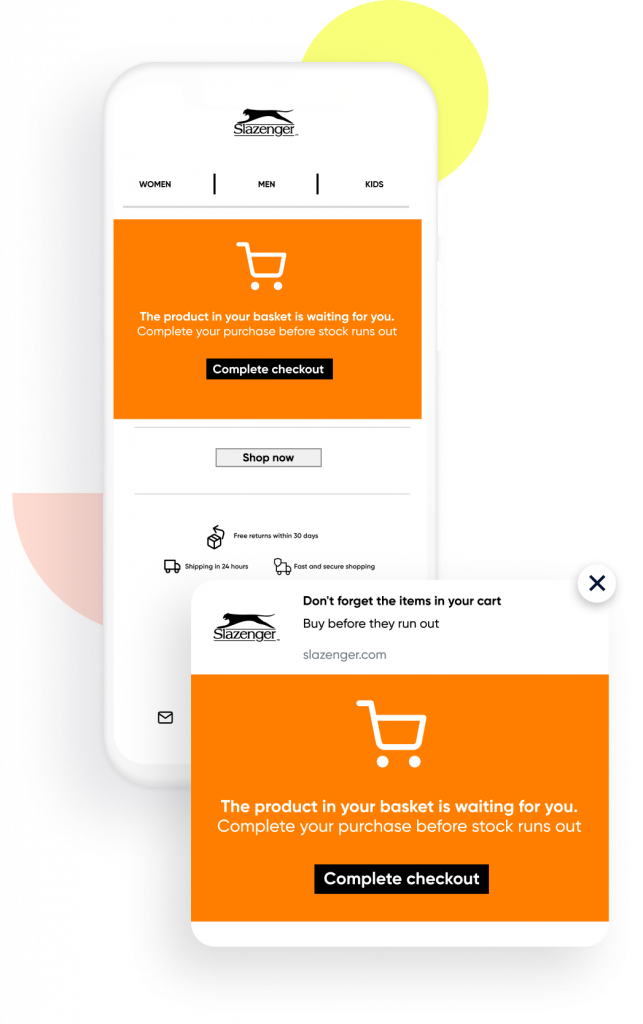
They used Insider One’s automation tools, including advanced segmentation and Architect, to personalize cart abandonment email sequences and automate follow-ups. This shows how you can use behaviour-triggered emails to turn hesitation into conversions while boosting engagement and long-term customer loyalty.
Challenges and limitations of email marketing
Email comes with predictable friction points. Compared to SMS, it’s easier to miss, easier to filter, and slower to drive immediate action.
- Lower open rates than SMS: Email doesn’t get the same instant visibility that SMS does. Average email open rates sit around the low-40% range in 2025 benchmarks, while SMS is often benchmarked at 98% opens. Email still converts well, but it usually needs stronger subject lines, better targeting, and repeated touches to match SMS-level immediacy.
- Spam/junk folder risks: A meaningful chunk of email never reaches the primary inbox. Recent benchmarks show that, on average, only about 87% of emails land in the inbox, while roughly 7% are filtered into spam and another 6% fail to reach recipients altogether. This is why you must focus on list hygiene, authentication, complaint rates, and engagement signals.
- Longer response times: While SMS tends to get responses quickly, email isn’t usually a real-time channel for most people. A common customer-service benchmark is that a good email response time is under 12 hours, with faster replies being ideal for support. In contrast, 77% of SMS messages receive a response within 10 minutes.
- Content saturation and inbox fatigue: 70% of consumers unsubscribed from at least three brands in the last three months due to message overload, and 37% said email is the most annoying channel when overwhelmed. This means email can backfire if you increase the sending frequency without monitoring how people are engaging.
The Verdict: SMS vs. Email Marketing: What’s the Right Choice?
SMS and email solve different problems in the conversion journey. The right choice depends on timing, intent, audience, and cost tolerance. SMS works well when you want to drive urgency and prompt users to take action. In contrast, email builds trust and persuades users over time.
SMS vs. email Marketing: Comparative effectiveness at a glance
Here’s how the two channels stack up on key metrics.
| Metric | SMS marketing | Email marketing |
| Open rate | 90-98% | 39-55% |
| Click-through rate | 19-35% | 2-4% |
| Response speed | Minutes (often <10 min) | Hours or longer |
| Conversion rate | 21-40% (in high-intent use cases) | 3-6% (stronger in automated flows) |
| Cost structure | Paid per message | Low cost per send |
| ROI benchmarks | Up to $4.54 revenue per message | $36 revenue per $1 spent |
When to use SMS
Use SMS when timing matters more than explanation. For example:
- Time-sensitive offers: Flash sales, expiring discounts, low-stock alerts, and back-in-stock notifications perform best via SMS.
- Transactional updates: Order confirmations, delivery alerts, payment reminders, and appointment confirmations reduce support tickets and prevent revenue loss.
- Local or regional marketing: SMS works well for store-specific offers, event reminders, and geo-targeted campaigns.
- Younger demographic targeting: Use it for drops, limited releases, and loyalty nudges with Gen Z or Millennials.
When to use email
Emails are best for providing customers with clarity and context. Here’s when to use it:
- Nurture campaigns and education: Welcome sequences, onboarding emails, educational content, and product tutorials work better in email because you have space to explain.
- Personalized offers: Send behavior-triggered emails based on what people viewed, bought, or ignored.
- Product launches and upselling: You can send email sequences for building anticipation for new products. For example, post-purchase emails can introduce complementary products and increase average order value.
- Long-form storytelling: Email is the right channel if you want to explain benefits, compare products, share testimonials, or build brand authority as well.
Why it’s not SMS vs. email
Most customers don’t stick to one channel. They bounce between inbox and phone screen based on timing and intent. That’s why the best-performing programs treat SMS and email as one coordinated system.
- Use both channels to lift engagement and conversion: SMS complements email by catching users when they’re not willing to read a longer message. A study shows that customers who received both SMS and email had a 126.9% higher conversion rate than those who received email only.
- Create a simple launch flow using email and SMS: Start with an email to introduce the product. Use it to explain what’s new, highlight key benefits, answer common questions, and include visuals. This builds awareness and gives customers the full picture. Then send a short SMS to people who didn’t click or buy. Keep it focused and time-sensitive to move customers from interest to action.
Insider One’s Architect is a journey orchestration capability that connects email, SMS, WhatsApp, push, and more into one coordinated flow, so messages stay consistent and connected across channels. It also supports practical experimentation, like sending part of an audience down an email path and part down an SMS path to learn which performs better for a given use case.
For brands, this matters because the win isn’t “more messages.” It’s better-timed messages across channels, with consistent targeting and measurement.
Insider One’s Architect helps brands design data-driven journeys across 12+ channels, including email, SMS, WhatsApp, push, web, and app, in one coordinated orchestration layer. Instead of sending isolated messages, you can guide customers through a structured sequence where each touchpoint builds on the last. Architect also lets teams test different channel paths for the same goal, such as sending one segment an email follow-up and another an SMS reminder, and then use performance data to pick the winning journey.
SMS vs. email marketing: Make the right choice with Insider One
SMS and email both perform best in different moments. SMS wins when timing matters, like reminders, last-chance offers, and urgent nudges. Email wins when context matters, like education, product storytelling, and lifecycle nurturing. The highest-converting programs coordinate both, because customers naturally move between inbox and phone screen.
Insider One helps enterprises do that from one place. It brings journey orchestration and reporting across channels so teams can design connected flows, like a launch email first, then an SMS follow-up to non-clickers to add urgency, without turning it into two separate campaigns.
Ready to maximize conversions across SMS and email? Sign up for a demo and see for yourself.
FAQs
SMS is generally more effective for immediate conversions because it has higher open rates and faster response times. Email, however, drives strong long-term revenue through automation and lifecycle campaigns. In short, SMS performs best for urgency-driven actions, while email performs better for nurturing and considered purchases.
Industries that rely on time-sensitive communication benefit the most from SMS marketing. This includes e-commerce (flash sales and cart recovery), retail (in-store promotions), travel and logistics (delivery updates), healthcare (appointment reminders), and financial services (transaction alerts and OTPs).
Most benchmarks suggest sending SMS sparingly, often around once per week, because overuse leads to opt-outs. Email can typically be sent more frequently, such as weekly or even multiple times per week, depending on engagement levels and list quality. The key is monitoring unsubscribe rates and engagement metrics rather than following a fixed rule.
Yes, SMS and email marketing work best when used together. Email can introduce and explain an offer, while SMS can follow up with a short reminder to drive urgency. Customers often engage with both channels, and coordinated campaigns tend to outperform single-channel efforts.

Keep Reading
4 min.

Chris Baldwin
3 Feb 2026
9 min

Muharrem
23 Dec 2025
7 min.
Chris Baldwin
8 Jul 2024