

 Platform Overview

 Integration Hub

 Agent One™

 Agent One Teams™

 Customer Data Management

 Personalization

 Journey Orchestration

 Reporting & Data

 Behavioral Analytics

 Web
Web

 Email
Email

 Site Search

 Conversational CX

 WhatsApp

 Web Push

 InStory

 App
App

 SMS & RCS

 Join the $0 Migration Movement™

 The Insider One Difference

 Compare Vendors

 Switch to Insider One

 Success Story

 Retail & Ecommerce

 Financial Services

 Travel & Hospitality

 Beauty & Cosmetics

 Automotive

 Telecommunications

 Total Economic Impact™ Study

 Blog
Blog

 E-Books & Guides

 Events

 Glossary
RCS Campaigns That Drive Real Engagement, Not Just Open Rates

Updated on 11 May 2026
9 min.
Table of Contents
- Why RCS engagement leaves SMS and email behind
- The RCS campaign types that move the needle at each lifecycle stage
- Building a personalized RCS campaign with unified customer data
- Orchestrating RCS alongside email, SMS, and push without channel chaos
- Measuring RCS campaign performance and iterating fast
- FAQs
Most Popular

Summary
| RCS outperforms SMS and email in engagement due to verified senders, rich media, and read receipts. It works best when mapped to lifecycle triggers (not used as a simple SMS replacement), with formats like cards and carousels tied to specific customer journeys. Interaction data from RCS can improve segmentation and next-best-action decisions, unlike SMS. Personalization depends on real-time behavioral data rather than static segments, and success relies heavily on smart orchestration across RCS and SMS channels. |
By the time brands start evaluating RCS, the acronym itself is rarely the real obstacle. The harder gap is a campaign-stage playbook: which message format belongs at which lifecycle triggers, how interaction data flows back into segmentation, and how to run RCS, SMS, email, and push without creating coordination debt. This piece is built around those questions.
The business case for rich communication services is already closing. Brands running live RCS pilots are not debating the channel’s potential; they are asking how to structure it so that read-receipt data, carousel taps, and reply signals feed into the same behavioral logic that governs the rest of their customer journeys. That is a cross-channel orchestration problem, and it is the lens through which the rest of this article is framed.
Why RCS engagement leaves SMS and email behind
What is actually driving the numbers
RCS business messaging outperforms SMS and email on engagement for structural reasons, and here is why.
First, RCS messages arrive from verified sender identities with a brand logo and checkmark, which reduces the friction of deciding whether to open a message, a hesitation that haunts SMS short codes.
Second, rich media elements, including product carousels, high-resolution images, and action buttons, give recipients something to interact with inside the message thread rather than forcing them to a browser.
Third, Android’s native Messages app renders RCS without requiring a third-party app download, which means reach is not limited to subscribers who have opted into a separate inbox experience.
How engagement differs from other channels
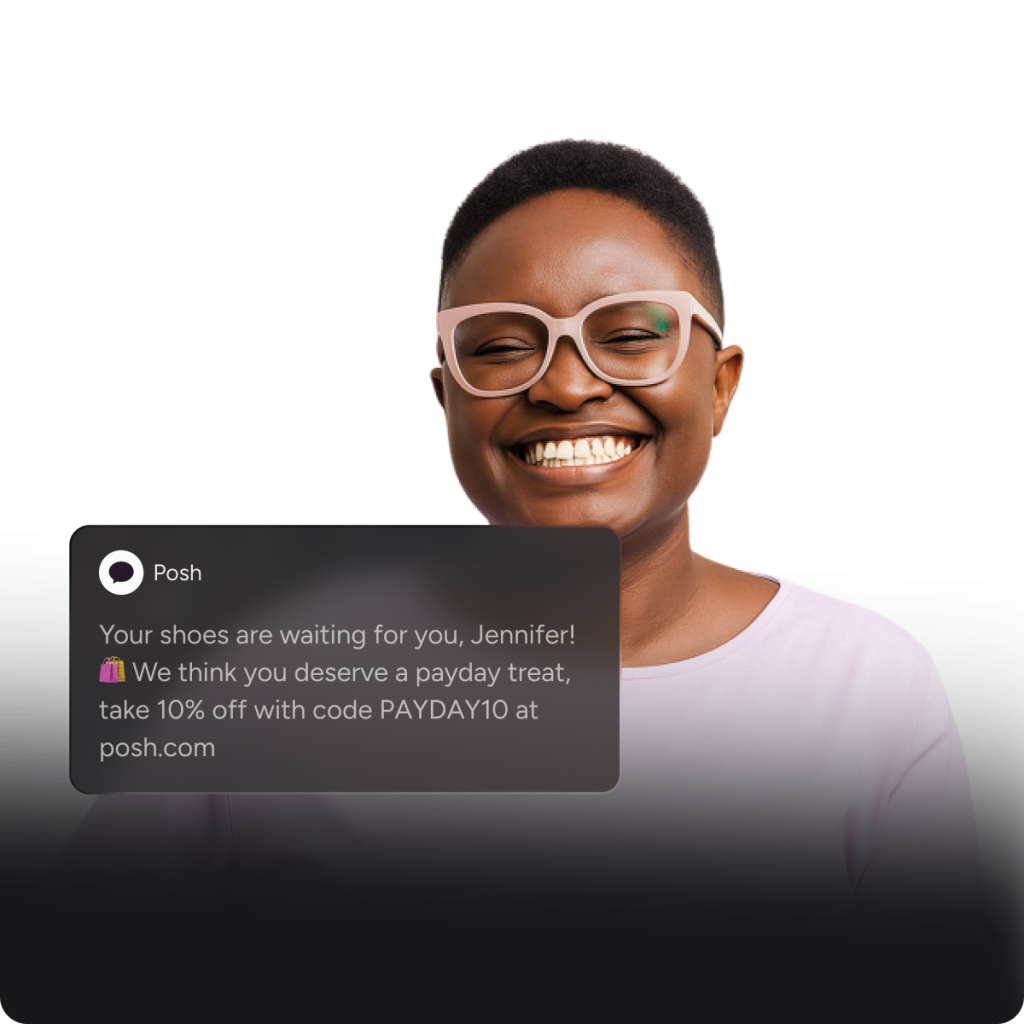
Engagement differences between RCS and other channels are structural, not incidental. The read-receipt signal closes a measurement gap that email has never solved cleanly. You know not just that a message was delivered, but that a specific customer read it, and if they did not act, when to follow up through a different channel. That feedback loop is absent from both SMS and most email environments, which makes RCS uniquely valuable for journey orchestration decisions rather than just individual campaign sends.
What engagement metrics do not tell you
Engagement metrics measure attention, not revenue. The reason RCS campaigns convert at a higher rate than SMS is not simply that more people open them. The format allows a complete purchase action, a loyalty redemption, or a re-engagement decision to happen inside the message thread itself, compressing the path from awareness to conversion in a way that a plain text link cannot replicate.
The RCS campaign types that move the needle at each lifecycle stage
Onboarding to create first impressions that reduce drop-off
An onboarding RCS message sent within the first 24 hours post sign-up or first purchase does different work than a welcome email. The format supports a structured onboarding card with action buttons, such as setting preferences, browsing categories, or activating a loyalty account, that a customer can complete in two taps without leaving the thread.
Suggested replies, which are pre-populated response chips, reduce the decision cost further. This matters in a window when intent is high, but the customer has not yet formed a habit. Instead of delaying the communication for a 24 or 48-hours batch send, align this format with the immediate moment of sign-up confirmation or order acknowledgment.
Browse abandonment and cart recovery: where carousels earn their place
For browse abandonment and cart recovery, the carousel format that RCS offers is a native advantage compared to other channels. For instance, a customer who browsed three pairs of running shoes without adding to cart receives a scrollable carousel inside their message thread showing the same three products with current price, availability, and a single-tap “Add to cart” button. This collapses the number of steps between the recovery message and a completed purchase from five or six down to two.
The important detail is that carousel content must pull from live browsing data, not from a category-level fallback. A carousel surfacing the wrong products performs worse than a plain text message, because the mismatch signals that the brand is not paying attention.
Loyalty and re-engagement: when suggested replies become behavioral signals
Re-engagement campaigns in RCS also tend to outperform their email equivalents because they generate a response signal rather than just a click. A message offering a loyalty member the choice between a discount on a future order and free shipping on the next purchase, delivered as two suggested reply chips, reveals which incentive type motivates that specific customer based on what they tap, even if they do not convert immediately.
That response data updates the customer’s profile and changes the logic for every subsequent message across every channel. SMS sends a link. RCS starts a conversation that improves your segmentation over time.
Building a personalized RCS campaign with unified customer data
Why static segments produce mediocre RCS campaigns
The most common mistake teams make when piloting RCS is treating it as a better SMS by writing the message in a customer relationship management (CRM) export spreadsheet and sending it to a list. That approach wastes the format’s personalization capability and often delivers a generic message inside a visually rich wrapper, which erodes trust faster than a plain text SMS would.
Effective RCS personalization requires that message content, including which product appears in the carousel, which offer appears in the rich card, and which suggested replies are shown, is resolved at send time from a live customer profile, not at list-build time from a static segment.
How live behavioral data powers dynamic RCS content
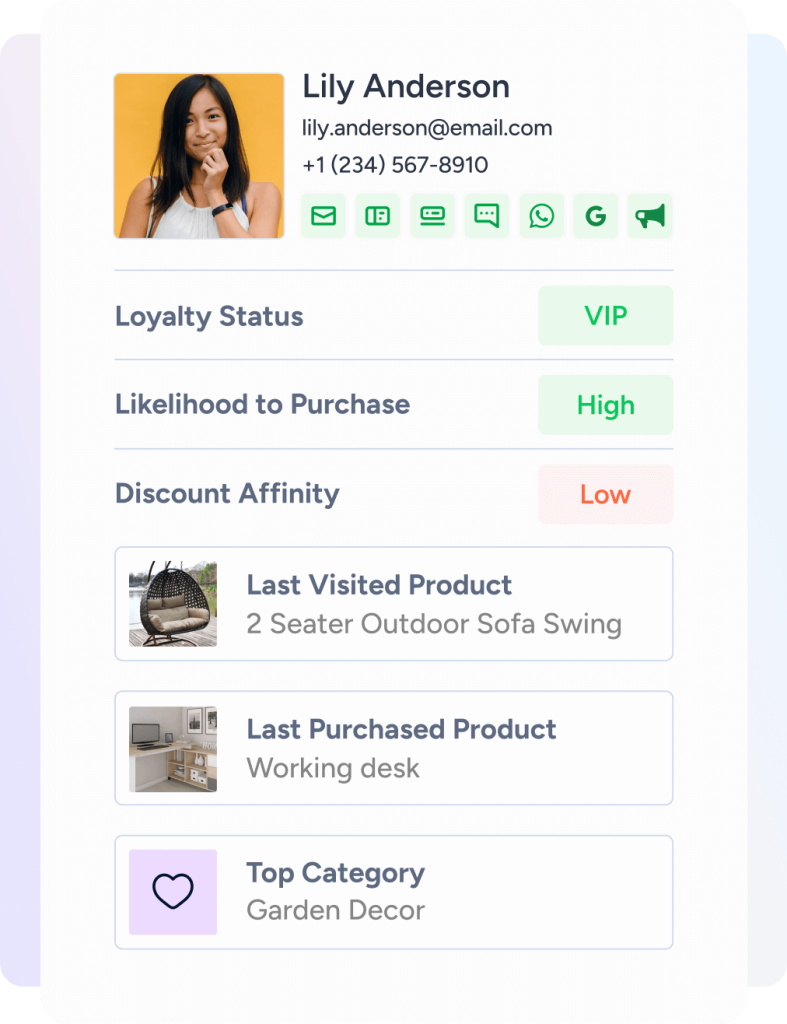
This is where the connection to a unified data layer becomes practical rather than theoretical. Insider One’s Customer Data Management capability consolidates purchase history, browsing behavior, channel preference, and lifecycle stage into a single profile that message content can draw from at the moment of send.
A customer who spent time browsing a specific product category recently, holds a loyalty tier that qualifies them for an exclusive offer, and has historically engaged with messages on Tuesday mornings gets a different carousel, a different call-to-action label, and a different send time than a first-time visitor in the same promotional segment. That degree of resolution is what separates an RCS campaign that outperforms from one that merely does not underperform.
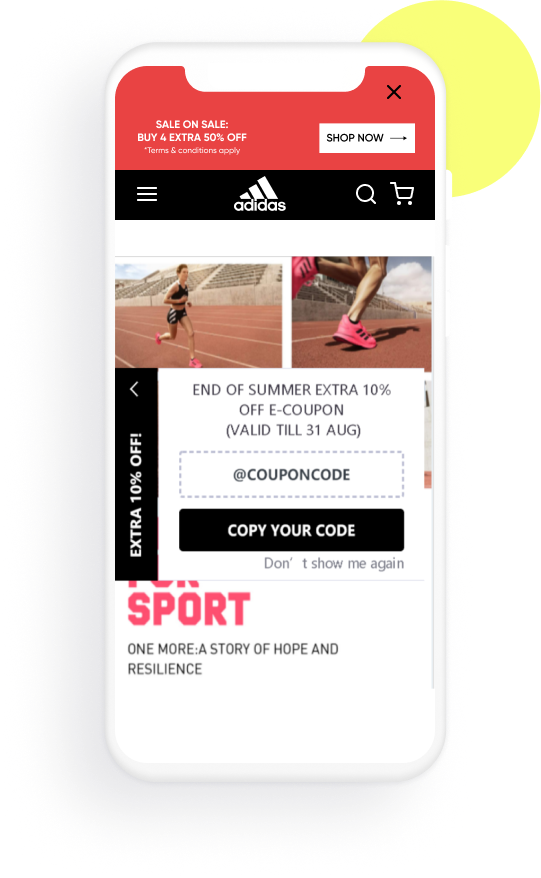
Adidas achieved a 259% increase in average order value and a 13% uplift in conversion rate in a single month by running Insider One’s personalization layer across their customer lifecycle, the same behavioral profile logic that enables dynamic RCS content at scale.
Orchestrating RCS alongside email, SMS, and push without channel chaos
A practical channel decision framework
The question of whether RCS should lead a journey, follow it, or fall back is not a matter of preference. It is a function of three variables:
- Device reachability – is this customer’s device RCS-enabled?
- Message urgency – does a time-sensitive offer need the reliability of SMS delivery?
- Message complexity – does this communication benefit from rich media, or is a single sentence enough?
A post-purchase confirmation requires nothing more than a clear SMS or push notification. A loyalty anniversary offer with a personalized reward selection is exactly the scenario where RCS earns a first-touchpoint role. Treating these decisions as part of the journey design rather than as ad-hoc execution choices is what prevents coordination debt from accumulating across channels.
SMS fallback and real-time capability detection
SMS fallback configuration is non-negotiable for any brand with a broad audience. A significant share of your customer base may be on iOS devices or older Android hardware that does not yet support RCS natively. Journey logic should detect RCS capability at the point of send and deliver an appropriately formatted message, rather than silently failing to reach the customer at all.
It is also crucial that if a customer’s device gains RCS capability during a messaging campaign, the orchestration layer automatically detects this change. Subsequent messages should then be delivered in the richer RCS format, eliminating the need for any manual re-segmentation of the audience. Insider One’s journey orchestration layer handles this channel-switching logic as part of the journey design, so the customer experience updates in real time rather than at the next campaign cycle.
MadeiraMadeira achieved significant return on investment using Architect, Insider One’s journey builder, to orchestrate personalized cross-channel flows. That result reflects the compounding value of treating channel logic as an integrated decision rather than a siloed execution.
Measuring RCS campaign performance and iterating fast
The metrics that matter beyond open rate
Read rate is a useful baseline signal, but it is not a performance metric on its own. The measurements that tell you whether an RCS campaign is working are further downstream: carousel interaction depth (which slide did the customer stop on, and did they tap from it?), call-to-action tap-through rate broken down by message variant, reply rate by segment for campaigns using suggested replies, and downstream conversion attribution tied back to specific RCS touchpoints in the journey.
These metrics exist because RCS is an interactive channel. The format generates interaction data that email and SMS do not produce. If your reporting stack is not capturing them, you are measuring RCS like SMS and losing most of its analytical value.
A 30-day testing cycle that builds learning quickly
The fastest way to develop RCS campaign competency is to run structured tests in the first 30 days rather than optimizing for volume. In weeks one and two, A/B test a rich card format against a text-only fallback on the same segment to establish a baseline lift figure. In weeks three and four, test two variations of suggested reply copy against each other in a re-engagement campaign, not to find a winner for that send, but to build a dataset of which incentive framing resonates with which behavioral segment.
Use engagement-window data from the first month to adjust send-time logic. If read rates are consistently higher for a given cohort in a particular morning window, that preference should be codified in the journey rather than replicated manually each campaign cycle.
For deeper context on building cross-channel re-engagement flows that RCS can anchor, check out the complete guide to cross-channel campaign management that covers the orchestration layer in full. The RCS messaging overview provides format-level detail on delivery configuration and carrier network specifics.
If you want to see how Insider One’s Architect and Customer Data Management turn live customer data into coordinated, revenue-driving experiences, book a personalized demo to see the exact use cases, decision logic, and growth levers most relevant to your team.
FAQs
RCS runs alongside SMS as a richer format for capable devices. SMS remains the fallback for customers on unsupported devices or networks, and any well-configured RCS campaign should include automated SMS fallback logic so no recipient is silently dropped from the journey.
Device reachability signals are detectable at the point of send through most enterprise messaging platforms, including Insider One’s. Journey orchestration that queries RCS capability in real time and routes accordingly is more reliable than pre-segmenting by device type from a customer relationship management (CRM) export, which becomes outdated quickly as hardware and operating system upgrades occur.
For teams running their first RCS pilot, a single rich card with a clear call to action and one suggested reply outperforms a complex carousel on test audiences unfamiliar with the format. Complexity scales well once you have established baseline engagement benchmarks; the first send should prioritize learning over feature demonstration.
When RCS is delivered through a platform with a unified data layer, read receipts, tap events, and reply selections update the customer’s behavioral profile immediately. Those updates can trigger next-best-action logic in adjacent channels. For example, a carousel tap that does not convert can trigger a follow-up email with the same product recommendation surfaced at a different time. This is the cross-channel loop that makes RCS strategically valuable beyond its standalone engagement metrics.

Keep Reading
7 min.

Muharrem Derinkok
4 Jun 2026
11 min.

Chris Baldwin
2 Jun 2026
4 min.
Chris Baldwin
3 Feb 2026