

 Platform Overview


 Integration Hub


 Agent One™


 Agent One™ Teams


 Customer Data Management


 Personalization


 Journey Orchestration


 Reporting & Data


 Behavioral Analytics


 Web


 Email


 Site Search


 Conversational CX


 WhatsApp


 Web Push


 InStory


 App


 SMS & RCS


 Join the $0 Migration Movement™


 The Insider One Difference


 Compare Vendors


 Switch to Insider One


 Success Story


 Retail & Ecommerce


 Financial Services


 Travel & Hospitality


 Beauty & Cosmetics


 Automotive


 Telecommunications


 Total Economic Impact™ Study


 Blog


 E-Books & Guides


 Events


 Glossary
Hande Cilingir Challenges 7 AI Myths at The One Summit in New York

Updated on 28 Oct 2026
8 mins.
Table of Contents
- 1. Myth: AI will make marketing teams unnecessary
- 2. Myth: AI is just another marketing channel
- 3. Myth: The best customer experience is the most automated one
- 4. Myth: AI will make brands irrelevant
- 5. Myth: The best AI model guarantees a competitive advantage
- 6. Myth: AI automatically makes personalization better
- 7. Myth: Predicting customer behavior is enough
- What these AI myths mean for marketing and retail leaders
- How Insider One helps businesses turn AI into action
Most Popular
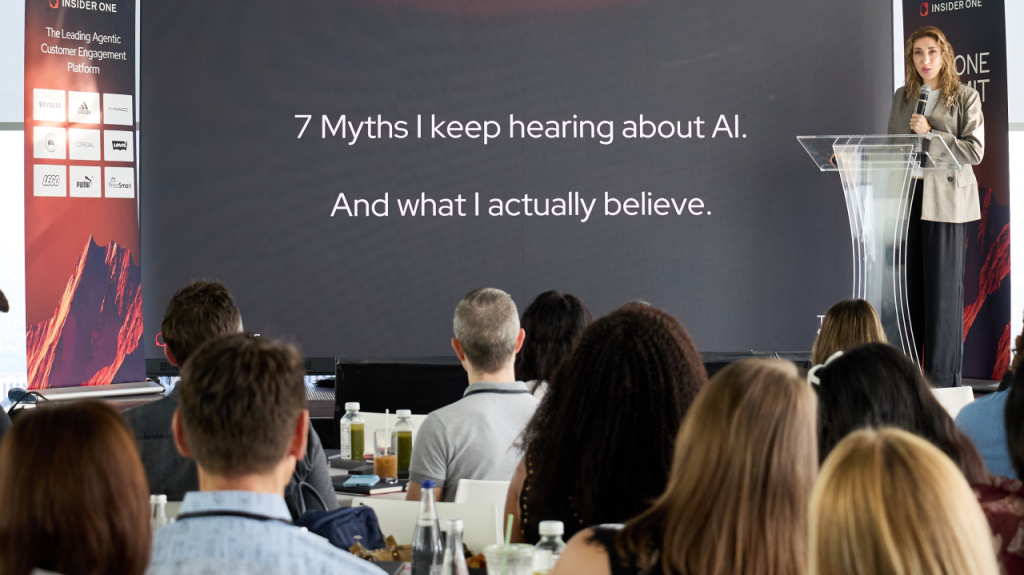
Artificial intelligence is changing how brands engage customers, make marketing decisions, and compete in retail. However, as AI adoption accelerates, some of the assumptions guiding businesses may be holding them back.
At The One Summit in New York, Hande Cilingir, Co-Founder and CEO of Insider One, challenged seven widely held beliefs about artificial intelligence and its impact on marketing and retail. She discussed why access to AI tools alone does not guarantee a competitive advantage and why customer understanding, sound judgment, and intelligent decision-making will become increasingly important.
During a discussion with Ryan Watson from Snowflake, Cilingir explored what separates AI experimentation from measurable retail impact. The event also featured Anupama Tripathy sharing The Vitamin Shoppe’s migration journey, highlighting the importance of technology architecture, organizational alignment, and choosing the right technology partner to achieve business outcomes.
Across these discussions, one theme stood out: access to AI is becoming widespread, but the ability to translate intelligence into better decisions and meaningful customer experiences remains a differentiator.
Here are seven AI myths Cilingir challenged and what her perspective means for marketing and retail leaders.
1. Myth: AI will make marketing teams unnecessary
AI can now support activities that once required significant manual effort, including content creation, audience segmentation, campaign execution, and performance analysis. This has led to questions about whether marketers will eventually become less important.
Cilingir challenged this assumption, explaining that AI will expand marketing capabilities rather than eliminate the need for human judgment.
As AI makes execution faster and more accessible, the ability to determine what is worth creating becomes increasingly important. When businesses have access to similar tools, producing more content alone is unlikely to differentiate a brand.
Cilingir emphasized that marketers should use AI to amplify their expertise rather than remove themselves from the process. Human creativity, strategic thinking, and an understanding of customer needs will continue to shape the decisions that intelligent systems execute.
For marketing teams, the opportunity lies in combining human judgment with AI-powered execution. This allows marketers to focus on business priorities and customer relationships while reducing repetitive work.
2. Myth: AI is just another marketing channel
Businesses have historically responded to changes in customer behavior by adding new channels to their marketing mix. Cilingir argued that AI represents a more fundamental shift.
AI is changing how customers discover products, evaluate alternatives, and make purchasing decisions. Instead of moving between multiple websites and search results, consumers can increasingly use AI-powered conversations to explore options and receive recommendations.
According to Cilingir, this changes the question marketers need to ask. Rather than simply deciding where AI fits into an existing channel strategy, businesses must consider how their brands will remain visible and relevant when AI becomes part of the buying process.
Retailers need to connect customer experiences across websites, mobile apps, email, messaging, and emerging AI interfaces. A well-planned cross-channel marketing strategy can help businesses coordinate these interactions as customer journeys evolve.
The opportunity is to treat AI as a new way customers discover and interact with brands, rather than another channel operating independently from the rest of the customer experience.
3. Myth: The best customer experience is the most automated one
AI enables businesses to automate more customer interactions than ever before. However, Cilingir challenged the assumption that every interaction should be automated simply because the technology makes it possible.
She highlighted the importance of understanding when automation improves the customer experience and when human attention creates greater value.
For example, a customer checking an order status may value a quick automated response. Someone dealing with a serious complaint or making a high-consideration purchase may need human support, empathy, or additional guidance.
Cilingir’s perspective is that effective customer engagement requires businesses to recognize these differences. The objective should not be to automate every interaction, but to determine the most appropriate response for each situation.
This requires clear workflows, access to relevant customer information, and appropriate guardrails for AI-driven interactions.
Through customer journey orchestration, businesses can coordinate interactions across channels and adapt customer journeys based on behavior and engagement. This helps brands balance the speed of automation with human assistance when it matters most.
4. Myth: AI will make brands irrelevant
As AI makes it easier for customers to compare prices, product features, and reviews, some businesses may question whether brand differentiation will become less important.
Cilingir argued that the opposite can happen. While AI can make product information easier to compare, it cannot replace everything that makes a brand meaningful to customers.
Brand identity, trust, emotional connection, service quality, and the overall shopping experience all influence purchasing decisions. Two products may offer similar features, but customers can still prefer one brand because of what it represents and the experiences associated with it.
Cilingir also highlighted how retail is evolving rather than disappearing. Physical stores, digital channels, and AI-assisted discovery are becoming interconnected parts of the customer journey.
For retailers, this means continuing to invest in the experiences and relationships that distinguish them from competitors. Consistent communication, relevant recommendations, reliable service, and a recognizable brand identity remain important even as purchasing behavior changes.
Technology will continue to evolve, but businesses still need to give customers compelling reasons to choose and remain loyal to their brands.
5. Myth: The best AI model guarantees a competitive advantage
With businesses closely following developments in AI models, Cilingir questioned whether access to the most advanced model is enough to establish a lasting competitive advantage.
She acknowledged the importance of model capabilities but emphasized that the surrounding system matters just as much. This includes the customer information available to AI, the workflows it can access, the actions it can take, and the relationships businesses have developed with their customers.
A model may generate an effective marketing message, for example, but that message will not necessarily be relevant without an understanding of the customer’s preferences, recent behavior, and relationship with the brand.
Cilingir highlighted customer understanding as an important source of differentiation. Businesses need to know more than a customer’s basic attributes. They need to understand how individuals shop, which channels they engage with, and what influences their decisions.
A strong customer data management foundation helps businesses connect customer information and make it more useful across marketing activities.
As AI capabilities become more widely accessible, the ability to combine intelligence with proprietary customer context and connected workflows can become an important competitive advantage.
6. Myth: AI automatically makes personalization better
AI makes it easier to generate large volumes of content and tailor campaigns to different audiences. However, Cilingir challenged the assumption that greater access to AI automatically makes personalization more effective.
She explained that personalization based on basic customer attributes or historical purchases can quickly become generic when every brand can produce similar variations.
For Cilingir, effective personalization requires understanding what a customer needs at a particular moment rather than relying only on what a business already knows about them.
Consider a customer who purchased running shoes six months ago. That information provides a useful starting point, but recent browsing behavior, rejected product options, and immediate delivery requirements can provide a much richer understanding of the customer’s current needs.
This distinction matters because relevant personalization depends on interpreting customer signals in context and responding appropriately.
Through AI-powered personalization, businesses can use customer data and behavioral insights to create more relevant experiences across engagement channels.
The goal is not to produce more variations of the same message. It is to understand which interaction is most useful for each customer and when that interaction should happen.
7. Myth: Predicting customer behavior is enough
Predictive analytics has helped marketers estimate which customers are likely to purchase, respond to a campaign, or stop engaging with a brand. Cilingir challenged the assumption that making these predictions is the ultimate objective of AI.
She explained that knowing what a customer is likely to do does not automatically determine what a business should do next.
For example, a customer who is already highly likely to purchase may not need a discount. Offering an incentive could reduce margins without generating an additional sale.
The more important question is which action is most likely to create value for both the customer and the business.
Cilingir highlighted the shift from predicting behavior toward making decisions and taking action. This requires AI systems to consider customer signals, business objectives, and the potential consequences of different actions.
AI-driven decisioning for customer engagement can help businesses move beyond predictions and use customer intelligence to guide engagement decisions.
For marketing leaders, this means evaluating AI not only by its ability to forecast behavior, but also by how effectively it helps determine the next-best action and improves business outcomes.
What these AI myths mean for marketing and retail leaders
Across the seven myths, Cilingir highlighted a consistent theme: as AI tools become more accessible, customer context, judgment, and the quality of decisions become increasingly important.
AI can make content production faster, improve predictive capabilities, and help businesses automate marketing execution. However, these capabilities do not automatically provide a deeper understanding of customers or guarantee better outcomes.
For marketing and retail leaders, Cilingir’s perspective points to three important priorities.
Understand customers in context. Connecting customer data with behavioral insights helps businesses understand what individuals need at different stages of their journeys.
Focus on decision quality. Businesses should use AI to determine which actions are most likely to create value, rather than simply automating existing processes or producing more content.
Build the right foundation for execution. AI needs to work within connected data systems, appropriate workflows, and clear business objectives to translate insights into measurable outcomes.
The discussions at The One Summit also highlighted the importance of technology architecture and organizational alignment. Anupama Tripathy’s presentation on The Vitamin Shoppe’s migration journey demonstrated why successful transformation involves more than adopting new technology. Businesses need the right foundation, aligned teams, and a technology partner capable of supporting their objectives.
Ultimately, Cilingir’s perspective is that AI will continue to change how marketing operates, but businesses must remain focused on understanding customers and making better decisions.
How Insider One helps businesses turn AI into action
Insider One brings together customer data, personalization, journey orchestration, and AI-powered capabilities to help businesses deliver relevant customer experiences across channels.
By connecting customer insights with marketing execution, businesses can better understand customer needs, coordinate engagement, and make informed decisions about what to communicate and when.
This approach supports a move beyond isolated AI experiments toward connected customer engagement aligned with measurable business objectives.
The ideas Cilingir shared at The One Summit reinforce an important consideration for businesses investing in AI: technology creates greater value when organizations can turn intelligence into the right action and measure its impact on customer and business outcomes.
As AI adoption continues to expand, brands have an opportunity to build more connected customer engagement strategies that support stronger relationships, improved experiences, and long-term growth.
See how Insider One can support your AI strategy
Request a demo: Discuss your business goals with the Insider One team and explore how AI-powered customer engagement can support your marketing objectives. Request a demo.
Explore the platform: Take a guided look at Insider One’s platform and discover its capabilities for personalization, customer journey orchestration, and AI-powered engagement. Take a platform tour.

Keep Reading
4 min.

Chris Baldwin
3 Feb 2026
10 min.
Chris Baldwin
28 Oct 2026
10 mins.

Nicolas Algoedt
28 Oct 2026