

 Platform Overview

 Integration Hub

 Agent One™

 Agent One™ Teams

 Customer Data Management

 Personalization

 Journey Orchestration

 Reporting & Data

 Behavioral Analytics

 Web
Web

 Email
Email

 Site Search

 Conversational CX

 WhatsApp

 Web Push

 InStory

 App
App

 SMS & RCS

 Join the $0 Migration Movement™

 The Insider One Difference

 Compare Vendors

 Switch to Insider One

 Success Story

 Retail & Ecommerce

 Financial Services

 Travel & Hospitality

 Beauty & Cosmetics

 Automotive

 Telecommunications

 Total Economic Impact™ Study

 Blog
Blog

 E-Books & Guides

 Events

 Glossary
Gamification in Customer Engagement: Benefits and Risks

Updated on 5 Oct 2026
15 min.
Table of Contents
Most Popular
Summary
- Gamification works when it rewards meaningful actions like purchases, referrals, reviews, and profile completion.
- Match mechanics to customer motivation, brand values, and measurable goals.
- Poor design can cause reward fatigue, abuse, and vanity metrics.
- Use tiers for premium brands, challenges for time-sensitive pushes, leaderboards for competitive categories, and progress loops for data capture.
- Keep points, badges, and rewards consistent across channels to maintain trust.
- Skip gamification when it feels inappropriate, stressful, or cannot be tied to revenue.
Leaderboards that do not build loyalty. Points programmes that feel hollow. Badges nobody wants.
Bolted on as standalone gimmicks, these produce a spike in activity that collapses once the novelty fades. That points fatigue is one of the main reasons traditional loyalty programmes lose momentum.
This guide is for retention, lifecycle and customer experience leaders deciding whether to gamify, which mechanic fits their audience, and how to tell early whether it is working.
It covers what drives success, the warning signs of a programme going wrong, a six-step implementation sequence, and a framework for when to leave gamification alone.
What is gamification in customer engagement?
Gamification applies game-design elements and psychological triggers, such as achievement, competition and progression, inside a non-game environment to drive specific customer behaviours.
Traditional loyalty programmes are transactional and backward-looking: they reward what you already spent. Gamification is behavioural and proactive, encouraging what the customer is doing right now.
The core mechanics:
- Progress loops. Visualising a journey, such as “70% profile complete”, to trigger the endowed progress effect, where people are more likely to finish something they have already started.
- Social proof and leaderboards. Tapping status and social influence, which works best in fitness, beauty and community-driven retail.
- Challenges and streaks. Rewarding consistency rather than transaction volume, which lifts daily active usage.
- Instant feedback. Micro-rewards such as badges or animations that reinforce a behaviour at the moment it happens.
What the mechanics look like together
Picture a shopper with a premium skincare brand. A tracker on their profile shows they are 85% of the way to VIP status, so they add their skin type and birthday to close the gap, which is valuable zero-party data volunteered rather than inferred. A seven-day streak encourages a daily app visit for a skincare tip, and a badge lands on day four. A photo review triggers an immediate on-screen reward and a contributor badge, which produces user-generated content that becomes social proof for other shoppers. A top reviewers leaderboard gives the top ten early access to new drops.
By the time that customer reaches VIP, the brand has moved them from price-sensitive browser to habitual buyer, and has collected preference data along the way.
When does gamification work?
Gamification succeeds when it feels like an extension of the brand rather than a layer bolted on top.
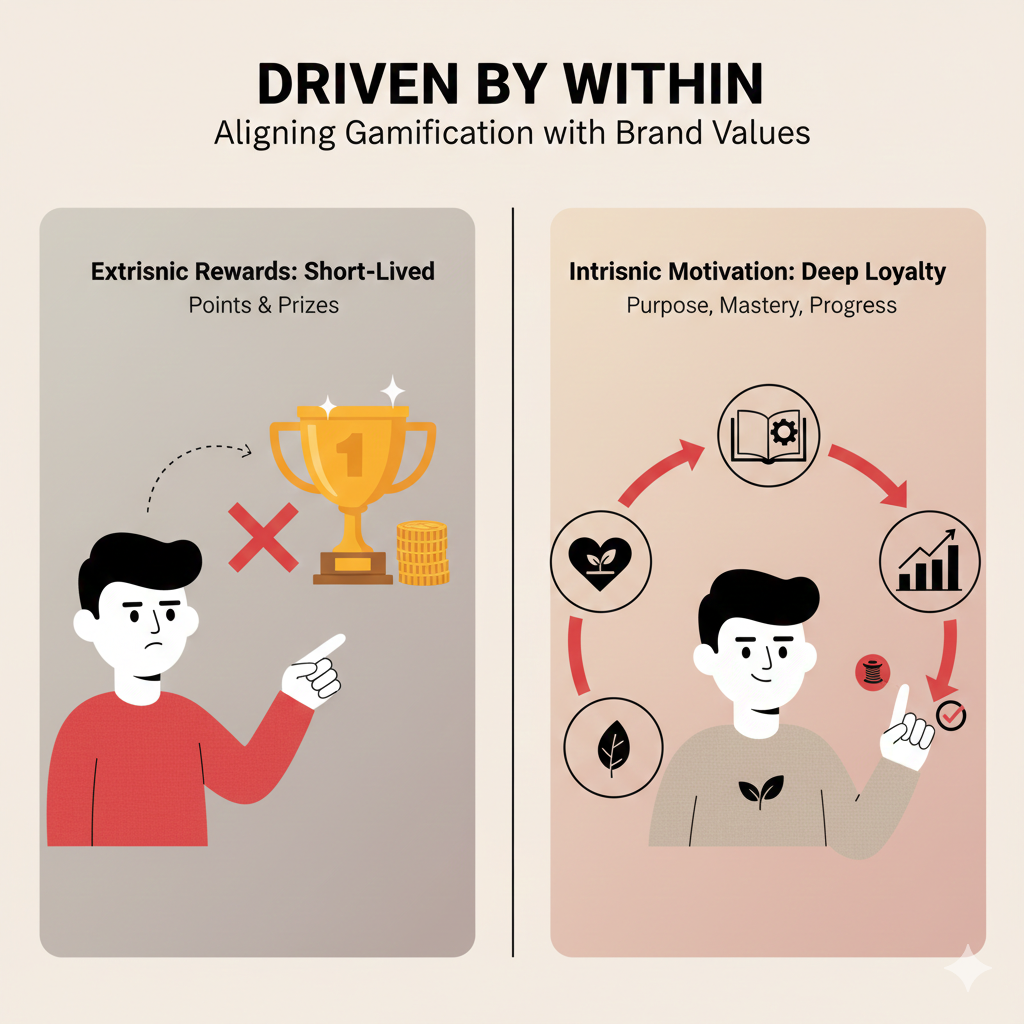
Align with intrinsic motivation and brand values
Points and prizes grab attention but rarely sustain it. Durable loyalty runs on intrinsic motivators: purpose, mastery and visible progress.
A sustainable fashion brand might award mastery badges to customers who learn about eco-friendly fabric care. That turns the mechanic into an expression of what the company stands for, which external prizes cannot buy.
Tie mechanics to meaningful behaviours
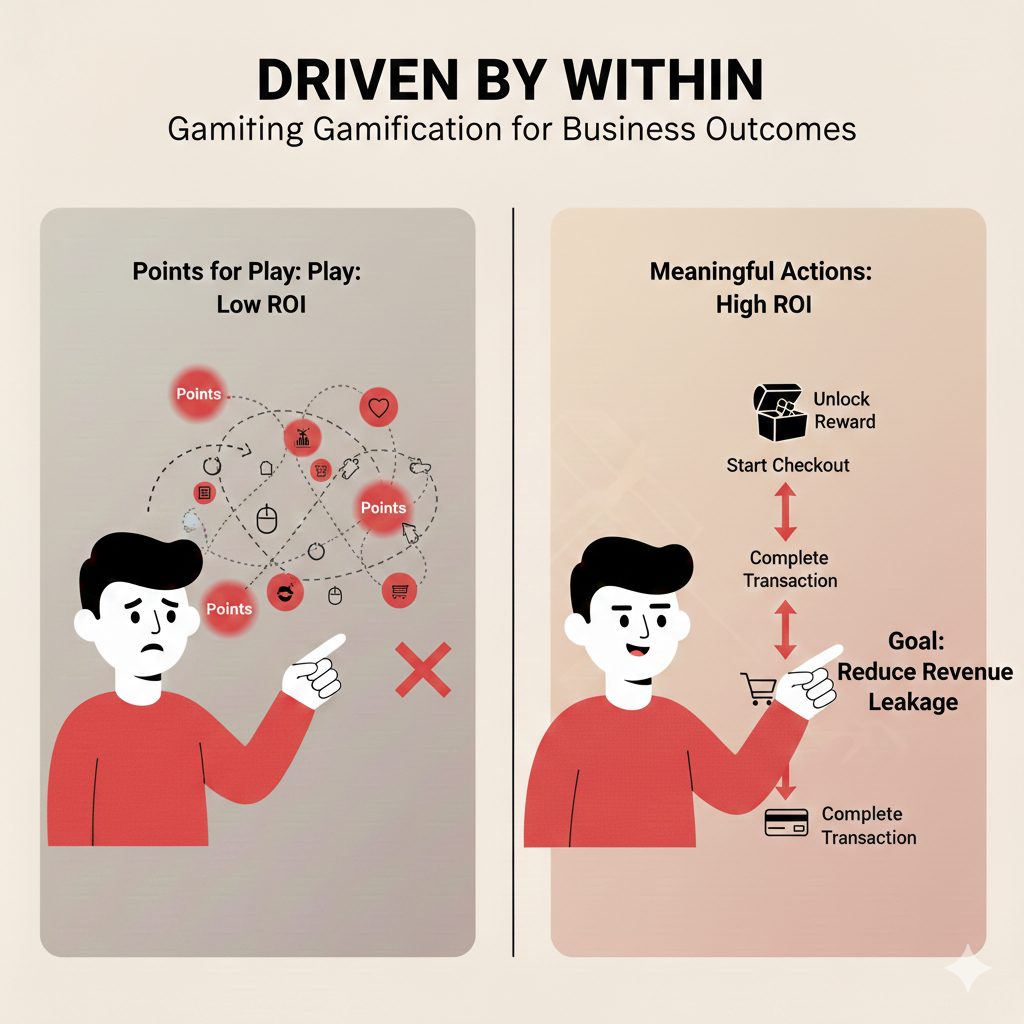
Gamification fails when it becomes play for the sake of points. Mechanics need to attach to outcomes: repeat purchase frequency, churn reduction, referrals.
Rather than rewarding every click, use journey orchestration to incentivise high-value actions. To recover revenue leaking at checkout, a first purchase quest that unlocks its reward only after the transaction completes keeps the mechanic tied to the outcome instead of creating a distraction.
Match mechanics to context and audience
Research published in Frontiers in Communication in 2025 found that gamification elements including challenges, points and enjoyment improve engagement in mobile commerce, but only where they are contextually relevant.
The organism stage of the stimulus-organism-response framework explains why: customers process the same stimulus differently depending on their state. On mobile, where attention is fragmented, micro-challenges completed in seconds outperform long-form competitions.
Effective gamification also raises switching costs in a way customers accept, because status earned is status they would lose by leaving.
Sustain novelty and feedback
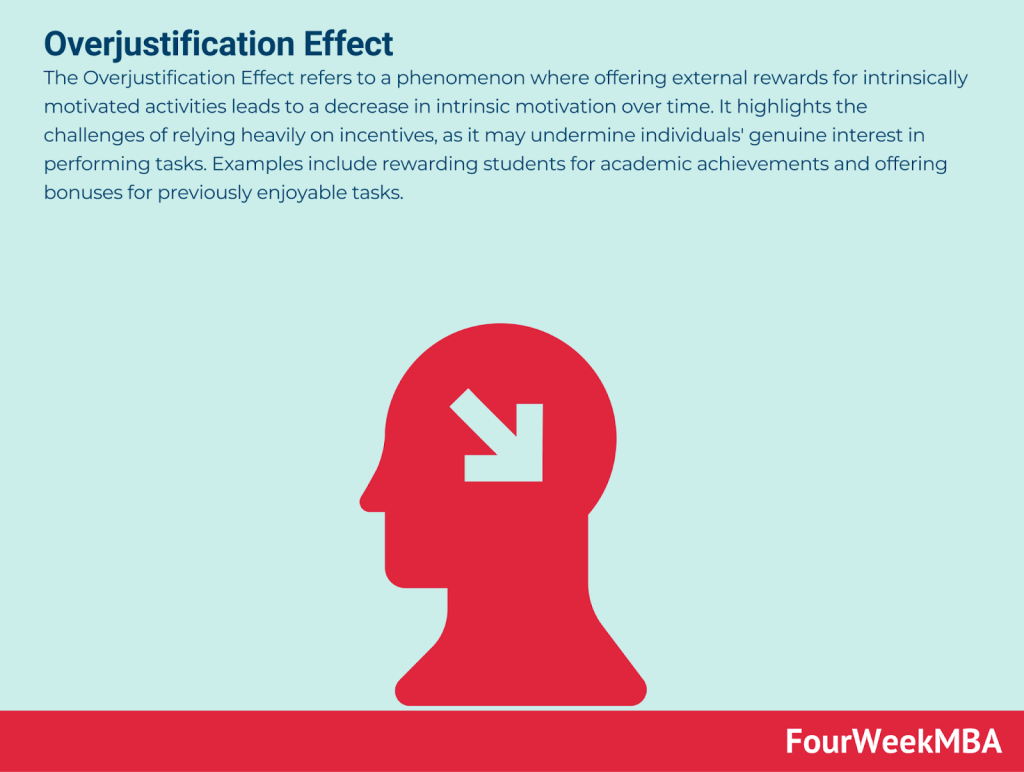
The over-justification effect sets in when mechanics go stale and people participate only for the reward.
Three habits prevent it:
- Real-time feedback, through on-screen animations or web push when a milestone is reached.
- Adaptive difficulty, increasing the challenge as customers become more proficient.
- Periodic novelty, through seasonal quests or limited-edition badges.
Make it measurable and native to the experience
Gamification should be woven into the journey closely enough that customers experience it as a better interaction rather than as a game imposed on them.
With Insider One AI and centralised orchestration, you can measure the impact of each mechanic as it runs, and A/B test gamified onboarding against standard onboarding to see exactly how much retention it adds.
When does gamification backfire?
Poorly built systems erode trust, suppress genuine motivation and create incentives nobody intended. Four warning signs.
Misaligned mechanics and motivators
When mechanics clash with the social context, gamification works against you. Competitive leaderboards in a category that values calm or collaboration create rivalry and stress rather than engagement.
If your brand is built on community and inclusivity, a top spender leaderboard alienates the large majority who know they will never appear on it. People disengage when the game looks rigged.
Rewarding activity instead of outcomes
Rewarding clicks over results produces empty engagement, and in practice it produces gaming.
Reward customers for number of products viewed, and some will click through dozens of pages as fast as possible to unlock a badge without considering a purchase. The result is a dashboard that looks healthy and revenue that does not move. Tying rewards to progression, such as completing a profile and then making a purchase, keeps the mechanic attached to something worth having.
Extrinsic rewards crowding out intrinsic motivation
The over-justification effect is a documented finding in motivation research: introducing external rewards can reduce someone’s pre-existing internal interest in an activity.
The practical risk is straightforward. If a customer likes your brand for its quality and you start paying them in points to engage, the points can become the reason they engage. When the points stop, so does the engagement.
Self-determination theory suggests the antidote, which is to build for autonomy by letting customers choose their own quests, competence by making rewards a signal of mastery, and relatedness by connecting customers to a wider community.
Fatigue, novelty loss and system abuse
Fatigue arrives when challenges become repetitive or predictable, and customers stop once they have cleared the easy levels.
Abuse arrives when people find loopholes. A handful of bad actors dominating a leaderboard or draining a reward pool undermines fairness for everyone else, and fairness is the thing the mechanic depends on.
How to do gamification right
1. Define the business goal and the behaviour
Too many programmes launch with fun features and no commercial anchor. Tether the mechanic to an outcome: customer lifetime value, cart abandonment, referral rate.
To reduce cart abandonment, trigger at the point of hesitation with a mystery reward revealed only if the customer returns within the hour. To raise lifetime value, reward the actions between purchases, such as completing a preference profile, since effort already invested makes switching less appealing. To lift referrals, replace the static link with a referral streak or tiered incentives and show the progress bar.
2. Understand the audience and the moment
Ground the strategy in segmentation and personas, because what motivates a discount-driven shopper will not land with a high-value VIP.
Context decides the mechanic. High-frequency retail rewards visual delight and instant gratification, so a mystery box on app login or a social share challenge fits. A customer data platform is what lets the orchestration layer pick the right moment to trigger.
3. Select mechanics that match motivation and brand
Mechanic choice is a branding decision. If it feels disconnected from your values, it reads as gimmick and costs trust.
- Tiers for long-term status. Best for premium and luxury, creating an aspirational ladder that rewards cumulative loyalty through unlockable experiences rather than loud animations.
- Challenges for time-sensitive pushes. A three-day discovery quest across new categories breaks habitual browsing and widens the basket during a launch or clearance.
- Leaderboards for social validation. Effective in competitive and community categories, but keep them inclusive. A leaderboard that only rewards the top few demotivates everyone else.
4. Sustain engagement past the novelty cliff
The biggest risk is predictability. Vary rewards based on real-time behaviour, since the same coupon at every level-up stops meaning anything, and an unexpected sample or an invitation to a closed event restarts curiosity. Seasonal layers such as a gifting treasure hunt keep the core programme from stagnating.
Sustained programmes also need communication. Trigger real-time nudges through WhatsApp or push notifications, where “you are 20 points from Gold” works as an anchor precisely because it is specific.
5. Measure behaviour, not badges
Look past total badges awarded and app opens.
- Track conversions. Judge the layer on deep-funnel outcomes. For a review quest, measure the share of verified purchases that produced quality reviews.
- Attribute by segment. VIPs may respond to exclusive status while at-risk customers respond to point multipliers, which is the difference between blanket rewarding and optimising for profit.
- Iterate. A/B test a linear progress bar against milestone progression and look at where customers drop out, since that is where a challenge became a chore.
For the measurement discipline behind this, our guide to personalization ROI covers holdout groups and incremental versus attributed revenue.
6. Run the risk checklist before launch
Gamification uses stronger psychological levers than standard marketing, so it carries more risk. If execution feels manipulative, unfair or clunky, you lose trust that is expensive to rebuild.
- Avoid leaderboards dominated by the highest spenders by creating parallel tracks, so every segment has a path to achievement.
- Keep rules intuitive and scores updated in real time across channels, since delayed recognition frustrates more than it motivates.
- Integrate mechanics through a central orchestration layer so an achievement on one channel is recognised everywhere immediately.
- Exchange rewards for zero-party data transparently, so customers feel they are trading information for a better experience rather than being tracked quietly.
Quick comparison: when to gamify and when to avoid
| Strategic lens | When to gamify | When to avoid |
| Customer objective | Habitual, frequent interactions such as daily logins, profile completion or reviews | Sensitive or stressful tasks, such as filing an insurance claim or managing debt |
| Business outcome | Rewards tie to specific micro-conversions you can count | You cannot yet prove a revenue lift, which produces confetti without return |
| Audience profile | Receptive to interactivity, status and digital recognition | Sceptical or time-poor audiences who read game elements as unprofessional |
| Technical readiness | Orchestration can update scores and trigger rewards across channels in real time | Points lag or differ between web and app, creating friction and distrust |
| Psychological impact | The mechanic makes a necessary task genuinely satisfying | Rewards are lucrative enough to encourage cheating or low-quality activity |
The rule underneath all of it: if gamification does not add value to the customer’s experience, it will eventually subtract value from your brand.
How Insider One keeps gamified journeys consistent
Gamification is less forgiving of technical lag than ordinary campaigns, because the customer is keeping score. A promotional email that lands an hour late is a missed opportunity. A badge that does not appear, or a points balance that reads differently in the app than on the website, is a broken promise, and it costs more trust than the mechanic was ever going to earn.
That makes state consistency the hard requirement, ahead of the game design.
Insider One holds progress state on a single customer profile, so an achievement earned in the app is recognised on web, in email and in WhatsApp without waiting for a sync. For values that move by the minute, such as point balances and tier thresholds, a journey can fetch the current figure at decision time rather than reading a scheduled copy, so “you are 20 points from Gold Status” is accurate at the moment it arrives.
The mechanics stay in marketers’ hands. On-site and in-app templates cover progress trackers, reveal mechanics such as wheel of fortune and scratch to win, and quizzes that double as zero-party data capture when a customer completes a profile to close a progress gap. Yves Rocher used the wheel of fortune template to gamify its on-site experience and reported a 6% expansion of its lead database.
Measurement works the same way. Architect A/B tests a linear progress bar against milestone progression, and results break out by segment, so you can see whether VIPs respond to status while at-risk customers respond to point multipliers.
Conclusion
Gamification is not a feature to switch on. It is a behaviour-change mechanism, which means it needs a target behaviour, a mechanic that suits the audience, and a technical layer that keeps score accurately across every channel.
Get those three right and it compounds, because status is harder to walk away from than a discount. Get them wrong and you have taught customers to work your system rather than value your brand.
Take the interactive platform tour, or book a demo to pressure-test a gamified journey before you launch it.
FAQs
Gamification is the strategic integration of game-design elements, such as points, badges, tiers, and progress bars, into non-game environments to drive specific customer behaviors. It involves the use of psychological triggers to motivate users through the customer lifecycle, transforming passive browsing into active participation.
It taps into fundamental human drivers like achievement, competition, and curiosity.
By providing instant feedback (e.g., a “Level Up” notification) and visualizing progress (e.g., a completion bar), brands create a dopamine-driven habit loop. This encourages users to spend more time within the brand’s ecosystem and complete high-value actions they might otherwise ignore.
Yes.
Gamification backfires when it is perceived as manipulative, clunky, or irrelevant to the brand.
If the “game” is too difficult, users become frustrated; if it is too easy, they become bored.
Additionally, if the rewards are too transactional, you risk the “Over-justification Effect,” where customers only engage for the prize and lose their intrinsic connection to your brand.
Rewarding activity rather than outcomes, so points go to clicks instead of conversions. Unclear rules that make customers feel cheated. Technical silos, where a badge earned in the app never appears on the website. And arcade-style mechanics applied to a luxury or business audience.
Traditional loyalty programs are often transactional and backward-looking.
They reward you for what you spent in the past (e.g., “Spend $100, get a $10 coupon”).
Whereas, gamification is behavioral and proactive. It encourages you in what you are doing right now (e.g., “Complete your profile to unlock Gold Status”).
Three questions. Do you have micro-behaviours that lead to revenue, such as reviews or repeat visits? Is your audience receptive to status-based rewards? Can your orchestration layer recognise and reward those behaviours in real time across channels? Three yeses make gamification worth building.

Keep Reading
4 min.

Chris Baldwin
3 Feb 2026
10 min.
Chris Baldwin
5 Oct 2026
10 min.

Julia Bouyeure
4 Oct 2026