

 Platform Overview

 Integration Hub

 Insider One AI™

 Customer Data Management

 Personalization

 Journey Orchestration

 Reporting & Data

 Behavioral Analytics

 Web
Web

 Email
Email

 Site Search

 Conversational CX

 WhatsApp

 Web Push

 InStory

 App
App

 SMS & RCS

 Join the $0 Migration Movement™

 The Insider One Difference

 Compare Vendors

 Switch to Insider One

 Success Story

 Retail & Ecommerce

 Financial Services

 Travel & Hospitality

 Beauty & Cosmetics

 Automotive

 Telecommunications

 Total Economic Impact™ Study

 Blog
Blog

 E-Books & Guides

 Glossary
Top SMS Marketing Platforms for Analytics, Attribution, and Campaign Reporting

Updated on 19 Jun 2026
10 min.
Table of Contents
- Summary
- What should you know about these SMS marketing platforms at a glance?
- How do the top SMS marketing platforms compare for analytics?
- Which SMS analytics metrics prove return on investment (ROI)?
- How do you choose an SMS marketing platform for analytics?
- What should you do next in your evaluation?
- Frequently asked questions
Most Popular

Summary
The best SMS marketing platforms for analytics help teams connect SMS activity to revenue through accurate attribution, ROI measurement, and customer insights. Insider One stands out for cross-channel attribution and unified analytics, while Attentive and Klaviyo are strong choices for ecommerce brands, Braze suits enterprise teams, and Twilio offers maximum flexibility for data-driven organizations with engineering resources.
Marketing teams launch SMS campaigns, watch the clicks roll in, and report engagement metrics to leadership. But when asked how much revenue SMS actually generated, the answer gets murky. The best SMS marketing choice for analytics focuses on revenue connection and attribution quality, not just delivery or open metrics.
It focuses on connecting SMS activity to revenue, proving incrementality, and exporting data when platform attribution falls short. Teams running SMS alongside email and push face an even harder problem: every channel claims credit for the same conversion, inflating reported revenue and making it impossible to know what’s working.
What should you know about these SMS marketing platforms at a glance?
| Platform | Revenue Attribution | Deliverability Diagnostics | Google Analytics 4 (GA4)/Shopify Integration | Application programming interface (API)/Export | Best For |
| Insider One | Cross-channel deduplication | AI-native health checks | Native | Webhooks and APIs | Omnichannel teams |
| SMS Point Solutions | Click or view-based (SMS-only, no cross-channel deduplication) | Carrier filtering signals, 10DLC monitoring | Single-channel native | API available | Single-channel SMS teams |
| Integrated Email and SMS Platforms | Last-touch within owned channels only | Basic | Native for owned stack | API available | Brands consolidating email and SMS |
| Legacy Enterprise Hubs | Custom via data warehouse export | Basic | Custom setup required | Event streaming (engineering required) | Enterprise with dedicated data teams |
| Developer-First Messaging APIs | Build your own (no native attribution) | API event logs only | Custom integration required | Full event streams | Engineering-led teams with BI stack |
SMS analytics platforms fall into four categories: Point Solutions focused on SMS-only attribution, Integrated Email and SMS Platforms that combine owned channels with last-touch models, Legacy Enterprise Hubs that require dedicated data engineering resources, and Autonomous Execution Platforms like Insider One that unify a built-in Customer Data Platform, Generative and Predictive AI, and cross-channel orchestration, eliminating attribution inflation by design.
How do the top SMS marketing platforms compare for analytics?
Each platform below is evaluated on analytics strengths, attribution approach, integration options, limitations, and best-fit use case. Insider One represents the Autonomous Execution Platform category, the only architecture that natively eliminates attribution inflation across SMS, email, push, and WhatsApp without engineering dependencies.
Insider One

Teams running SMS alongside email, web push, and WhatsApp often see inflated revenue claims because each channel takes credit for the same conversion. Insider One solves this with a Unified Customer Data Platform that deduplicates attribution across channels in real time.
Enterprise retail teams use Insider One’s Predictive AI segments to ensure SMS spend creates incremental revenue: targeting Likelihood to Purchase segments for AI-triggered back-in-stock alerts, Discount Affinity profiles for price-drop notifications, and VIP predictive audiences for early access campaigns, preventing SMS budgets from cannibalizing email conversions already destined to close.
Behavioral Analytics provides event-based funnels, flows, Cohort Analysis, and Lifetime Value (LTV) tracking natively within the platform. You don’t need a separate analytics tool or BI team involvement. Architect, Insider One’s customer journey orchestration solution, enables journey-level analytics with revenue, AOV, and conversion rate tracked per variant.
Send Time Optimization (STO) and Next-Best-Channel routing ensure each customer receives the right message through the highest-converting channel at the optimal moment.
Sirius AI™, Insider One’s Generative and Predictive artificial intelligence (AI) capabilities, powers A/B Auto-Winner Selection that optimizes based on Conversions or Revenue and includes Extended Path Allocation to keep multi-variant testing running after a winner is found. Sirius AI™ powers Agentic AI execution through Agent One: it not only analyzes which segment converts best, but it also automatically builds the predictive segment, selects the optimal journey variant, and launches the campaign without manual intervention. Insider One is recognized as a Leader in the IDC MarketScape for AI-Enabled Marketing Platforms.
- Unified Customer Data Platform with real-time profile enrichment, cross-channel identity resolution, and UPSERT API for ingesting external engagement data from third-party regional vendors
- Behavioral Analytics with funnels, flows, cohorts, and custom dashboards that show conversion rate and revenue by segment
- Journey-level attribution in Architect with revenue per variant and conversion rate by path
- 100+ integrations including GA4, Shopify, Snowflake, and CDPs, plus a UPSERT API for enterprise teams using third-party vendors for specific regions who want a single source of truth inside Insider One
Best for omnichannel teams running SMS, email, and push who need deduplicated attribution across channels. To see how enterprise retail brands implement this, request a demo. To explore real-world implementations, visit our customer success stories.
Attentive

A Shopify brand notices that revenue in Attentive doesn’t match Shopify orders. Why? Attentive uses a configurable attribution window and attributes based on click or view. This captures high-level influence but requires careful reconciliation with your order system.
Deliverability diagnostics include 10-digit long code (10DLC) compliance monitoring and carrier filtering signals. A/B testing includes statistical significance calculations. Attribution is SMS only, so teams running email elsewhere see fragmented reporting.
Best for Shopify DTC brands prioritizing SMS as a standalone channel with strong deliverability visibility. If you’re comparing what “good” attribution setups look like across stacks, start with the examples in the product demo hub.
Klaviyo
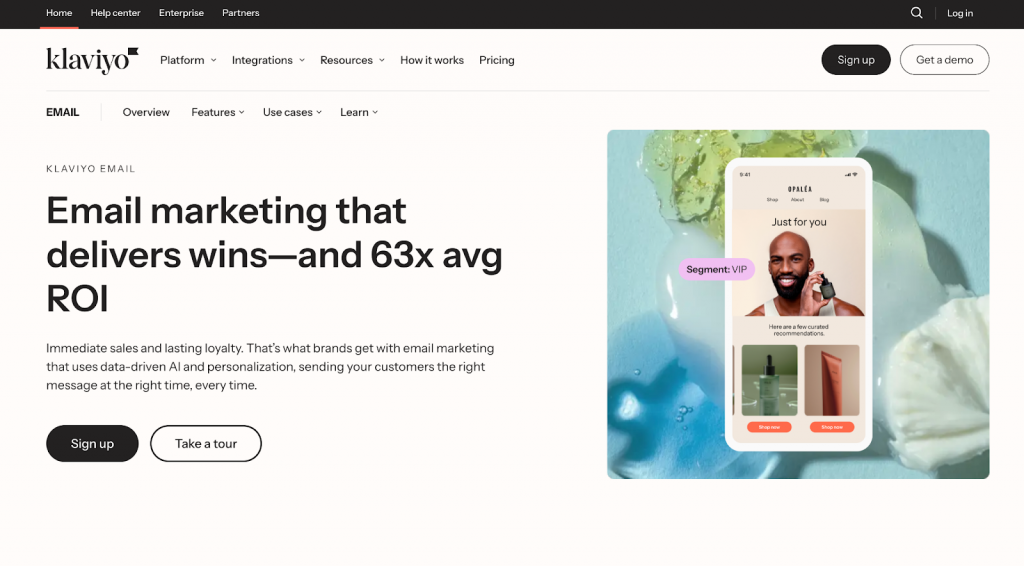
A team runs email and SMS in Klaviyo and sees both channels claiming credit for the same purchase. Klaviyo uses last-touch attribution with a configurable window, and the unified profile prevents double-counting across owned channels.
Flow analytics, predictive LTV, and benchmarks by industry round out the analytics capabilities. Attribution is last-touch only. Teams wanting multi-touch modeling need to export data to a warehouse.
Best for ecommerce brands running email and SMS in one platform who want unified reporting. If you need cross-channel attribution that doesn’t collapse into last-touch, request a demo and we’ll walk through deduped, journey-level revenue.
Braze

An enterprise team uses Snowflake as the source of truth and needs SMS data exported for custom attribution models. Braze provides Canvas-level analytics with conversion tracking, but deep attribution requires exporting events via Currents to a warehouse.
The experimentation framework, export APIs, and identity stitching across devices are strong. Native SMS attribution is limited, and teams often export events to a warehouse for deeper analysis. Teams need BI resources to build custom dashboards.
Best for enterprise brands with data engineering capacity who want SMS as part of a warehouse-centric stack.
Twilio
A team chooses Twilio for flexibility but realizes there’s no native dashboard, no attribution, and no revenue reporting out of the box. Twilio provides webhooks and event streams. Analytics requires building Urchin Tracking Module (UTM) tagging, Google Analytics 4 (GA4) Measurement Protocol integration, and business intelligence (BI) dashboards.
Full control over event taxonomy and identity resolution via Segment are possible. Significant engineering investment is required with no marketer-accessible reporting.
Best for teams with dedicated data engineering who want full control and already have a BI stack. If you want a faster path to marketer-ready analytics without the build, explore the walkthroughs in the product demo hub.
Which SMS analytics metrics prove return on investment (ROI)?
Teams report click-through rate (CTR) and delivery rate to leadership, but can’t answer “how much revenue did SMS drive?” Proving ROI requires three metric tiers: deliverability, engagement, and revenue.
Which deliverability and list health metrics matter most?
A campaign shows a delivery rate drop from the previous month. The team doesn’t know why until carrier filtering escalates. Monitor these leading indicators weekly:
- Delivery rate: Set a baseline and flag drops immediately
- Bounce types: Separate hard bounces from soft bounces
- Opt-out rate: Watch for spikes after specific campaigns
- Invalid number rate: Track across your subscriber list
Which engagement metrics should you track?
Teams compare CTR across campaigns without accounting for send time, audience segment, or message type. CTR varies heavily by campaign type. Transactional messages naturally outperform promotional blasts.
- CTR: Total clicks divided by total delivered messages
- Response rate: Percentage of replies for 2-way SMS campaigns
- Time-to-click: Median time from delivery to the first click
Which revenue metrics and formulas matter most?
Leadership asks for SMS ROI. The challenge is not the calculation — it is reconciling platform-reported revenue against your order management system, and separating SMS-influenced from SMS-driven conversions. Platforms with native cross-channel attribution resolve this without a monthly manual reconciliation workflow.
- Revenue per recipient: The primary executive metric for proving SMS channel contribution, validated against your order system
- Cost per acquisition: Benchmark SMS-driven new customer cost against your other owned and paid acquisition channels to validate channel efficiency
- Return on ad spend (ROAS): Total SMS-attributed revenue validated against your order management system, divided by total SMS spend
Enterprise brands using Insider One’s built-in UCDP eliminate manual reconciliation by tracking deduplicated attribution across channels in real time.
What attribution models and pitfalls should you know?
A retail team runs SMS and email campaigns for cart abandoners and repeat buyers. Both platforms can claim credit for the same purchase when they use last-click attribution with overlapping windows.
- Last-click: Credit goes to the last clicked channel before purchase
- Discount code: Credit goes to the specific code used at checkout
- Urchin Tracking Module (UTM)-based: Google Analytics 4 (GA4) source and medium tracking assign credit
If SMS is your only channel, last-click attribution is sufficient. If you run multiple channels, validate by comparing platform-reported revenue to order system revenue.
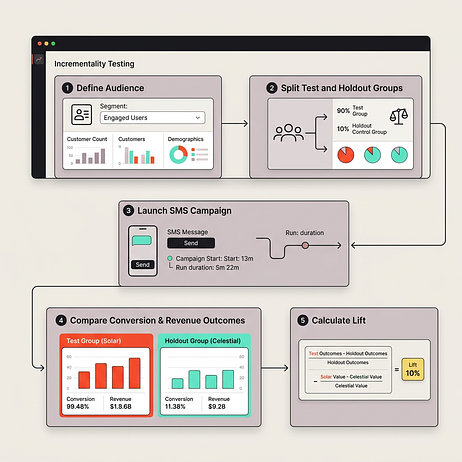
How does incrementality testing with holdout groups work?
Leadership asks if these customers would have purchased anyway without receiving the SMS. Holdout testing is the only definitive way to prove incrementality.
- Define the test population such as cart abandoners
- Randomly assign a holdout group that receives no SMS
- Run the campaign for a defined period
- Compare conversion rate and revenue between test and holdout
- Calculate incremental lift to determine true SMS contribution beyond the baseline conversion rate of your holdout group
This requires sufficient volume to reach statistical significance. Smaller teams need to run longer tests.
How do you choose an SMS marketing platform for analytics?
The team has shortlisted platforms but doesn’t know how to weight analytics capabilities against other factors.
Which platform fits your business model?
- Shopify DTC with SMS as primary channel: Prioritize native Shopify integration and discount code attribution
- Omnichannel with email and SMS: Prioritize unified profiles and cross-channel attribution
- Enterprise with warehouse-first analytics: Prioritize API exports and event streaming
- B2B sales or recruiting: Prioritize CRM integration and conversation analytics
- SMB with engagement focus: Prioritize ease of use and basic dashboards
What red flags should you watch for in SMS analytics platforms?
- No configurable attribution window: The platform locks you into a default window that doesn’t match your purchase cycle
- No event export or API: You can’t build custom attribution models or reconcile against your order system
- No UTM support: Links strip parameters, making GA4 attribution impossible
- Black-box attribution: The platform doesn’t explain how revenue is attributed
What should you do next in your evaluation?
The right platform depends on whether you need native revenue attribution, warehouse exports, or unified reporting across channels. Prioritize revenue attribution, integration depth, and data exportability. A platform that cannot prove incrementality will eventually lose executive support.
Enterprise brands running multi-channel programs need cross-stack deduplication and Agentic AI optimization, not just SMS-specific dashboards. If you want to see exactly how these attribution strategies work at scale, request a demo, and we’ll map the analytics to your stack.
Frequently asked questions
The optimal window depends on your product’s typical time-to-purchase. Analyze click-to-purchase times for your audience and set the window to capture most conversions. Shorter windows reduce over-attribution but undercount slower buyers.
Key metrics include list growth rate, engagement decay, hard bounce rate, and consent source quality. Monitor these weekly to catch issues before they affect deliverability.
Use consistent UTM parameters with utm_source=sms and utm_medium=text. Ensure link shorteners preserve tags and create a custom channel group in GA4 for SMS. For server-side tracking, use GA4 Measurement Protocol to send click events.
Core metrics include delivery rate, CTR, conversion rate, revenue per recipient, and opt-out rate. Revenue per recipient is the most important for proving ROI: total attributed revenue divided by total recipients.
Yes. Insider One’s Behavioral Analytics includes native Cohort Analysis and Lifetime Value (LTV) tracking within the platform, no data warehouse or BI team required. Group subscribers by signup month, first purchase date, or campaign cohort, then track conversion rate, revenue, or engagement decay over time to understand the long-term value of your SMS program.

Keep Reading
7 min.

Muharrem Derinkok
4 Jun 2026
11 min.

Chris Baldwin
2 Jun 2026
4 min.
Chris Baldwin
3 Feb 2026