

 Platform Overview

 Integration Hub

 Agent One™

 Agent One Teams™

 Customer Data Management

 Personalization

 Journey Orchestration

 Reporting & Data

 Behavioral Analytics

 Web
Web

 Email
Email

 Site Search

 Conversational CX

 WhatsApp

 Web Push

 InStory

 App
App

 SMS & RCS

 Join the $0 Migration Movement™

 The Insider One Difference

 Compare Vendors

 Switch to Insider One

 Success Story

 Retail & Ecommerce

 Financial Services

 Travel & Hospitality

 Beauty & Cosmetics

 Automotive

 Telecommunications

 Total Economic Impact™ Study

 Blog
Blog

 E-Books & Guides

 Events

 Glossary
RCS vs SMS: What Marketers Actually Need to Know in 2026

Updated on 11 May 2026
14 min.
Table of Contents
- What RCS and SMS actually are (and why the distinction matters for campaigns)
- Feature-by-feature comparison: where RCS outperforms SMS and where SMS still wins
- How engagement differs between RCS and SMS
- When to use RCS, when to use SMS, and how to run both in one flow
- Building a fallback architecture that actually converts
- How to start adding RCS without overhauling your SMS program
- The practical blockers to plan around
- Why the platform underneath RCS and SMS matters
- FAQs
Most Popular


Summary
| RCS and SMS serve different but complementary roles in messaging strategy. RCS enables rich, interactive, branded experiences, while SMS ensures universal reach for critical messages like OTPs and alerts. SMS wins on reliability and reach, but RCS drives higher engagement and conversions when available. The best approach is a hybrid flow where RCS is sent first and SMS acts as an automatic fallback. Platforms like Insider One can orchestrate this routing and personalization using unified customer data. |
Your SMS program is probably working. Open rates are high, opt-in lists are healthy, and campaign delivery is reliable. So when someone in a planning meeting mentions RCS, it is natural to ask whether this is a genuine upgrade or just another channel to manage. The honest answer is that it depends on what you are trying to accomplish, and the distinction matters more than most vendor content will tell you.
The confusion around RCS vs SMS often starts with how the two protocols are described, usually as a feature competition, as if marketers should simply pick the flashier option and move on. That framing misses the point. SMS and RCS serve different moments in a customer journey, and understanding where each one fits is what separates teams that see a measurable lift from teams that run parallel programs that undercut each other.
What RCS and SMS actually are (and why the distinction matters for campaigns)
Short Message Service (SMS) is carrier-native. Every message routes through the public switched telephone network, caps at 160 characters per segment, and lands on any mobile device without requiring data or Wi-Fi. That universality is its defining feature and its ceiling.
Rich Communication Services (RCS) runs over an Internet Protocol (IP)-based architecture. Messages travel over data or Wi-Fi, support significantly more characters than SMS, carry HD images and video, and can include interactive elements such as carousels and quick-reply buttons. RCS Business Messaging is governed by the GSMA’s Universal Profile, the global standard that most major carriers and device manufacturers implement for application-to-person (A2P) messaging, which adds verified brand profiles and delivery receipts to the mix.
Where MMS fits in
Marketers frequently conflate three distinct formats, which leads to campaigns designed for the wrong medium. Understanding each one clearly prevents that mistake:
• SMS: Text only, 160 characters per segment, carrier-routed, works on every device
• MMS: Multimedia Messaging Service (MMS) supports images, GIFs, and short video through carrier infrastructure, but at lower resolution and smaller file sizes than RCS
• RCS: IP-based, branded, interactive, supports HD media and rich user interface (UI) elements such as carousels and quick-reply buttons
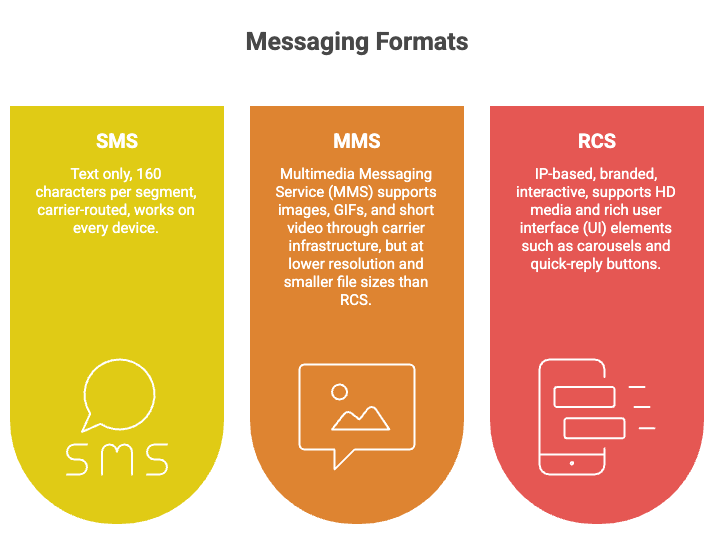
MMS sits between the two in terms of capability, but it shares SMS’s carrier routing rather than RCS’s IP architecture. If your team has been using MMS for image-forward campaigns, RCS is not an incremental improvement but a different category of experience entirely.
Feature-by-feature comparison: where RCS outperforms SMS and where SMS still wins
What RCS brings to the table
The capability gap between RCS and SMS is significant. RCS supports verified sender profiles, which means recipients see your brand name and logo rather than an unknown number.

Carousels let a single message surface multiple products. Quick-reply buttons reduce the friction between receiving a message and taking action. Read receipts give marketers visibility into whether a message was actually opened, not just delivered.
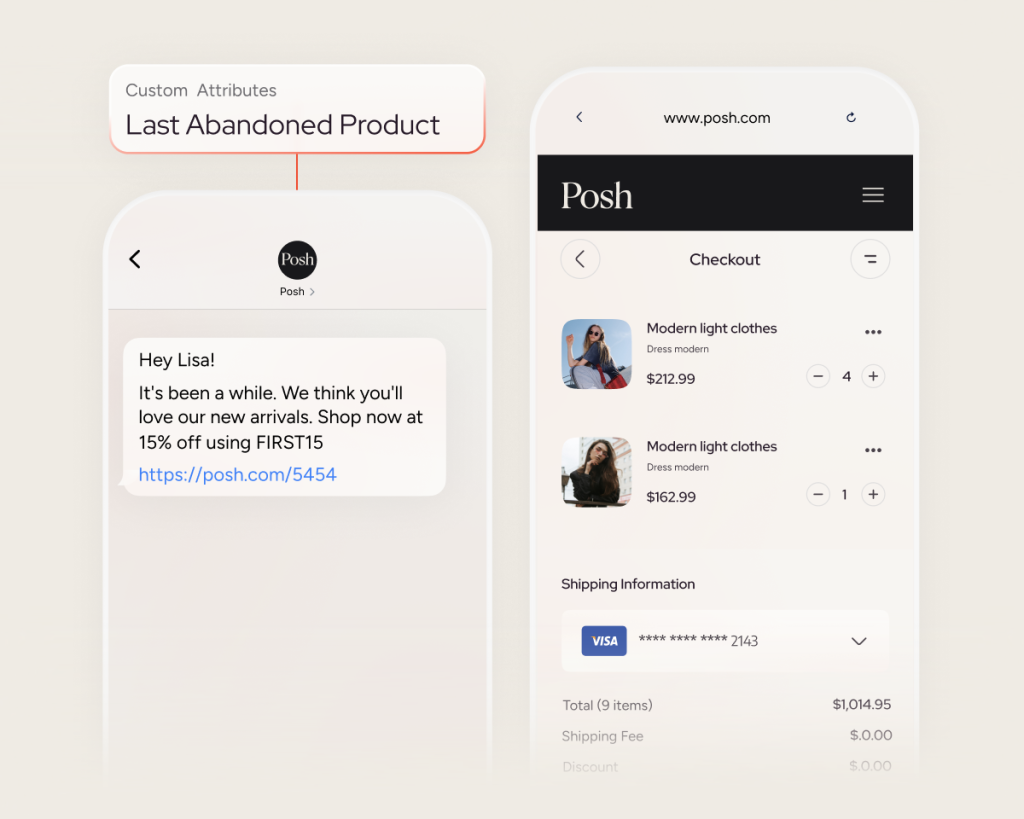
For conversion-oriented campaigns such as abandoned cart recovery, product launch announcements, and loyalty reward redemptions, these elements change what is possible.
A well-built RCS message for an abandoned cart can show product images, display a “Complete purchase” button, and surface several related items in a scrollable carousel, all within a single message thread. When that carousel is populated from live behavioral data using Insider One’s Smart Recommender, the products shown reflect each customer’s actual browsing and purchase history rather than a manually curated selection, a distinction that meaningfully changes how recipients engage.
Where SMS genuinely wins
None of those capabilities matters if the message does not arrive. SMS’s advantage is unconditional delivery. No internet connection, no carrier RCS support, and no device compatibility requirement stand between a message and its recipient as long as that phone receives a cellular signal.
That reliability makes SMS the right default for OTPs, fraud alerts, appointment confirmations, and any message where a failure to deliver has a real consequence.
Cost-per-send is another practical factor. RCS typically costs more per message than SMS, a gap that compounds quickly against large lists. For broad sends to mixed audiences, especially across regions where RCS carrier coverage remains uneven, SMS’s lower unit cost often produces better overall return on investment (ROI), even if the per-message engagement rate is lower.
How engagement differs between RCS and SMS
The two channels behave differently across the customer journey, and those differences are meaningful when choosing a format for a specific campaign goal. SMS consistently achieves very high open rates, which makes it effective for reaching audiences quickly.
RCS, with its interactive elements and verified brand profiles, tends to drive stronger downstream action for conversion-focused messages. SMS gets opened; RCS gets acted on. That distinction should inform how you prioritize investment across channels, rather than treating one format as universally superior.
The picture shifted meaningfully when Apple released iOS 18 with native RCS support in September 2024, extending RCS capability to iPhones alongside Android devices. This substantially expanded the addressable pool for RCS Business Messaging in the United States and other markets with strong iPhone penetration.
Before that release, any US brand sending RCS was effectively excluding a significant share of its audience by default. That exclusion is no longer automatic, though RCS Business Messaging still requires carrier support and coverage is not uniform across all regions and operators.
A note on channel engagement
Industry-reported engagement figures for RCS and SMS vary widely depending on vertical, audience quality, message type, and measurement methodology. Any specific percentage ranges you encounter, including those in vendor materials, should be treated as directional rather than guaranteed outcomes for any specific program. The more reliable approach is to run a matched holdout test against your own list and use your own baseline as the benchmark.
When to use RCS, when to use SMS, and how to run both in one flow
Matching the channel to the use case
Use case alignment matters more than channel preference. A practical framework for deciding which channel fits each message type:
RCS is the right choice for:
• Product launches with visual storytelling
• Abandoned cart recovery with product imagery and direct purchase buttons
• Loyalty program updates with personalized reward carousels
• Conversational commerce flows where quick-reply buttons and structured message sequences guide customers from intent to purchase without leaving the messaging thread
• Re-engagement campaigns where brand recognition and creative differentiation matter
• Post-purchase upsell and cross-sell flows in retail and e-commerce, where AI-driven product carousels surface items relevant to each customer’s individual history
• Travel booking confirmations with check-in buttons and upgrade offers surfaced at the right moment in the journey
• Financial services onboarding journeys, credit limit increase notifications, and investment portfolio summaries where verified sender identity is essential to establish trust and meet compliance expectations
• Subscription and telco plan upgrade offers, where a visually rich message with a single action button removes friction from a high-value conversion
SMS is the right choice for:
• OTPs and two-factor authentication
• Fraud alerts and security notifications
• Time-sensitive operational messages such as shipping updates and appointment reminders
• Broad list sends to audiences with an unknown device mix or limited RCS coverage
• Regions where RCS carrier support remains sparse
• Markets with high prepaid device penetration where data connectivity is less reliable
The channel decision should follow the message’s job. If the goal is authentication or urgent notification, SMS wins on speed and reliability. If the goal is to move someone from browsing to purchase, RCS’s interactive format earns its higher cost.
Building a fallback architecture that actually converts
Running both channels well means designing for the fallback scenario from the beginning, not treating SMS as an afterthought when RCS fails. The standard architecture sends RCS first, checks device and network capability, and automatically downgrades to SMS when RCS cannot be delivered.
Insider One’s Architect journey builder handles this routing automatically, checking carrier capability data at send time for each contact and adjusting the send path accordingly. The fallback decision and message-level personalization happen within the same journey logic, so you are not building and maintaining two separate campaign structures.
The critical design principle is that your SMS fallback message must convert on its own, without relying on any visual element from the RCS version.
That means writing fallback copy that works as a standalone message, includes a clear call-to-action with a link, and communicates enough context that a recipient who has never seen the RCS version is not confused.
If your RCS message leads with a product carousel and a quick-reply button, your SMS fallback needs to do the same work in plain text. Draft both versions in parallel, not sequentially.
For teams building journey orchestration across multiple touchpoints, this fallback logic integrates naturally into branching flows. Route RCS-capable users down one path, SMS-only users down another, and measure each arm separately to understand true channel incrementality.
How to start adding RCS without overhauling your SMS program
A phased approach that manages risk
The instinct to rebuild an entire SMS program around RCS before seeing results is understandable but unnecessary. A lower-risk entry path looks like this:
• Register your RCS Business Agent: This is the verified sender identity that carriers and devices use to display your brand profile. Insider One guides customers through the registration and carrier submission process. Lead times vary by carrier and region, so build in several weeks minimum, and sometimes longer
• Start with post-purchase or re-engagement flows: These audiences are already engaged, the stakes of a failed experiment are lower, and use cases such as order confirmation with an upsell carousel or a win-back with a strong offer showcase RCS’s strengths without disrupting acquisition programs. With Insider One, these flows are built in Architect using live behavioral triggers from the Customer Data Platform, so carousel content and offer timing adapt to each contact automatically
• Use your existing SMS opt-in list: RCS for Business uses the same phone number infrastructure as SMS, so existing opt-ins generally carry over, and you do not need to rebuild consent from scratch
• Measure incrementality, not just engagement: Compare RCS performance against your SMS baseline using matched audiences or holdout groups, not raw engagement rates in isolation. Insider One attributes performance across channels against a single customer timeline, making it straightforward to isolate what RCS adds over and above your SMS baseline
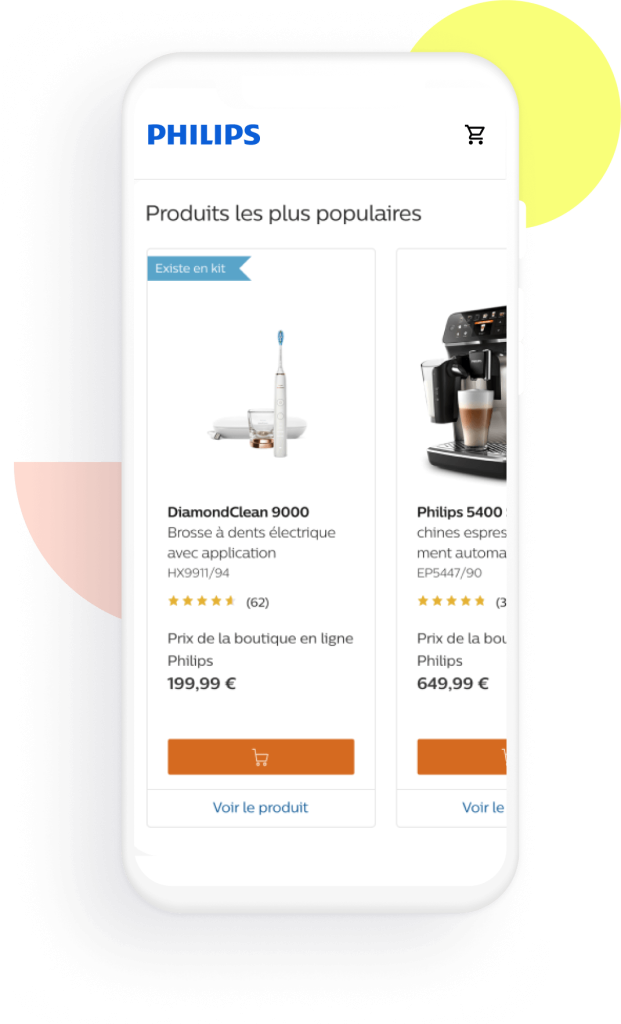
Philips worked with Insider One’s Smart Recommender to apply a single behavioral recommendation model across multiple surfaces rather than running isolated experiments on each channel. The same logic that powers an email or web recommendation can populate an RCS product carousel — so teams that have already built cross-channel recommendation flows on Insider One are not rebuilding them when they add RCS. Read the Philips success story
The practical blockers to plan around
Several real constraints slow RCS adoption, and acknowledging them early saves time later. Carrier pricing for RCS varies more than SMS pricing does, and the premium per message requires a cost-benefit model before you scale.
RCS Business Messaging has broad carrier support across the United States, United Kingdom, Germany, France, and most of Western Europe, as well as India and parts of Latin America. Coverage remains limited across Southeast Asia, the Middle East, and Africa, where carrier adoption is still in early stages. A campaign targeting a UK or US audience will encounter fewer obstacles than one targeting markets where rollout has not yet completed.
Verification lead times are a planning reality rather than a technical flaw, so budget for registration and approval time before committing to a campaign launch date. Most critically, the platform you run this on needs to support both channels under a unified customer profile. Without that, you are managing two separate data models, and the fallback logic and attribution both break down.
Insider One’s Customer Data Platform unifies behavioral, transactional, and device-level data across every channel in real time, making RCS and SMS fallback routing, audience segmentation, and meaningful attribution operationally feasible without manual integration. As the Customer Data Platform receives updated device and carrier signals, Architect reflects those changes in routing decisions on subsequent sends.
Before a campaign even sends, Insider One’s Customer Data Platform can pre-segment the audience by purchase likelihood, engagement recency, or channel preference, so the RCS arm of a campaign starts with the contacts most likely to respond to a rich-format message, rather than routing everyone who is technically RCS-capable into the same send regardless of intent.
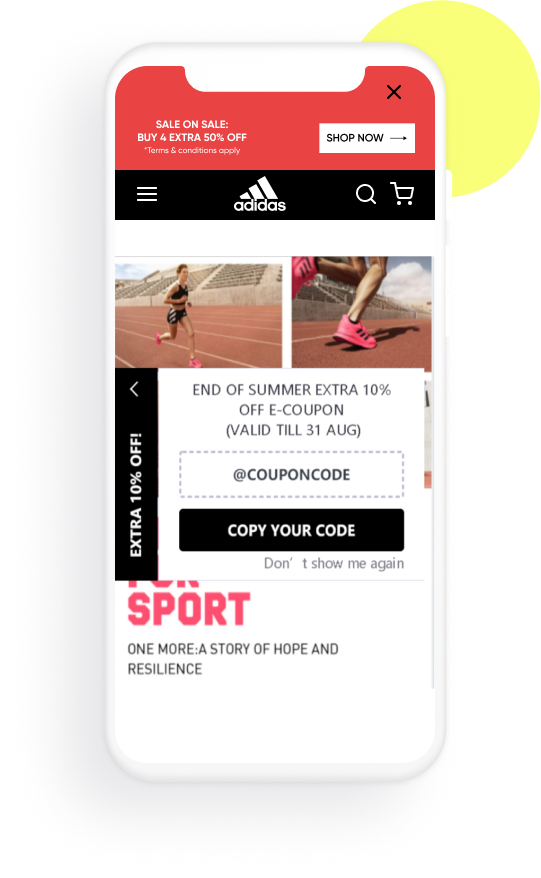
Adidas built its channel orchestration on Insider One’s unified data layer rather than stitching separate channel tools together after the fact, the same architectural decision that makes RCS-to-SMS fallback routing and cross-channel attribution reliable at scale. When each channel reads from and writes to the same customer record, adding RCS becomes a configuration decision rather than an integration project. Read the Adidas success story →
For teams evaluating how RCS fits into a broader omnichannel stack, Insider One supports journey orchestration through Architect and content personalization through Smart Recommender across SMS, RCS, email, push, and web. Channel selection, fallback logic, and content personalization are all managed within a single platform and against a single customer profile, rather than requiring separate integrations and manual synchronization for each channel.
Why the platform underneath RCS and SMS matters
The decision to add RCS is often framed as a creative and channel strategy question. The harder question is whether the platform underneath can execute that strategy without creating a data and integration problem that costs more to manage than the channel gains deliver.
Insider One’s three core capabilities form a connected system rather than separate tools. The Customer Data Platform maintains a unified profile for each contact, updated continuously as behavioral, transactional, and device signals come in. Architect reads from that profile to make routing and timing decisions for every send — including whether to deliver via RCS or fall back to SMS. Smart Recommender draws on the same behavioral model to populate content, so a product carousel in an RCS message reflects the same signals that would drive a web or email recommendation, without requiring a separate integration for each channel.
A platform that supports RCS and SMS under a unified customer profile provides several capabilities that a point-solution approach cannot:
• Send-time device routing: Routing decisions happen at send time using current carrier capability data, not static audience segments built at campaign setup. This matters because device capabilities change as contacts upgrade phones and carriers expand RCS support
• Unified attribution: Performance data for both channels lives in the same customer timeline, making it possible to measure true channel incrementality rather than comparing engagement rates across two separate reporting environments
• AI-driven content decisions: When product carousels in RCS messages are populated using the same behavioral model that drives web personalization, recommendation quality compounds across channels rather than being siloed to whichever team built that specific campaign
• Journey logic that persists across channel switches: A contact who receives the SMS fallback version of an RCS message should not re-enter the RCS arm of the journey on the next send. Shared contact state across channels prevents these errors automatically
These are execution capabilities, not marketing claims. They determine whether an RCS program scales beyond a pilot or remains a one-off creative exercise that never earns a permanent budget allocation.
If you want to see how Insider One’s Smart Recommender, Architect, and Customer Data Platform turn live customer data into coordinated, revenue-driving experiences across RCS, SMS, and beyond, book a personalized demo to see the exact use cases, decision logic, and growth levers most relevant to your team.
FAQs
Yes, in most markets. RCS for Business uses phone numbers as identifiers, so existing SMS consent generally applies to RCS sends. That said, consent requirements vary by region, so confirm with your legal team before assuming full list portability, especially if you operate across multiple jurisdictions.
Insider One automatically downgrades the message to SMS. The recipient receives the text version without any visible error or gap in experience. The creative and copy in your SMS fallback need to be designed to stand alone, because a meaningful share of sends will route that way, particularly during early rollout.
RCS per-message costs run higher than SMS, though the gap varies by carrier and volume. The right framing is not whether RCS is cheaper but whether the conversion rate improvement justifies the higher unit cost for a given use case. For high-intent audiences and conversion-focused flows, the math often works in RCS’s favor. For broad awareness sends or transactional notifications where delivery reliability matters most, SMS frequently delivers better overall ROI.
Not necessarily, but you do need both formats planned from the start of a campaign. The most common mistake is building the RCS creative first and then trying to compress it into an SMS fallback. Teams that design both versions in parallel, treating them as two different messages serving the same campaign goal, produce better SMS fallbacks and end up with cleaner RCS creative that does not rely on elements the fallback cannot replicate.
The most reliable approach is a matched holdout test: split your RCS-eligible audience into two groups of equal size and composition, send RCS to one and SMS to the other, and compare downstream conversion, not just opens or clicks. Measuring raw engagement in isolation conflates format quality with audience quality. Insider One attributes both channel arms against the same customer timeline, isolating what the RCS format adds over and above your SMS baseline.
The key requirement is a shared customer profile that both channels read from and write to. Without it, device-level routing decisions rely on stale data, attribution splits across two reporting environments, and journey logic cannot carry contact state across a channel switch. Insider One manages RCS and SMS within the same journey builder and against the same Customer Data Platform, so the operational complexity of running both channels together stays at the campaign level rather than becoming an infrastructure project.

Keep Reading
7 min.

Muharrem Derinkok
4 Jun 2026
11 min.

Chris Baldwin
2 Jun 2026
4 min.
Chris Baldwin
3 Feb 2026