

 Platform Overview

 Integration Hub

 Agent One™

 Agent One Teams™

 Customer Data Management

 Personalization

 Journey Orchestration

 Reporting & Data

 Behavioral Analytics

 Web
Web

 Email
Email

 Site Search

 Conversational CX

 WhatsApp

 Web Push

 InStory

 App
App

 SMS & RCS

 Join the $0 Migration Movement™

 The Insider One Difference

 Compare Vendors

 Switch to Insider One

 Success Story

 Retail & Ecommerce

 Financial Services

 Travel & Hospitality

 Beauty & Cosmetics

 Automotive

 Telecommunications

 Total Economic Impact™ Study

 Blog
Blog

 E-Books & Guides

 Events

 Glossary
How to Build Personalisation Strategies for Omnichannel Marketing

Updated on 11 Aug 2026
12 min.
Table of Contents
- What should you know first?
- What is personalization in marketing?
- Why personalization strategies matter for revenue and retention?
- How personalization works across data, AI, and channels?
- Why should you consolidate your stack from a Legacy CDP to Insider One?
- Which personalization strategies should you prioritize?
- How do you collect customer data with explicit consent?
- How do you build customer segments and predictive audiences that stay fresh?
- How do you personalize web and app experiences in real time?
- How do you deploy product recommendations that handle cold start?
- How do you personalize email, SMS, and WhatsApp with modular templates?
- How do you orchestrate cross-channel journeys with frequency caps?
- How do you use conversational commerce for support and sales?
- How do you apply contextual and location signals without creepiness?
- How do you run experiments and auto-select winners to prevent stale experiences?
- How do you measure revenue impact with unified reporting and alerts?
- Which personalization trends should you act on next?
- How Insider One powers personalization across every channel?
- FAQs
Most Popular
Personalization isn’t a feature anymore. It’s the foundation of how modern marketing teams drive revenue, retain customers, and compete at scale.
But most teams treat it like a collection of disconnected tactics: a recommendation widget here, a segmented email there, a dynamic homepage for high-value users. Without a unified strategy, those efforts stay siloed. The lift never compounds.
This guide walks you through personalization strategies that build on each other, from data collection and consent through real-time activation and measurement.
Each strategy includes prerequisites, key performance indicators (KPIs), and practical implementation steps so you can move from theory to execution without guesswork.
If you’re ready to turn fragmented personalization into a repeatable system that scales across every channel, this is where you start.
What should you know first?
Personalization strategies are the repeatable methods teams use to deliver relevant experiences based on customer data, behavior, and context across every channel.
- Unified data comes first: channel-level tactics fail without a shared customer profile
- These strategies build on each other, from consent and segmentation through measurement
- Each includes prerequisites and KPIs so you can implement without guesswork
What is personalization in marketing?
Personalization in marketing is the practice of using customer data to deliver relevant content, offers, and experiences at the individual level. It’s system-driven and scales without manual intervention.
That’s different from segmentation, which groups users by shared traits, and customization, which lets users self-select preferences. All three create relevance, but they work differently.
| Approach | Data requirement | Scalability | Example |
| Segmentation | Demographic or behavioral cohorts | High | Email campaigns to “high-value customers” |
| Customization | User-declared preferences | Medium | Letting users choose notification frequency |
| Personalization | Real-time behavioral and profile data | High | Dynamic homepage hero based on browse history |
Why personalization strategies matter for revenue and retention?
Most teams already personalize something. The problem? Without a unified strategy, the performance improvement stays limited to individual campaigns and never compounds.
Personalization improves results in three areas:
- Conversion lift: Relevant experiences reduce friction at decision points like cart, checkout, and booking confirmation
- Retention and lifetime value (LTV): Personalized post-purchase flows increase repeat purchase rates and reduce churn
- Customer acquisition cost (CAC) efficiency: Predictive audiences improve paid media targeting, reducing wasted spend on low-intent users
Personalization adds complexity. If your team lacks unified customer profiles, skip real-time personalization and focus on segment-level relevance first. If your catalog is small, manual merchandising may outperform algorithmic recommendations.
How personalization works across data, AI, and channels?
Personalization breaks when teams treat it as a channel feature instead of a platform capability. A recommendation widget on the homepage means nothing if the customer data platform (CDP) doesn’t recognize the same user on email.
Effective personalization relies on four layers:
- Data layer: Unified customer profiles with identity resolution, event streaming, and consent state
- Decisioning & Orchestration layer: Rules, models, or hybrid logic that determines what to show and when
- Activation layer: Channel connectors that deliver the decision (web, email, SMS, app push, WhatsApp)
- Feedback layer: Event capture that closes the loop and improves future decisions
Artificial intelligence (AI) automates specific tasks within this architecture:
- Segment creation: Predictive audiences based on likelihood to purchase, churn, or engage
- Content generation: Dynamic subject lines, product descriptions, and image selection
- Send-time optimization: Per-user timing based on historical engagement patterns
- Next-best-action: Channel and message selection based on real-time eligibility and propensity
Real-time web personalization requires very fast response times from the decisioning layer. If your stack can’t meet that, use pre-computed segments and cache personalized content at the edge.
If you want to see what low-latency decisioning looks like in the real world, Book a demo and we’ll walk through how to activate it across web, app, and messaging without rebuilding your stack.
Why should you consolidate your stack from a Legacy CDP to Insider One?
Many organizations find themselves in “integration debt” (paying for a legacy CDP to store data, a separate engine to personalize the web, and yet another tool to send emails.) This fragmentation creates data latency and inflates total cost of ownership (TCO).
To drive true efficiency, teams are moving toward a unified System of Growth that combines data management with native activation.
| Feature | Legacy CDP | Insider One (System of Growth) |
| Primary Function | Data Collection: Acts as a passive storage tank for customer data. | Data Activation: Built to turn unified data into real-time cross-channel action. |
| Speed & Latency | Batch Processing: Often suffers from “sync lag,” where data is hours old before it can be used. | Real-Time Decisioning: Sub-millisecond latency for instant web and app personalization. |
| AI Integration | Bolt-on AI: Requires third-party tools or data scientists to export and use models. | Native Sirius AI™: Predictive modeling (likelihood to purchase/churn) is built into the workflow. |
| Channel Reach | Siloed: Requires complex integrations to push data to separate email or SMS tools. | Native Omnichannel: Built-in support for WhatsApp, SMS, App, Web, and Email. |
| Identity Resolution | Basic: Struggles with cross-device stitching for anonymous users. | Advanced: Real-time stitching of anonymous-to-known profiles across the entire journey. |
The bottom line: Consolidating your stack into a single platform doesn’t just save on licensing fees; it eliminates the “data tax” caused by disconnected systems, allowing your team to move from data to revenue in milliseconds rather than days.
Which personalization strategies should you prioritize?
These strategies are sequenced by dependency: data collection comes before segmentation, segmentation before activation, activation before measurement. Teams at different maturity levels can enter at different points, but skipping foundational steps creates fragile personalization that breaks under scale.
How do you collect customer data with explicit consent?
Teams collect behavioral data without mapping consent states, then discover they can’t activate half their audience in regulated channels like email or SMS.
You need to categorize data types and align them with permission levels:
- Zero-party data: Explicitly shared by the customer (preferences, quiz answers, stated interests), requires clear value exchange
- First-party data: Observed behavior on owned properties (page views, purchases, app events), requires cookie/tracking consent where applicable
- Second-party data: Shared from partners, requires contractual and consent alignment
| Consent state | Allowed treatments |
| Full opt-in | All channels, all personalization |
| Partial opt-in (email only) | Email personalization; suppress SMS/push |
| Soft opt-in (transactional only) | Order updates; no promotional content |
| No consent | Anonymous web personalization only |
Let users control frequency, channel, and content category through a preference center. Granular preferences reduce unsubscribes and improve deliverability.
How do you build customer segments and predictive audiences that stay fresh?
When did your segments last refresh? Static segments decay as customer behavior changes. A “high-value” segment built months ago may now include churned users.
| Method | Data requirement | Maintenance | Best for |
| Rules-based | Attributes (e.g., purchase count above a threshold) | Low | Simple, stable criteria |
| RFM scoring | Recency, frequency, monetary value | Medium | Ecommerce lifecycle targeting |
| Clustering | Behavioral features | High | Discovery of unknown segments |
| Predictive | Historical outcomes + ML | Medium | Likelihood to purchase, churn, engage |
Recency, frequency, monetary value (RFM) scoring is a reliable starting point. Score recency (time since last purchase), frequency (order activity in a recent period), and monetary value (total spend) on a simple scale. Combine scores to create segments such as “Champions,” “At-risk,” and “New customers.”
Before activating any segment, check its quality:
- Size: Is it large enough to be actionable?
- Distinctiveness: Does behavior differ meaningfully from other segments?
- Stability: Does membership churn too quickly to activate?
- Accessibility: Can you reach this segment in your activation channels?
How do you personalize web and app experiences in real time?
Real-time web personalization only works if your decisioning layer can return a response before the page renders. If latency is too high, users see a flash of default content before the personalized version loads.
Focus on these on-site modules:
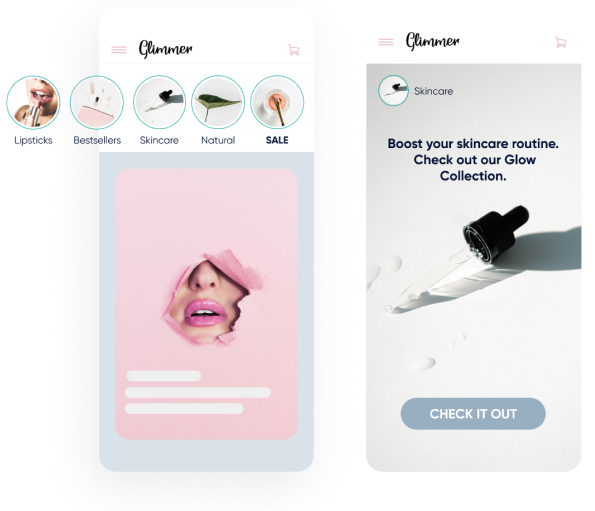
- Hero banner: Dynamic based on segment, referral source, or browse history
- Product recommendations: Personalized carousels (recently viewed, similar items, frequently bought together)
- Social proof: Location-based (“Popular in your area”) or behavior-based (“Customers who viewed this also bought”)
- Exit-intent overlays: Triggered by mouse movement toward browser close
Server-side rendering is fastest but requires backend integration. Client-side rendering is easier to implement but causes flicker. Edge-side rendering at the CDN layer balances speed and flexibility.
Always define a default experience for cases where personalization fails. An empty carousel is worse than a bestsellers fallback.
How do you deploy product recommendations that handle cold start?
Which recommendation algorithm should you use? The answer depends on your catalog size, data volume, and whether you need to recommend to anonymous visitors.
- Collaborative filtering: “Users who bought X also bought Y,” requires purchase history and struggles with new users and new products
- Content-based: “Products similar to what you viewed,” works for new users but requires rich product metadata
- Hybrid: Combines both, offers strong performance, and adds implementation complexity
Cold-start scenarios need explicit fallback logic. For new users with an established catalog, default to bestsellers or trending items until behavior accumulates. For established users with a new product, use content-based similarity to surface new arrivals. For new users with a new product, fall back to editorial curation or category-level popularity.
Over-relying on collaborative filtering creates popularity bias. Failing to exclude out-of-stock items erodes trust. Recommending products the user already purchased (without replenishment logic) feels tone-deaf.
How do you personalize email, SMS, and WhatsApp with modular templates?
Email personalization is limited by client rendering. Open-time content (live inventory, countdown timers) doesn’t work in all email clients, and Apple Mail Privacy Protection inflates open rates, making send-time optimization less reliable.
Use a modular template architecture:
- Static modules: Brand header, footer, legal disclaimers
- Dynamic modules: Product recommendations, personalized copy blocks, location-based offers
- Fallback modules: Default content when personalization data is missing
| Channel | Personalization limit | Compliance note |
| Open-time content unreliable in some clients | CAN-SPAM, GDPR consent required | |
| SMS | Tight character limits | Quiet hours (set by local policy) |
| Template approval required for outbound | Session window limits free-form replies |
For app-installed users, deep-link from email/SMS directly to the relevant product or category in the app. For non-app users, fall back to mobile web. Want proven module patterns and channel-specific guardrails your team can ship fast? Start in the product demo hub and see how omnichannel templates and fallback logic work in practice.
How do you orchestrate cross-channel journeys with frequency caps?
Without frequency caps, a customer who abandons a cart receives an email, an SMS, a push notification, and a WhatsApp message in a short window. That creates a poor customer experience.
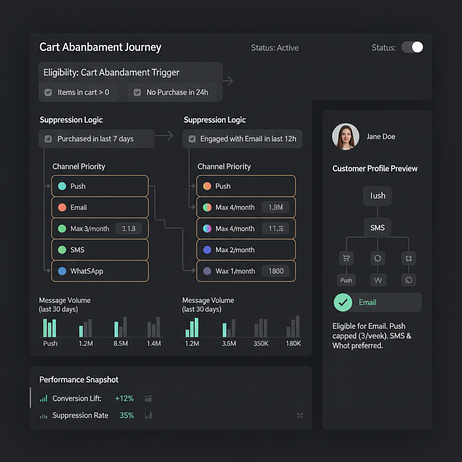
Architect, Insider One’s customer journey orchestration solution, manages this through several components:
- Eligibility rules: Who qualifies for this journey? (e.g., cart value above a minimum threshold, not purchased recently)
- Exclusion rules: Who should be excluded? (e.g., already received a promo today, in active support ticket)
- Channel priority: If multiple channels are eligible, which fires first? (e.g., push > email > SMS based on cost)
- Frequency caps: Maximum messages per channel per time period (e.g., limited push and email volume)
Sample arbitration logic:
- Check eligibility: Cart abandoned long enough to be meaningful, cart value above your threshold
- Check exclusion: No recent purchase, no promo sent today
- Apply cap & select channel: If push-enabled and not recently messaged on push, send push. Else, send email.
How do you use conversational commerce for support and sales?
Chatbots are often treated as deflection tools, designed to reduce support tickets. But when connected to customer profiles, conversational commerce becomes a personalization channel.
Agent One™, Insider One’s suite of purpose-built agents for customer engagement, enables an intent-to-action flow:
- Intent recognition: Natural language understanding (NLU) identifies what the user wants (product question, order status, return request)
- Profile lookup: Pull customer data (past purchases, loyalty tier, open orders)
- Personalized response: Tailor the answer based on context (e.g., “Your order shipped yesterday” vs. generic tracking instructions)
- Handoff logic: If confidence is low or issue is complex, route to human agent with full context
Set clear escalation triggers (negative sentiment, repeated misunderstanding, high-value customer) to prevent frustrating loops.
How do you apply contextual and location signals without creepiness?
Precise global positioning system (GPS)-based personalization feels invasive. City-level IP geolocation feels safe. The line between helpful and creepy depends on transparency and value exchange.
| Signal | Precision | Use case | Creepiness risk |
| IP geolocation | City-level | Local store availability, currency | Low |
| GPS (app) | Street-level | Store proximity alerts, delivery estimated time of arrival (ETA) | High if unexplained |
| Weather API | City-level | Seasonal product recommendations | Low |
| Device type | Device category | Responsive content, app install prompts | Low |
| Referral source | Campaign-level | Personalized landing pages | Low |
Mitigate risk with transparency: explain the signal (“Because you’re in Chicago, here are stores near you”), offer opt-out controls, and avoid sensitive inferences based on health, financial status, or political affiliation.
GPS-based personalization requires explicit app permission. If the user hasn’t granted location access, fall back to IP geolocation or skip location personalization entirely. If you want to pressure-test your consent-to-personalization rules before they hit production, Book a demo and we’ll show how to operationalize “helpful, not creepy” at scale.
How do you run experiments and auto-select winners to prevent stale experiences?
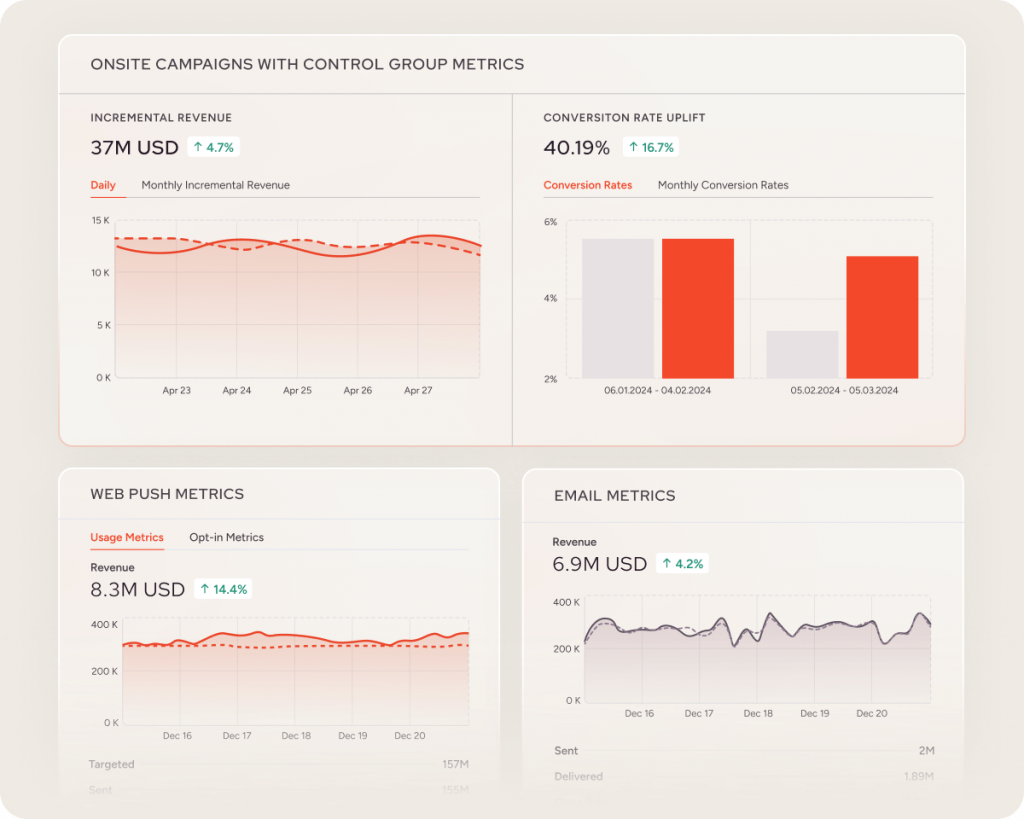
Teams run A/B tests without holdouts, then claim personalization “worked” based on in-test conversion rates. Quantifying personalization ROI remains a persistent challenge across marketing teams. Without a control group that receives no personalization, you limit your ability to measure incremental lift.
Follow a rigorous experimentation hierarchy:
- A/B test: Compare two variants (e.g., personalized vs. generic subject line)
- Holdout test: Reserve a subset of users who receive no personalization to measure true incrementality
- Multi-armed bandit: Dynamically allocate traffic to winning variants as results accumulate
Sirius AI™, Insider One’s extensive set of AI capabilities & predictive modeling, automates winner selection. But you still need a solid test plan: define your hypothesis, primary and secondary metrics, required sample size, minimum duration long enough to account for day-of-week effects, and holdout size.
Ending tests early based on early results inflates lift due to novelty effect. Testing too many variants at once dilutes sample size. Personalization may help some segments and hurt others, so check segment-level effects.
How do you measure revenue impact with unified reporting and alerts?
Can you attribute revenue to a specific personalization strategy, or only to “personalized campaigns” as a category? If the latter, you can’t optimize.
Different stakeholders need role-specific dashboards:
- Campaign manager: Variant performance, send volume, click-through rate, conversion rate
- Customer relationship management (CRM) lead: Segment-level LTV, churn rate, reactivation rate
- Executive: Revenue attributed to personalization, incrementality vs. holdout, cost per acquisition
| Metric | Alert trigger | Action |
| Deliverability drop | Meaningful decline week-over-week | Investigate sender reputation, list hygiene |
| Conversion rate drop | Meaningful decline vs. rolling average | Pause campaign, review personalization logic |
| Recommendation click-through rate (CTR) drop | Meaningful decline | Check model freshness, inventory availability |
Perfect attribution is impossible. Use a consistent model (first-touch, last-touch, or linear) and focus on directional trends, not absolute numbers.
Which personalization trends should you act on next?
Trends are only useful if they change what you do today.
- First-party data priority: Third-party cookies are deprecated or unreliable, and most marketers still struggle with unifying their customer data. Action: Audit your data collection to ensure you’re capturing first-party behavioral and transactional data with proper consent.
- Server-side tracking: Client-side tracking is increasingly blocked by browsers and ad blockers. Action: Evaluate server-side event capture for critical conversion events.
- Generative AI for content: AI-generated subject lines, product descriptions, and images are production-ready. Action: Pilot AI content generation on a low-risk campaign to establish brand guidelines and approval workflows.
- Preference centers as personalization input: Zero-party data from preference centers is becoming a primary personalization signal. Action: Redesign your preference center to capture content interests, not just channel opt-ins.
- Privacy sandbox and contextual targeting: As behavioral targeting becomes harder, contextual signals (page content, referral source) are regaining importance. Action: Test contextual personalization alongside behavioral to compare performance.
How Insider One powers personalization across every channel?
Insider One maps directly to the strategies outlined above:
- Unified customer profiles: Foundation for data collection and segmentation
- Sirius AI™: Powers predictive audiences, send-time optimization, and content generation
- Smart Recommender: Drives product recommendations with collaborative filtering, content-based, and hybrid algorithms
- Architect: Enables cross-channel journey orchestration with eligibility, suppression, and frequency caps
- Agent One™: Supports conversational commerce with Shopping Agent™ and Support Agent™
By unifying these capabilities into a single, natively integrated platform, Insider One enables significant tech stack consolidation, eliminating the high costs and data latency associated with maintaining fragmented point solutions.
Teams using Insider One get a unified data foundation with identity resolution and consent management, real-time decisioning with low-latency performance for web personalization, native support for email, SMS, WhatsApp, web, app, and conversational channels, and built-in experimentation with A/B Auto-Winner Selection and holdout support. If you’re ready to connect the dots from consent to segments to journeys to incrementality, explore the full flow in the product demo hub.
FAQs
Start with unified data collection and segmentation, then layer on product recommendations, triggered cart abandonment flows, and real-time web personalization. Measure everything with holdout tests to prove incremental lift.
Map consent states to allowed treatments before activating any personalization. Use zero-party data (explicitly shared preferences) and first-party behavioral data collected with proper consent. Avoid sensitive inferences and always provide opt-out controls.
Segmentation groups users by shared traits; personalization tailors experiences at the individual level using real-time data. Segmentation is a prerequisite for personalization, but personalization goes further by adapting content dynamically based on behavior and context.
Use holdout tests to measure incremental lift against a control group that receives no personalization. Track revenue attributed to personalized campaigns, segment-level LTV, and conversion rate by personalization variant.
At minimum, you need a CDP for unified profiles, a decisioning layer for rules or models, and activation connectors for your channels (email, SMS, web, app). Advanced personalization adds AI for predictive audiences, recommendations, and content generation.

Keep Reading
7 min.

Muharrem Derinkok
4 Jun 2026
11 min.

Chris Baldwin
2 Jun 2026
4 min.
Chris Baldwin
3 Feb 2026