

 Platform Overview

 Integration Hub

 Insider One AI™

 Customer Data Management

 Personalization

 Journey Orchestration

 Reporting & Data

 Behavioral Analytics

 Web
Web

 Email
Email

 Site Search

 Conversational CX

 WhatsApp

 Web Push

 InStory

 App
App

 SMS & RCS

 Join the $0 Migration Movement™

 The Insider One Difference

 Compare Vendors

 Switch to Insider One

 Success Story

 Retail & Ecommerce

 Financial Services

 Travel & Hospitality

 Beauty & Cosmetics

 Automotive

 Telecommunications

 Total Economic Impact™ Study

 Blog
Blog

 E-Books & Guides

 Glossary
The New Rules of Engagement: Why Omnichannel Personalization Matters Now

Updated on 11 Aug 2026
11 min.
Table of Contents
- Summary
- What is omnichannel personalization?
- Why omnichannel personalization matters for growth and loyalty.
- How omnichannel personalization works end to end.
- How to get started with omnichannel personalization.
- Omnichannel personalization examples with outcomes.
- How to measure omnichannel personalization impact.
- Privacy, consent, and governance for omnichannel personalization.
- How Insider One powers omnichannel personalization?
- FAQs
Most Popular
Summary
Omnichannel personalization creates real-time, connected experiences across channels, treating interactions as a single continuous conversation. It requires unified profiles, shared decisioning, and coordinated orchestration, unlike multichannel approaches that operate separately. Start small with a few channels, a shared ID, and coordinated decisions before scaling.
According to Segment’s State of Personalization report, most marketing teams believe they’re running omnichannel personalization when they’re actually operating disconnected channels with shared branding. A customer abandons a cart on mobile, receives an email, clicks through on desktop, and the site treats them like a stranger. That experience reflects disconnected channel coordination, not a unified omnichannel program.
True omnichannel personalization means every channel inherits context from the last interaction and contributes to a unified decisioning layer. When a customer browses shoes on their phone and opens your app later, the app already knows what they viewed and adjusts the experience accordingly.
This guide explains how omnichannel personalization actually works, what infrastructure you need to support it, and how to start with a narrow proof of concept that demonstrates value before you scale. You’ll learn the difference between multichannel, cross-channel, and omnichannel approaches, how to build the foundational layers that enable coordination, and how to measure impact beyond individual-channel metrics.
What is omnichannel personalization?
Most marketing teams call their programs “omnichannel” but run channels independently. A customer abandons a cart on mobile, gets an email, clicks through on desktop, and sees no recognition of the prior session. That’s multichannel with shared branding. Not omnichannel.
Omnichannel personalization is the practice of delivering coordinated, context-aware experiences across every channel a customer uses. Each touchpoint inherits context from prior interactions and contributes to a shared decisioning layer. When you browse shoes on your phone and later open the brand’s app, the app already knows what you looked at.
A few questions tell you whether your program qualifies:
- Shared context: Does the next channel know what happened on the previous one?
- Consistent eligibility: Do all channels reference the same rules for who sees what offer?
- Measurable continuity: Can you track a single customer’s path across channels in a single view?
| Approach | Data state | Decisioning | Customer experience |
| Multichannel | Siloed by channel | Independent rules | Disconnected |
| Cross-channel | Connected in batches | Some linked triggers | Partially connected |
| Omnichannel | Unified in real time | Centralized arbitration | Continuous |
Why omnichannel personalization matters for growth and loyalty.
When channels operate independently, the same customer receives redundant messages, conflicting offers, or promotions for products they already purchased. Wasted spend. Channel fatigue. Eroded trust.
Omnichannel coordination fixes key problems:
- Redundant outreach: Frequency caps applied globally prevent over-messaging across email, push, short message service (SMS), and paid
- Offer conflicts: A single eligibility layer ensures a customer doesn’t see a higher discount on one channel after converting at full price on another
- Post-purchase misfires: Exclusion rules propagate quickly, so a customer who just bought doesn’t get retargeted for the same item
These connect directly to outcomes you already track. Cost per acquisition drops when paid suppression works. Retention improves when messaging respects customer state, a finding reinforced by Salesforce’s Connected Customer research. Return on ad spend (ROAS) increases when eligibility stays consistent.
How omnichannel personalization works end to end.
Teams buy a customer data platform (CDP), a journey builder, and a personalization engine, then wonder why channels still operate in silos. The issue is architectural coordination across the tools you already use.
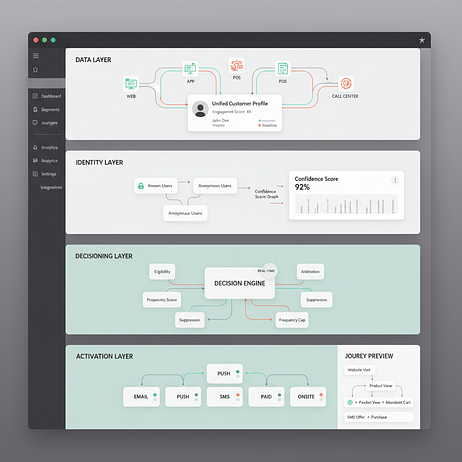
A working omnichannel system has these layers:
- Data layer: Ingests events from web, app, point-of-sale, call center, and third-party sources
- Identity layer: Resolves multiple identifiers into a single profile with confidence scoring
- Decisioning layer: Evaluates eligibility, applies propensity models, and arbitrates conflicts
- Orchestration & Activation layer: Delivers messages and experiences across channels with orchestration controls
Each layer has latency requirements. The data layer must stream events in near real time for the identity layer to keep profiles current. The decisioning layer must respond extremely quickly for web personalization but can tolerate more delay for batch email. If you want to see what this architecture looks like in a real enterprise stack, book a demo and we’ll walk through the layers, latency, and where coordination usually breaks.
Unified customer profile and data foundation.
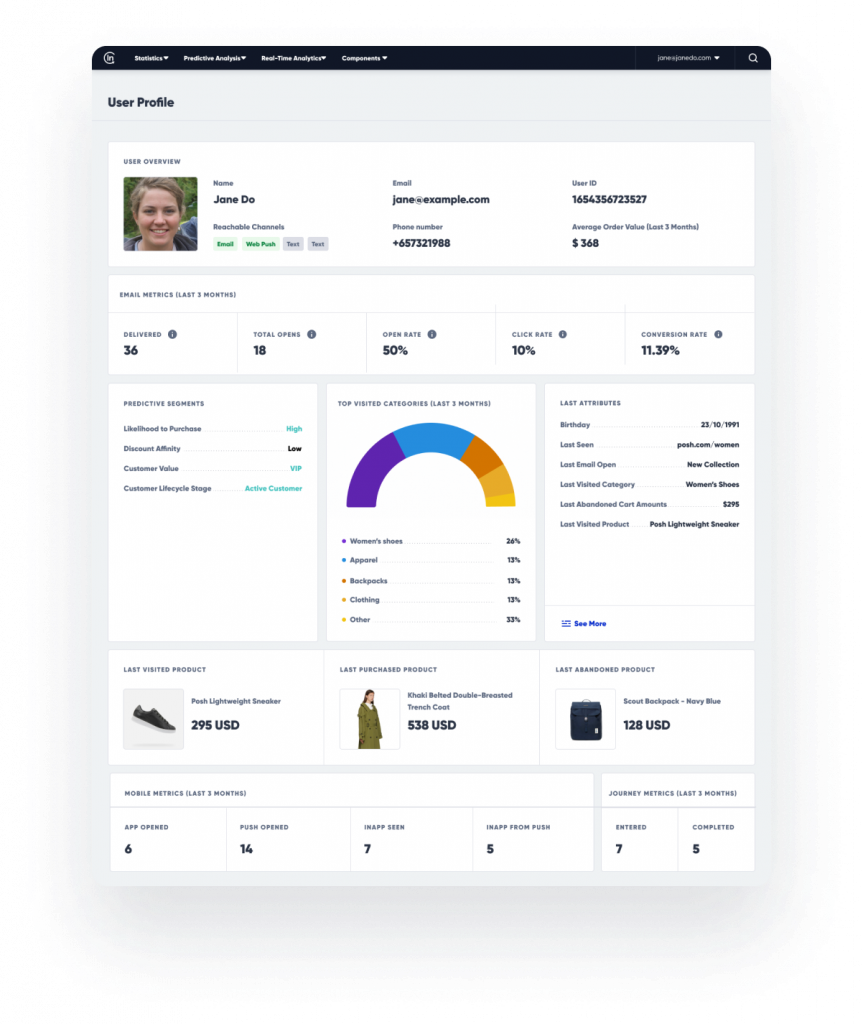
A customer appears as separate profiles instead of a unified customer profile because they used different email addresses on web, app, and in-store. Fragmented history. Conflicting segments. Personalization that treats one person as multiple strangers.
Identity resolution links identifiers like email, phone, device ID, and loyalty ID to a single profile. Deterministic matching uses exact identifier matches. Probabilistic matching relies on behavioral signals and requires confidence thresholds.
Track these metrics to keep your profiles healthy:
- Match rate: Percentage of events that resolve to a known profile
- Duplicate rate: Percentage of profiles that represent the same person
- Profile freshness: Latency between an event occurring and the profile reflecting it
Governance matters here. Define merge rules for which identifier wins when two profiles combine. Set split rules for when to separate a merged profile. Block low-quality identifiers like shared family emails.
Real-time decisioning and next best action.
Teams build segments and assume personalization follows. But segments answer “who is eligible.” Decisioning answers “what should this person see right now, given everything else competing for their attention.”
The decisioning pipeline runs through several checks:
- Eligibility: Does this customer qualify based on segment membership, consent, and business rules?
- Propensity scoring: How likely is this customer to respond to this offer versus alternatives?
- Arbitration: When multiple offers are eligible, which one wins based on priority hierarchy?
- Frequency capping: Has this customer already received their limit across channels?
- Suppression: Is there a reason to withhold this message, like a recent purchase or open support ticket?
Service recovery messages, such as password resets or fraud alerts, should always win. Lifecycle triggers like onboarding come next. Promotional offers last. This prevents a discount email from interrupting a support flow. To see how eligibility, arbitration, and global caps are applied in practice, explore the real flows in our product demo hub.
Cross-channel orchestration and delivery control.
A journey sends an email, waits for a click, then sends a push notification. But the customer already converted via a different journey. Without cross-journey stop conditions, they receive the push anyway.
Journey orchestration sequences messages, manages timing, and coordinates across journeys. You need a set of controls:
- Event triggers: What action or condition starts the flow?
- Wait conditions: How long before the next step, and does the clock reset if the customer takes action?
- Fallback logic: If the primary channel fails, what’s the backup?
- Stop conditions: What events should exit the customer from this journey?
Stop conditions must be global. A customer who converts anywhere should exit all promotional journeys, not just the journey that drove the conversion.
How to get started with omnichannel personalization.
Omnichannel sounds like a multi-year transformation project. That framing stalls progress. A more practical approach: prove coordination works on a narrow scope, then expand.
Minimum viable omnichannel requires multiple channels, a shared identifier, and a coordinated decision. If you can demonstrate that a customer who converts on web is suppressed from the email journey quickly, you’ve proven the architecture works. Everything else is scale.
Map the customer journey with channel transitions.
Teams map touchpoints by channel, creating separate flows for email, app onboarding, and web personalization. The result is a collection of channel-specific flows with no visibility into transitions.
Reframe journey mapping as transition mapping. Identify moments where a customer moves from one channel to another:
- Browse on mobile, add to cart on desktop
- Receive email, click through to app
- Start in-store, complete online
For each transition, document what context should carry over, what identifier links the sessions, and what latency the handoff requires.
Audit data, identity, and channel readiness.
Before launching a pilot, you need to know whether your infrastructure can support coordination. A journey that depends on real-time profile updates will fail if the data layer refresh cycle is too slow.
Data readiness:
- Which channels send events to the CDP?
- What’s the delay from event to profile update?
- What percentage of events include a resolvable identifier?
Identity readiness:
- Strong match rate for known customers
- Low duplicate rate
- Cross-device linking between web and app sessions
Channel readiness:
- Opt-in rates by channel
- Application programming interface (API) availability for real-time triggers
- Suppression list sync frequency
If you want a faster way to spot the gaps that quietly kill coordination, book a demo and we’ll map your readiness to the exact latency, identity, and suppression requirements that matter.
Automate one high-impact connection.
The right first connection is a connection where the trigger event is already captured reliably, the channels involved have high opt-in rates, and the business impact is measurable quickly.
Post-purchase suppression: When a purchase event fires, suppress the customer from promotional email and paid retargeting for the purchased category. Measure reduction in “already bought” complaints.
Abandoned cart with channel escalation: Email soon after abandonment, push later if no open, SMS later for high-value customers. Measure recovery rate.
Browse-to-app handoff: When a customer views a product on web with the app installed, send a push notification with the viewed product. Measure cross-device conversion rate.
Omnichannel personalization examples with outcomes.
Useful examples include the trigger, decision logic, channels involved, guardrails applied, and outcome measured.
Retail abandoned browse: A product page view with no add-to-cart triggers an email with viewed products, then a push with a limited-time offer if no open. Suppress if the customer purchased in any category within a short window. Measure recovery rate against an email-only control to verify whether the flow improves conversions.
Financial services onboarding: Account opened but key action not completed triggers an in-app prompt, then email, then SMS for high-value segments. Stop on completion and cap total touches. Measure completion rate and messages per customer to confirm whether the sequence improves efficiency.
Travel booking abandonment: A search or booking started but not completed triggers monitoring for a price drop on the searched route. Push notification with price drop alert, then email with full itinerary options. Suppress if the customer booked any trip. Measure booking rate for the price-drop cohort against a control group to confirm lift.
Want to see these patterns as ready-to-adapt playbooks (including guardrails like caps, suppression, and arbitration)? Open the product demo hub and jump straight to the journeys.
How to measure omnichannel personalization impact.
Teams report channel metrics like email open rate or push click rate and declare success. But if the same customer received messages across multiple channels, which channel drove the outcome? Would they have converted anyway?
Shift from channel attribution to program attribution. The question isn’t “which channel gets credit” but “did the coordinated program drive incremental outcomes compared to no program.”
Holdout testing: Reserve a percentage of eligible customers from the program entirely. Compare conversion, revenue, and engagement between exposed and holdout groups.
Incrementality by channel: For each channel in a journey, measure the lift from adding that channel versus the prior step alone. This identifies which channels contribute versus which are redundant.
Unified key performance indicator (KPI) hierarchy:
- Primary: Incremental revenue or conversion attributed to the program
- Secondary: Customer-level engagement across channels
- Operational: Delivery rates, suppression accuracy, latency
Avoid holdouts when the program is legally required, when the customer population is too small, or when the expected effect is too small to detect.
Privacy, consent, and governance for omnichannel personalization.
A customer opts out of email but continues receiving SMS because the preference center doesn’t sync across channels. Or a customer in the European Union (EU) receives a message that references data they never consented to share.
Omnichannel personalization amplifies privacy requirements because data flows across more systems and consent must propagate in real time.
| Purpose | Channels requiring consent | Propagation requirement |
| Marketing | Email, SMS, push, paid | Real-time sync to all systems |
| Transactional | Email, SMS | Must respect opt-out |
| Personalization | Web, app | Separate tracking consent |
Key operational requirements:
- Consent receipt: Store when, how, and what the customer consented to
- Purpose limitation: Use data only for the purpose consented
- Propagation latency: Opt-out must reach all systems quickly
- Audit trail: Log every message sent with the consent basis at time of send
How Insider One powers omnichannel personalization?
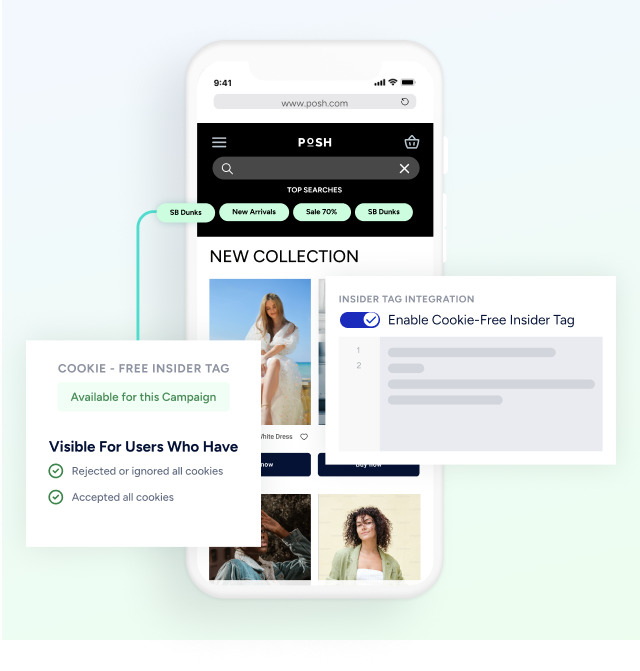
Insider One’s Actionable CDP unifies data from web, app, point-of-sale (POS), and third-party sources into a single profile with real-time identity resolution. It supports configurable identity resolution to create a 360-degree view of known and unknown users.
Architect, Insider One’s customer journey orchestration solution, coordinates personalized experiences across the industry’s widest set of channels:
- Web & Mobile Web: Onsite personalization, experiments, and 100+ high-converting templates.
- Mobile App: In-app messaging, app push notifications, and app-specific gamification.
- Messaging Channels: Email (including native AMP blocks), SMS, MMS.
- Advanced Conversational Channels: Whatsapp Business, Line, and RCS.
- Paid Media & Ad Channels: Native connectors for Facebook, Instagram, Google Ads, and TikTok to enable real-time retargeting and audience suppression.
- AI Agents: Support and Shopping Agents that provide 1:1 automated assistance across web and messaging apps.
Sirius AI™ evaluates user eligibility, applies propensity models, and selects the next-best action in real time. This ensures every message—from a WhatsApp order confirmation to a personalized TikTok ad—is delivered at the optimal time and through the most effective channel.
Why Choose a Unified Platform? The Strategic Advantages of the “Power of One”
Operating from a single, AI-native platform provides distinct advantages over a fragmented “patchwork” of point solutions:
- Unified Data & Zero Latency: Because the CDP is built directly into the engagement layer, data flows seamlessly from ingestion to action. This eliminates the sync delays and data silos common when using separate vendors for data management and messaging.
- Platform Consolidation & Cost Efficiency: Insider One replaces multiple point solutions (CDP, search, messaging, personalization) with a single contract and interface. This reduces total cost of ownership by eliminating redundant integration fees and hidden “per-message” credit costs.
- Faster Time-to-Value: Brands can launch their first personalized campaign in as little as five days. The Onboarding Center and Test Lab allow non-technical teams to validate data and go live without heavy reliance on IT or external agencies.
- Consistent Customer Experience: With shared frequency caps and global stop conditions, customers never receive conflicting offers or redundant messages across different channels. Every interaction inherits the context of the last, regardless of where it takes place.
- Agentic Execution: Unlike tools that merely provide “insights” for a human to act on, Insider One’s AI-native architecture enables autonomous optimization. Features like A/B Auto-Winner Selection and Next Best Channel automatically route traffic to the highest-performing paths to maximize ROI
If you’re ready to move from “connected channels” to real coordination, with global caps, exclusion, and measurable incrementality, book a demo and we’ll show you exactly how it runs.
FAQs
A small set of channels, a shared identifier, and a coordinated decision such as a frequency cap or suppression rule. Start there and expand as you prove value.
Apply principles: transparency so the customer understands why they’re seeing this, value exchange so the personalization helps them, and restraint so you don’t use sensitive inferences even if you can.
Configure post-purchase suppression rules that propagate to all channels quickly after the purchase event. Suppress the purchased product or category for a defined window and switch messaging to care or cross-sell content instead.

Keep Reading
7 min.

Muharrem Derinkok
4 Jun 2026
11 min.

Chris Baldwin
2 Jun 2026
4 min.
Chris Baldwin
3 Feb 2026