

 Platform Overview

 Integration Hub

 Sirius AI™

 Customer Data Management

 Personalization

 Journey Orchestration

 Reporting & Data

 Behavioral Analytics

 Web
Web

 Email
Email

 Site Search

 Conversational CX

 WhatsApp

 Web Push

 InStory

 App
App

 SMS & RCS

 Join the $0 Migration Movement™

 The Insider One Difference

 Compare Vendors

 Switch to Insider One

 Success Story

 Retail & Ecommerce

 Financial Services

 Travel & Hospitality

 Beauty & Cosmetics

 Automotive

 Telecommunications

 Interactive Platform Tour

 Blog
Blog

 E-Books & Guides

 Glossary
Insider One vs Segment vs Bloomreach: Which Enterprise CDP is the Best Fit for You?

Updated on 31 Mar 2026
17 min.
Table of Contents
Most Popular
You have a mountain of insights sitting in your CRM, another in your POS, and a third in your mobile app.
But if those systems don’t talk to each other, ecommerce personalization becomes a series of disconnected guesses.
That’s the reason so many enterprise marketing teams are turning to Customer Data Platforms (CDP).
These systems can help them unify fragmented data across multiple sources and activate that data to create high-fidelity 1:1 customer experiences.
That being said, most evaluations start with feature lists and pricing sheets.
But the platforms that look identical in a demo can perform wildly differently when you’re processing millions of events, orchestrating multi-step journeys, or proving ROI to a CFO who needs hard numbers.
This guide compares three leading enterprise CDP solutions (Insider One, Segment, and Bloomreach) through the lens of real-world performance. We’ll examine data unification speed, cross-channel activation capabilities, AI-powered decisioning, integration ecosystems, and the metrics that actually matter when you’re trying to drive revenue.
By the end, you’ll have a clear framework for evaluating which platform fits your technical requirements and business model.
What is an enterprise CDP?
An enterprise customer data platform (CDP) is a centralized system that collects, unifies, and activates customer data from every touchpoint (web, mobile, email, SMS, in-store POS, customer service interactions, and more) into a single actionable customer profile.
Unlike basic marketing databases or CRMs that store static contact information, an enterprise CDP operates in real-time. It ingests behavioral signals as they happen, resolves identities across devices and sessions, and makes that unified data immediately available for personalization, analytics, and orchestration.
What sets enterprise CDPs apart from mid-market solutions:
- Scale: Enterprise CDPs process billions of events per month without performance degradation
- Real-time processing: Sub-second data ingestion and activation (typically 50-200 milliseconds from event capture to profile update) across all channels
- Advanced identity resolution: Deterministic matching (email, phone number, customer ID) and probabilistic matching (device fingerprinting, behavioral patterns) to unify anonymous and known users across an average of 3-5 devices per customer
- Cross-channel orchestration: Native activation across 10+ channels
- Enterprise-grade security: SOC 2, GDPR, CCPA compliance with role-based access controls
- API-first architecture: Deep integrations with existing MarTech, data warehouses, and business intelligence tools
Why enterprise CDPs matter for your business
The average enterprise has data scattered across 15+ systems.
None of them talk to each other.
The cost of fragmentation:
- In-store revenue leakage: A customer browses winter coats on your website and abandons a $450 cart. Two hours later, they walk into your physical store. Your sales associate cannot see their digital intent. While the specific coat (Navy, Size Medium) sits in the stockroom 30 feet away, the associate suggests an unrelated style. The customer leaves empty-handed. Your abandoned cart email fires six hours later, but the customer already purchased from a competitor that surfaced relevant inventory in real-time.
- Duplicate acquisition costs: Your paid search team spends $85 to acquire a new customer who is actually an existing loyalty member using a secondary email address. Your CRM fails to deduplicate the identity. The customer misses their 15% loyalty discount at checkout, forcing them to contact support for manual verification. You paid a premium to “acquire” a customer you already owned, resulting in a 2-star review and a broken brand experience.
- Data-driven channel conflict: On Thursday, your email team sends a 20% discount to 500,000 subscribers. On Friday, the SMS team sends a 15% code to 80,000 customers. With a 40,000-user overlap, customers receive conflicting offers within 24 hours. This confusion drives 6,200 support tickets, spiking queue volume by 340% and increasing weekly agent costs by $18,000. Campaign revenue underperforms by 31% because customers delay purchases to resolve the price discrepancy.
What enterprise CDPs solve:
- Unified customer view: Every team (whether its marketing, service, sales, product) operates from the same real-time profile
- Personalization at scale: Deliver 1:1 experiences across web, app, email, and SMS based on complete behavioral history
- Predictive intelligence: Use AI to anticipate churn, recommend next-best actions, and optimize send times
- Cross-channel orchestration: Trigger the right message on the right channel at the exact moment of intent
- Measurable impact: Attribute revenue to specific touchpoints and prove marketing ROI with hard data
Enterprise CDP comparison: Insider One vs Segment vs Bloomreach
1. Insider One CDP
Insider One is an AI-native customer engagement platform built for enterprises that need data unification (collecting customer data from multiple sources into a single profile), cross-channel orchestration (coordinating messages across email, SMS, app, web, and more), and personalization (tailoring content and timing to individual behavior) in a single system.
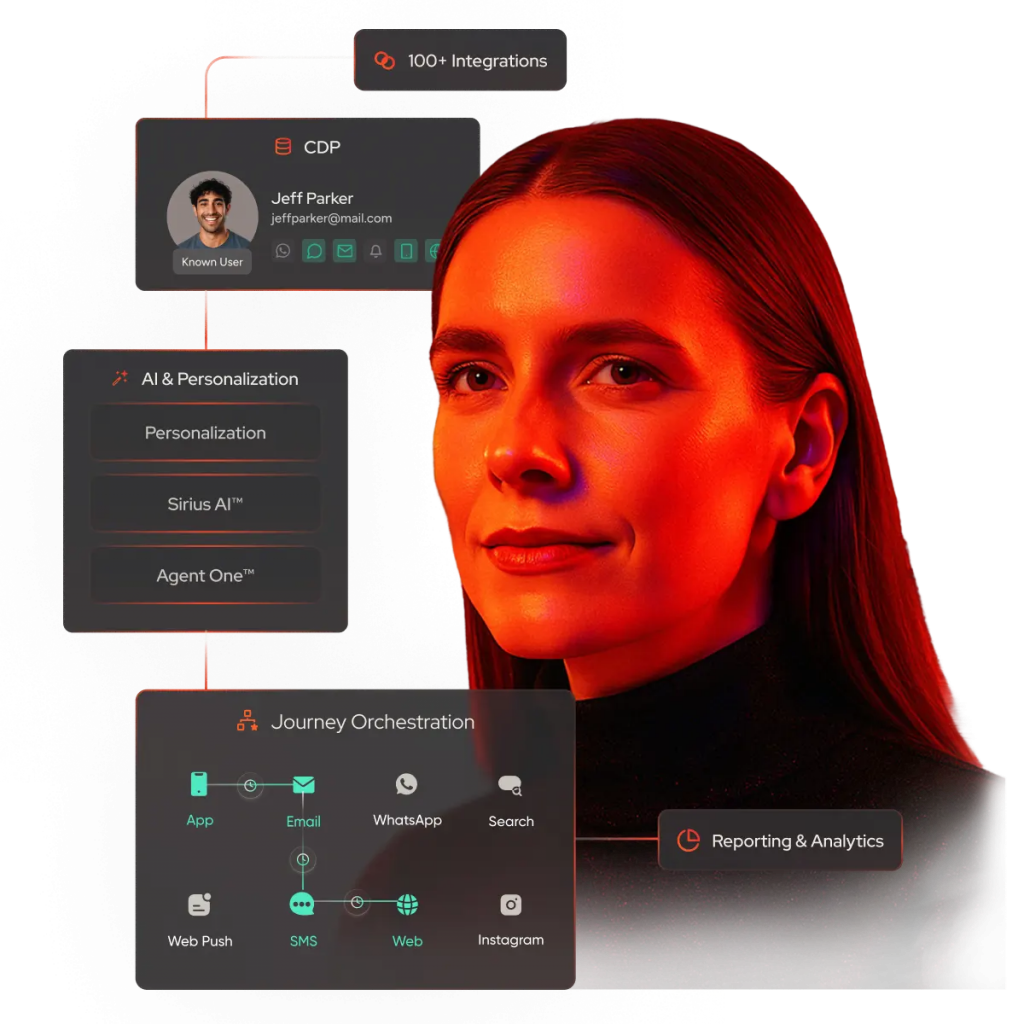
Unlike pure-play CDPs that only collect and unify data, Insider One combines its CDP with activation tools; meaning you can segment, orchestrate, and personalize without stitching together multiple vendors.
Key features:
- Actionable CDP: Unifies data from 100+ sources including Salesforce, Shopify, custom APIs, Google Analytics, and in-store POS systems, processing up to 10 billion events monthly into real-time customer profiles that update in under 200 milliseconds
- Sirius AI™: Insider One’s AI-powered engine that powers predictive segmentation (identifying which customers are likely to convert, churn, or take specific actions), next-best-channel recommendations (determining whether to reach a user via email, SMS, WhatsApp, or push), and dynamic content personalization (automatically adjusting messaging based on individual preferences and behavior)
- Agent One™: Autonomous AI agents that handle tasks like answering product questions (resolving 60-70% of queries without human intervention), recommending items based on browsing history, and surfacing actionable insights from customer data
- 12+ Native Channels: Email, SMS, WhatsApp Business, RCS (Rich Communication Services), Web Push, App Push (iOS and Android), In-App Messages, InStories (mobile-first ephemeral content), On-Site Notifications, and more—all activated from a single orchestration layer without requiring separate vendor integrations
- Architect: Visual drag-and-drop journey builder that lets marketers design complex multi-branch customer journeys without writing code
- Real-time segmentation: 120+ out-of-the-box attributes (purchase frequency, average order value, last visit date, product affinity, lifecycle stage, churn risk score) with profile updates completing in 50-200 milliseconds, enabling instant campaign triggers
Pros & cons
| Pros | Cons |
| Easy to use with helpful support: Users consistently praise the intuitive interface and responsive customer support team | Steep learning curve initially: Users report the dashboard and feature set can be overwhelming at first, requiring time to gain proficiency |
| Highly personalized campaigns: AI-driven insights enable targeted customer engagement that significantly boosts conversions and product discovery | Time-consuming onboarding: Implementation process can lead to delays in launching campaigns and configuring attributes efficiently |
| Strong automation capabilities: Platform automates personalized campaigns effectively, reducing manual work while improving engagement | Complex setup: The extensive feature set and initial configuration can be difficult to navigate without dedicated training |
| Effective product discovery optimization: Users report improved customer engagement and conversion rates through personalized recommendations | Customer support challenges during setup: Some users experience slow onboarding with back-and-forth needed to resolve initial issues |
| Comprehensive feature set: Robust capabilities for campaign management, personalization, and customer engagement across channels | Integration complications: Some users face delays and technical challenges when connecting Insider One to existing systems |
G2 (4.8/5 stars):
| “Insider One’s AI powered recommendation engine is extremely impressive. It analyzes our customers’ behavior and predicts what they might be interested in, making it easy to recommend the right products to the right customers.The ability to personalize content and promotions with Web Push has also been a game-changer. We have been able to send push notifications that are tailored to each customer’s interests, leading to higher engagement rates. These two products together have helped us see a 14.5% increase in conversion rate.” |
2. Segment CDP
Segment (a Twilio company) is a leading CDP designed to collect, clean, and route customer data to downstream tools.
It acts as the central data layer of your tech stack, ensuring every tool (from analytics to marketing automation) receives consistent high-quality data in real-time.
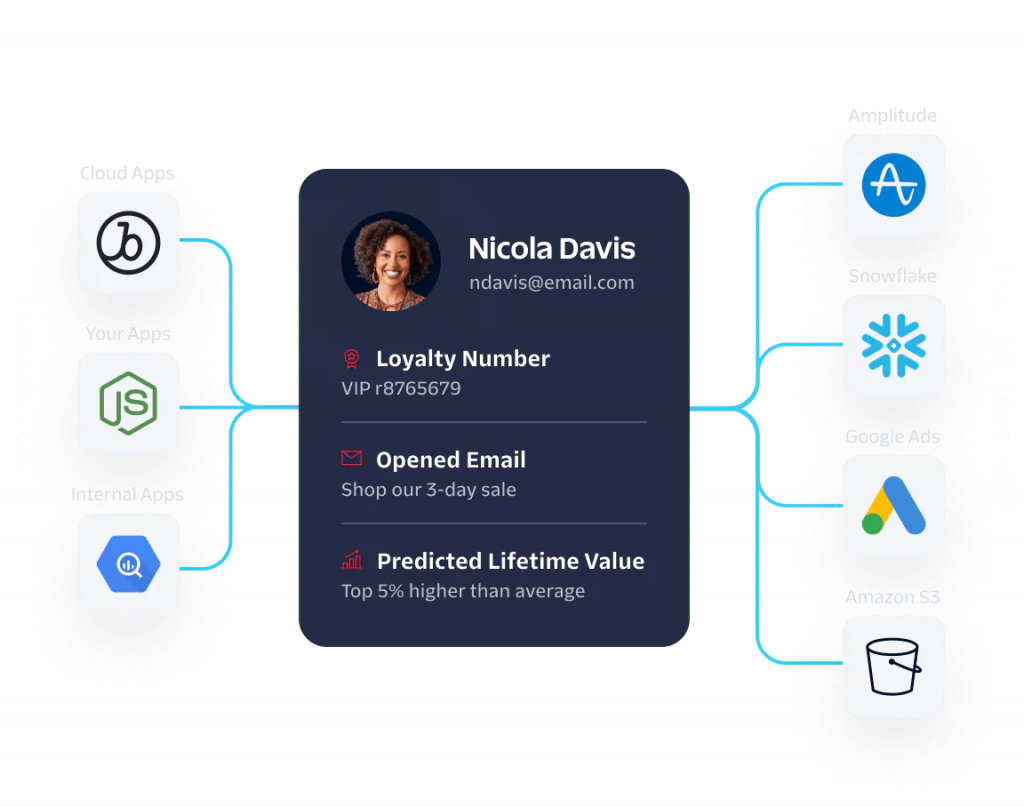
Segment does not activate campaigns or send messages directly.
Instead, it integrates with your existing MarTech stack (email, SMS, ad networks) to ensure those tools operate from a single source of truth.
Key features:
- Event streaming: Real-time data collection from web, mobile, and server-side sources (Node.js, Python, Go, etc.), processing millions of events per second with latency under 500ms.
- 450+ integrations: Pre-built connectors to analytics (Amplitude, Mixpanel), marketing (Braze, Iterable), data warehousing (Snowflake, BigQuery), and advertising (Google, Meta, TikTok).
- Protocols: A data governance layer that enforces naming conventions and schema validation, blocking inconsistent or dirty data before it hits your downstream tools.
- Unify (formerly Personas): Identity resolution that merges user data across devices into a “Golden Profile” and provides an audience-building interface for complex segmentation.
- Reverse ETL: Syncs “computed traits” or segments from your data warehouse back into operational tools like Salesforce or Zendesk.
- CustomerAI: Predictive modeling features that allow teams to calculate likelihood to churn or forecast Lifetime Value (LTV) directly within the platform.
Pros & cons
| Pros | Cons |
| Easy to use and integrate: Users find the platform intuitive with straightforward setup for connecting data sources and destinations | Expensive pricing model: Users cite high costs, especially as usage scales with Monthly Tracked Users (MTUs), making it less affordable for growing businesses |
| Seamless integrations: Enables quick connections to 400+ tools without extensive coding or heavy engineering support | High learning curve: Development teams report challenges with implementation, configuration, and understanding the platform’s full capabilities |
| Developer-friendly: Strong documentation and API-first design appeal to technical teams | Poor customer support during implementation: Users experience difficulties getting timely help, making onboarding and troubleshooting challenging |
| Clean data infrastructure: Effectively tags website activity and creates clear event streams for downstream tools | Interface design issues: Users criticize the UI for hindering report creation, audience management, and navigation |
| Best-in-class data routing: Ensures consistent, high-quality data flows to analytics, marketing, and data warehousing tools | Long-term cost concerns: Users worry about expenses associated with mistakes during implementation and ongoing usage as data volume grows |
G2 (4.5/5 stars):
3. Bloomreach CDP
| “I’ve been using Segment at different companies for the last 6 years and every time I’ve introduced Segment to an org, it had an immediate impact across multiple teams – marketing, growth, product, cx. Some highlights:– Flexibility to plug in new tools and replay historical data– All user data in one place (360 visibility)– Ease of use and speed of deployment of new campaigns, personalization across multiple channels– Strong product roadmap and a great support team” |
Bloomreach is a commerce experience cloud that combines a CDP with product discovery, content management, and email/SMS activation. It’s built specifically for e-commerce and retail, with features like AI-powered product recommendations and visual search.
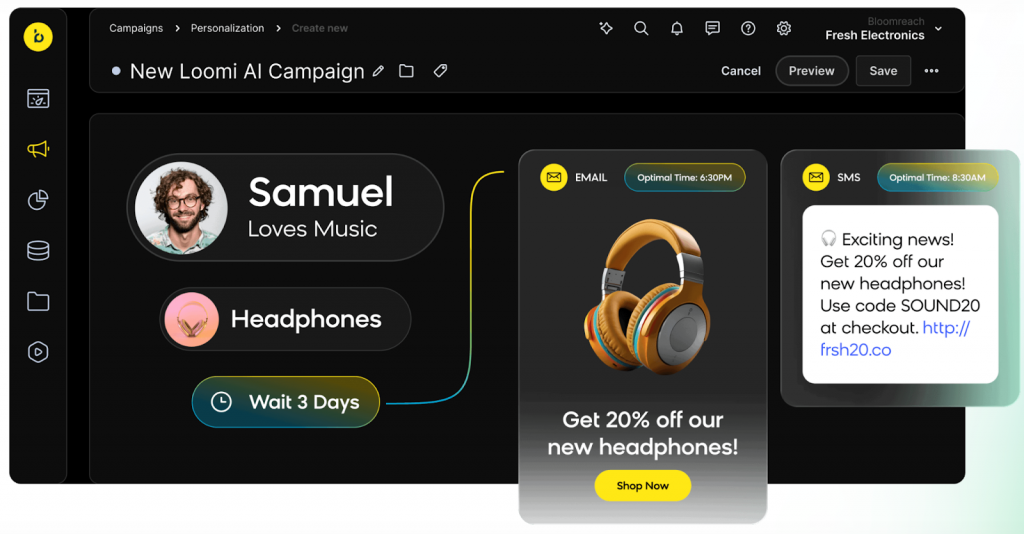
The platform positions itself as an end-to-end commerce solution—data, content, and activation in one stack.
Key features:
- Engagement CDP: Collects and unifies customer data with a focus on e-commerce behaviors (product views, cart adds, purchases)
- Loomi AI: Generative and predictive AI for content creation, product recommendations, and send-time optimization
- Discovery: AI-powered site search and product recommendations
- Content CMS: Headless content management for e-commerce storefronts
- Email & SMS activation: Native email and SMS tools for campaign execution
- Predictive models: Churn prediction, product affinity, and CLV scoring
Pros & cons
| Pros | Cons |
| Easy to use: Users find the platform intuitive, enhancing daily operations and campaign effectiveness once familiar with the system | Steep learning curve: Users consistently report difficulty navigating the platform initially, particularly challenging for new users and junior team members |
| Outstanding customer support: Users highlight quick response times, exceptional assistance, and efficiency in resolving issues from the support team | Learning difficulty for campaign setup: New users find configuring campaigns and understanding workflows particularly challenging |
| Easy integration and documentation: Clear documentation and straightforward integration process enhance campaign efficiency and user experience | Missing features: Users note limitations such as a basic survey builder, limited single customer views, and cumbersome advanced functionalities |
| Strong customer engagement capabilities: Platform enhances communication and personalization through innovative tools for customer interactions | Limited features compared to competitors: Some users feel the platform’s functionality is restricted, particularly for advanced use cases |
| Commerce-native design: Built specifically for ecommerce with deep understanding of product catalogs, SKUs, and purchase behavior | Feature complexity vs. availability trade-off: While some features exist, users find them difficult to use or less robust than expected |
G2 (4.6/5 stars):
| “I like that Bloomreach makes it easier to create segments and target the right customers at the right times. It’s also great that there is almost nothing you can’t do with Bloomreach as it combines content management, flow organizing, and data analysis all in one. We can create intelligent flows that cater to our target groups, analyze data, and tweak and adjust for the best results. I also find it helpful to use the integration to connect with Facebook for retargeting campaigns that target the right customers.” |
Key factors to consider when choosing an enterprise CDP
When picking an enterprise CDP, here are a few important factors you should consider:
Real-time data process and analytics
Enterprise CDPs must process data in real-time to enable immediate action on high-intent customer moments.
Why it matters:
If your CDP syncs profiles overnight, you can’t react when it counts. A customer abandons their cart at 2 PM, but your system doesn’t update their profile until 9 PM. By then, they’ve already purchased from a competitor.
What to evaluate:
- Ingestion latency: How quickly does the CDP capture and process new events?
- Profile update speed: Can you segment and trigger campaigns within seconds of data collection?
- Real-time analytics: Do you have live visibility into customer behavior and campaign performance?
Cross-channel orchestration and personalization
A CDP that only collects data without native activation forces you to maintain separate tools for email, SMS, push, and web.
This creates integration overhead and delays time-to-value.
Why it matters:
You need to activate campaigns across channels from a single platform to maintain consistent customer experiences and reduce vendor sprawl.
What to evaluate:
- Native channel support: Can you execute campaigns across email, SMS, WhatsApp, push, web, and in-app from one platform?
- Journey orchestration: Can you build multi-step branching customer journeys that adapt based on real-time behavior?
- AI-powered decisioning: Does the platform automatically recommend next-best actions, optimal channels, and send times?
Integration capabilities with existing tech stack
Your CDP must connect seamlessly with your CRM, analytics platforms, data warehouse, and marketing tools to avoid data silos and manual workarounds.
Why it matters:
Poor integration support creates engineering bottlenecks, delays implementation, and prevents you from leveraging existing technology investments.
What to evaluate:
- Pre-built connectors: Does the CDP offer native integrations with your existing tools (Salesforce, Google Analytics, Shopify)?
- API flexibility: Can your engineering team build custom integrations when needed?
- Data warehouse support: Can you sync data bidirectionally with Snowflake, BigQuery, or Redshift?
Scalability & performance at enterprise levels
A CDP that performs well with 100,000 customer profiles may collapse under 50 million profiles or billions of monthly events.
Why it matters:
As your business grows, your CDP must maintain fast query times, reliable uptime, and consistent performance without requiring platform migration.
What to evaluate:
- Event throughput: Can the platform process billions of events per month without performance degradation?
- Profile capacity: How many customer profiles can the system manage while maintaining fast segmentation and query speeds?
- Uptime guarantees: What Service Level Agreements (SLAs) does the vendor provide?
Ease of use & adoption for marketing teams
If your CDP requires engineering support for every segment or campaign, your marketing team can’t move quickly or test new strategies.
Why it matters:
The best platforms balance technical power with intuitive interfaces; allowing marketers to build journeys, create segments, and launch campaigns independently.
What to evaluate:
- Visual workflow builder: Can non-technical users design complex, multi-branch journeys without coding?
- Pre-built segments and templates: Are there out-of-the-box configurations to accelerate time-to-value?
- Training and support: Does the vendor provide comprehensive onboarding, documentation, and ongoing customer success resources?
Pricing & contract flexibility
CDP pricing models vary significantly.
Some charge per customer profile, others per event or Monthly Tracked User (MTU), and some use fixed enterprise licensing.
Why it matters:
Understanding cost structure and how pricing scales with growth prevents budget surprises and ensures long-term affordability.
What to evaluate:
- Pricing model: Per profile, per MTU, per event, or flat enterprise fee?
- Contract terms: Annual vs. multi-year commitments? Flexibility to scale up or down?
- Add-on costs: Are advanced features (AI, additional channels, API access) priced separately or included?
Key metrics to measure ROI
Implementing a CDP requires significant investment. Proving ROI means tracking metrics that tie directly to revenue growth and customer value.
Conversion rate uplift
What it measures: The percentage increase in conversions after deploying personalized customer journeys.
How to calculate:
| Conversion Rate Uplift = ((New Conversion Rate – Old Conversion Rate) / Old Conversion Rate) × 100 |
Example: If your baseline checkout conversion was 2.5% and rises to 3.8% after deploying AI-powered cart recovery, your uplift is 52%.
Why it matters: Conversion rate is the clearest indicator that CDP-driven personalization is delivering business impact.
Customer lifetime value (CLV)
What it measures: The total revenue a customer generates over their entire relationship with your brand.
How to calculate:
| CLV = (Average Order Value) × (Purchase Frequency) × (Customer Lifespan) |
Example: A customer who spends $80 per order, purchases 4 times per year, and remains active for 3 years has a CLV of $960.
Why it matters: CDPs increase CLV by improving retention, enabling effective cross-sell and upsell, and delivering personalized engagement that keeps customers coming back.
Churn reduction
What it measures: The percentage decrease in customers who stop engaging or purchasing from your brand.
How to calculate:
| Churn Rate = (Customers Lost in Period / Total Customers at Start of Period) × 100 |
Example: If 500 of your 10,000 active customers churned last quarter, your churn rate is 5%. If a predictive re-engagement campaign reduces that to 3.5%, you’ve cut churn by 30%.
Why it matters: Reducing churn directly protects revenue and lowers customer acquisition costs.
Average order value (AOV)
What it measures: The average revenue generated per transaction.
How to calculate:
| AOV = Total Revenue / Number of Orders |
Example: If you generated $500,000 from 10,000 orders, your AOV is $50. If personalized product recommendations increase that to $58, you’ve gained 16% per transaction.
Why it matters: CDPs drive AOV increases through intelligent cross-selling, bundle recommendations, and dynamic personalized offers delivered at optimal moments.
Engagement metrics
What they measure:
How actively customers interact with your brand across channels—email open rates, click-through rates, SMS responses, app sessions, and time spent browsing your site.
Why they matter:
Rising engagement signals that your personalization is working.
When email open rates jump from 18% to 28% and click rates climb from 2.5% to 4.8% after deploying a CDP, it means your segmentation and messaging are hitting the mark.
You’re reaching customers with content they actually care about.
Operational cost savings
What it measures: How much you save by consolidating MarTech tools—reducing vendor licensing fees, cutting integration maintenance, and eliminating manual workflow overhead.
Why it matters: Running separate platforms for email, SMS, analytics, and personalization creates hidden costs.
A unified CDP eliminates these by:
- Cutting licensing fees—no more paying for redundant tools that overlap in function
- Reducing integration maintenance—fewer vendor connections means less time managing API breakages and data sync issues
- Freeing your team to focus on strategy instead of wrangling data across disconnected systems
- Accelerating campaign launches—no waiting for IT to manually sync customer data between platforms
Example: A retail brand consolidated 5 tools (email platform, SMS provider, personalization engine, analytics, data warehouse) into a single CDP and cut annual MarTech costs by $180,000—while actually improving campaign performance.
Best practices for implementing an enterprise CDP
Follow this framework to implement an enterprise CDP:
- Start with clear business goals and KPIs: Before you implement anything, know what you’re trying to achieve. Are you trying to cut support costs by 30%? Increase conversions by 20%? Recover more abandoned carts? Pick 2-3 metrics that matter like resolution rate, customer satisfaction, cost per conversation, conversion rate, or average order value.
- Audit and consolidate data sources: Take stock of where your customer data lives—your CRM, email platform, analytics tools, mobile app, POS systems, loyalty programs, support tools. Find the overlaps and conflicts (like the same customer showing up three times with different email addresses). Decide which system is the source of truth for each type of data. Plan how information will flow into your CDP—real-time through APIs, scheduled batches, or continuous event streams. Clean up your data first. Outdated records and messy formatting will only hurt your CDP’s performance.
- Plan Phased Rollout: Start by connecting your core systems and building unified customer profiles (Weeks 1-4). Then launch one high-impact use case, like recovering abandoned carts through email and SMS (Weeks 5-8). Next, expand to more sophisticated cross-channel journeys and segmentation (Weeks 9-12). After that, keep testing and optimizing.
- Team training: Train your marketing, CRM, and analytics teams early. Give them hands-on practice with scenarios that match your actual business needs. Document your processes so anyone can learn how to build segments or launch campaigns.
- Monitor performance & optimize continuously: Keep an eye on how your journeys are performing. Where are customers completing the journey? Where are they dropping off? Which segments convert best? Which channels work better for your audience—email, SMS, or push notifications? Use real-time dashboards (like Insider’s Architect) to see live analytics, A/B test results, and early warnings about underperforming segments. Review your results monthly—double down on what’s working, pause what isn’t. Keep testing different approaches: try new subject lines, adjust send times, experiment with different offers and journey structures.
Conclusion
To help you make a decision, here’s a recap of what we’ve covered:
- Insider One is the best choice for enterprises that want a unified platform combining CDP, AI-powered orchestration, and native cross-channel activation. If you need to consolidate vendors, scale personalization, and prove ROI fast, Insider One delivers.
- Segment is ideal for technically sophisticated teams that already have strong downstream activation tools and need best-in-class data infrastructure. If your priority is clean, consistent data flowing to your existing MarTech stack, Segment excels.
- Bloomreach works best for ecommerce-first brands that want product discovery, content, and engagement in one platform. If you’re a retailer building a unified commerce experience, Bloomreach is purpose-built for that.
The decision framework:
- Do you need a unified platform or are you comfortable stitching tools together?
- Is real-time cross-channel orchestration critical, or is data routing your primary need?
- Are you optimizing for speed-to-value, or do you have time for multi-vendor integration?
The right CDP transforms fragmented data into strategic advantage. It reduces churn, increases CLV, and ensures every customer interaction is relevant, timely, and personalized.
Ready to see how Insider One can transform your customer engagement strategy?
Book a personalized demo with our team.
Frequently asked questions
An enterprise Customer Data Platform (CDP) is a centralized system that unifies customer data from web, mobile, email, CRM, POS, and other sources into real-time, actionable profiles. It enables personalization, cross-channel orchestration, and predictive analytics at scale.
Insider One combines CDP, orchestration, and activation in one platform with 12+ native channels and AI-native decisioning. Segment is a pure-play CDP focused on data collection and routing, requiring separate tools for activation. Bloomreach is a commerce-focused CDP with built-in product discovery and email/SMS, optimized specifically for e-commerce.
Prioritize:
Real-time data ingestion and profile updates
Cross-channel orchestration and native activation
AI-powered personalization and predictive intelligence
Deep integrations with your existing tech stack
Scalability to handle billions of events without performance loss
Intuitive UX for non-technical marketing teams
A CDP improves ROI by:
Increasing conversion rates through personalized journeys
Reducing churn with predictive re-engagement
Boosting AOV via AI-powered product recommendations
Lowering acquisition costs by improving retention
It enhances CX by:
Ensuring consistent and relevant messaging across all channels
Remembering customer preferences and history across touchpoints
Delivering timely interventions at moments of intent
Pricing varies by platform and scales with usage:
Insider One: Custom enterprise pricing based on features, channels, and data volume
Segment: Usage-based pricing per MTU (Monthly Tracked User), typically starting at $120/month for small volumes and scaling significantly for enterprises
Bloomreach: Custom pricing, often bundled with Discovery and Content modules
Most enterprise deals range from $50K to $500K+ annually depending on scale and features.
Implementation timelines vary:
Basic setup: 4-8 weeks to connect core data sources and build unified profiles
First use case live: 8-12 weeks to launch initial campaigns (e.g., cart abandonment)

Keep Reading
4 min.

Chris Baldwin
3 Feb 2026
9 min

Muharrem
23 Dec 2025
7 min.
Chris Baldwin
8 Jul 2024