

 Platform Overview

 Integration Hub

 Agent One™

 Agent One™ Teams

 Customer Data Management

 Personalization

 Journey Orchestration

 Reporting & Data

 Behavioral Analytics

 Web
Web

 Email
Email

 Site Search

 Conversational CX

 WhatsApp

 Web Push

 InStory

 App
App

 SMS & RCS

 Join the $0 Migration Movement™

 The Insider One Difference

 Compare Vendors

 Switch to Insider One

 Success Story

 Retail & Ecommerce

 Financial Services

 Travel & Hospitality

 Beauty & Cosmetics

 Automotive

 Telecommunications

 Total Economic Impact™ Study

 Blog
Blog

 E-Books & Guides

 Events

 Glossary
Customer Engagement Strategies: The Ultimate Guide for 2026

Updated on 10 Aug 2026
15 min.
Table of Contents
- What is customer engagement?
- The real cost of getting customer engagement wrong
- Customer engagement vs. customer experience
- 4 customer engagement strategies that drive revenue in 2026
- How to measure customer engagement: Metrics that actually matter
- The future of customer engagement
- Why choose Insider One for customer engagement
- FAQs
Most Popular
Your loyalty program has 2 million members.
But only 2% of them have made a purchase in the last 90 days.
That’s not a loyalty program. That’s a list.
The gap between “customers who signed up” and “customers who actually come back” is where most ecommerce brands quietly lose revenue. Not to bad products, but to messages that arrive too late, channels that don’t talk to each other, and segments built on data that’s already weeks old.
The problem is rarely reach.
Most ecommerce teams are already running email, SMS, push, and paid retargeting simultaneously.
The problem is that all those channels are firing independently, without a shared picture of who this customer is right now. What they just browsed, what made them abandon, whether they’re drifting toward a competitor or three clicks away from their highest-ever order value.
The fix comes from building a system where customer data updates in real time, channels coordinate based on actual behavior, and every interaction is specific enough to be worth the customer’s attention.
This guide covers what customer engagement means for ecommerce brands at scale, why most programs stall after the first purchase, and the tactics and metrics separating brands seeing 30%+ retention improvements from those still optimizing for opens and clicks.
What is customer engagement?
Customer engagement is the sum of every meaningful interaction a customer has with your brand across every channel, at every stage of their lifecycle, that builds or erodes their relationship with you.
A customer receiving your weekly promotional email is not engaged.
Whereas, a customer who opens it, clicks through to a product they’ve been browsing, and adds it to their cart is. A customer who contacts support, gets an immediate resolution, and leaves a five-star review is too.
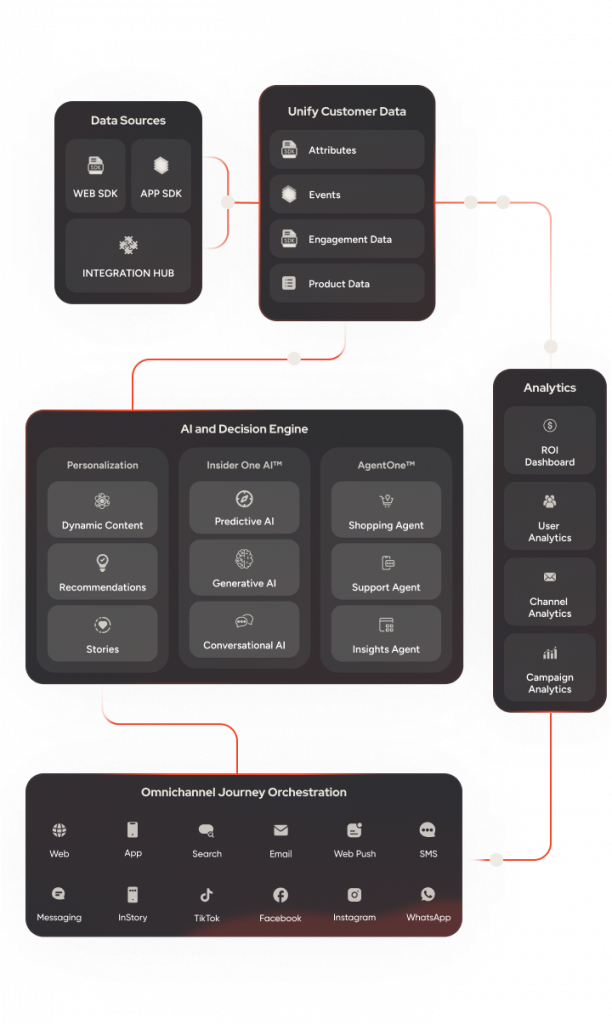
For ecommerce brands, engagement operates across three layers:
- Behavioral engagement covers what customers actively do. How often they visit your site or app, which product categories they browse repeatedly without buying, how many sessions it takes them to convert, and whether their purchase frequency is increasing or declining over time. These patterns tell you whether a customer is warming up, coasting, or quietly preparing to leave.
- Emotional engagement is harder to quantify but shows up in measurable signals. A customer who leaves an unprompted five-star review mentioning a specific product detail is emotionally engaged. So is a customer who complains loudly because they care enough to expect better. Customers who are emotionally disengaged don’t complain. They simply stop showing up. NPS trends, review sentiment, and voluntary opt-ins to loyalty programs are the closest proxies for this dimension.
- Financial engagement is where the other two ultimately express themselves in revenue terms. The signal to watch is the pattern of spend: whether average order value is growing as customers explore more of your catalog, whether they’re buying at full price or only during sales, and whether purchase intervals are shortening (habit formation) or lengthening (drift).
Most ecommerce teams measure behavioral engagement in their analytics platform and try to influence financial engagement.
That’s a mistake.
Brands consistently outperforming their benchmarks connect all three into a unified customer health score the entire organization can act on.
The real cost of getting customer engagement wrong
Acquiring a new customer costs 5x more than retaining an existing one. And even a 5% increase in retention can improve profits by 25-95%.
Most ecommerce brands know these numbers. Yet they still run disconnected campaigns, treat engagement as a marketing metric rather than a company-wide priority, and measure success by numbers that tell you almost nothing about actual relationship quality.
Before getting into strategy, here is what poor engagement actually costs in practice.
- The re-engagement email that arrives six hours too late. A customer adds $340 worth of skincare products to their cart on a Tuesday afternoon. They reach the shipping page, see a $12 delivery fee, and abandon. Your re-engagement email fires at 9 PM with a generic “You left something behind” subject line. By that point, they’ve already purchased from a competitor who offered free shipping over $200 and sent a push notification within eight minutes of abandonment. Waiving that $12 fee would have cost your brand nothing on a $340 order. You lost the sale and paid for the email sequence anyway.
- The promotional conflict that generates support tickets. On Thursday, your email team sends a 20% discount to 800,000 subscribers. On Friday, the SMS team sends a 15% code to 120,000 customers. There’s a 55,000-user overlap. Those customers receive two different offers within 24 hours, wait to see if something better arrives, and flood your support queue asking which discount applies. You’re now paying support agents to resolve a conflict your own channels created, while campaign revenue underperforms because purchase decisions stall.
- The loyalty member acquired twice. Your paid search team spends $65 acquiring a customer who is already a loyalty member with 4,200 points, using a secondary email address. Identity resolution fails to deduplicate. The customer completes their purchase without being recognized, misses their loyalty discount, and contacts support for manual verification. You paid acquisition costs for a customer you already owned, delivered a broken experience to someone who earned better, and generated a support interaction costing $8-12 to resolve.
Each of these is a daily occurrence at scale. Individually they look like operational hiccups. Collectively they represent serious, compounding revenue leakage.
Customer engagement vs. customer experience
The terms customer engagement and customer experience are often used interchangeably.
However, conflating them leads to misallocated budget.
- Customer experience is the environment your brand creates. Elements like website performance, product quality, checkout flow friction, packaging, in-store design, and support response time matter. It’s shaped by every touchpoint, including the passive ones customers don’t consciously register until something goes wrong. When a customer says “I just love shopping here,” they’re usually describing customer experience.
- Customer engagement is the active two-way exchange happening within that environment. For instance, the message you send at the right moment, the journey that responds to what a customer just did, and the intervention that arrives before a customer has decided to leave. When a customer says “they always seem to know what I need,” they’re describing customer engagement.
Think of customer experience as the physical store, including the layout, the lighting, the ease of finding what you came for, and the quality of the products on the shelf.
Customer engagement, on the other hand, is the sales associate who remembers you bought the same jacket in black last season, who tells you the new color just came in before it hits the floor, and who knows not to approach you when you have headphones in because you prefer to browse alone.
You can have a flawless customer experience yet poor engagement.
A beautiful website with fast load times and a smooth checkout will convert a customer once. Focusing on customer engagement is what will make them come back, spend more, and tell other people about you.
4 customer engagement strategies that drive revenue in 2026
To drive more revenue, implement these customer engagement strategies in 2026:
1. Real-time behavioral segmentation
Static segments are rear-view mirrors.
- “Customers who purchased in the last 90 days.”
- “Loyalty tier: Gold.”
- “Browsed category: Women’s Outerwear.”
By the time you act on them, the customer has already moved.
Consider what real-time segmentation looks like in practice.
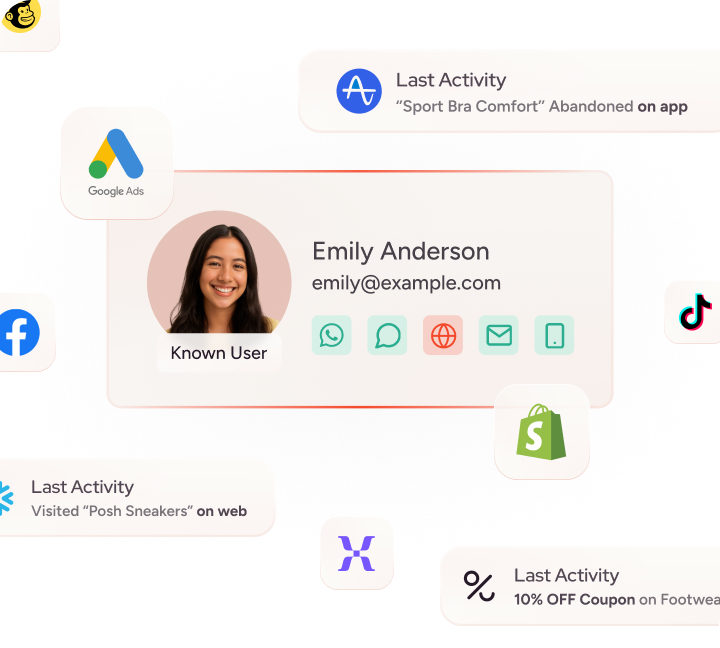
A customer visits your site and searches for “running shoes for flat feet.” They click on three products, read reviews on two, zoom into sole detail images, navigate to the sizing guide, and leave without adding anything to cart.
That entire sequence happened in 14 minutes.
A real-time behavioral segmentation system captures it, places this customer into a high-intent, high-consideration segment immediately, and triggers a follow-up that addresses flat foot support, links to the specific products they reviewed, and references the size guide they already read.
What most brands send instead: 20% off the entire running category, because the profile shows “browsed: running shoes.”
The micro-signals that separate a high-intent visitor from a casual browser include whether they used site search (significantly higher intent than navigation browsing), whether they zoomed into product detail images, how many review pages they read, whether they navigated to a size or fit guide, and whether they added to cart and removed it versus never adding at all. Each is a different intent state requiring a different response.
What to evaluate in your stack: How quickly does your platform update a customer’s profile after a behavioral event? If the answer is “next batch run” or “within an hour,” you’re working with stale data. Profile updates need to complete in milliseconds to enable real-time triggers.
Insider One’s CDP unifies behavioral data from 100+ integrations into a single customer profile, with real-time activation built for enterprise-scale event volumes, so a customer’s latest behavior can drive what they receive moments later.
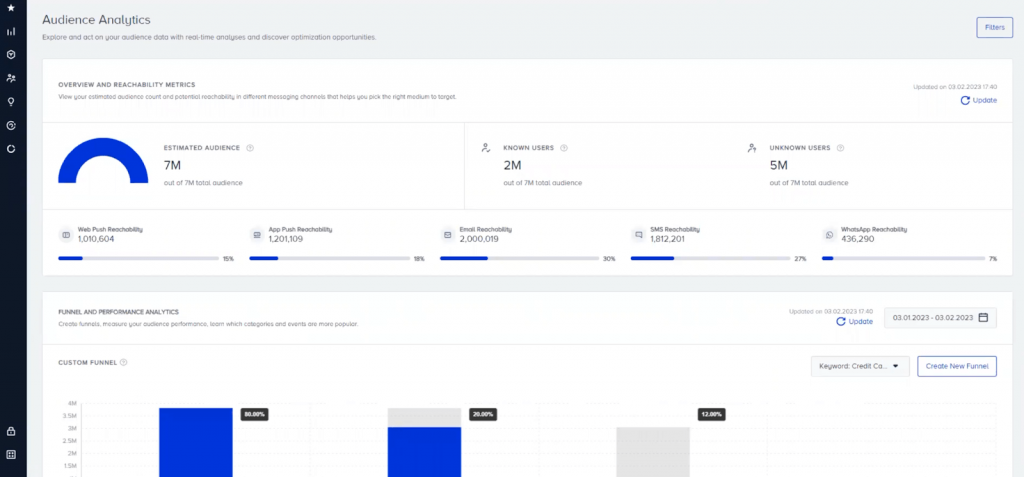
2. Cross-channel journey orchestration
The average enterprise customer interacts across 5-7 touchpoints before converting on a considered purchase. This can be the sequence:
- Social ad
- Site visit
- Retargeting ad
- Product page
- Abandonment
- Push notification
- And finally SMS conversion
Seven touchpoints across four channels, and each one needs to know what the others have already done.
Effective orchestration requires three things working simultaneously.
- Shared behavioral state across all channels in real time. When a customer purchases, that event needs to propagate to every active channel within seconds. Suppression logic only works if the purchase event reaches the suppression rule before the next message fires.
- Journey branching based on what customers do and don’t do. A customer who opens your re-engagement email three times in 48 hours without clicking might have witnessed a content or CTA failure. A customer who doesn’t open at all may need a different channel or a cooling-off period. If you treat both identically because “they didn’t convert,” you’re leaving money on the table.
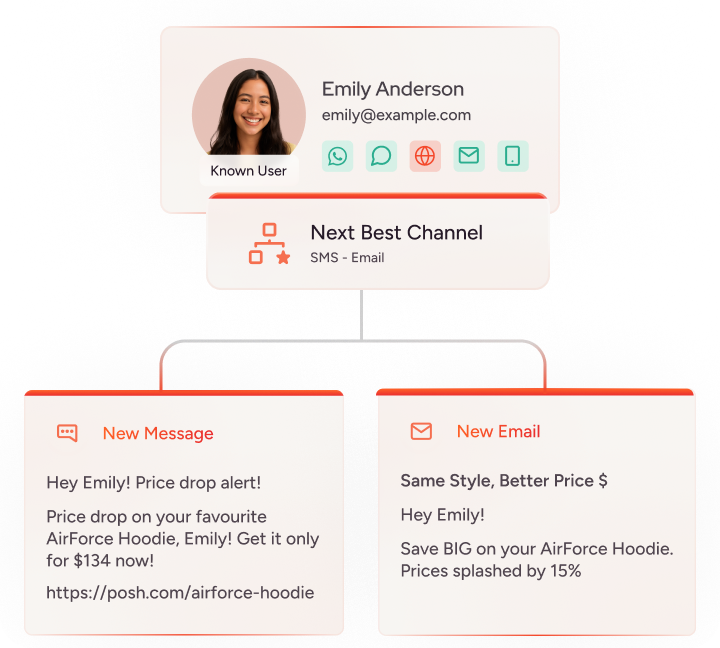
- Channel selection based on individual response history. Some customers open every push notification within three minutes and ignore email for days. Others have push disabled and respond only to SMS. Historical channel-level engagement data for each individual should determine which channel leads.
Insider’s Architect lets marketing teams build these multi-branch journeys visually without writing code, connecting all native channels from a single orchestration layer so every channel decision is made with full context of what’s already happened.
3. AI-powered personalization at scale
Sending the “millennial women who bought skincare” segment a message about new moisturizers is better than sending it to your entire list.
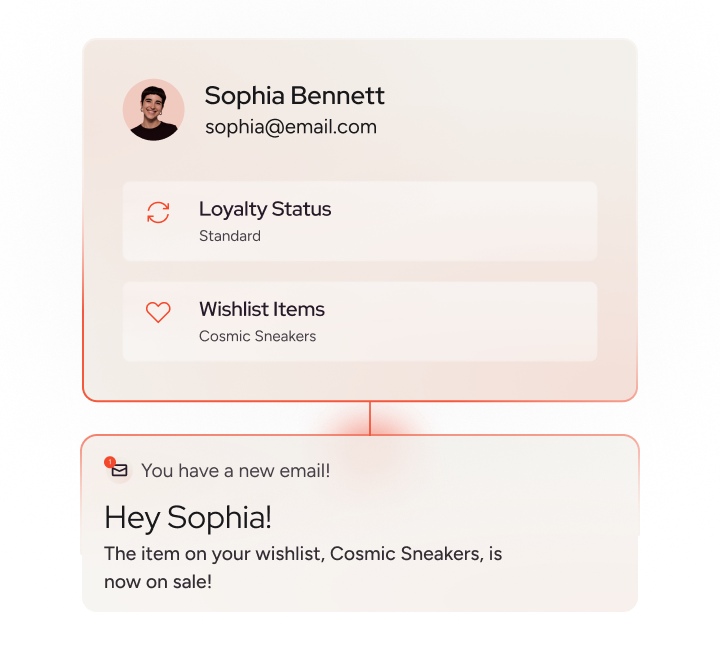
True personalization operates at the individual level.
- Which product to recommend to this specific customer based on their full behavioral history
- Which message framing will resonate based on what they’ve responded to before
- Which channel to use based on how this individual typically engages
- And when to send based on their observed rhythm
At millions of customers, that level of individual decision-making requires AI.
- Product recommendations that reflect current intent. A customer who bought running shoes six months ago and has spent three weeks browsing trail gear, hydration vests, and GPS watches is training for something more serious. Their recommendation should reflect that shift. Insider One’s Insider One AI processes real-time behavioral signals across multiple channels to optimize audiences, journeys, and content, so experiences stay current as customer interests change.
- Send time optimization at the individual level. Segment-level analysis might tell you “high-value customers engage best on Tuesday mornings.” But within that segment, one customer opens email at 6:45 AM before her commute, another at 12:30 PM during lunch, a third at 9 PM after his kids are in bed. Sending all three at Tuesday 9 AM is suboptimal for two of them. AI that learns individual engagement rhythms consistently outperforms cohort-level timing.
- Next-best-channel recommendation based on historical response patterns. A customer with a 0% push notification open rate shouldn’t keep receiving push as the primary channel. If that same customer opens 78% of SMS messages within four minutes, SMS is the right channel for time-sensitive communications. AI models built on individual-level channel history make these routing decisions automatically, without the marketing team manually maintaining channel-preference segments.
4. Lifecycle programs that track individual behavior
The most common lifecycle program failure is wrong timing.
Most triggers rely on fixed calendar rules rather than actual customer behavior.
Consider two customers in a “lapsing” segment set at 60 days since their last purchase.
- Customer A typically buys every 20 days; at 60 days, she is three cycles overdue and your intervention is late.
- Customer B buys every 75 days; at 60 days, she is still in her normal cycle. A re-engagement email treating her as at-risk signals that the brand does not know her.
Lifecycle triggers must stay relative to each customer’s established behavioral baseline.
This applies to win-back content as well.
A customer who browsed denim repeatedly likely encountered a size availability issue. A customer with an unresolved support ticket suffered an experience failure. A single “10% off” email addresses neither. One retail brand segmented lapsed users by their last interaction:
- Cart abandonment: Received friction-removal messaging (free shipping).
- Support interaction: Received a service recovery sequence.
- Post-purchase, no-return: Received new arrivals in their previous category.
This segmented approach achieved a 19.3% reactivation rate, compared to 6.1% for the single-campaign method.
How to measure customer engagement: Metrics that actually matter
Most engagement dashboards prioritize vanity over value. Metrics like opens, clicks, and follower counts often show weak correlation with revenue.
To drive actual growth, focus on these CFO-aligned indicators.
Customer lifetime value (CLV)
CLV is the total revenue a customer generates across their entire relationship with your brand.
This is the single metric that captures whether your engagement programs are working over time, because it integrates purchase frequency, order value, and relationship duration into one number.
| CLV = Average Order Value × Purchase Frequency × Customer Lifespan |
If your average customer spends $85 per order, purchases 4.2 times per year, and stays active for 2.1 years, their CLV is $749.70. A post-purchase engagement program that extends average customer lifespan by six months pushes that to $792.75, a $43 improvement per customer. Across 200,000 active customers, that’s $8.6M in additional revenue without acquiring a single new customer.
CLV makes the compound effect of retention visible in dollar terms, which is why it’s the right metric for engagement investment decisions.
Repeat purchase rate
The percentage of customers who make more than one purchase within a defined period. For ecommerce brands, this is the most direct indicator of whether post-purchase engagement is working.
A low repeat purchase rate despite strong initial conversion means something in the follow-up failed to give customers a compelling reason to return. That could be the communication sequence, the next-purchase incentive, or the product experience itself. All of it is fixable, and fixing it costs significantly less than replacing churned customers with new ones.
| For many ecommerce brands, a healthy repeat purchase rate often falls between 25% and 40% within 12 months, while top performers with strong post-purchase engagement can reach 50% or higher. |
Predictive churn risk score
Churn rate is a lagging indicator. By the time someone churns, the intervention window has already closed.
Predictive churn risk scoring identifies at-risk customers while they’re still reachable.
| Churn Rate = (Customers Lost in Period ÷ Customers at Start of Period) × 100 |
Key signals that precede churn include:
- Session frequency: Dropping 40% below a customer’s established average.
- Promotion dependency: Shifting from full-price browsing to only visiting during sales.
- Unresolved support: Interactions that require multiple contacts.
- Lengthening intervals: Purchase gaps increasing by more than 1.5x their historical pattern.
A customer scoring high on churn risk while still active costs less to intervene with, is still reachable through your channels, and has a meaningfully higher probability of recovery than one who has already left.
Net Promoter Score (NPS) Trend
NPS measures the percentage of customers who would actively recommend your brand minus those who would actively discourage others.
A single measurement is a data point. Whereas, the trend across six to twelve months is a signal.
A brand with a high repeat purchase rate but declining NPS is one where customers keep buying out of habit or convenience, but wouldn’t advocate for it.
That’s a structurally fragile position.
Convenience-based retention breaks at the first credible competitive alternative.
Tracking NPS by acquisition cohort (customers acquired in the same period) also tells you whether the experience is improving or degrading for newer customers relative to established ones, which surfaces quality problems before they show up in revenue data.
Use Insider One’s Reporting & Analytics to track these trends in one place.
The future of customer engagement
Three shifts are reshaping enterprise strategy and will define competitive advantage over the next 18–24 months:
- Agentic AI is making proactive engagement possible at scale. We’re heading into a world where agentic AI systems act before the customer has to initiate anything. For instance, Insider’s Agent One autonomously resolves a large share of customer support queries, surfaces personalized product recommendations in real-time conversations, and detects campaign performance anomalies before revenue impact escalates.
- Conversational commerce is compressing the purchase journey. The redirect model (where a marketing message sends a customer to a website to complete a purchase) adds friction at the highest-intent moment. Customers on WhatsApp who are asked to click through to a website to buy have a drop-off risk at every step of that redirect. Brands enabling end-to-end purchasing within the messaging thread eliminate that risk. Insider’s Conversational CX powers end-to-end conversational journeys in messaging channels and works with WhatsApp Commerce to enable full purchasing within WhatsApp.
- The brands with the best first-party and zero-party data will win on personalization. Third-party tracking restrictions across browsers and operating systems are tightening every year. The competitive moat is now built from the quality of data collected directly from customers who chose to share it, and the speed with which that data can be activated into relevant experiences. Building that infrastructure, and the customer trust that makes people willing to share their preferences, is the long-term work that determines which brands can still deliver genuinely personalized experiences five years from now.
Ecommerce brands pulling ahead in 2026 are winning because every interaction is specific enough to be worth the customer’s attention, arrives through the channel that customer actually responds to, and triggers at the moment that customer is most likely to act.
Why choose Insider One for customer engagement
Insider One gives ecommerce teams one platform for customer data, personalization, journey orchestration and every channel their customers actually use, from email and SMS to WhatsApp, push, in-app and site search. Everything runs from a shared, real-time picture of each customer.
That means the four strategies in this guide are configuration, not a build project.
Real-time segmentation. Profiles update in milliseconds, with 120+ behavioral and predictive attributes including churn risk, predicted lifetime value and discount affinity. A customer’s latest session drives what they receive moments later.
Cross-channel orchestration. Architect connects every native channel on one canvas, with suppression and frequency capping applied at the profile level, so a purchase silences every channel at once.
AI personalization. Insider One AI sets send time per individual, routes each message to the channel that person actually responds to, and adapts recommendations as interests shift.
Behavior-based lifecycle triggers. Each customer’s own purchase interval is an attribute, so win-back fires relative to their baseline rather than a fixed 60 days.
Over 2,000 brands run on Insider One, including Vodafone, adidas, MAC Cosmetics and Clarins, with results published across retail and e-commerce. Forrester’s Total Economic Impact study reports 449% ROI and $10.2M in additional revenue.
And if you are locked into a platform that cannot do this, the $0 Migration Movement exists to remove the cost barrier to switching.
Book a demo to see it against your own data, or explore the platform tour first, no forms required.
FAQs
A customer engagement strategy is a coordinated plan for how a brand will interact with customers across every channel and lifecycle stage to build a relationship that sustains repeat purchasing, increases customer lifetime value, and generates advocacy over time.
It defines:
Which behavioral signals to act on
How quickly
Through which channels
With what content
And which revenue-connected metrics to use to evaluate whether it’s working
Metrics with the strongest and most direct connection to revenue outcomes include customer lifetime value, repeat purchase rate, predictive churn risk score, and channel-level purchase conversion rate. While open and click rates are useful diagnostic signals for identifying execution problems, they shouldn’t be primary success metrics because they don’t always correlate reliably with revenue.
Highest-impact levers are:
Real-time behavioral segmentation that responds to what customers are doing in the current session rather than what they did 60 days ago
Cross-channel orchestration where every channel decision is made with full context of what that customer has already experienced
AI-powered personalization at the individual rather than segment level
And lifecycle programs where intervention triggers are based on each customer’s personal behavioral baseline rather than fixed calendar thresholds
Engagement is the ongoing active interaction between a customer and your brand. Whereas, customer loyalty is the behavioral outcome of sustained high-quality engagement over time.
A customer can be behaviorally engaged, opening emails, browsing regularly, making occasional purchases, while remaining functionally disloyal if they’re simultaneously shopping multiple competitors and choosing based purely on price or convenience.
Loyalty means your brand is the default choice when a competitor offers a comparable alternative.
A well-executed customer engagement strategy builds toward that outcome by making each interaction valuable enough that switching carries a real perceived cost.

Keep Reading
4 min.

Chris Baldwin
3 Feb 2026
8 mins.
Chris Baldwin
8 Oct 2026
8 mins.
Chris Baldwin
8 Oct 2026