

 Platform Overview

 Integration Hub

 Agent One™

 Agent One Teams™

 Customer Data Management

 Personalization

 Journey Orchestration

 Reporting & Data

 Behavioral Analytics

 Web
Web

 Email
Email

 Site Search

 Conversational CX

 WhatsApp

 Web Push

 InStory

 App
App

 SMS & RCS

 Join the $0 Migration Movement™

 The Insider One Difference

 Compare Vendors

 Switch to Insider One

 Success Story

 Retail & Ecommerce

 Financial Services

 Travel & Hospitality

 Beauty & Cosmetics

 Automotive

 Telecommunications

 Total Economic Impact™ Study

 Blog
Blog

 E-Books & Guides

 Events

 Glossary
Cross-Channel Marketing Automation That Improves Customer Engagement

Updated on 12 Aug 2026
10 min.
Table of Contents
- Summary
- Why most cross-channel strategies fail before they start
- The building blocks of a connected cross-channel engagement system
- Behavior-triggered sequences vs. broadcast campaigns
- Real cross-channel marketing examples worth studying
- Choosing the right platform capabilities for your engagement goals
- Get started with coordinated cross-channel engagement with Insider One
- FAQs
Most Popular

Summary
Cross-channel marketing fails when customer data isn’t unified in real time, causing disconnected messaging across email, SMS, and push. The most effective systems combine unified profiles, behavioral segmentation, orchestration, and cross-channel attribution. Behavior-triggered campaigns outperform broadcasts because they respond instantly to customer actions, and brands that coordinate these elements see stronger engagement and conversion results.
Your team is running email, SMS, push notifications, and paid retargeting. You have invested in each channel, built content calendars, configured automation rules, and set up reporting dashboards. And yet customers still complain that your messages feel random, repetitive, or out of sync with where they are in their journey. These channels are live, but the connection is still missing.
Effective marketing is not about how to launch more channels, but how to make the ones you are already running feel like a single, intelligent conversation with each customer rather than four separate monologues happening simultaneously. That shift requires a specific architecture, a clear sequence logic, and platform capabilities that actually support execution rather than merely promising it.
Why most cross-channel strategies fail before they start
The most common explanation for poor cross-channel performance is a technology problem with the wrong tool, the wrong vendor, and the wrong integration. The more accurate explanation is a data architecture problem that ends up as a customer experience problem.
When a customer browses a product on mobile, opens an email about an unrelated promotion 20 minutes later, or receives an SMS with a discount for an item they already purchased, the failure is not in any single channel. It is in the absence of a shared, real-time view of that customer across all of them.
That gap between expectation and experience is not primarily a failure of ambition or budget. It is a failure of execution architecture. Teams add channels sequentially, each with its own data store, its own send logic, and its own definition of who the customer is. The result is a stack where every tool has a different view on customer behaviours and it is the customer who pays the price in the form of irrelevant, mistimed, or contradictory messages.
The building blocks of a connected cross-channel engagement system
Fixing a fragmented cross-channel marketing strategy is not about replacing every tool you have. It is about understanding which structural components are missing and what each one does for the customer experience.
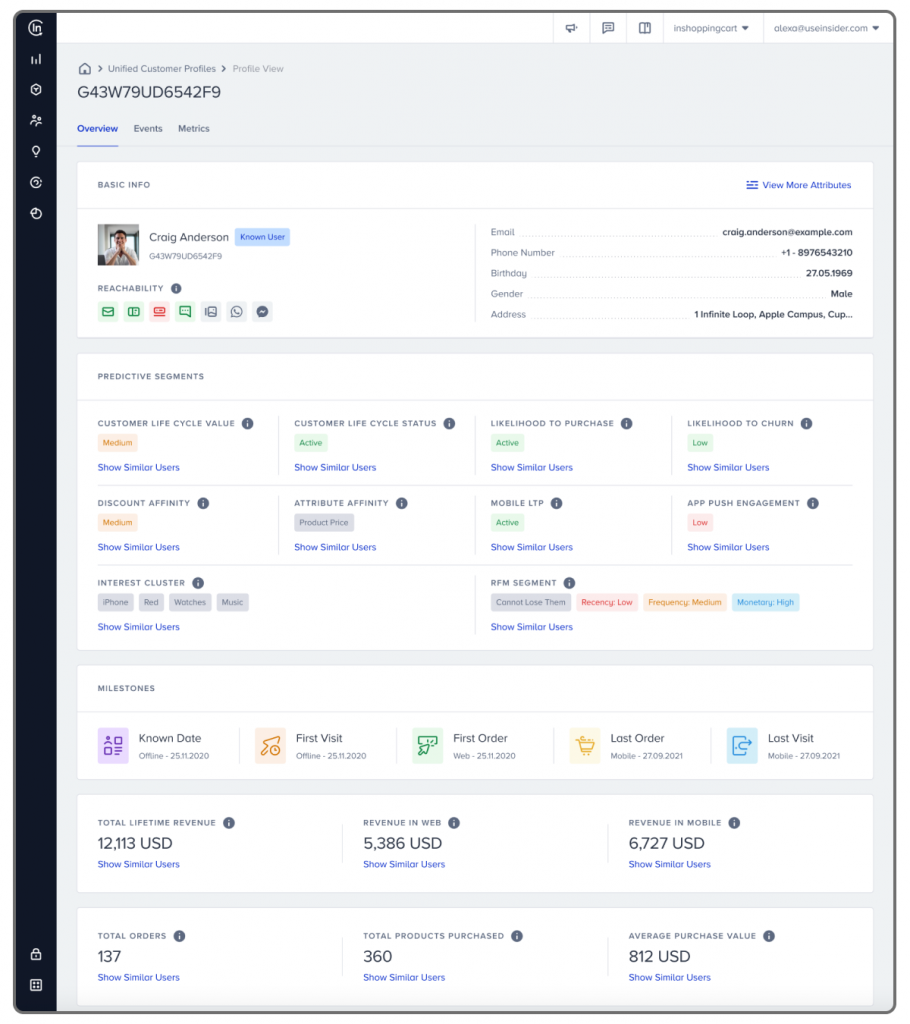
Unified customer profile as the single source of behavioral truth
Every customer interaction, whether it is a product view, a cart addition, an email open, or an in-store purchase, needs to resolve to a single, continuously updated profile. Without that, your segmentation logic in one channel will contradict your suppression logic in another.
A customer who just purchased should not receive a “don’t forget to buy” push notification, but if your push tool and your order management system do not share data in real time, that is exactly what happens. Customer Data Management is the foundation that makes every other component work.
Behavioral segmentation: beyond demographics and RFM
Recency, Frequency, and Monetary (RFM) scoring is a useful starting point, but it describes what customers have done historically. What determines whether a behavior-triggered message converts is whether it responds to what a customer is doing right now.
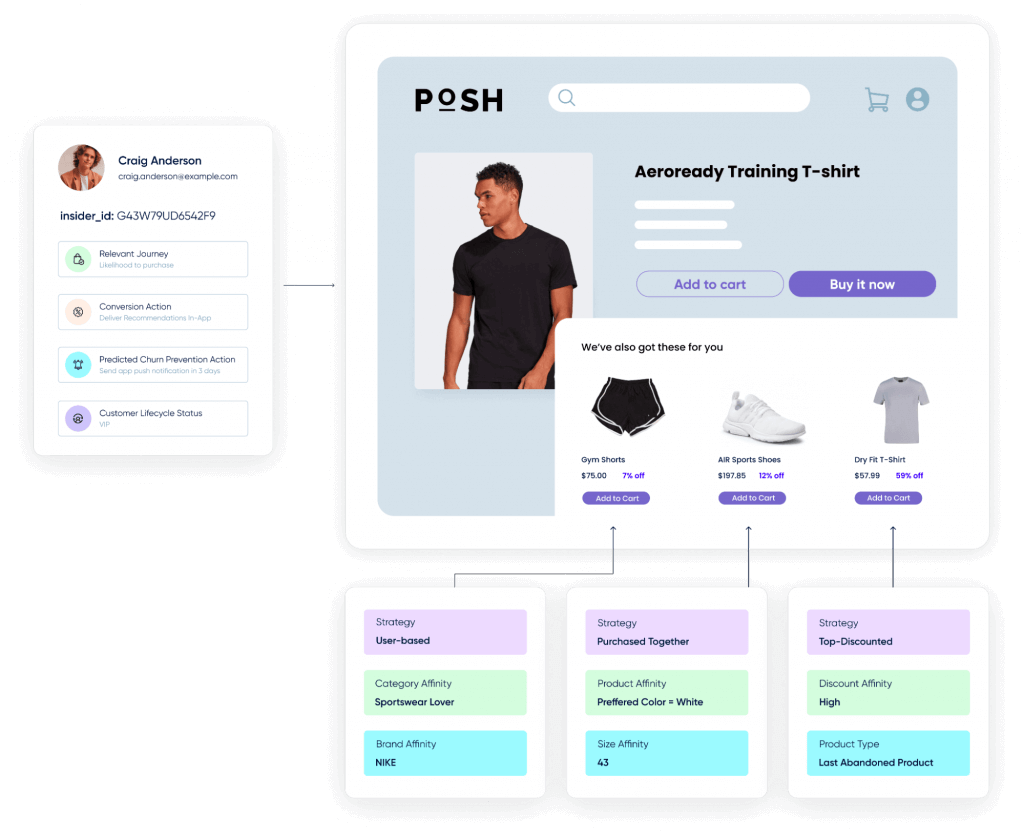
Combining RFM logic with real-time intent signals, product affinity scores, and predictive indicators like likelihood to purchase gives your segmentation the specificity to send the right message at the right moment, rather than the right message to the right demographic but three days late.
Channel orchestration is not just scheduling
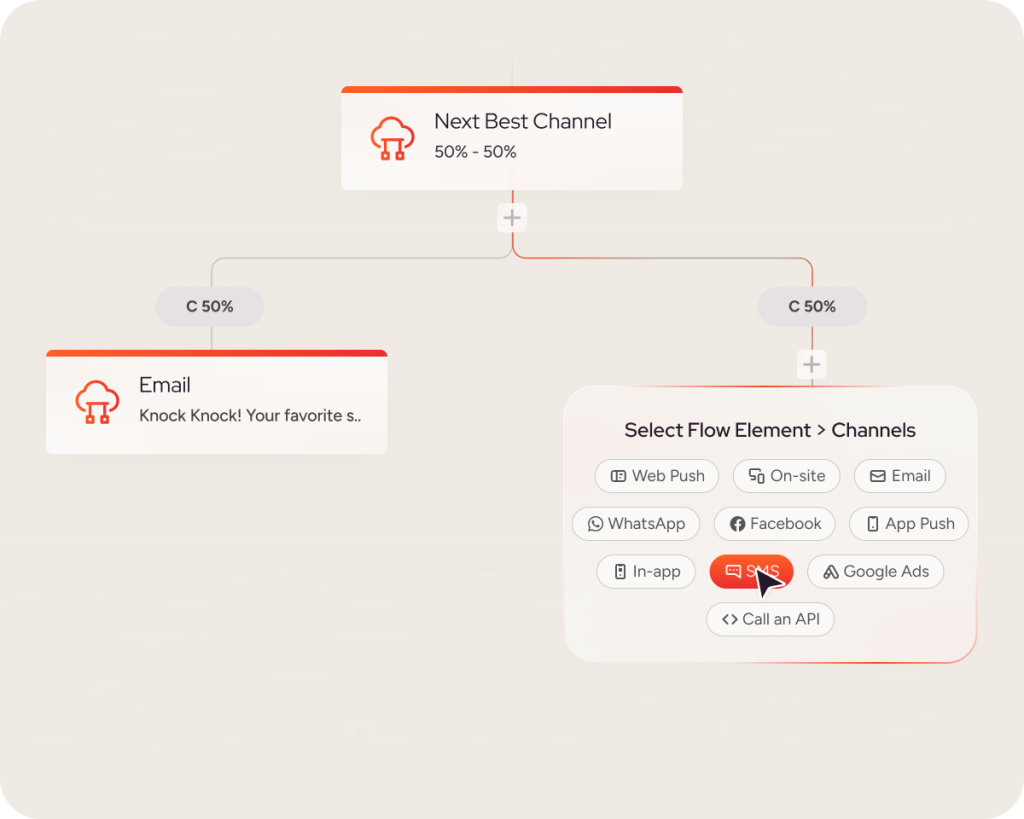
Scheduling a message for Tuesday at 10 a.m. is not orchestration. Orchestration means the system knows which channel a specific customer is most likely to respond to, routes them there first, checks whether they engaged, and escalates to the next channel if they did not.
That logic requires branching rules, wait conditions, reachability checks, and suppression triggers working together inside a single journey canvas, not across four separate platforms that cannot see each other’s send history.
Attribution feedback loop that closes the measurement gap
Without cross-channel attribution, you have channel-level performance data but no understanding of which sequence of touches drove conversion. You might correctly identify that the email drove a click, while missing that the customer had already been engaged by a push notification 18 hours earlier that created the context for that click.
A closed-loop attribution model that tracks contribution across the full sequence is what allows you to optimize timing, channel order, and message frequency over time, rather than optimizing each channel in isolation.
Behavior-triggered sequences vs. broadcast campaigns
The performance difference between behavior-triggered customer journey orchestration and scheduled broadcast campaigns is structural, not marginal.
A broadcast campaign sends the same message to a defined segment at a pre-set time. A triggered sequence sends a specific message to a specific individual based on something they just did, then adapts the next step based on how they respond. The distinction matters because one approach scales your calendar and the other scales your relevance.
How a triggered sequence actually works
Consider a customer who views the same product category twice in a single session, adds an item to their cart, and then exits without completing the purchase. A broadcast campaign may re-engage that customer with a weekly promotional email that mentions nothing about what they were looking at.
A triggered sequence behaves differently. Within the hour, the customer receives a push notification featuring the exact product they viewed, when they open the app, they see a social proof element, and an option to return to checkout.
If they do not open it, a personalized email arrives 24 hours later featuring that product, contextual recommendations in the same category, and a time-limited incentive. If they still do not convert, the third step routes to SMS, not because SMS is always the best channel, but because the sequence logic has already determined that email and push did not engage this particular user in this session.
That decision logic, anchored to behavior rather than to a calendar, is what separates sequences that drive retention from campaigns that drive fatigue.
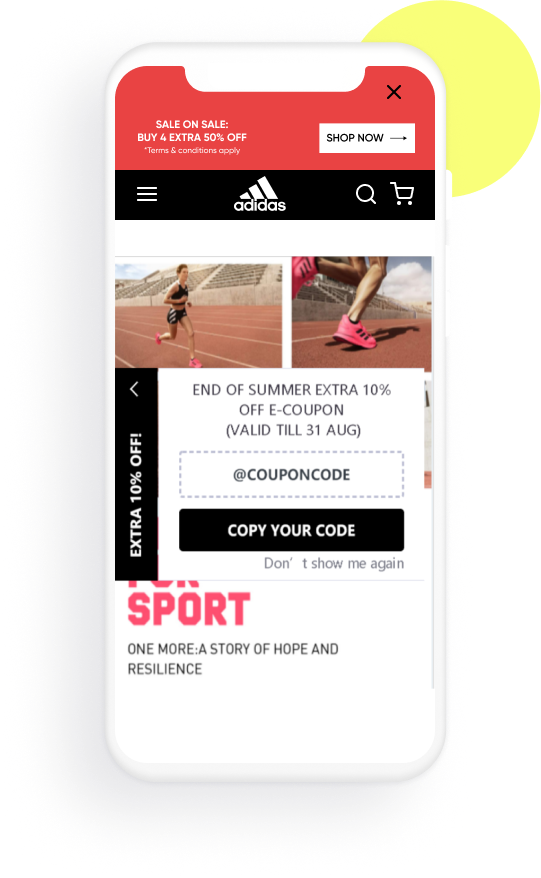
Adidas demonstrated this in practice: by using Insider One’s behavior-triggered personalization to coordinate the right message across touchpoints, they achieved a 259% increase in average order value and a 13% lift in conversion rate within a single month. The result came from the logic of the sequence, not just the volume of messages sent.
Real cross-channel marketing examples worth studying
Retail: coordinating urgency without creating noise
A mid-to-large retail brand running across web, app, email, and web push faces a specific challenge during high-traffic periods like peak season or promotional windows. The temptation is to broadcast across every channel simultaneously to maximize reach.
The brands that perform better take a different approach by identifying which customers are already in an active consideration window based on behavioral signals, sending them a targeted onsite experience first, and suppressing the broader broadcast for that segment entirely.
Channel selection is based on prior engagement signals. A customer who consistently opens push notifications but rarely opens email gets routed to push channel first, not because push is universally better, but because it works better for that customer based on observed behavior.
Suppression rules prevent the same customer from receiving the same message across three channels in the same 24-hour window. These are not sophisticated technical capabilities in isolation; they are disciplined execution choices that require the right data architecture to be possible at all.
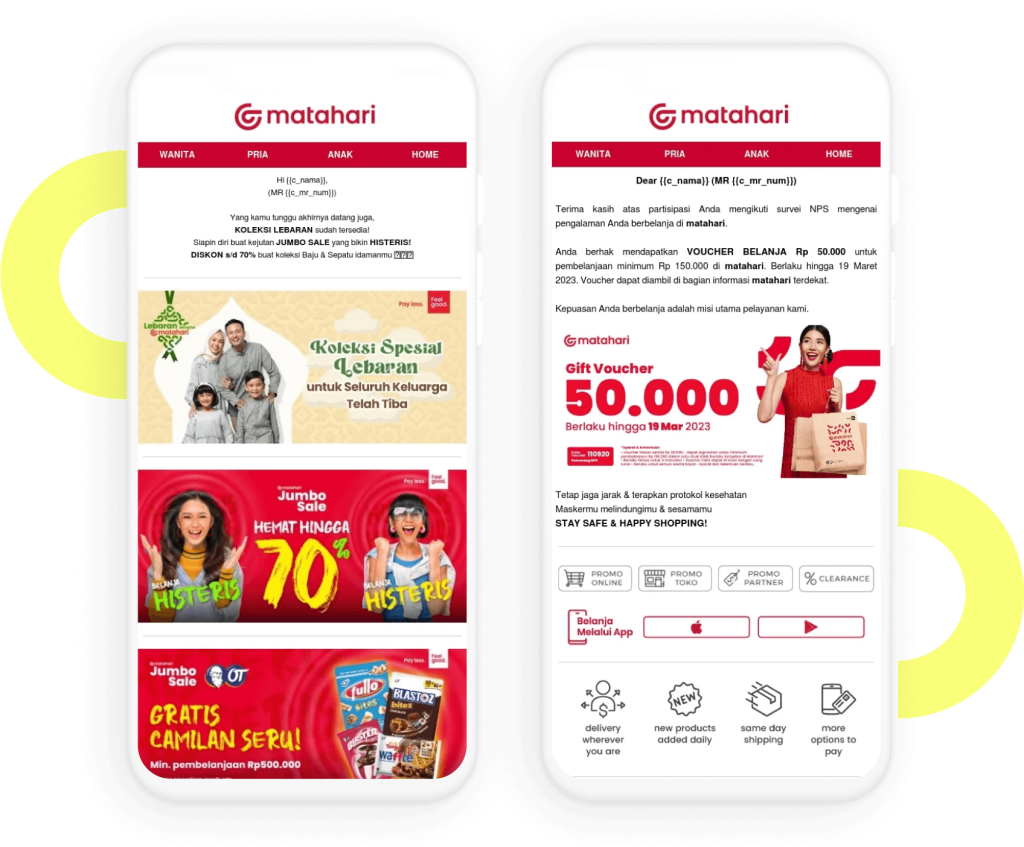
Matahari, one of Indonesia’s largest retail platforms, applied this kind of coordinated personalization logic and achieved a 356X return on investment in four months. The result reflects what is possible when engagement decisions are grounded in a unified customer profile rather than channel-specific assumptions.
Fintech and financial services: timing and trust
In financial services, the stakes of mistimed messaging are higher than in retail. A customer who just made a significant transfer does not want a cross-sell message 15 minutes later. A customer who has been comparing loan products across three sessions without applying is, however, a strong candidate for a personalized follow-up that addresses their specific consideration window.
The structural approach is the same: a unified profile that captures research behavior across web and app, segmentation logic that distinguishes active consideration from passive browsing, and a suppression layer that respects recent high-stakes transactions before initiating a new sequence. Channel selection in financial services also tends to weigh toward in-app messaging and email over SMS for compliance and preference reasons, though this is a brand decision informed by customer data and regulatory context rather than a universal rule.
Choosing the right platform capabilities for your engagement goals
Most teams do not fail at cross-channel engagement because they chose the wrong channels. They fail because the platform capabilities underpinning their stack are not matched to what cross-channel execution actually requires. Five capabilities determine whether your engagement system can deliver at scale.
Real-time unified profiles. If your customer profile updates on a batch schedule rather than in real time, your behavioral triggers will always be delayed. A customer who converted an hour ago should not receive an abandonment message. This is a data infrastructure question, not a marketing question.
Predictive segmentation. Segments defined only by past behavior describe who your customers were. Predictive models that surface likelihood to purchase, likelihood to churn, or affinity scores let you act on where customers are heading, which is where the conversion opportunity lives.
Native multi-channel send. When email, SMS, push, and onsite campaigns run through a single platform rather than through separate point solutions, the journey logic can actually see what has been sent, what was opened, and what was ignored before deciding the next step. That visibility is not possible when your email service provider (ESP), your push provider, and your SMS tool do not share event data in real time.
Journey branching logic. The ability to build conditional paths inside a single journey canvas, checking reachability, checking engagement, applying suppression rules, and routing customers to alternate channels based on behavior, is what transforms a simple automation into a responsive engagement system. Insider One’s Architect is built specifically for this kind of multi-step, multi-condition orchestration.
Cross-channel attribution reporting. If your reporting tells you how each channel performed in isolation but not how channels worked together to drive conversion, you are optimizing each instrument in the orchestra without listening to how they sound together. Attribution logic that spans the full journey is what allows you to make better decisions about channel order, timing, and frequency.
How to self-diagnose your current stack
Ask yourself or your team on the following 3 questions:
- If a customer converts right now, how long before every channel in your stack knows about it? If the answer is hours or days, you have a real-time profile problem
- Can you build a journey that routes a customer differently based on whether they opened your last message? If not, you have a branching logic problem.
- Can you tell which combination of touches drove your last significant conversion, not just which final click? If not, you have an attribution problem.
A purpose-built omnichannel marketing automation platform addresses all three. A stitched-together point solution stack typically addresses none of them without significant custom engineering work. That is not a technology argument for its own sake; it is a practical question about where your team’s time goes into building the infrastructure for connected engagement, or into actually running it.
Get started with coordinated cross-channel engagement with Insider One
Cross-channel engagement done well is not about being everywhere at once. It is about being exactly where your customer is, with the right message, at the right moment, informed by everything they have done before. If your current stack makes that feel harder than it should, the gap is almost always in the data layer and the orchestration logic, not in the channels themselves.
If you want to see how Insider One’s Architect and Customer Data Management turn live customer data into coordinated, revenue-driving experiences, book a personalized demo to see the exact use cases, decision logic, and growth levers most relevant to your team.
FAQs
Cross-channel marketing coordinates messages and experiences across multiple channels with shared data and sequenced logic. Omnichannel marketing extends that by making the experience fully consistent regardless of where or how a customer engages, with the channel itself becoming invisible. Cross-channel is the execution layer; omnichannel is the customer outcome.
There is no universal number. Start with the channels where your customers are most active based on observed engagement data. Two well-coordinated channels with shared profile data will outperform five disconnected channels running separate campaigns. Add channels when your data architecture and journey logic can support them without creating fragmentation.
Building the sequence before unifying the data. A cart abandonment flow that sends push, email, and SMS in the right order is still broken if each channel is working from a different version of the customer profile. The trigger logic is only as good as the data feeding it.
Suppression rules prevent a customer from receiving the same message across multiple channels within a defined time window, or from receiving any message immediately after a high-intent action like a purchase. They protect the customer experience without reducing engagement. In practice, well-designed suppression logic often improves conversion rates because customers receive fewer, more relevant messages rather than more frequent, less targeted ones.

Keep Reading
7 min.

Muharrem Derinkok
4 Jun 2026
11 min.

Chris Baldwin
2 Jun 2026
4 min.
Chris Baldwin
3 Feb 2026