

 Platform Overview

 Integration Hub

 Sirius AI™

 Customer Data Management

 Personalization

 Journey Orchestration

 Reporting & Data

 Behavioral Analytics

 Web
Web

 Email
Email

 Site Search

 Conversational CX

 WhatsApp

 Web Push

 InStory

 App
App

 SMS & RCS

 Join the $0 Migration Movement™

 The Insider One Difference

 Compare Vendors

 Switch to Insider One

 Success Story

 Retail & Ecommerce

 Financial Services

 Travel & Hospitality

 Beauty & Cosmetics

 Automotive

 Telecommunications

 Interactive Platform Tour

 Blog
Blog

 E-Books & Guides

 Glossary
Every Marketer’s Essential Guide to Conversational Marketing in 2026

Updated on 18 Mar 2026
11 min.
Table of Contents
- What is conversational marketing, and why does it matter in 2026?
- Key benefits of conversational marketing
- How AI and advanced technologies power conversational marketing
- Top channels for conversational marketing in 2026
- Best practices for modern conversational marketing
- Future trends shaping conversational marketing beyond 2026
- From chat to conversion: How Insider One can help you scale conversations
- Frequently asked questions
Most Popular



Conversational marketing has evolved way beyond simple chat widgets. It’s now the engine behind modern digital growth. Brands that excel at real-time, two-way conversations across web chat, SMS, WhatsApp, social DMs, and voice? They’re the ones building lasting loyalty and driving serious revenue.
This guide walks you through the essentials. You’ll learn what conversational marketing actually is, why it’s critical for your success, and how to create a strategy your team can confidently execute. We’ll share practical playbooks, the KPIs you should track, and channel-specific strategies that get results.
Plus, you’ll discover how Insider One’s AI-native platform ties everything together. It unifies your data, applies predictive personalization, and automates based on behavior to scale personalized engagement across every touchpoint. The outcome is simple: every customer conversation becomes more impactful and efficient.
What is conversational marketing, and why does it matter in 2026?
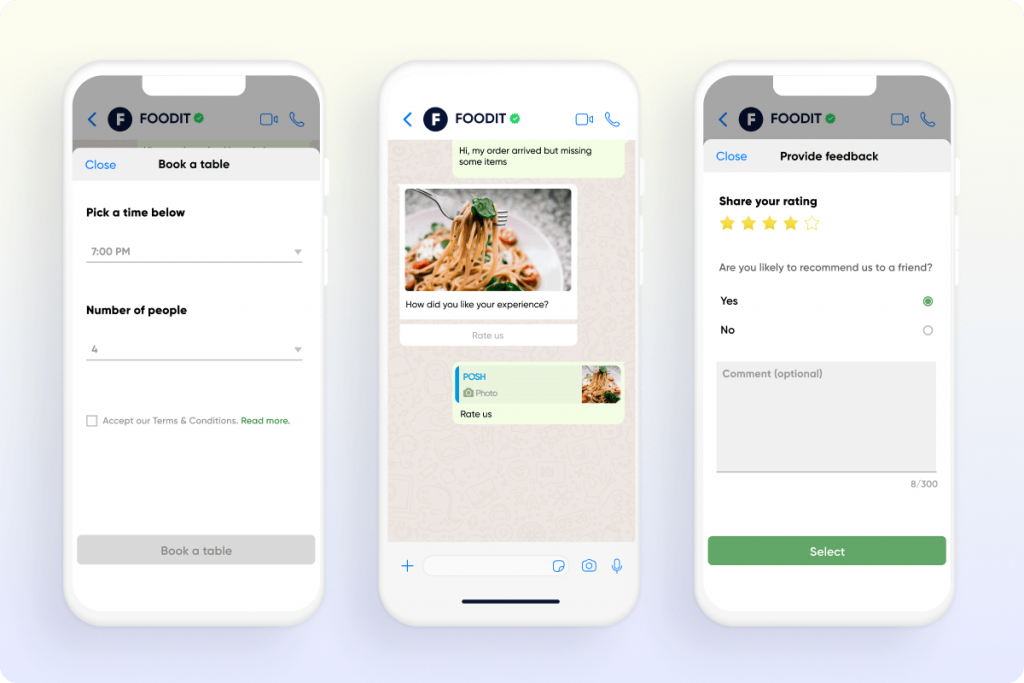
Conversational marketing is a dynamic, real-time approach that uses chatbots, voice assistants, and instant messaging to engage customers across digital touchpoints. Instead of static forms or rigid menus, it creates natural, two-way conversations, making customer interactions faster, more personalized, and far more engaging.
The shift toward real-time chat, AI-driven chatbots, and voice interfaces is more important than ever for modern customer engagement. Consumers increasingly opt for instant, conversational exchanges and prefer to tap on assistants and messaging apps instead of click through multiple web pages.
Why does this matter in 2026?
Customers expect quick, personalized responses, and brands without conversational marketing struggle to keep up. Conversational AI helps businesses deliver instant service while maintaining quality engagement.
Conversational experiences shape every stage of the customer journey, from discovery to purchase to support. Brands that connect these conversations across channels build stronger loyalty and improve lifetime value.
Key benefits of conversational marketing
Conversational marketing has rapidly evolved into a powerful tool for businesses, offering clear advantages that drive both customer satisfaction and business growth. Here are the key benefits:
Higher conversion rates
Conversational marketing creates personalized, seamless customer journeys. By guiding customers down clear paths, answering questions in real time, and offering tailored recommendations, it helps customers make decisions faster and more confidently.
Why it matters: When customers don’t have to navigate complex forms or wait for answers, they’re more likely to convert, resulting in higher sales and improved revenue.
Improved customer satisfaction
Customers today expect fast, relevant responses. AI-powered conversations allow businesses to provide immediate, accurate, and personalized support, making customers feel heard and valued.
Why it matters: With quick, human-like responses, conversational AI boosts customer satisfaction. A satisfied customer is more likely to return, boosting loyalty and encouraging positive word-of-mouth.
Real-time feedback loops
Conversational marketing tools collect valuable data from every interaction. These insights can be used to continuously refine messaging, improve product offerings, and adapt to evolving customer needs.
Why it matters: Real-time feedback allows businesses to stay agile, keeping content and interactions aligned with customer expectations. This dynamic approach leads to higher engagement and conversions over time.
Increased engagement and reduced churn
Conversational AI allows businesses to interact with customers at key moments, offering timely, relevant messages that keep customers engaged across the entire journey, from initial discovery to post-purchase support.
Why it matters: Engaging customers at the right time with personalized content reduces churn and helps maintain long-term relationships, increasing customer lifetime value.
Enhanced lead qualification
AI-powered agents qualify leads faster by gathering information in real time, assessing customer intent, and directing high-potential leads to human agents for further follow-up.
Why it matters: Efficient lead qualification saves time for sales teams, ensuring they focus on high-value prospects, improving conversion rates, and increasing productivity.
How AI and advanced technologies power conversational marketing
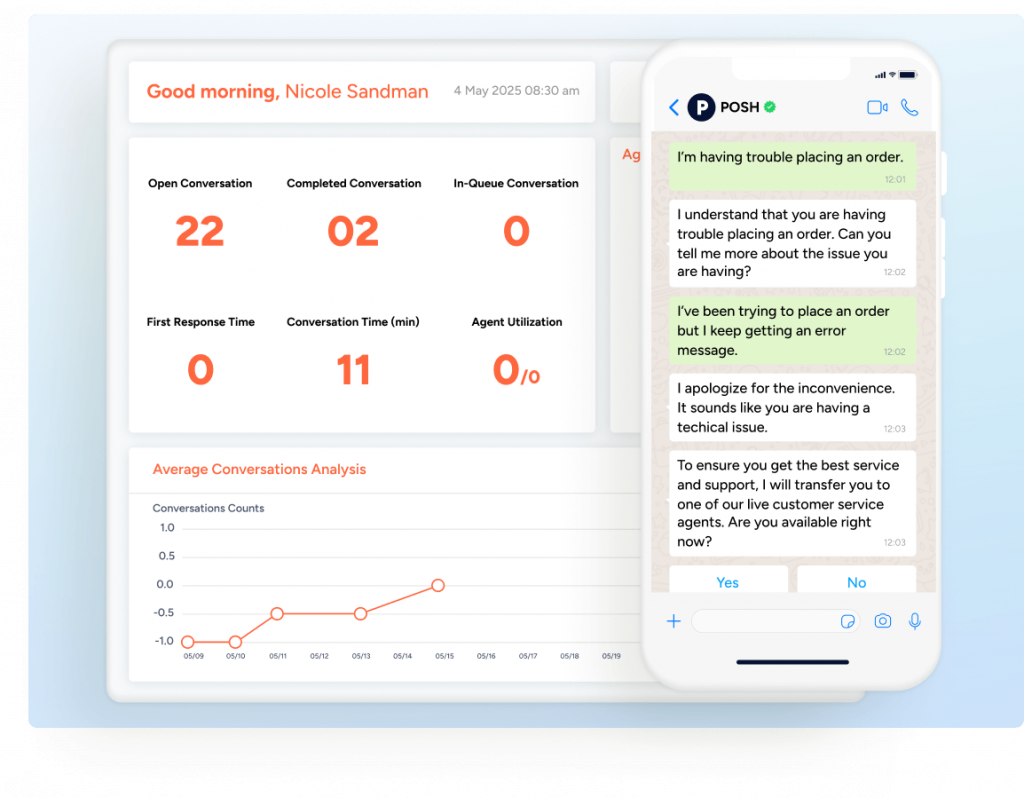
AI-driven conversational marketing uses natural language processing (NLP) and machine learning to interpret customer intent, automate dialogue, and deliver hyper-personalized responses in real time.
What has changed in 2026 is AI’s role: it’s no longer a support tool but a co‑pilot that optimizes campaigns, automates audience segmentation, and continuously tests content and flows AI co‑pilot for optimization.
NLP advancements allow AI chatbots and voice assistants to resolve multi-step, domain-specific queries and hand off seamlessly to humans when necessary. Meanwhile, recommendation engines elevate discovery, curating products and content with precision, and increasingly shape customer choices at scale, a trend highlighted in 2026 outlooks.
Practically, this means:
- Predictive personalization: Model propensity, timing, and next best action for each user
- Marketing automation: Orchestrate intent-based flows across channels without manual effort
- Continuous learning: Use conversation transcripts and outcomes to refine prompts, intents, and journey logic
Explore how Insider One operationalizes these capabilities across channels in our overview of conversational marketing and orchestration.
Top channels for conversational marketing in 2026
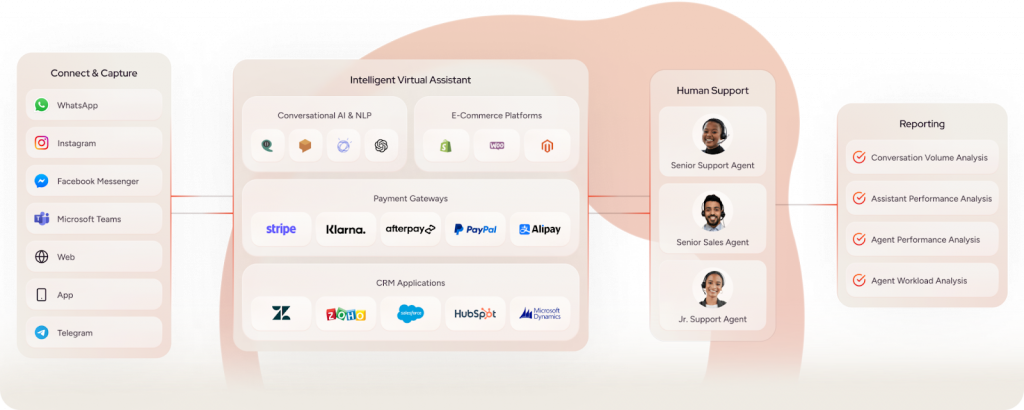
The most successful conversational marketing strategies focus on channels where customers already expect immediate responses and engage frequently. Here are the key channels to prioritize in 2026:
Real-time website chat
Instant support, context-rich interactions, and the ability to increase conversions make website chat a powerful tool. It’s perfect for offering pre-sale guidance, guided selling, or customer support for high-intent visitors.
SMS and WhatsApp messaging
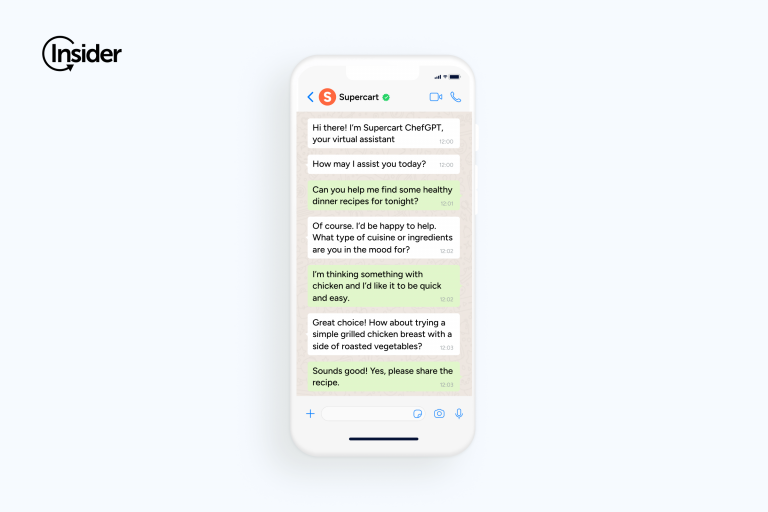
These channels offer nearly 100% reach and fast open rates, making them ideal for order updates, reminders, or limited-time offers. WhatsApp, in particular, also supports rich media (RCS) and end-to-end encryption, making it suitable for service, re-engagement, and conversational commerce.
SMS and WhatsApp work well for audiences who prefer text-based communication, with WhatsApp being especially dominant in regions where it’s the primary messaging app.
Social DMs (Instagram, Facebook Messenger)
Social DMs are essential for social commerce, influencer campaigns, and support. With seamless handoffs to customer service, they’re ideal for social-first shoppers who prefer interacting with brands directly via their favorite platforms.
Voice assistants (Alexa, Google Assistant)
Voice assistants continue to grow, with about a fifth of mobile queries now voice-based. Voice interfaces are perfect for hands-free interactions and providing quick answers to FAQs, reorders, or account status queries, especially for mobile-first and accessibility-focused users.
In-app messaging
In-app messaging enables highly relevant communication based on deep behavioral triggers. It’s ideal for onboarding, upselling, and retention, especially for users who are already active within your app.
Omnichannel orchestration is key
As customers seamlessly switch between devices and channels mid-journey, it’s crucial to ensure their context and state are preserved across each touchpoint. Omnichannel orchestration is essential to delivering a smooth, personalized experience. With Insider One, you can support unified conversational messaging and create intent-driven journeys across all platforms, ensuring no customer interaction is ever out of context.
Quick-reference channel guide:
| Channel | Pros | Best use cases | Audience fit |
| Website chat | Instant help, rich context, conversion lift | Pre-sale guidance, guided selling, support | High-intent site visitors |
| SMS | Near-100% reach, fast open rates | Order updates, reminders, and limited-time offers | Subscribers comfortable with text |
| Rich media, encryption, global adoption | Service, re-engagement, conversational commerce | Regions where WhatsApp is the primary messenger | |
| Social DMs | Native to discovery, seamless handoffs | Social commerce, influencer campaigns, support | Social-first shoppers and followers |
| Voice assistants | Hands-free, quick answers | FAQs, reorders, and account status | Mobile-first, accessibility-focused audiences |
| In-app messaging | High relevance, deep behavioral triggers | Onboarding, upsell, retention | Active users of your app |
Best practices for modern conversational marketing
To succeed in conversational marketing, brands should focus on creating smooth, personalized interactions. Here are the key best practices:
- Audit customer journeys: Review customer touchpoints to find opportunities for conversations and areas where the experience can be improved, such as during checkout or support.
- Leverage first-party data: Use customer profiles to personalize interactions based on location, behavior, lifecycle, and intent in real time.
- Blend AI with authenticity: Set clear brand tone guidelines and ensure smooth transitions to human agents when needed. Regularly review conversations to ensure they remain natural.
- Embrace hyper-personalization: Use AI to tailor conversations at scale, adapting to each customer’s behavior, preferences, and needs.
- Optimize continuously: Regularly refine prompts, dialogue flows, and UI language through testing and AI-driven insights to make interactions clearer and faster.
- Orchestrate cross-channel journeys: Ensure smooth interactions across all channels with rules, testing, and privacy safeguards to maintain consistency and compliance.
Future trends shaping conversational marketing beyond 2026
The future of conversational marketing is set to be nothing short of transformative. As we look beyond 2026, the next generation of AI-powered interactions will reshape the way brands engage with customers, creating deeper connections and smoother experiences across every touchpoint. Here are the key trends driving this evolution:
The rise of autonomous AI Agents as the digital co-worker
Agentic AI is evolving beyond just answering questions. These intelligent agents are becoming autonomous digital workers, capable of managing end-to-end processes without human intervention.
From handling customer inquiries to completing transactions and managing workflows, AI agents are becoming essential operational assets. Their ability to learn, adapt, and seamlessly integrate with business systems will allow companies to scale quickly and efficiently.
Multimodal interactions become the standard
The era of purely text-based chat is quickly fading. Multimodal AI will take conversational marketing to new heights, allowing customers to engage with brands through text, voice, images, and even video.
Whether it’s voice commands, visual searches, or text-based chat, customers will have the flexibility to communicate in whatever way feels most natural to them. This will make interactions more engaging and personalized, leading to seamless experiences that are both intuitive and rich with context.
Generative AI for hyper-personalized conversations
Gone are the days of generic responses. Generative AI will fuel conversations that are hyper-personalized based on the unique context, preferences, and behaviors of each customer.
As AI continues to evolve, it will go beyond answering FAQs to offering context-aware, real-time recommendations and delivering personalized offers and solutions. This advanced intelligence will even anticipate customer needs before they ask, creating an experience that feels almost magical.
Voice search and conversational commerce dominate
Voice search is growing rapidly and will soon become the preferred method of interaction for many customers. Voice assistants like Alexa and Google Assistant will handle a variety of tasks, from answering questions to completing orders.
This shift will pave the way for conversational commerce, enabling customers to make purchases, check order statuses, and engage with brands using simple voice commands.
AI-powered content recommendations redefine discovery
AI will play a key role in curating customer experiences in ways that were previously impossible. By combining predictive analytics with real-time intent recognition, AI will surface hyper-relevant content, offers, and product recommendations at precisely the right moment.
This will elevate product discovery, allowing customers to find what they need when they need it, without sifting through endless options. With this shift, content becomes more personalized than ever before.
Privacy and ethical AI: Building trust in every interaction
As AI becomes more ingrained in customer interactions, privacy and ethical concerns will need to be addressed. Customers will expect more transparency around how their data is used and will demand that brands prioritize data security.
In this new world, trust will be key to success, and companies will need to focus on clear consent mechanisms, robust data protection, and accountability to create safe, respectful environments for their customers.
From chat to conversion: How Insider One can help you scale conversations
Insider One’s platform equips brands with powerful tools to drive real-time, engaging conversations that convert. Here are Insider One’s key capabilities that can help scale your conversational marketing efforts:
- AI-powered conversational orchestration: Automate and streamline multi-step customer journeys, ensuring personalized interactions at scale across every channel, from web chat to social messaging.
- WhatsApp Commerce: Seamlessly manage opt-ins, use message templates, and automate interactions to drive conversions directly on WhatsApp, a platform trusted by millions globally.
- Unified customer profiles for contextual chat: With real-time data integration, Insider ensures that every conversation is informed by a comprehensive view of the customer, making each interaction contextually relevant and highly personalized.
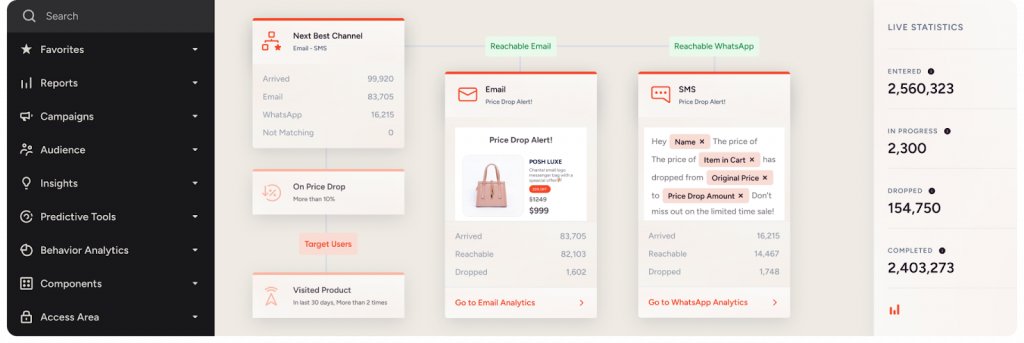
Take a demo to see how Insider One powers personalized, real-time conversations across channels.
Frequently asked questions
The most effective channels in 2026 include real-time website chat, SMS and WhatsApp, social DMs, voice assistants, and in-app messaging, all of which enable tailored two-way customer engagement.
AI analyzes customer data and behaviors to deliver hyper-personalized messages automatically, ensuring each conversation aligns with the user’s preferences and needs.
Key conversational marketing KPIs include response time, engagement rates, conversions/bookings, revenue generated, customer satisfaction (CSAT), and Net Promoter Score (NPS).
Focus on combining AI efficiency with relatable messaging while ensuring your brand voice remains consistent in every automated interaction.
Conversational marketing complements digital strategies by creating seamless, real-time interactions that enhance personalization, boost conversion, and unify multichannel touchpoints.

Keep Reading
4 min.

Chris Baldwin
3 Feb 2026
9 min

Muharrem
23 Dec 2025
10 min.
Muharrem
11 Oct 2024