

 Platform Overview

 Integration Hub

 Sirius AI™

 Customer Data Management

 Personalization

 Journey Orchestration

 Reporting & Data

 Behavioral Analytics

 Web
Web

 Email
Email

 Site Search

 Conversational CX

 WhatsApp

 Web Push

 InStory

 App
App

 SMS & RCS

 Join the $0 Migration Movement™

 The Insider One Difference

 Compare Vendors

 Switch to Insider One

 Success Story

 Retail & Ecommerce

 Financial Services

 Travel & Hospitality

 Beauty & Cosmetics

 Automotive

 Telecommunications

 Interactive Platform Tour

 Blog
Blog

 E-Books & Guides

 Glossary
Email service providers (ESP): Things you must check

Updated on 6 Apr 2026
9 min.
Table of Contents
- What should you know at a glance?
- What is an email service provider?
- What ESP capabilities matter most, and how should you evaluate them?
- What should you check in list management, consent, and preference centers?
- How should you evaluate segmentation and audience building?
- How should you evaluate automation and triggered journeys?
- What should you check in templates, dynamic content, and personalization?
- What should you check in deliverability and authentication?
- How should you evaluate A/B testing and optimization?
- What should you measure in analytics and reporting?
- What should you check in integrations with CRM, ecommerce, and CDP?
- What are common types of email service providers?
- How does an ESP compare with a CRM, a CDP, and marketing automation?
- How should you choose an ESP?
- How does Insider One help?
- FAQs
Most Popular
Email service providers handle the infrastructure that makes modern marketing possible, but most teams don’t evaluate them correctly. They focus on UI polish and feature lists, then discover during implementation that deliverability is weak, segmentation is rigid, or integrations require custom development.
This guide explains what an ESP actually does, how it differs from customer relationship management (CRM) systems and customer data platforms (CDPs), and how to choose one without post-purchase surprises. You’ll learn which capabilities matter most, how to structure a proof of concept that tests real-world inbox placement, and when a standalone ESP makes sense versus an all-in-one platform that combines CDP, personalization, and cross-channel orchestration in one system.
What should you know at a glance?
ESP in marketing stands for email service provider: the platform that sends, automates, and tracks marketing and transactional email at scale.
- Deliverability and integration depth matter more than UI polish when evaluating ESPs
- Standalone ESPs handle email execution only; all-in-one platforms combine CDP, personalization, and cross-channel orchestration
- A structured proof-of-concept with real-world inbox placement testing prevents post-purchase surprises
What is an email service provider?
Marketing teams need to send personalized messages to large audiences, track engagement, and protect sender reputation. Standard inbox providers like Gmail or Outlook aren’t built for this.
An ESP is the infrastructure layer that handles mass email communication. It manages:
- Sending at scale: Simple Mail Transfer Protocol (SMTP) relay, IP address management, and throttling to prevent server overloads
- List and consent management: Subscriber storage, preference centers, and suppression lists
- Segmentation: Filtering audiences by attributes, behavior, or predictive scores
- Automation: Triggered sequences based on events like sign-ups, purchases, or inactivity
- Template and content tools: Drag-and-drop editors, dynamic content blocks, and personalization tokens
- Deliverability management: Authentication protocols including Sender Policy Framework (SPF), DomainKeys Identified Mail (DKIM), and Domain-based Message Authentication, Reporting, and Conformance (DMARC), reputation monitoring, and bounce handling
- Reporting: Opens, clicks, conversions, and revenue attribution
A standalone ESP focuses on email execution. It doesn’t include CRM contact management, sales pipeline tracking, or cross-channel journey orchestration. Some platforms bundle these capabilities, but the boundaries matter when you’re building your stack.
What ESP capabilities matter most, and how should you evaluate them?
Teams often select an ESP based on feature checklists, then discover gaps during implementation. Segmentation logic turns out to be too rigid. Automation lacks branching. Deliverability tools are absent entirely.
What should you check in list management, consent, and preference centers?
Consent mismanagement causes deliverability damage and compliance risk. Teams discover gaps only after a suppression list fails to propagate or a preference center lacks granularity.
When evaluating, ask:
- Double opt-in support: Can the ESP enforce confirmed opt-in for specific lists or regions?
- Suppression logic: Does the system honor global suppression, list-level suppression, and transactional overrides?
- Preference center flexibility: Can subscribers manage frequency, channel, and content preferences, not just unsubscribe?
- Consent propagation: When a user unsubscribes, does that status sync to integrated systems in real-time?
For teams operating in regulated regions, ensure the platform allows you to map lawful bases for processing data.
How should you evaluate segmentation and audience building?
Most ESPs offer demographic segmentation based on age, location, or sign-up date. Behavioral and predictive segmentation support more targeted campaigns.
| Segment type | Data required | Use case |
| Demographic | Profile attributes | Broad campaigns, regional targeting |
| Behavioral | Event data (page views, purchases, cart adds) | Triggered campaigns, abandonment recovery |
| Predictive | Historical transactions, engagement scores | Churn prevention, high-value targeting |
| Dynamic | Real-time event streams | Time-sensitive offers, flash sales |
Can the ESP build segments from behavioral events without engineering support?
Does it support predictive scoring natively, or does that require a separate CDP?
How quickly do dynamic segments refresh?
If you want to see what segmentation looks like when CDP-grade data and activation live in one place, book a demo and we’ll walk through real-world audience building end to end.
How should you evaluate automation and triggered journeys?
Teams build automations that fire correctly but lack branching, frequency caps, or exit conditions. This leads to over-messaging.
Evaluation criteria:
- Trigger flexibility: Event-based, time-based, and API-triggered starts
- Branching logic: If/then conditions based on segment membership, engagement, or external data
- Wait steps and timing: Configurable delays and send-time optimization
- Frequency caps: Global and journey-level limits
- Exit conditions: Automatic removal when a user converts
For example, a cart abandonment journey should include a wait step, a branch for “opened but didn’t click,” and a second branch for “no engagement,” each leading to different follow-up content.
To pressure-test what “real” journey branching and caps look like in practice, explore the flows in the product demo hub and compare them to what your current ESP can actually support.
What should you check in templates, dynamic content, and personalization?
Drag-and-drop editors are a basic requirement. Dynamic content, modules that change based on user data, is where personalization scales.
- Modular templates: Reusable content blocks assembled into campaigns
- Dynamic content blocks: Conditional rendering based on segment, attribute, or event data
- Personalization tokens: Merge fields for name, product, location
- Fallback logic: Default values when data is missing
- Product feed integration: Real-time inventory, pricing, and image pulls
- Accessibility matters too. Responsive design, alt text for images, and color contrast are non-negotiable for enterprise teams.
What should you check in deliverability and authentication?
Deliverability issues rarely surface until campaigns underperform. People assume emails are landing in inboxes, but reputation damage can cause filtering or bounces.
- SPF, DKIM, DMARC: Authentication protocols that verify sender identity
- Sender reputation: Internet service provider (ISP)-level scoring based on complaint rates, bounce rates, and engagement
- Throttling: Gradual send pacing to avoid triggering spam filters on new IPs
How should you evaluate A/B testing and optimization?
Teams that run A/B tests without statistical significance might get lost in “noice”. Another common blindspot could be over-focusing on one variable like testing subject lines endlessly while ignoring higher-impact variables like send time or content structure.
- Variables: Subject line, preheader, send time, content, CTA placement
- Sample size: Does the ESP calculate required sample size?
- Significance threshold: Configurable confidence level
- Holdout groups: Ability to withhold a control group for incrementality measurement
What should you measure in analytics and reporting?
Open rates are no longer reliable due to Apple Mail Privacy Protection pre-fetching. Teams still tracking opens as a success signal are measuring bot activity.
| Metric | Formula | Post-privacy caveat |
| Open rate | Opens ÷ Delivered | Inflated by MPP; directional only |
| Click-through rate | Clicks ÷ Delivered | More reliable engagement signal |
| Conversion rate | Conversions ÷ Delivered | Requires attribution setup |
| Revenue per recipient | Revenue ÷ Delivered | Best outcome metric for commerce |
What should you check in integrations with CRM, ecommerce, and CDP?
Bidirectional sync with systems and event streaming capabilities are important for ESP as important data points like consent should be updated and synced in real-time.
- One-way push: ESP receives data but doesn’t write back
- Bidirectional sync: Changes propagate both directions
- Event streaming: Real-time behavioral data flows into the ESP for triggering
Clarify which system is the source of truth for customer data. Ambiguity causes data drift and compliance gaps. If your team no longer wants to rely on “native integrations” that aren’t, book a demo to see how unified profiles and activation cut the sync work and reduce surprises.
What are common types of email service providers?
“ESP” covers everything from API-first transactional senders to enterprise marketing suites. Choosing the wrong category wastes the budget.
| ESP type | Best for | Typical capabilities |
| Marketing ESP | Campaign execution, automation | Templates, journeys, reporting |
| Transactional ESP | Order confirmations, password resets | High deliverability, API-first |
| Enterprise suite | Large teams, complex journeys | Advanced segmentation, governance |
| All-in-one platform | Unified CDP, email, and cross-channel | CDP, personalization, journey orchestration |
Many teams use a transactional ESP for operational messages and a marketing ESP for campaigns. This works if deliverability reputation is managed separately.
Want a clearer view of what you gain (and drop) with each category? Run a quick side-by-side in the product demo hub and map it to your stack.
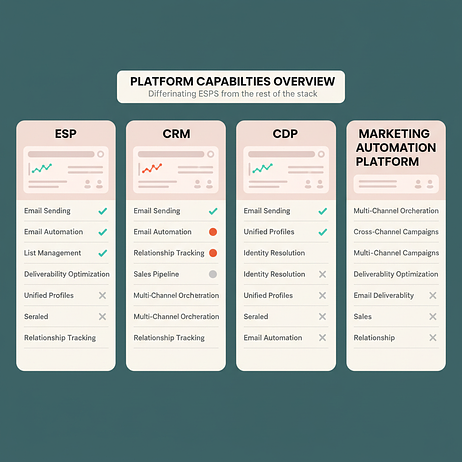
How does an ESP compare with a CRM, a CDP, and marketing automation?
Vendors blur lines between these systems. Teams end up with redundant tools or gaps.
- ESP: Sends and tracks email; manages lists, automation, and deliverability
- CRM: Manages customer relationships and sales pipeline; not built for high-volume email
- CDP: Unifies customer data from multiple sources into a single profile
- Marketing automation platform: Orchestrates multi-channel campaigns including email, landing pages, and lead scoring
If your CRM has email capabilities, evaluate whether its deliverability, segmentation, and automation match a dedicated ESP. CRM email tools often lag in these areas.
A CDP handles identity resolution and segmentation. An ESP handles email execution. Some platforms combine both, eliminating sync complexity.
How should you choose an ESP?
Teams select an ESP based on demos and feature lists, then discover during implementation that deliverability is weak or integrations require custom development.
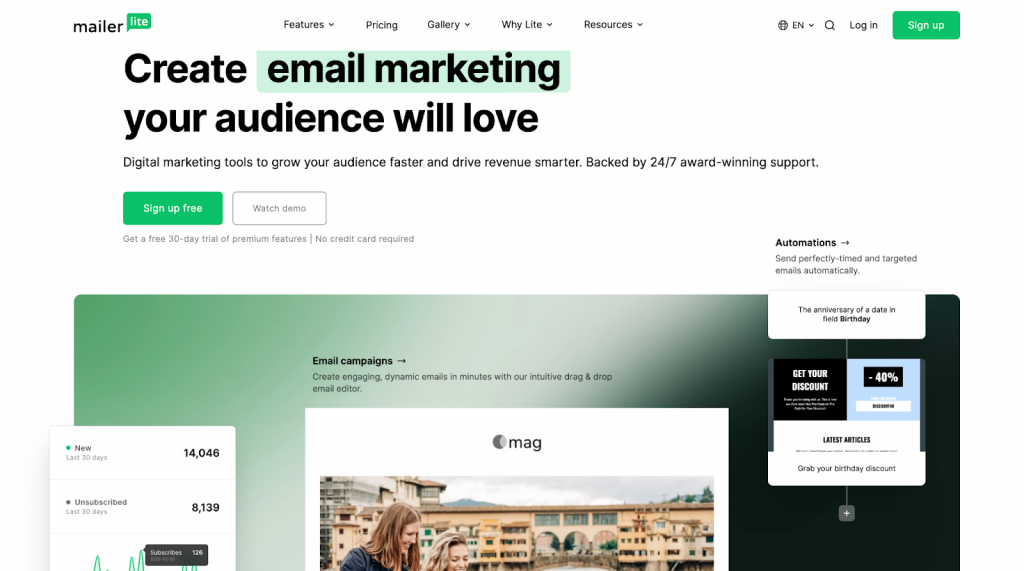
What should your requirements checklist and vendor scorecard include?
Not all requirements are equal. Deliverability and integration capabilities should carry more weight than UI polish.
| Criterion | Weight |
| Deliverability tools and support | Highest |
| Native integrations | High |
| Segmentation and automation depth | High |
| Reporting and attribution | Medium |
| Template and content tools | Lower |
| Pricing predictability | Lower |
Score each vendor on a consistent rating scale per criterion, apply your weights, and sum for a total score.
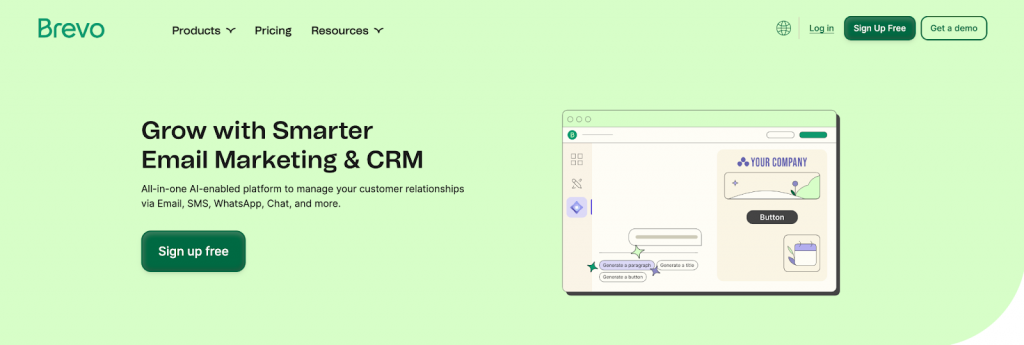
How should you evaluate pricing models and total cost of ownership?
ESP pricing looks simple, but total cost includes overages, setup fees, support tiers, and integration costs.
- Per subscriber (MTU): Fixed cost per monthly tracked user; predictable but penalizes list growth
- Per send: Cost per email sent; scales with volume but rewards list hygiene
- Tiered: Feature access gated by pricing tier
Ask for overage caps, annual pricing locks, and inclusion of premium support in the base contract.
How should you plan migration and time to value?
ESP migrations fail when teams underestimate DNS changes, IP warm-up, or template porting. Define a rollback plan before cutover is crucial.
- Discovery: Audit current automations, templates, segments, and integrations
- Setup: Configure new ESP, set up authentication, build integrations
- Content migration: Port templates, recreate automations, map segments
- Warm-up: Gradual volume increase on new IPs
- Parallel run: Send from both ESPs; compare performance
- Cutover: Shift all traffic to new ESP
- Optimization: Refine automations, test new capabilities
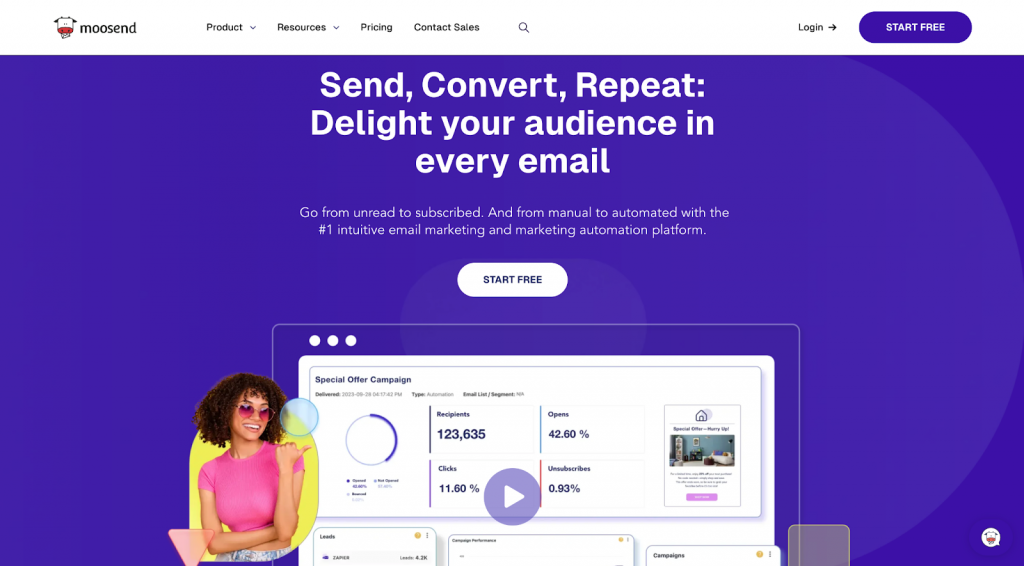
How should you verify deliverability during a proof of concept?
Most proofs of concept (POCs) focus on UI and features, ignoring real-world inbox placement.
- Seed list testing: Send identical campaigns to seed addresses across Gmail, Outlook, Yahoo
- Engagement cohort comparison: Send to a matched sample from each vendor
- Complaint monitoring: Track complaint rates during POC sends
- Authentication audit: Verify SPF, DKIM, and DMARC pass rates
POC sends should include a large enough recipient sample to generate statistically meaningful data.
How does Insider One help?
Insider One brings together CDP, AI, personalization, journey orchestration, and reporting in one platform.
- Unified customer profiles: Insider One’s Customer Data Platform (CDP) unifies customer, engagement, and product data from integrations into complete customer profiles
- AI-powered optimization: Sirius AI™, Insider One’s extensive set of AI capabilities, automates send-time optimization, A/B winner selection, and next-best-channel decisions
- Journey orchestration: Architect, Insider One’s customer journey orchestration solution, supports event-triggered, branching journeys across email, SMS, WhatsApp, web push, and paid media from a single canvas
- Faster time to value: Migration Lab™ and white-glove onboarding help teams launch with predictable MTU-based pricing and no hidden charges
If you’re evaluating whether to keep a standalone ESP or consolidate into an all-in-one, start with a real walk-through of how the pieces connect. Explore the product demo hub to see CDP, email, and orchestration working as one system.
FAQs
ESP stands for email service provider. It refers to the platform that sends, automates, and tracks marketing and transactional email at scale.
An ESP handles email execution, including sending, automation, and deliverability. A CRM manages customer relationships and sales pipeline. Dedicated ESPs typically offer deeper deliverability, segmentation, and automation capabilities than CRM email tools.
Declining deliverability, limited segmentation or automation, slow campaign execution due to IT dependencies, or pricing that scales unpredictably. If your current ESP can’t support your growth or integration requirements, it’s time to evaluate alternatives.
Prioritize deliverability tools, native integrations with your CRM and ecommerce platform, segmentation and automation depth, and transparent pricing. Evaluate these capabilities during a structured proof of concept, not just a demo.
A well-planned migration typically takes multiple weeks, including discovery, setup, content migration, IP warm-up, parallel run, and cutover. Rushed migrations risk deliverability damage and delayed time to value.

Keep Reading
4 min.

Chris Baldwin
3 Feb 2026
9 min

Muharrem
23 Dec 2025
7 min.
Chris Baldwin
8 Jul 2024