

 Platform Overview

 Integration Hub

 Sirius AI™

 Customer Data Management

 Personalization

 Journey Orchestration

 Reporting & Data

 Behavioral Analytics

 Web
Web

 Email
Email

 Site Search

 Conversational CX

 WhatsApp

 Web Push

 InStory

 App
App

 SMS & RCS

 Join the $0 Migration Movement™

 The Insider One Difference

 Compare Vendors

 Switch to Insider One

 Success Story

 Retail & Ecommerce

 Financial Services

 Travel & Hospitality

 Beauty & Cosmetics

 Automotive

 Telecommunications

 Interactive Platform Tour

 Blog
Blog

 E-Books & Guides

 Glossary
Conversational AI for E‑Commerce: Boosting Conversions and AOV

Updated on 12 Jan 2026
15 min.
Table of Contents
Most Popular




Every purchase is now a conversation.
Customers no longer follow linear funnels. They browse with intent, pause at price or relevance, compare options, and expect answers instantly. The real conversion moment now happens before checkout, inside the interaction that either resolves friction or amplifies it. This shift has pushed conversational AI from a support add-on into a growth lever.
Conversational AI for e-commerce uses live behavioral, transactional, and contextual data to engage shoppers across chat, voice, and messaging channels. It interprets intent as it forms and guides users toward the next best action. This intent-led decisioning is what clearly separates conversational AI from traditional chatbots.
Older bots were reactive and rule-driven, designed to answer questions and close support tickets. AI commerce assistants are predictive and revenue-aware. They anticipate intent, personalize recommendations, handle objections, and step in when the probability to convert, upsell, or abandon shifts in real time. This is why conversational AI has become a direct lever for conversion and AOV.
Building on this shift, this article breaks down how conversational AI delivers measurable uplift, what features matter, how e-commerce teams can implement it, and how Insider One powers conversational commerce.
The Rise of Conversational AI in E-Commerce
Click-based shopping has reached its limit. Today, product catalogs are larger, buying journeys are longer, and customer patience is thinner. What shoppers want is instant clarity, reassurance, and relevance. That demand is pushing e-commerce toward conversation-driven commerce.
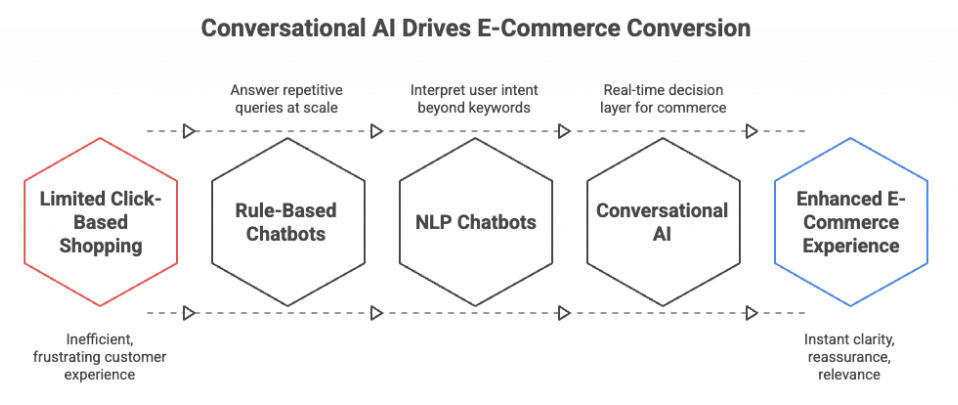
When brands surface answers, recommendations, and offers at the moment intent forms, decisions happen faster and conversion rises. Brands now report up to 25% higher lead conversion when using AI chatbots. This shift did not happen overnight. Conversational AI in e-commerce evolved in clear phases. Here’s how it got here.
Phase 1: Rule-based Chatbots
Rule-based chatbots are deterministic automation systems designed to answer known, repetitive queries at scale.
They operate on hard-coded decision trees. When a user asks a question, these bots simply match keywords or menu choices to a predefined response. They can’t infer intent, remember previous messages, or see what the user was doing in the session. Each interaction runs in isolation and breaks the moment the conversation steps outside the script.
Example: A shopper types ‘order status’ and the rule-based chatbot responds by pulling a tracking link from the order management system. The exchange works because the request matches a predefined rule. Now, the conversation immediately breaks the moment you ask something outside that script, like ‘will this size fit me?’. The bot can’t adapt, guide discovery, or help the shopper move forward. It may reduce support tickets, but it has no role in driving conversion or increasing AOV.
Phase 2: NLP Chatbots
NLP chatbots use probabilistic language understanding to interpret user intent beyond exact keywords. Under the hood, they route messages through intent classification and entity extraction models, which match inputs to predefined intents with confidence scores. The response still comes from a fixed template and only after the user asks a question.
Example: When a shopper says ‘I want to send these shoes back’, the bot correctly understands the return request. The interaction works from a language standpoint. The conversation ends after initiating a return workflow. However, the system can’t see that the shopper recently viewed a higher-priced alternative. These chatbots can’t assess the risk of churn or suggest an exchange.
Phase 3: Conversational AI
Conversational AI turns conversation into a real-time decision layer for commerce. It continuously ingests conversational input alongside live behavioral signals, transaction history, and unified customer profiles. The system re-evaluates intent across every turn instead of locking onto a single message.
Then, machine learning models score next-best actions based on predicted outcomes like conversion probability, upsell likelihood, and drop-off risk. The system uses these scores to generate personalized responses, recommendations, and offers, and then executes them through direct integrations with commerce, pricing, and orchestration systems. This means you often complete the transaction within the conversation itself.
Example: A shopper lingers on a product page and compares variants. The conversational AI system detects hesitation through dwell time and comparison behavior, surfaces size guidance, and recommends a complementary item using affinity models. Plus, it applies a contextual incentive and completes checkout within chat.
Why Conversational AI Boosts Conversions and AOV
Conversational AI lifts conversion and AOV by simply changing the moment of decision. It resolves intent in real time and executes the next step inside the journey instead of forcing shoppers to self-navigate uncertainty.

Frictionless Journeys
Most drop-offs happen when shoppers hit friction they can’t resolve fast enough. Conversational AI removes that delay. It answers sizing, delivery, pricing, and policy questions instantly and in context, so customers stop bouncing between product pages, FAQs, and checkout pages. This matters because checkout friction remains a major leakage point.
In fact, a report by Rep AI shows that shoppers interacting with AI chat features complete purchases at a rate of 12.3%, compared to just 3.1% for those who don’t. A huge share of those drop-offs is tied directly to issues such as extra costs, delivery concerns, trust, and checkout complexity. Conversational AI compresses the time-to-purchase by reducing steps, eliminating page-hopping, and supporting AI-enabled checkouts.
Context-Aware Personalization
Conversational AI personalized recommendations based on users’ browsing history, product affinity signals, prior purchases, and real-time session behavior. Predictive models then score multiple possible next actions against expected outcomes.
For example, they evaluate whether showing a comparison will reduce drop-off, whether a bundle will increase basket value, or whether reassurance is more likely to close the purchase than a discount. The system selects the action with the highest predicted impact and delivers it inside the conversation.
According to McKinsey, 71% expect personalized interactions, and 76% get frustrated when they don’t receive them. Conversational AI meets that expectation inside the decision moment. That is where AOV lifts actually come from. The conversational AI assistant nudges upgrades, add-ons, or better-fit options precisely when the shopper is deciding.
Cart Recovery and Nurture
Cart recovery works when you treat abandonment as a signal instead of a one-time event. Conversational AI captures real-time events like add-to-cart, checkout drop, coupon attempts, or payment failures and ties them to an identified or stitched user profile.
From there, the AI runs a decision flow. It scores the next best action based on conversion likelihood and value at stake, selects the right channel, including WhatsApp, SMS, and Instagram DM, and times the outreach based on intent strength. The system auto-applies guardrails like frequency caps and suppression rules. The message continues the conversation by addressing the exact objection, suggesting an alternative, or applying an incentive only when it is likely to change the outcome.
Execution completes the loop. The system uses deep links to restore the exact cart state, preserve selections, and minimize checkout steps. That’s how it feels conversational instead of transactional.
Human-Like Experience
Conversational AI boosts conversion by behaving less like a bot and more like a competent associate. It listens, carries context across turns, remembers preferences, and responds naturally. That makes customers feel seen, which changes behavior. They ask more questions, explore more options, and come back with less hesitation.
Salesforce reported a 42% year-over-year increase in AI chatbot usage during the holiday period it analyzed, showing how quickly shoppers adopt conversational help when it reduces effort. When customers feel seen, their experience compounds into repeat purchases, and AOV expands beyond a single order.
Conversational AI wins when it removes friction, personalizes with context, re-engages like a human, and executes the next step. Keep reading to find ways to implement conversational AI for e-commerce success.
How to Implement Conversational AI for E-Commerce Success
Conversational AI works only when it is built into the commerce engine. Teams that see real impact treat it as a decision system that spans the journey, the data stack, and revenue goals. Here’s what the rollout looks like.
1. Define the Use Case
Start by anchoring conversational AI to a single, primary outcome. Teams that try to solve everything at once usually dilute impact. Choose where AI should move the needle first:
- Conversion uplift on product pages
- Cart recovery for abandoned sessions, or
- Post-purchase engagement to drive repeat orders and upsells
Each use case demands different signals, timing, and success metrics. Conversion-focused flows optimize for intent resolution and next-best action. Cart recovery prioritizes speed, channel choice, and objection handling. Post-purchase engagement centers on reassurance, delivery transparency, and cross-sell relevance. Clarity here determines every downstream decision.
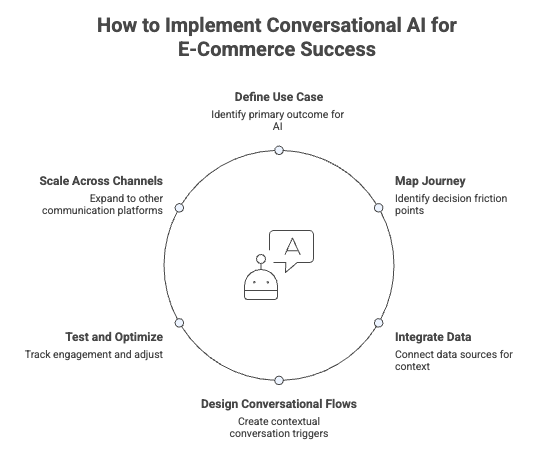
2. Map the Journey
Next, map the buying journey end-to-end and identify decision friction. Look for moments where customers hesitate, search for reassurance, or abandon altogether. Common high-impact moments include:
- Product discovery
- Size or compatibility questions
- Checkout errors
- Delivery timeline
- Returns
Conversational AI works best when it intervenes at these inflection points. The goal is to place an AI conversational chat platform where it shortens the path forward, answering questions that otherwise require page hopping, support tickets, or delayed follow-ups.
3. Integrate Data Sources
Context is what separates conversational AI from chatbots. To enable it, teams must connect CRM data, CDP profiles, real-time behavioral events, and product catalog metadata into a unified decisioning layer.
This integration allows the AI to know who the customer is, what they’ve browsed, what they’ve purchased, and what they’re doing right now. Without this foundation, recommendations stay generic, and conversations lose commercial relevance. Integrations allow the system to personalize responses, score intent, and choose actions based on predicted outcomes rather than assumptions.
4. Design Conversational Flows
Design conversations that help users when they need it the most. Remember, effective conversational triggers are contextual and optional. Examples include prompts like:
- ‘Need help choosing between these options?’ during comparison behavior
- ‘Want to see a quick comparison?’ during repeated product switching
- ‘Need help finding the right size or fit?’ during size-guide views or image zooms
- ‘Still deciding if this is the right option?’ during long product-page dwell time
- ‘Want me to save this and pick up later?’ during exit intent or tab switching
- ‘Still thinking about your last item?’ after checkout hesitation
Behind each prompt sits decision logic. The AI decides whether to show a comparison, suggest a bundle, answer a policy question, or apply an incentive. The flow should adapt based on how the user responds, carrying context forward instead of restarting the conversation each time.
5. Test and Optimize
Track engagement rates, assisted conversion, AOV lift, and drop-off reduction at each interaction point. Compare sessions with and without conversational support to isolate the impact. Optimization often comes from small adjustments like:
- Delaying the trigger until the intent is clear
- Raising intent thresholds before offering incentives
- Changing the first response from offer-led to reassurance-led
- Adjusting channel timing based on intent decay
- Refining message suppression and frequency rules
Ultimately, you must treat conversational AI as a living system instead of a one-time deployment to see compounding gains over time.
6. Scale Across Channels
Once performance stabilizes on web chat, expand to channels where conversations already happen. WhatsApp, Instagram DMs, and in-app messaging allow brands to continue the same context-rich interaction beyond the website.
The key is consistency. The conversation should persist across channels, carrying user context, preferences, and journey state forward. When implemented correctly, customers experience one continuous dialogue instead of disconnected messages, which strengthens trust and increases lifetime value.
Build it this way, and conversational AI becomes the infrastructure powering the decisions that turn conversations into revenue.
Why Insider One Is the Platform to Power Conversational AI Commerce
Conversational AI drives revenue when it runs on complete context, real-time decisioning, and native commerce execution. This is where most stacks break. They stitch together chat tools, CDPs, and automation layers, then expect intelligence to emerge. Insider One takes a different approach; here’s how.
- Unified customer data: At the foundation sits Insider One’s unified customer data layer, combining its customer data platform with Architect. Every conversational decision draws from a live, continuously updated profile that includes browsing behavior, purchase history, channel engagement, and predictive attributes. This matters because conversational AI fails when it lacks context. Insider’s architecture ensures every message, recommendation, or offer reflects where the customer is in their journey.
- WhatsApp commerce and flows: That context becomes actionable through WhatsApp Commerce and conversational flows. Insider One enables true chat-to-checkout journeys, where discovery, comparison, objection handling, and purchase happen inside a single conversation. Customers don’t bounce between pages, links, and forms. The system restores cart state, applies recommendations, and completes transactions directly within messaging environments that users already trust and respond to.
- AgentOne™: AgentOne™ bridges the gap where automation needs human judgment. Insider One’s hybrid AI-plus-human model allows seamless handover when complexity, regulation, or high-value interactions demand it. The AI carries full context into the handoff, so agents step in informed. This avoids the common failure point where customers repeat themselves, and momentum dies.
- Generative AI orchestration: Insider also pushes orchestration beyond rules with Generative AI–driven execution. Instead of relying on static templates, the platform can automatically draft personalized responses, recommendations, and offers based on real-time intent and predicted outcomes. The system decides what to say, when to say it, and where to say it, without marketers hard-coding every path.
- Integrations: All of this works within existing ecosystems. Insider integrates natively with Shopify, Salesforce, Magento, and major CRMs, allowing teams to activate conversational AI without re-architecting their stack. Commerce, CRM, and messaging systems stay connected, while decisioning happens centrally.
The impact shows up quickly when the system runs end-to-end. Adidas saw a 26% uplift in AOV within a month, driven by personalized recommendations and intent-aware conversational engagement. At enterprise scale, Toyota achieved a 259% increase in AOV, proving that the same architecture works for sustained value across complex journeys and large customer bases.
Conversational AI should move conversion and AOV. Book a demo to see how Insider makes that happen.
The Next Wave of Conversational AI in Retail
Retail is shifting from ‘assist me’ chats to ‘shop with me’ experiences. AI is now the front door for discovery and decisions. With 49.6% of U.S. consumers using voice search for shopping in 2025, conversational inputs are no longer novel. Brands are responding by embedding full purchase flows into chat, turning conversation into a buying interface. Here’s what comes next for conversational AI in retail.
- AI-powered shopping companions that remember preferences: The next leap is memory. Shopping companions will stop resetting on every visit and start remembering sizes, budgets, preferences, and past rejections. E-commerce platforms like Amazon already allow customers to manage what its assistant remembers to refine recommendations over time. That persistence turns personalization into a relationship.
- Voice moves in the buying loop: Voice is entering the full commerce flow. With half of U.S. consumers using voice for shopping, voice is becoming the starting point for real transactions. Shoppers begin with voice, then move fluidly to chat or screen to decide and buy, without restarting the journey.
- AR and chat convergence removes the last-mile doubt: AR removes visual doubt by showing products in real context. Conversational AI removes decision doubt by answering objections in real time. Shopify shows products with 3D and AR drive an average 94% lift in conversion. Plus, 27% of shoppers are more likely to purchase after viewing 3D, and 65% more likely after using AR. The next wave brings these together. A shopper tries a product in AR, asks ‘does this come in a warmer tone’ or ‘What pairs with this?’, and gets intent-aware recommendations without ever leaving the visual experience.
- Generative AI makes upselling feel like advice: Generative AI is changing how commerce conversations feel, and that shift directly impacts order value. Instead of rigid prompts, shoppers can speak naturally: ‘I want something similar, but more formal,’ or ‘Show me a better option for gifting.’ The assistant maintains context across turns, adapts recommendations as preferences sharpen, and guides exploration without sounding promotional. That natural flow encourages shoppers to consider upgrades, bundles, and better-fit alternatives. The result is higher AOV driven by guidance and confidence.
The next retail storefront will live in a persistent assistant that spans chat, voice, and visual experiences. Brands that instrument this as a primary channel will convert more intent and waste less demand. Insider One continues to expand its generative AI capabilities to power hyper-personalized, multi-channel shopping experiences.
Frequently Asked Questions (FAQs)
Got questions? Find answers to the most common conversational AI questions in e-commerce.
Conversational AI goes beyond scripted responses by understanding intent, context, and behavior in real time. Unlike regular chatbots that react to keywords, conversational AI predicts next-best actions and can guide discovery, personalize recommendations, and complete transactions. Platforms like Insider One power this by combining customer data, decisioning, and execution across channels.
Yes. Conversational AI directly impacts conversion and AOV by resolving intent at the moment of decision. By reducing friction, personalizing offers, and enabling chat-to-checkout flows, brands see faster purchases and larger baskets. This is why conversational AI has moved from support to a revenue-driving system.
Brands should track assisted conversion rate, AOV uplift, cart recovery rate, and drop-off reduction across conversational touchpoints. Engagement metrics like response rate and conversation completion also matter. Comparing sessions with and without conversational AI helps isolate incremental value.
Conversational AI does not require massive datasets on day one, but it performs best when it has access to unified, relevant data. Real-time behavioral signals, product context, and basic customer history are often enough to deliver value early. Predictions and personalization improve as data depth grows.
Insider One’s conversational AI maintains context across web chat and WhatsApp by using unified customer profiles and shared decisioning logic. A conversation that starts on the website can continue on WhatsApp without losing intent, cart state, or preferences. This allows brands to deliver consistent, end-to-end conversational commerce experiences across channels.
In 2026, conversational AI in e-commerce will move from assistance to persistent shopping companions that remember preferences and actively guide buying decisions across channels. Voice will become a primary entry point for discovery, while generative AI and AR-enabled conversations make shopping more natural and immersive, pushing both conversion and AOV higher. Platforms like Insider One are advancing generative AI to power these hyper-personalized, multi-channel commerce experiences at scale.

Keep Reading
9 min

Nazgul Kemelbek
23 Dec 2025
10 min
Nazgul Kemelbek
11 Oct 2024
10 min

Chris Baldwin
3 Oct 2024