

 Platform Overview

 Integration Hub

 Sirius AI™

 Customer Data Management

 Personalization

 Journey Orchestration

 Reporting & Data

 Behavioral Analytics

 Web
Web

 Email
Email

 Site Search

 Conversational CX

 WhatsApp

 Web Push

 InStory

 App
App

 SMS & RCS

 Join the $0 Migration Movement™

 The Insider One Difference

 Compare Vendors

 Switch to Insider One

 Success Story

 Retail & Ecommerce

 Financial Services

 Travel & Hospitality

 Beauty & Cosmetics

 Automotive

 Telecommunications

 Interactive Platform Tour

 Blog
Blog

 E-Books & Guides

 Glossary
Personalization in Retail: Complete Guide to 2026 Strategies

Updated on 23 Feb 2026
7 min.
Table of Contents
- What is the value of personalization in retail?
- The key benefits of personalization in retail
- Omnichannel strategies for personalization in retail
- Scaling your omnichannel strategy with advanced capabilities
- How to overcome the top personalization challenges in retail
- AI-driven personalization in retail
- How Insider One applies AI across the retail journey
- Frequently Asked Questions (FAQs)
Most Popular



“If we have 4.5 million customers, we shouldn’t have one store; we should have 4.5 million stores.” That’s Jeff Bezos speaking to The Washington Post back in 1998.
Nearly three decades later, that vision isn’t just real. It’s the new baseline.
Personalization in retail isn’t a competitive edge anymore. It’s how modern commerce works. Shoppers move fluidly between ecommerce sites, mobile apps, messaging channels, and physical stores.
They expect brands to recognize them, remember them, and anticipate their needs at every step. McKinsey reports that 71 percent of consumers now expect personalized interactions, and 76 percent feel frustrated when brands fail to deliver.
Leaders are already seeing the upside. Brands that master personalization generate 5–15 percent revenue uplift and 10–30 percent improvements in marketing efficiency. Top performers? They capture up to 40 percent more revenue from these efforts than others.
This guide brings together the latest insights to help you understand the value of personalization today, build omnichannel strategies, overcome new data and AI challenges, and embrace what’s next in AI-driven retail.
What is the value of personalization in retail?
Personalization in retail means delivering experiences tailored to each shopper across every channel: web, app, email, messaging, and in-store. It includes everything from product recommendations to targeted promotions, personalized landing pages, real-time content blocks, individualized messages, and predictive next-best actions.
Why personalization matters
Personalization creates measurable impact across the full retail value chain. When the experience matches each shopper’s needs, they discover products faster, navigate with less friction, and move toward purchase with more confidence.
Relevant recommendations increase average order value. Tailored communication builds long-term loyalty, leading to higher lifetime value and stronger retention.
There’s also a clear operational benefit: personalized journeys reduce wasted spend by focusing efforts on the messages and channels that actually resonate.
The numbers back it up. McKinsey finds that brands applying AI-driven personalization can:
- Increase customer satisfaction by 15–20 percent
- Boost revenue by 5–8 percent
- Reduce cost to serve by up to 30 percent
Personalization isn’t just an experience enhancer. It’s one of the most powerful growth levers available to modern retailers, shaping everything from conversion and merchandising to loyalty, efficiency, and profitability.
The key benefits of personalization in retail
Customers today expect relevance at every touchpoint. When retailers deliver personalized experiences, the benefits show up across the entire business, from stronger conversions to smarter decisions. Here are the real, proven benefits:
Faster product discovery: Personalization reduces the time customers spend searching by surfacing products that match their needs, tastes, and intent. This helps shoppers feel more confident and less overwhelmed, especially in large catalogs.
Higher conversion rates and revenue lift: When the experience feels relevant, customers move more smoothly through the journey. Personalized recommendations, dynamic content, and timely nudges lead to more add-to-cart actions and fewer drop-offs.
Stronger loyalty and repeat purchases: Customers return to brands that make shopping easier and more personal. When a brand remembers what a shopper likes and communicates accordingly, trust grows. So does retention.
Better insight into customer behavior: Personalization requires consolidating data from multiple touchpoints, which gives retailers a deeper understanding of what customers want, how they browse, and what drives their decisions. These insights improve everything from merchandising to marketing.
More efficient marketing and reduced waste: Targeting customers based on intent (not guesswork) makes campaigns more effective. Retailers spend less sending irrelevant messages and get more engagement from the ones that matter.
Improved overall customer experience: When the journey feels smooth, relevant, and helpful, customers associate the brand with convenience and ease. Two of the biggest drivers of satisfaction in modern retail.
Omnichannel strategies for personalization in retail
Most retailers say they personalize the shopping experience. Yet few deliver the kind of relevance customers actually feel. The gap often stems from a common misconception: believing segmentation alone equals personalization. Segmentation matters, but it’s only step one.
To unlock the full value of personalization, retailers need an omnichannel approach that connects physical stores, ecommerce, mobile apps, messaging channels, and support touchpoints into a single, seamless experience.
This matters because omnichannel shoppers buy more often, spend more per visit, and expect brands to stay consistent no matter where the journey begins.
A strong omnichannel personalization program begins with three foundational steps:
1. Unify your customer data
Omnichannel personalization starts with understanding your customer across every touchpoint. A Customer Data Platform (CDP) brings together behavioral, transactional, loyalty, and in-store signals into a single, continuously updated profile. With a unified view, retailers can:
- See how a shopper moves between channels
- Understand real-time intent
- Track category and product affinities
- Build journeys that respond to context, not assumptions
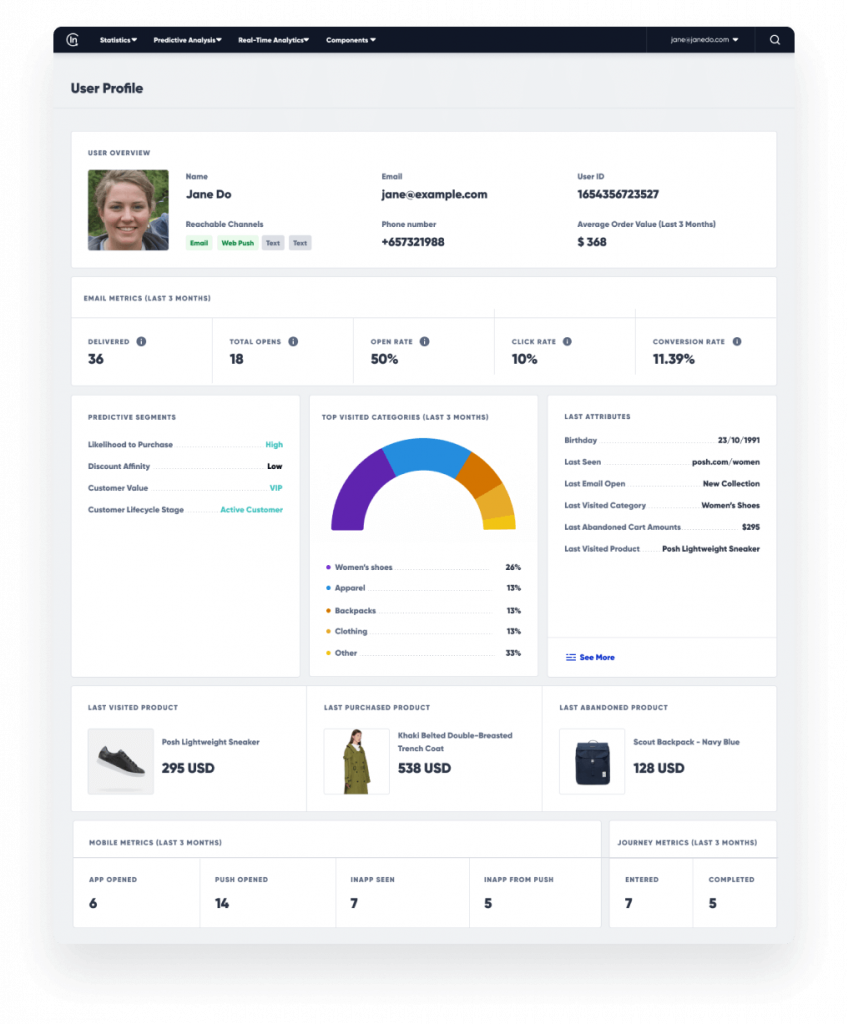
Without unified data, personalization remains fragmented. With it, retailers gain the clarity needed to personalize with confidence.
2. Segment your audience based on predicted behavior
Segmentation today is far more advanced than demographic buckets. AI enables retailers to build predictive segments that reflect future behavior, such as:
- Likelihood to purchase
- Likelihood to churn
- Expected next-best category
- Discount dependency
- Channel preference
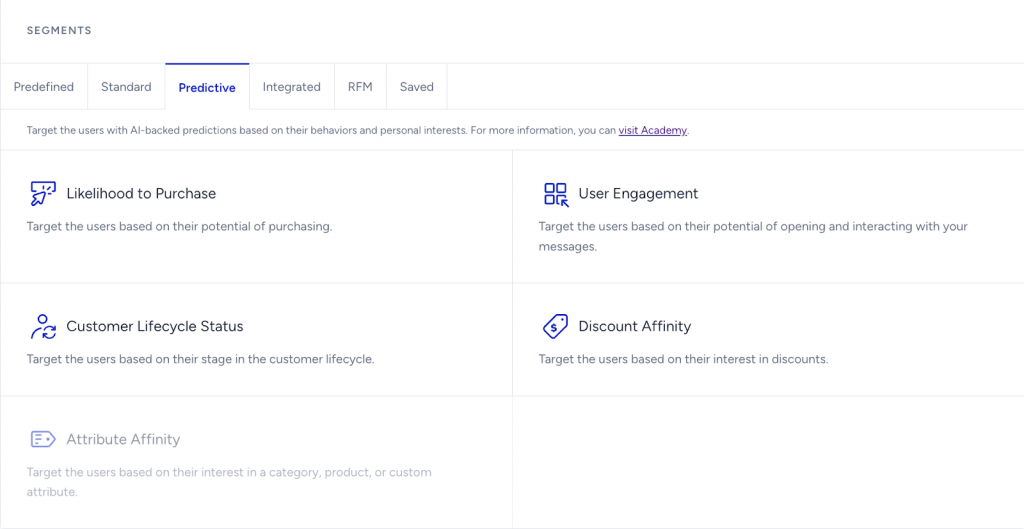
This predictive layer is powerful because it moves personalization from reactive to proactive. Instead of responding to what customers did, retailers can shape experiences based on what customers are likely to do next. This makes every communication more timely, more contextual, and more valuable.
3. Create a connected, consistent experience across channels
Information alone doesn’t drive results. Activation does. Once a unified profile and predictive segments are in place, you need to bring personalization to life across every channel:
- Website and app
- Email, SMS, WhatsApp
- Push notifications
- In-store screens and POS
- Support and conversational interfaces
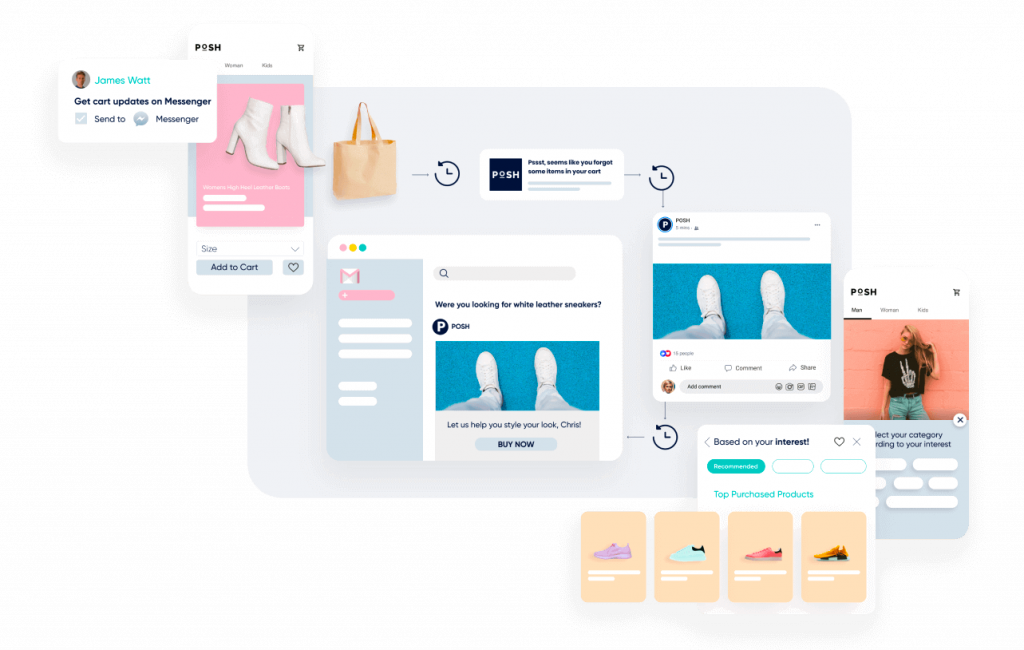
Insider One’s native support for 12+ channels makes this orchestration seamless, allowing teams to deliver consistent messaging and real-time adaptation without heavy operational workload. The goal is simple: ensure every touchpoint feels like part of one coherent journey, whether a customer switches devices, exits and returns, or moves from online to in-store.
Scaling your omnichannel strategy with advanced capabilities
Once the foundational layers are in place, retailers can accelerate personalization with more sophisticated techniques:
Launch multichannel journeys faster with pre-built templates: Templates help teams deliver personalized experiences without building everything from zero, ideal for accelerating campaigns or scaling across regions.
Enable conversational commerce on preferred channels: WhatsApp Commerce and other messaging-first experiences let customers browse, ask questions, and complete purchases without leaving their favorite channel.
Run continuous A/B and multivariate testing: Experiment with different messages, channels, or entire journey paths. Insider One’s AI then identifies the winning version and automatically routes traffic for optimal results.
Optimize timing with AI-driven send-time optimization: Instead of guessing when to communicate, brands can deliver messages exactly when each customer is most likely to engage, improving efficiency and campaign performance.
How to overcome the top personalization challenges in retail
Personalization delivers meaningful impact, but it also comes with a new set of challenges, many centred around trust, data, and the growing role of AI. Consumer expectations continue to rise, yet so do concerns. Shoppers want relevance, but they also want control.
The good news: most customers are open to sharing their data when the value exchange is clear. They want transparency, choice, and the reassurance that brands are using their information ethically and securely.
In 2026, the challenge is less about whether personalization should happen and more about how to deliver it in a way that feels safe, respectful, and trustworthy.
Key challenges retailers face in 2026
- Data fragmentation: Customer data lives across disconnected systems, making it difficult to build a unified customer view.
- AI transparency & bias: As AI shapes recommendations and decisions, customers want to understand why they see certain messages or offers.
- Privacy & compliance: Third-party cookies are gone, forcing retailers to rethink data collection strategies.
- Measuring ROI: Without proper attribution and incrementality testing, personalization impact can be hard to quantify.
Practical solutions to overcome these challenges
- Shift toward first- and zero-party data: Collect preferences directly from customers through quizzes, surveys, and explicit opt-in mechanisms.
- Communicate with transparency: Clearly explain what data is collected, why it’s needed, and how it enhances the customer experience.
- Adopt cookieless personalization strategies: Use real-time behavior, contextual signals, and owned data rather than relying on third-party cookies.
- Ensure AI responsibility: Provide explainable recommendations and implement safeguards to reduce bias.
- Use a pilot-to-scale approach: Start with targeted personalization initiatives, measure the impact, and scale what works.
Build scalable data infrastructure: Invest in CDPs and real-time connectors to unify data and activate it instantly.
When retailers combine transparency, responsible AI, and strong data foundations, personalization becomes not just effective, but sustainable, compliant, and customer-approved.
AI-driven personalization in retail
AI has become the backbone of retail personalization in 2026. As customer journeys grow more complex and expectations continue to rise, retailers can no longer rely on manual rules, batch campaigns, or static segmentation.
AI enables brands to interpret real-time signals, anticipate intent, and deliver experiences that feel relevant in the moment, at a scale no human team could achieve.
Predictive + Generative AI: The new personalization stack
Personalization in 2026 is powered by two complementary AI layers:
- Predictive AI forecasts what each shopper is likely to do next, whether they’re ready to buy, at risk of churning, exploring a new category, or waiting for a discount.
- Generative AI transforms those predictions into action by creating personalized content, product suggestions, and cross-channel journeys instantly and at scale.
Together, they automate personalization from insight to execution, ensuring every touchpoint adapts in real time.
How Insider One applies AI across the retail journey
Insider One unifies predictive and generative AI into a single platform, enabling retailers to deliver 1:1 experiences across 12+ channels without heavy manual work:
- AI-powered recommendations: Algorithms deliver AI product recommendations tailored to individual preferences, which improve shopping experiences and increase the likelihood of purchases.
- AI-led merchandising: Insider One’s site search and merchandising solution, Eureka, uses data and AI to deliver the most relevant search results to customers. Eureka understands the intent and context behind every search query to ensure customers find what they’re looking for in the fewest clicks possible.
- Conversational commerce: With advanced intent recognition, AI-powered chatbots can handle complex customer inputs to recommend the right products, resolve inquiries, and more.
- Generative CX: Put your customer experience on autopilot with GenAI. Build targeted segments in a fraction of the time, orchestrate connected omnichannel customer journeys in seconds, and generate campaign copy automatically.
Ultimately, the best shopping experience is one that’s highly personalized. And while that might’ve previously seemed like an impossible feat for retailers, modern technology makes effective personalization not only possible but painless.
See how Insider One helps retailers deliver AI-powered personalization at scale.
Request a demo now.
Frequently Asked Questions (FAQs)
Personalization in retail is the practice of tailoring the shopping experience to each customer based on their behavior, preferences, context, and real-time intent. Instead of showing the same content to everyone, retailers adapt products, messages, and journeys so each shopper receives an experience that feels relevant to them.
AI makes personalization smarter and faster by analyzing signals that humans can’t process at scale. It predicts what customers are likely to do next, surfaces the most relevant products, adapts content in real time, and automates complex journeys across channels. With AI, retailers can deliver 1:1 experiences instantly—even for millions of users.
Predictive personalization uses AI models to anticipate customer intent before they act. It can predict likelihood to purchase, churn risk, preferred channels, or next-best categories. These predictions help retailers deliver timely, proactive experiences that increase conversions, retention, and customer satisfaction.
Start by unifying your customer data into a single profile, then segment your audience based on real-time and predicted behaviors. From there, activate personalized content and messaging across all channels: web, app, email, SMS, WhatsApp, and in-store, ensuring every interaction feels consistent and connected. Continuous testing and optimization help refine the experience.
Insider One combines predictive AI, generative AI, and real-time customer data into a single platform that powers connected experiences across 12+ channels. With tools like AI recommendations, Eureka™ Search & Merchandising, WhatsApp Commerce, and automated cross-channel journeys, brands can deliver personalized experiences at scale, without heavy manual work.

Keep Reading
4 min.

Chris Baldwin
3 Feb 2026
9 min

Muharrem
23 Dec 2025
10 min.
Muharrem
11 Oct 2024